

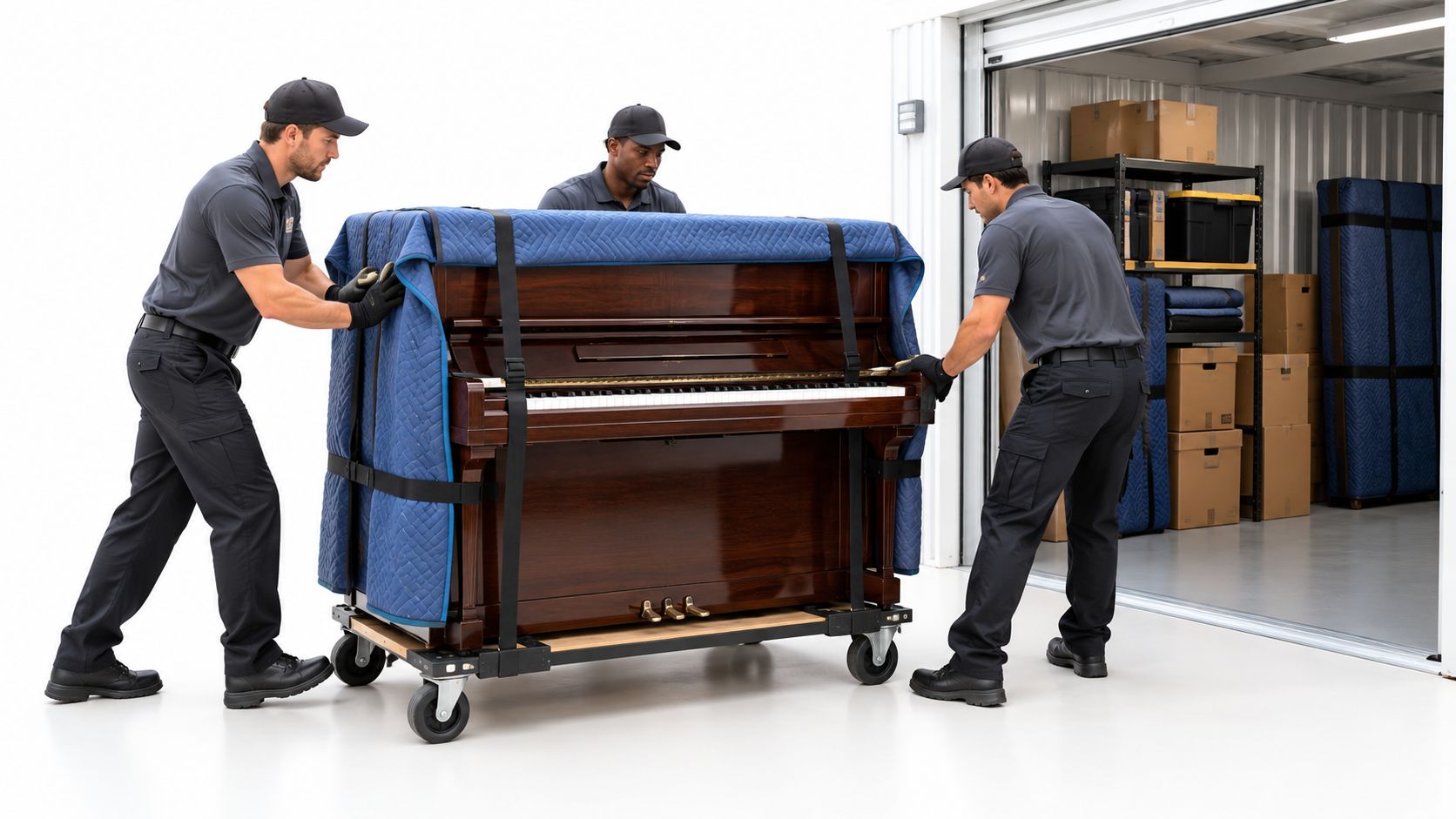
A renovation has a way of exposing every weak point in a moving plan. The hallway is blocked with flooring, the painter needs access to the room, and the upright piano that has been part of the household for years suddenly has nowhere safe to go. For a Sydney homeowner, piano removal and storage isn't a matter of finding spare floor space. The route out, the vehicle access, the storage environment and the return journey all need to work together.
The cheapest option can become expensive if a crew can't manage a tight stair turn, if a storage unit has unstable humidity, or if the instrument needs extra servicing after sitting in unsuitable conditions. A piano is furniture, but it also contains timber, felt, metal and a sensitive action. Treating it like an ordinary item from a general furniture removals job is where many avoidable problems begin.
A Sydney Household Facing the Piano Decision
A Balmain terrace is mid-renovation. One room is being painted, flooring is stacked along the hallway, and an old upright needs to be out before the next trade arrives. The household has three realistic choices: move the piano into storage while the floors are completed, take it directly to the new home in Parramatta, or sell it and avoid the handling altogether.
The first two choices are not separate purchases. Piano removal and storage are one logistics decision because the same move may involve collection, protection, transport, placement inside the storage facility and a later delivery to the new address. If the storage unit is on an upper level, the crew also needs to understand the lift, ramp and trolley route before the quote is finalised.
Balmain terraces create the sort of access problems that don't appear in a basic online form. A crew may face a narrow side gate, no driveway, a loading zone that can't be held for long, and stairs that turn sharply before reaching the front room. In an apartment, the building manager or strata committee may require a booked lift slot, protective coverings and an approved moving window. A truck waiting in the wrong place can turn a straightforward piano move into a rushed carry.
Practical rule: The piano's route matters as much as the piano itself. A clear instrument description without access photographs isn't a complete quote.
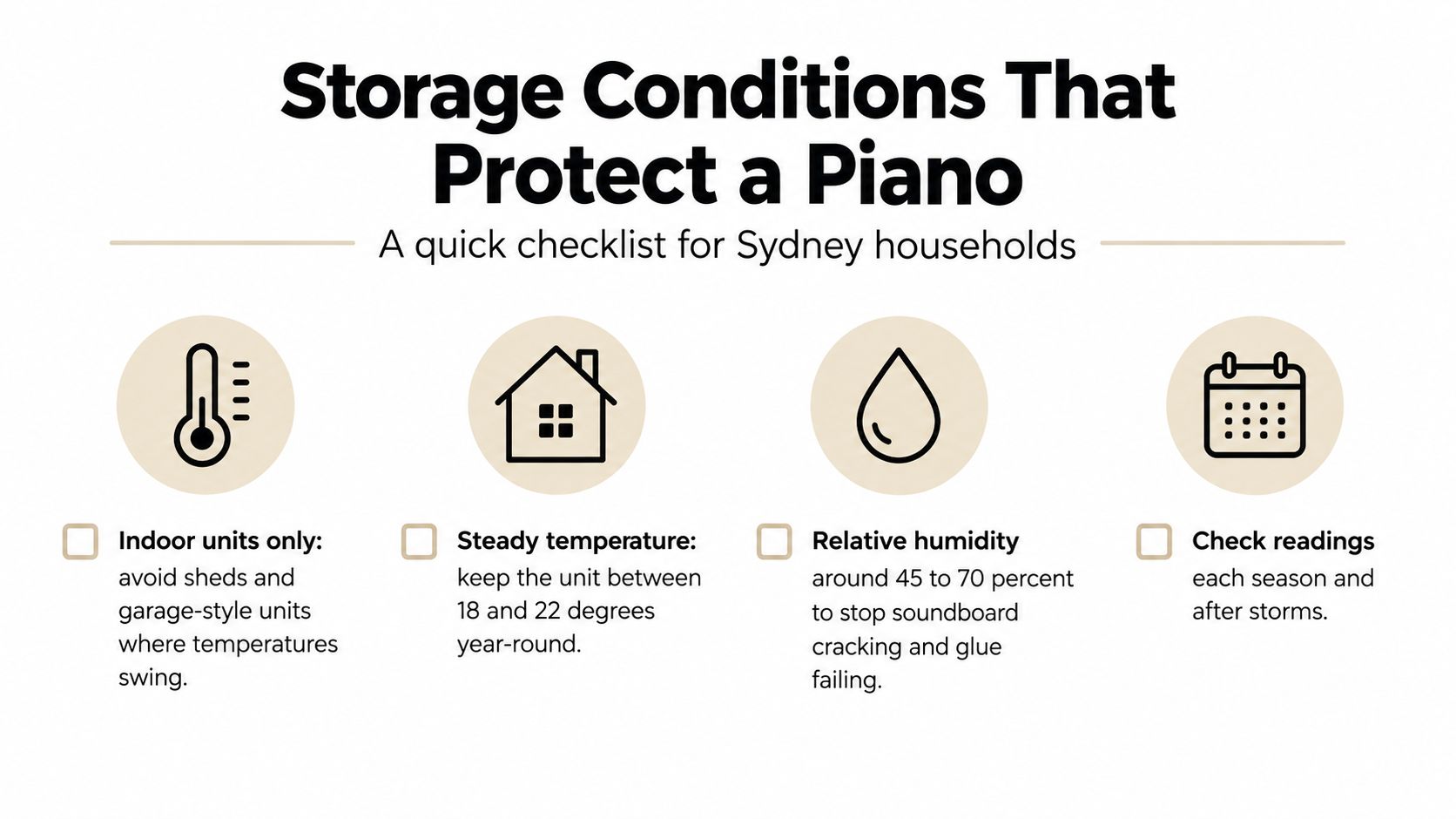
Storage adds another risk. Stable indoor conditions help protect the cabinet and internal components, while a garage, shed or exposed space can subject the instrument to temperature and humidity swings. Australian piano-care guidance recommends conditions around 18 to 22°C, with relative humidity around 45% to 70%, ideally near 50% to 55%. Local piano storage guidance also notes that an instrument may need four to six weeks to acclimatise before retuning.
That retuning cost isn't always included in a casual moving quote. The household must decide whether the piano is going directly into a prepared room, moving into safe storage, or leaving the home permanently. The sensible next step is an in-home or video assessment showing the instrument, stairs, doorway sequence, loading point and proposed storage access. Without that, a low hourly rate may reflect an easy suburban pickup that bears little resemblance to the actual Balmain job.
Planning the Piano Move Before Moving Day
A professional plan starts with the instrument and ends with the truck position. Uprights and grands don't follow the same handling process, so the removalist needs clear information before sending a crew.
Upright access checks
For an upright, measure every doorway, hallway turn and stair rise between the piano and the vehicle. Count the steps and note whether the staircase has a landing, a tight winder or a handrail that reduces the usable width. Check whether the front door opens directly over a footpath, into a courtyard or towards a gate.
Send photographs from both ends of the route. A wide lounge can still become difficult if the piano must rotate immediately outside the room, and a generous front door may be irrelevant if the gate or path is narrower. Independent Australian moving guidance recommends checking doorways, stair turns and lift clearances before the lift-out, not after the crew has arrived. This piano removal planning guide also supports keeping an upright vertical, securing the fallboard and using a piano-specific dolly and straps.
Grand piano preparation
A grand needs a different assessment. The legs, pedal assembly and lyre must be removed and protected before the instrument is placed in its cradle. The bench should travel as a secured item, not loose among household furniture, and the removalist should know whether the destination has enough room to rebuild the instrument safely.
The night before collection:
- Secure the case: Lock the fallboard and key cover, tape the pedals so they can't swing, and remove ornaments, sheet music and anything resting on top.
- Protect the route: Clear the path from the lounge to the truck, leaving at least 300mm on each side as a practical working margin.
- Protect personal information: Remove or deface photographs that show identifying details or evidence of the piano's value before sending them for a quote.
- Check the building: Confirm lift bookings, strata rules, weekend restrictions, parking conditions and any requirement for floor or wall protection.
Sydney has several recurring traps. Inner-city terraces may have narrow side gates. High-rise apartments may only allow a booked lift slot. A truck might need to stop on a clearway or busy street, while strata rules may restrict weekend moves. Those details affect the crew's equipment, timing and route.
Send the removalist photographs of the piano, each stair flight, the truck access point and the storage unit level. Include a short video of any tight turn. A proper survey lets the mover identify whether the job needs a stair-climber dolly, extra protection, a longer carry or building coordination before the booking is confirmed.
Safe Handling and Moving Techniques on the Day
The moving sequence should look controlled, not improvised. A trained two-person crew begins by checking the case, locking the fallboard and key cover, and removing loose accessories. The piano is then wrapped corner to corner with heavy furniture blankets. Tape holds the blankets in place, but it shouldn't be pulled tightly across the soundboard or finished surfaces.
Extra padding belongs on vulnerable corners and contact points. The crew should protect floors before bringing out equipment, particularly where a grand's legs or a piano board will be handled. This heavy furniture moving guidance is useful for households preparing the route, but a piano still requires specialist equipment and technique beyond ordinary furniture handling.
Equipment and restraint
An upright on flat ground may be positioned on a piano board with skids. Stairs usually require a stair-climber dolly or a four-wheel piano dolly, depending on the route and the instrument. A standard appliance dolly isn't a substitute for equipment designed to support a piano's shape and weight distribution.
The straps must secure the body or frame correctly. A ratchet strap goes around the body, with a secondary strap over the top for an upright where appropriate. The strap must never be tightened across a fragile lid or used as a shortcut around the case. A grand needs soft slings and a proper grand cradle after its legs and pedal assembly have been removed.
The lift-out
One mover works on the weight side and the other steers. They use slow, agreed counts on each step, with the crew stopping at every landing to reset grip, check blanket movement and confirm that the next turn is clear. Rushing at a winder or landing is how walls, stair edges and polished cases get damaged.
The following shortcuts aren't acceptable:
- Don't lay an upright on its side: Keep it upright unless a specialist has planned an exceptional handling method for the specific instrument.
- Don't lift a grand by its legs: The legs aren't carrying handles and can split or loosen under lifting forces.
- Don't drag across timber, tile or carpet: Use the correct board, skids and floor protection.
- Don't remove grand legs on an unprotected surface: Put down suitable protection before disassembly.
- Don't let the bench ride loose: Secure it separately inside the truck.
At the truck, the crew uses wheel chocks, positions the piano vertically against the bulkhead and straps it twice. The fallboard stays locked for the journey. The instrument shouldn't share an unstable load space with boxes that can shift into the case during braking.
Upright Versus Grand Pricing in NSW
Instrument type changes the job before distance or stairs are added. An upright is usually more compact and can often remain assembled, while a grand may require disassembly, a cradle, soft slings, separate protection for its legs and careful rebuilding at the destination.
Australian pricing guidance places local upright moves commonly around A$300 to A$600, while grand piano moves can start around A$500 to A$1,000 or more. The Australian piano removal pricing guide links the difference to heavier instruments, specialist protection and access challenges. These are useful starting points, not promises for a particular Sydney address.
| Piano type | Removal, single-leg NSW | Monthly climate-controlled storage |
|---|---|---|
| Upright | Around A$300 to A$600 for a local move | Ask the facility for an upright-sized rate |
| Grand | Around A$500 to A$1,000 or more | Ask the facility for a grand-sized rate |
Storage must be priced as part of the same decision. A unit that fits the case may not provide enough room for safe handling, inspection and airflow. A grand also needs space for its separated legs, lyre and bench, with no risk of other goods leaning against the cabinet.
What changes the quote
Stairs, distance and access can shift the final figure substantially. Ask whether the quote includes a piano board, stair equipment, leg removal, corner protection, a difficult-surface surcharge such as marble steps, waiting time for a lift, and placement inside the storage unit. Ask separately whether delivery out of storage and retuning are included.
An Australian cost guide notes that Sydney piano moves are commonly estimated around A$500 to A$900, while complex Australia-wide jobs can reach A$1,500 or more. The interstate piano removal cost overview makes clear why distance, stairs and specialist equipment matter. Compare quotes by scope, not by the first hourly figure.
Storage Conditions That Protect a Piano
A piano shouldn't go into an ordinary garage-style unit just because the booking is convenient. Australian care guidance warns that damage can occur when relative humidity rises above 55% or falls below 35%, and advises against sheds, garages, carports and verandas for long-term storage. This Australian storage advice explains why stable indoor conditions are part of preservation, not a luxury upgrade.
Use this checklist before accepting a storage unit:
- Choose an indoor unit: Ask whether the facility controls temperature and humidity, rather than merely describing the building as enclosed.
- Check the readings: Aim for a steady temperature of 18 to 22°C and relative humidity around 45% to 70%, ideally nearer 50% to 55%. The figures and their preservation context are outlined in Australian piano storage guidance.
- Keep the base dry: Raise the piano off concrete on suitable pallets or planks, with stable support and enough clearance for inspection.
- Avoid hot and wet zones: Keep it away from direct sunlight, heaters, air-conditioning vents, roller doors, condensation and external walls where conditions fluctuate.
- Use breathable protection: A cloth piano cover is preferable to plastic wrapped tightly around the cabinet because trapped moisture can damage the finish and encourage mould.
- Keep the case clear: Don't lean boxes, tools or furniture against the piano. Leave room for the crew to inspect and move around it.
Reading the unit properly
Ask to see the unit's hygrometer and find out where it sits. A reading near the door may not represent the conditions around the piano, particularly when the door opens regularly. Ask whether the facility retains HVAC or humidity records and how staff respond if readings move outside the agreed range.
For broader context on how storage providers price space by footprint and size, this guide to storage prices by size can help with comparison questions, although a Sydney piano booking still needs local access and climate details.
Don't seal the fallboard tightly if the storage provider or piano technician advises airflow around the keys. On collection, let the piano settle in its new room before arranging tuning. Australian guidance says acclimatisation can take four to six weeks, so a piano moved into storage and then back into a home shouldn't be tuned immediately on arrival.
Why Access Often Matters More Than Weight
An upright in a Surry Hills terrace with a tight stair turn can be harder to move than a grand rolling out of a ground-floor Penrith garage. The grand may be heavier, but the Penrith route gives the crew working space, a short carry and direct vehicle access. The terrace may require careful rotation, stair protection, a long carry and a truck positioned away from the front door.
That difference is why access drives so many price changes. The relevant questions aren't limited to how much the piano weighs. They include whether the movers can use a lift, whether the stairs have a landing, whether the case can turn without striking a wall, and whether the truck can stop close enough to avoid an exposed carry.
Sydney friction points
Inner West terraces often have narrow frontage and side gates that reduce the usable route. Apartments on the North Shore may require a lift booking, building certificates or a specific moving window. Heritage homes around the eastern beaches can have delicate staircases, restricted landings and surfaces that need more protection than a standard removal.
Busy streets create another problem. A loading zone may be occupied, a clearway may restrict truck placement, or a building manager may only release the lift for a short slot. The crew then needs a confirmed sequence, not an assumption that parking will work out on the day.
A Sydney piano-moving guide specifically warns against dragging across timber, tile or carpet, walking a piano around corners with friends, and lifting a grand by its legs. It also recommends checking doorway widths, stair shape, landing space, floor surfaces, truck position and the route into the property before moving. This Sydney piano access guide reflects the practical checks that prevent avoidable damage.
Interstate complications
Interstate removals add distance, longer carries, depot transfers and sometimes hoisting or specialised loading. A piano that moves directly from a Sydney home into a protected destination room has a different risk profile from one that sits temporarily in a transfer depot or truck.
The cheapest quote often assumes easy access at both ends. Once stair turns, lift bookings, loading-zone restrictions, storage handling and re-delivery are included, the job changes shape. A quote that ignores those conditions may look attractive until the customer pays for extra labour, rehandling, repairs or a later retune.
Insurance, Specialist Care and Booking the Job
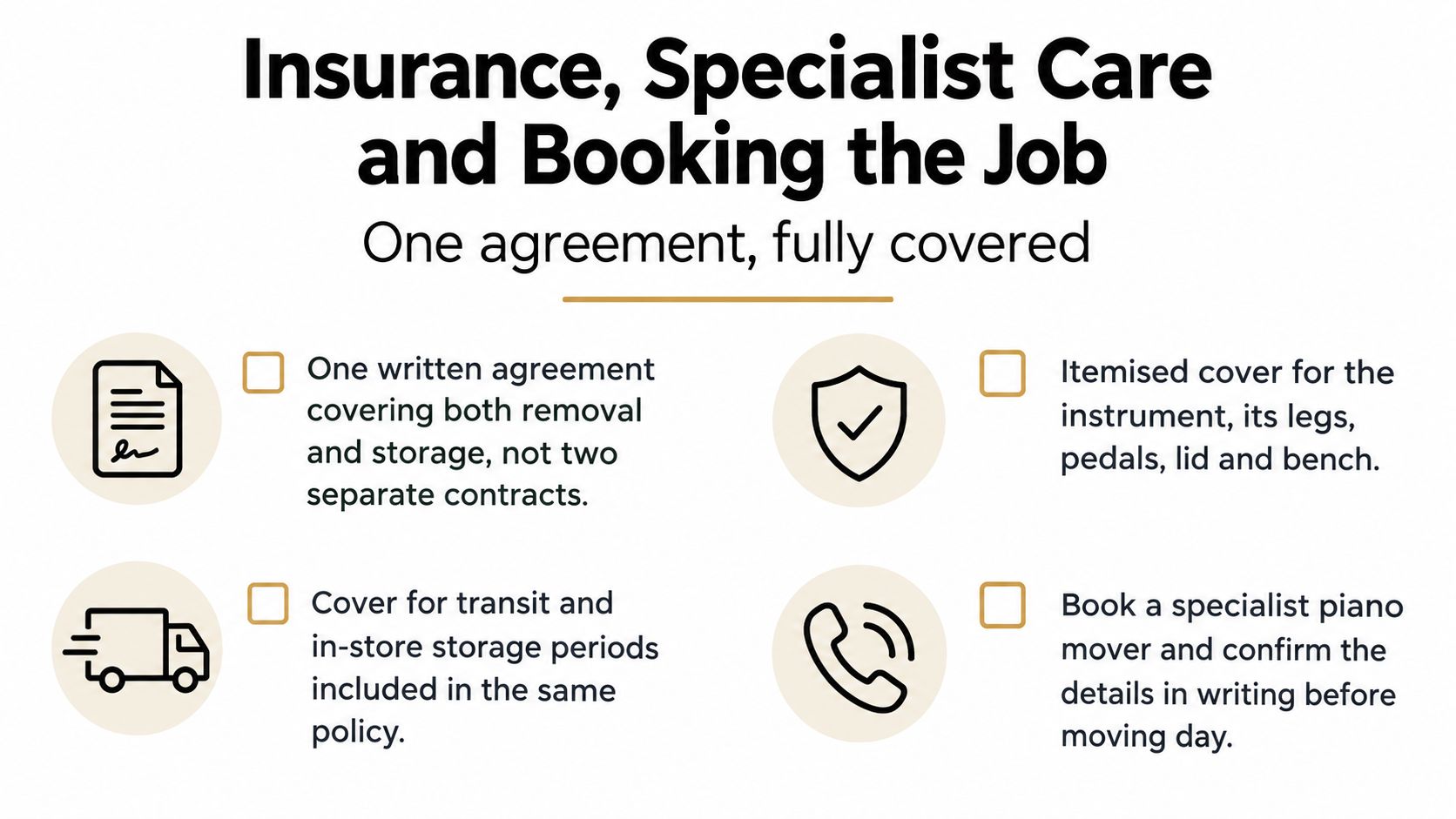
The cleanest arrangement is one written agreement covering pickup, transport, storage and delivery. It should identify the piano, its legs, pedals, lid, bench and accessories, then state what happens if the instrument is damaged during transit or while it remains in storage.
Ask for itemised cover rather than a broad statement that the move is insured. Confirm the transit period, in-store period, exclusions, excess and declared value. This storage insurance guide is useful when checking whether a normal household policy treats stored goods differently from items inside the home.
What belongs in writing
The storage clause should specify an indoor, climate-stable facility and the agreed humidity range. Ask whether access is restricted, who can enter the unit and how the piano will be positioned. Photographic condition reports should be taken at pickup, on arrival into storage and at final delivery.
For grands, a pre-move technician inspection can identify existing cracks, loose legs, pedal issues or finish damage before the crew touches the instrument. Document any agreed detuning tolerance during transport, then arrange a retuning window after acclimatisation rather than booking the tuner for the day of delivery. The right timing depends on the instrument and the conditions it has experienced, but immediate tuning isn't a sensible default.
The removalist should name the equipment and crew standard in the quote:
- Piano equipment: Piano dollies, skid boards, stair equipment, ramps, corner protectors and ratchet straps.
- Protection: Heavy blankets, floor coverings, soft slings and a suitable grand cradle where required.
- Coverage: Public liability and goods-in-transit cover, with storage treatment explained separately.
- Access planning: Stair counts, lift bookings, loading-zone permits, parking arrangements and allowed access times.
- Final price: A fixed written quote after an in-home or video survey, not a generic hourly estimate based only on piano type.
For a broader look at removal insurance arrangements, see insurance options for removal work. Home Removals Sydney is one Sydney-based option that handles piano moves alongside home removals Sydney, furniture removals Sydney, office relocations, storage and interstate removals, with tailored planning for access and protected placement.
Ask for a custom Sydney, NSW or interstate quote before you book. Include photographs, measurements, stair details, lift requirements, truck access, storage conditions and the expected return date, so the removalist can price the actual job rather than an idealised one.
Home Removals Sydney can assess your piano route, arrange specialist handling and coordinate secure storage when the instrument can't go straight into its new room. Visit Home Removals Sydney to request a quote for a Sydney, NSW or interstate piano move, and include your access photographs so the team can plan the job properly.
