

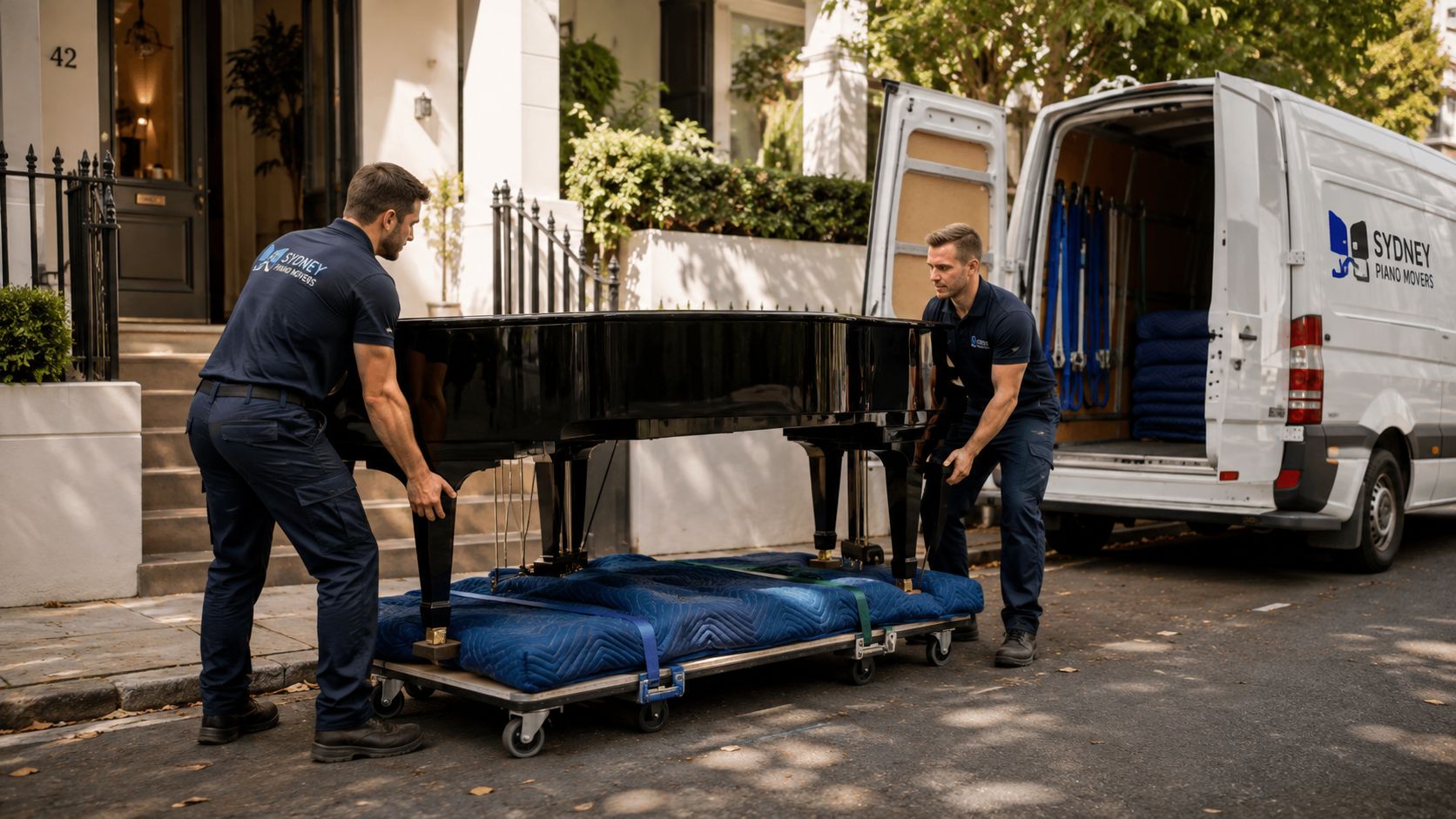
You're halfway through a Sydney move when the piano becomes the problem nobody budgeted for. It's sitting in a narrow Inner West terrace, the front path turns sharply towards the street, and the new apartment has a lift that looks generous until you measure the doorway. A standard furniture crew may move sofas and wardrobes all day, but a piano demands a different plan, different protection and a clear understanding of who carries the risk if something goes wrong.
That difference matters for homeowners, renters and businesses arranging Removalists Sydney, Home removals Sydney, office relocations or interstate removals. A piano is both a heavy load and a delicate instrument, so the right provider needs to manage access, balance, surfaces, transport and manual handling as one job.
Why Piano Moves Need Specialists Not Standard Removalists
Australia has been dealing with piano transport for a very long time. The first piano arrived with the First Fleet in 1788, and the earliest known piano manufactured in Australia dates to 1834, when John Benham made one. By 1888, an Australian music source estimated that about 700,000 pianos were in the country, with a population of 3,000,000, or roughly 23 pianos per 100 people. That history helps explain why piano transport became a distinct specialist task rather than an occasional variation on furniture removals. (ABC Classic's history of the early Australian piano)

A sofa can usually be tilted, slid or repositioned during a move. A piano can't be treated that way. Its weight isn't evenly distributed, its polished cabinet can mark easily, and sudden movement can damage both the instrument and the property. In a Sydney terrace, a crew may need to control a turn through a hallway while keeping the piano clear of plaster, skirting boards and door jambs. In an apartment, the lift booking, loading bay, lift dimensions and building rules can matter as much as the distance between addresses.
The risk is bigger than the moving fee
Safe Work Australia's latest WHS statistics show that 84% of serious claims involve body stressing, falls, slips and trips, being hit by moving objects, or mental stress. That classification doesn't mean every piano move will cause an injury, but it does show why heavy-item removal should be approached as a risk-managed WHS task rather than ordinary household transport. (Safe Work Australia's latest key WHS statistics)
The crew needs to understand load balance, hand positions, escape routes and communication. One person must be able to direct a turn while others control the load. If a piano starts to move unexpectedly on stairs or a ramp, there may be no safe opportunity to improvise.
Practical rule: A low quote isn't useful if it excludes the access work that makes the move difficult.
Specialist piano removalists bring planning into the quote. They ask whether the instrument is upright, grand or digital, whether stairs are involved, whether a lift is available, and whether the truck can park close enough to avoid an uncontrolled carry. That is the difference between a piano move that looks like part of a normal home relocation and one that is planned as a specialist logistics job.
How to Assess Your Piano and Property Before You Book
The most accurate quote starts with information you can gather before a removalist visits. Don't just provide the suburb and say “upright piano”. Record the instrument type, its dimensions and every constraint along the route.
Start with the instrument
Identify whether you have an upright, grand or digital piano. Measure the height of an upright, and measure the length of a grand from the keyboard end to the back. Australian relocation guidance places upright pianos often at 110 to 150 centimetres tall, baby grands typically at 1.4 to 1.6 metres long, and concert grands at about 2.2 to 2.7 metres long. Those dimensions show why the instrument's shape affects access planning, not just its overall weight. (Australian long-distance piano moving guidance)
If the piano has removable components, note them without dismantling anything yourself. Tell the provider about a damaged leg, loose pedal, delicate finish, sticking lid or existing scratch. A specialist can then decide what must be secured, padded or removed before loading.
Measure the complete route
Measure the clear width of the front door, internal doors, hallways and the narrowest turn. Include skirting boards, handrails, light fittings and any door that can't be removed. For stairs, count the flights, note landings and look for low ceilings or overhead lighting.
A lift requires more than its internal floor area. Measure the lift doorway, check the internal height and width, and ask building management about booking requirements, protective lining and permitted moving hours. A lift that accepts the piano may still leave insufficient room for movers to control it safely.

Document the surfaces and approach
Photograph the route from several angles. Include the kerb, driveway, gates, steps, balconies, stairwells, lift lobby and parking position. In Sydney, a short path across uneven paving or a tight driveway can change the equipment and crew plan.
Note whether the floors are timber, tiles, polished concrete, carpet or outdoor pavers. The piano isn't the only item being protected. Floor runners, corner protection and controlled turns reduce the chance of damage to the home.
Send the measurements and photographs with your quote request. A provider who asks for this information is assessing the job properly. A provider who offers a firm price without asking about stairs, turns or the delivery building may be leaving important assumptions out of the quote.
Preparing Your Piano and Home for a Safe Move
Moving day should begin with a controlled route, not last-minute problem solving. Clear the path and tell the crew what changes underfoot or overhead. Piano removal is a WHS task involving a heavy, unstable load, so preparation reduces exposure to avoidable hazards without asking the owner to handle the instrument.
Clear the working path
Walk from the piano room to the truck and remove plants, rugs, ornaments, small tables and loose items. Open doors and gates fully where safe, and confirm lift or loading-bay bookings with building management. In Sydney terraces and apartment blocks, a locked gate or unavailable loading zone can force the crew to hold a heavy piano while access is rearranged.
Leave working space at corners, doorways and landings. Point out polished floors, uneven paving, narrow passages, low clearances and transitions between indoor and outdoor surfaces. Mark walls or door frames that need extra padding, and keep children and pets away from the route.
Preparation also protects the property. Floor runners, corner protection and controlled turns reduce contact with timber, tile, carpet, walls and door frames. The crew still decides how to manage the load, but clear information lets them choose the right method before lifting begins.
Secure the instrument correctly
Close and secure the keyboard lid. Keep keys, pedals and music stands from swinging or opening during handling, but do not tape directly onto a polished finish. The specialist should apply moving blankets and suitable straps, with added protection around corners and exposed surfaces.
The working sequence is simple: measure first, clear obstructions, protect the property, secure the lid, wrap the piano, then move it with a heavy-duty dolly and a spotter. Australian piano-moving guidance warns that dragging and sudden turns can damage both flooring and the piano's finish. (AU guidance on moving a piano safely)

What not to do
Do not drag the piano across timber, tile or carpet, or try to “walk” it around a corner with friends holding the cabinet. Never lift a grand by its legs. Component removal should only happen when the provider has given specific instructions.
Stairs need a planned lift, suitable gear and enough people to control the load. Australian removal guidance recommends at least four helpers, with one mover maintaining balance while others watch clearance and overheads. (Australian advice on moving a piano)
Equipment Vehicles and Crew Techniques Specialists Use
A tight Sydney terrace, a steep stairwell or a high-rise lift can change the entire moving method. Specialist work starts with matching equipment and crew roles to that access, rather than treating the piano as another household item. Before loading, the team should have a heavy-duty piano dolly, rated straps, moving blankets, floor protection, corner guards and ramps suited to the route. A grand piano may also require a piano board and controlled preparation before it can be moved safely.

Why each tool has a job
A piano board provides a stable platform when the instrument's shape makes a standard dolly unsuitable. Skates and dollies carry the load across prepared surfaces, while straps give the crew control without relying on hand grip alone. The equipment must be rated for the piano and used as part of a planned movement, not added after the route becomes difficult.
Protection supplies address a separate risk. Floor runners reduce contact with timber, tile and carpet. Corner guards protect vulnerable edges, while thick blankets shield the cabinet from walls, door frames and other furniture. They do not make a hazardous route safe, but they limit incidental damage while the crew manages balance, clearance and turning space.
Vehicle choice matters just as much. An upright may suit a truck with a proper tailgate, while a grand or interstate move needs more room, reliable tie-down points and loading that avoids jolts. Ask whether the truck has a hydraulic lift gate, how the piano will be secured upright during transit, and how it will be separated from other goods. These details can expose whether a low quote includes the actual access and handling requirements.
Crew control matters on stairs and turns
The lead mover should call each movement, set the pace and stop the job when clearance disappears. At a tight corner, the crew rotates the load in a controlled sequence instead of forcing it around. One person watches the top and sides, while others manage the base, straps and balance.
Stairs alter the load on every step because gravity pulls against the crew. Proper lifting gear, enough trained hands and clear communication are required. A provider proposing ordinary straps and minimal labour for a difficult staircase should explain the method, crew size and contingency plan before booking. Guidance on safe piano handling on stairs reinforces why this access should be assessed separately from a level move.
For a grand piano, ask how the team will manage its shape, protection and preparation requirements. You can review the service details for grand piano removals in Sydney and compare them with the written scope in your quote.
Understanding Costs Insurance and Safety for Piano Moves in Sydney
A cheap quote can fail at the first staircase. It may cover a ground-level upright with clear parking, while your Sydney property involves terraces, narrow halls, a long carry, a restricted lift or several landings. If those conditions are absent from the written scope, the price can change when the crew arrives, and the job may become a rushed WHS decision rather than a controlled move.
Australian pricing guidance gives comparison bands of A$300 to A$600 for local upright moves and A$500 to A$1,000 or more for grand pianos. Sydney guides commonly place flat-rate expectations near A$500 to A$900, although some local work is charged by labour hours. These figures are reference points, not promises. The piano, route and handling method determine the actual labour. See our piano removal cost breakdown before comparing quotes.
| Move Scenario | Typical Price Band | Key Cost Driver |
|---|---|---|
| Local upright move | A$300–A$600 | Piano size, travel and straightforward access |
| Grand piano move | A$500–A$1,000+ | Instrument shape, protection and specialist labour |
| Sydney flat-rate style job | A$500–A$900 | Route, building access and included services |
| Stairs | A$50–A$150 per flight | Extra labour, lifting equipment and control |
The same Australian guidance indicates that stairs can add A$50 to A$150 per flight. (Australian piano-removal pricing guidance) A base rate is incomplete unless it states whether stairs, long carries, lift bookings, floor protection and additional handling are included.
Flat rates and hourly rates
A flat rate gives better cost control when both properties and the full route have been assessed. It is less reliable when the provider has guessed the access or excluded difficult handling. Hourly billing can suit a straightforward local move, but a delayed lift, blocked loading zone or unexpected turn can extend the job.
Ask for the assumptions behind either structure:
- Access: Confirm the stairs, landings, turns and long carries included.
- Labour: Ask how many movers are assigned and whether extra crew costs more.
- Protection: Check whether blankets, floor runners, corner guards and securing materials are included.
- Transport: Confirm the vehicle, loading method and whether the piano travels with other goods.
- Waiting time: Clarify building delays, lift bookings and parking restrictions.
Insurance and WHS allocation
Insurance should be discussed alongside the moving method. Ask what cover applies if the cabinet, finish, keys, pedals, walls or floors are damaged, and have the piano's existing condition recorded before loading. A valuable or antique instrument may need a separate valuation review rather than an assumption that standard transit cover matches its replacement value.
The written quote should also identify who controls each safety decision. The provider needs a plan for manual handling, lift use, stairs, weather, parking and stopping the move if the route is unsafe. Australian airline guidance places strict limits on passenger-carried instruments, with small instruments limited to 7 kg and 85 cm x 34 cm x 23 cm, while instruments over 32 kg must travel as freight. Pianos sit outside ordinary passenger handling, reinforcing the need for secure loading, protective packaging and trained crews. (AUSTA guidance on instruments and airlines)
How to Choose the Right Piano Removal Specialists and Book with Confidence
Choose the provider that gives you the clearest risk picture, not just the lowest headline price. A credible piano removal specialist will ask about the instrument, inspect or review the full route, explain the crew and equipment, and put exclusions in writing.
Use a practical vetting checklist
Start with relevant experience. Ask whether the team regularly handles uprights, grands, apartment lifts, terraces, stairs and interstate removals. Experience with ordinary furniture doesn't automatically prove competence with a piano.
Then check the commercial details:
- Insurance coverage: Ask about public liability, transit protection and how existing damage is recorded.
- Transparent quoting: Require the quote to identify stairs, tight access, parking, lift delays and additional labour.
- Fleet and equipment: Confirm the vehicle, lift gate, straps, blankets, dolly and any piano board required.
- Availability: Make sure the provider can meet your building booking, settlement or interstate timetable.
- Reviews: Look for comments about careful handling, communication and difficult access, not only punctual arrival.

Compare the service around the piano
A piano may be moving as part of a larger home relocation, office relocation, warehouse shift or interstate move. Ask whether the provider can coordinate the instrument with the rest of the consignment without treating it as an afterthought. The right arrangement may involve separate protection, a dedicated position in the truck and a delivery sequence that places the piano safely before other furniture blocks the room.
Home Removals Sydney is a family-owned provider based in Fairfield, NSW, offering fully insured home, office and warehouse relocations, packing, furniture assembly, storage and specialised handling for pianos, antiques and artwork. Its fleet ranges from 4-tonne vans to 62-tonne trucks, so customers can ask for a vehicle and crew plan suited to the move rather than accepting a generic truck allocation. (Questions to ask a removalist before hiring)
Send your quote request with the piano type, measurements, photographs, pickup and delivery suburbs, stairs, lift details, parking conditions and preferred date. If you're moving as part of a wider relocation, include the furniture, office equipment or storage requirements so the provider can price the whole logistics plan accurately.
Home Removals Sydney can organise insured piano transport across Sydney and interstate, with quotes based on your instrument and access conditions. Visit Home Removals Sydney with your measurements and route details to request a clear quote before moving day.
