

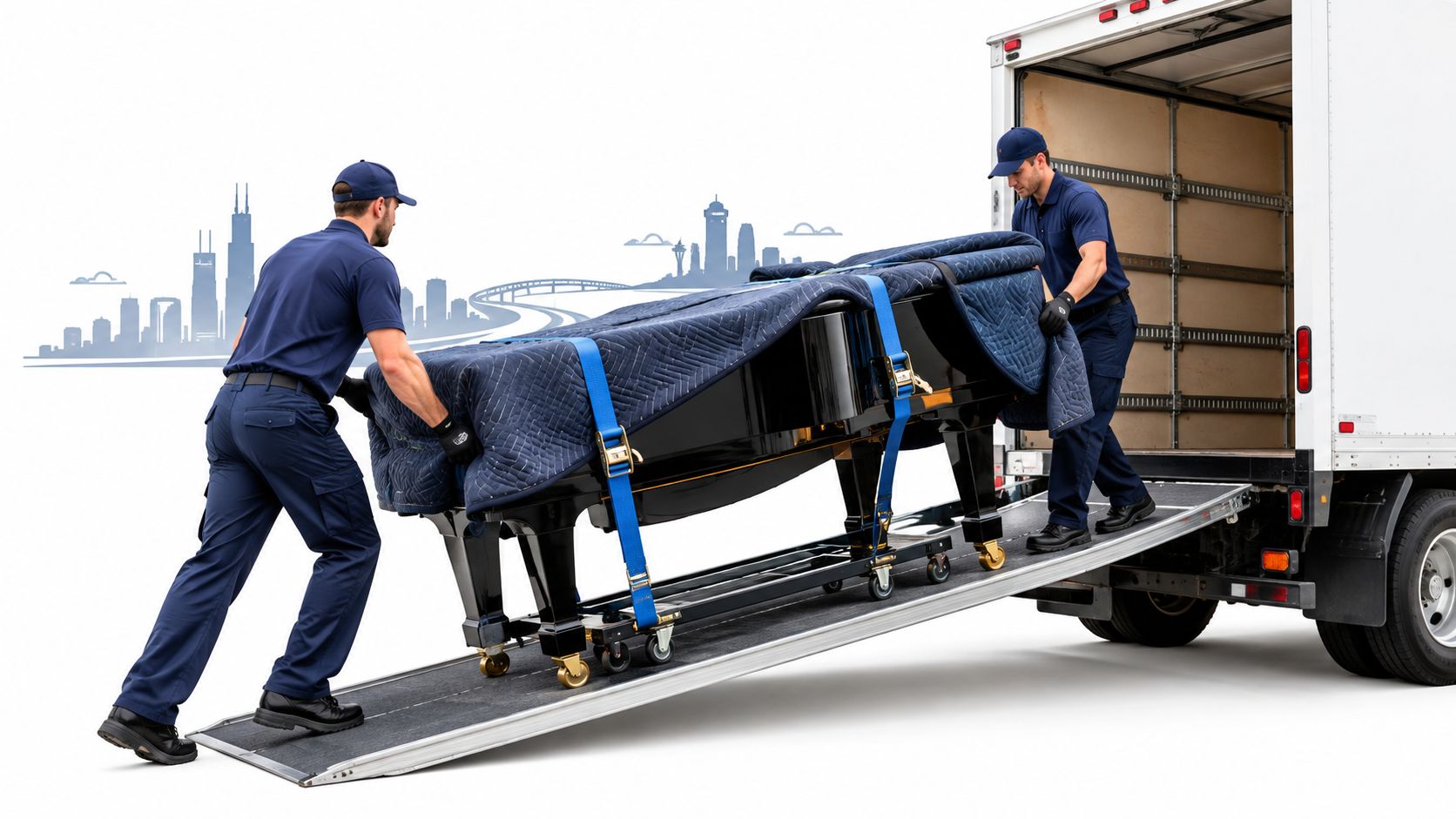
You're probably in the same spot many Sydney households reach when a move goes from “manageable” to “why is this so complicated?”. The truck quote for the lounge, beds, and boxes looks straightforward. Then the piano gets listed separately and one company says one figure, another says something much higher, and neither explanation feels complete.
That confusion usually comes from treating a piano like oversized furniture. It isn't. For interstate piano removals, the challenge isn't only the kilometres between homes. It's the combination of access, weight, vibration, and climate change between pickup and delivery. If you understand those four things, the quotes start to make sense.
Australia has been dealing with piano transport for a very long time. The country's first piano arrived aboard HMS Sirius in early 1788, and later accounts describe pianos being shipped and carried inland by horse, bullock, and camel. By 1888, one Australian source estimated about 700,000 pianos were in the country against a population of 3,000,000, which shows how widely the instrument spread across the continent (ABC history of the Australian piano). That long history matters because moving a piano across distance in Australia has never been a standard furniture job.
What an Interstate Piano Move Actually Involves
A family in Sydney books a Brisbane move and gets two piano quotes. One is lower. One is much higher. The natural assumption is that one company is overcharging or the other is trying to win the job cheap. Sometimes neither is true. They may be pricing two very different handling plans.
A proper interstate piano move is a chain of controlled steps. First comes the survey. Someone needs to check the piano type, measure access at both properties, note stairs, confirm parking, and work out whether the instrument can stay upright the whole way or needs a more specialised setup. After that, the team decides on wrapping, padding, securing, truck placement, and whether the move includes storage or a transfer between vehicles.

Why one quote can differ so much from another
Distance matters, but it often isn't the main driver. The bigger questions are usually these:
- What type of piano is it. An upright and a grand need different handling plans.
- How hard is access at pickup. Ground-floor garage access is different from a terrace with steps and a tight turn.
- How hard is access at delivery. A smooth unload can become a difficult final placement if the new home has narrow halls or a steep drive.
- What level of protection is included. Blanket wrapping, moisture barriers, skids, custom crating, and dedicated space in the truck all affect the plan.
A useful way to sense-check a quote is to compare it with broader guidance on AUSFF interstate moving services, especially if you're trying to understand how linehaul, shared loads, and access conditions influence interstate removals more generally.
The move happens twice
People often focus on the highway section because that's the long part. Operationally, the highest-risk moments are usually the transitions. Taking the piano out of the first property. Getting it into the truck. Bringing it out at the destination. Placing it exactly where it needs to go without scraping floors, walls, or the instrument itself.
Practical rule: A piano move is really two careful building-access jobs with a long road journey in between.
That's why specialist pricing often follows the complexity of handling, not just the route from Sydney to Brisbane, Melbourne, or Adelaide.
Understanding the Different Types of Pianos
Not every piano creates the same removal job. Before anyone can price or plan properly, they need to know what they're dealing with. The instrument's size, weight, shape, and age all change the method.
The one weight benchmark every homeowner should know is this: a standard upright piano typically weighs about 150 to 250 kilograms, while grand pianos can exceed 500 kilograms (NSW piano movers guide). That one fact explains a lot about crew selection, equipment, and why access questions matter so much.
Uprights, grands, digitals, and older instruments
Upright pianos are the most common in Sydney homes. They stand vertically, which helps with footprint, but their weight sits high and can shift awkwardly during turns and threshold crossings. They're usually moved upright on a padded dolly or piano board, with careful balance control the whole time.
Grand pianos are a different class of move. Their shape is wider, their legs are vulnerable, and they usually need partial disassembly before transport. The legs and pedal lyre are handled separately, then the body is protected and secured on a skid or board designed for that footprint.
Digital pianos are easier in one sense because there's no string tension to protect, but they still need thoughtful packing. Cabinet finishes, internal electronics, and stands can all be damaged by rough loading or poor stacking.
Specialty and antique pianos need the most caution. Player pianos, antique square pianos, and older family instruments can have brittle veneers, unusual dimensions, or fragile decorative details. Some need custom crating or museum-style wrapping, especially if the finish or structure is already delicate.
Piano types and handling requirements
| Piano Type | Typical Weight | Crew Required | Protection Method |
|---|---|---|---|
| Upright piano | About 150 to 250 kilograms | Usually a small specialist crew, adjusted for access | Padded blankets, dolly or piano board, straps |
| Grand piano | Can exceed 500 kilograms | Larger crew due to size, disassembly, and access complexity | Partial disassembly, skid or board, heavy padding, secure strapping |
| Digital piano | Varies by model | Depends on cabinet size and stairs | Blanket wrapping, carton or padded protection for components |
| Specialty or antique piano | Varies widely | Planned around fragility and access | Custom wrapping, possible crating, extra condition documentation |
Why type changes the plan
The mistake people make is assuming all “piano moving” is one service. It isn't. The team, gear, and risk points are different for each category. A straightforward upright on level access is one thing. A grand piano with stairs at both ends is a separate operation.
That's also why experienced Removalists Sydney teams ask detailed questions before quoting. They're not being difficult. They're trying to avoid guessing wrong on labour, equipment, and protection.
Climate and Vibration Risks on a Long Haul
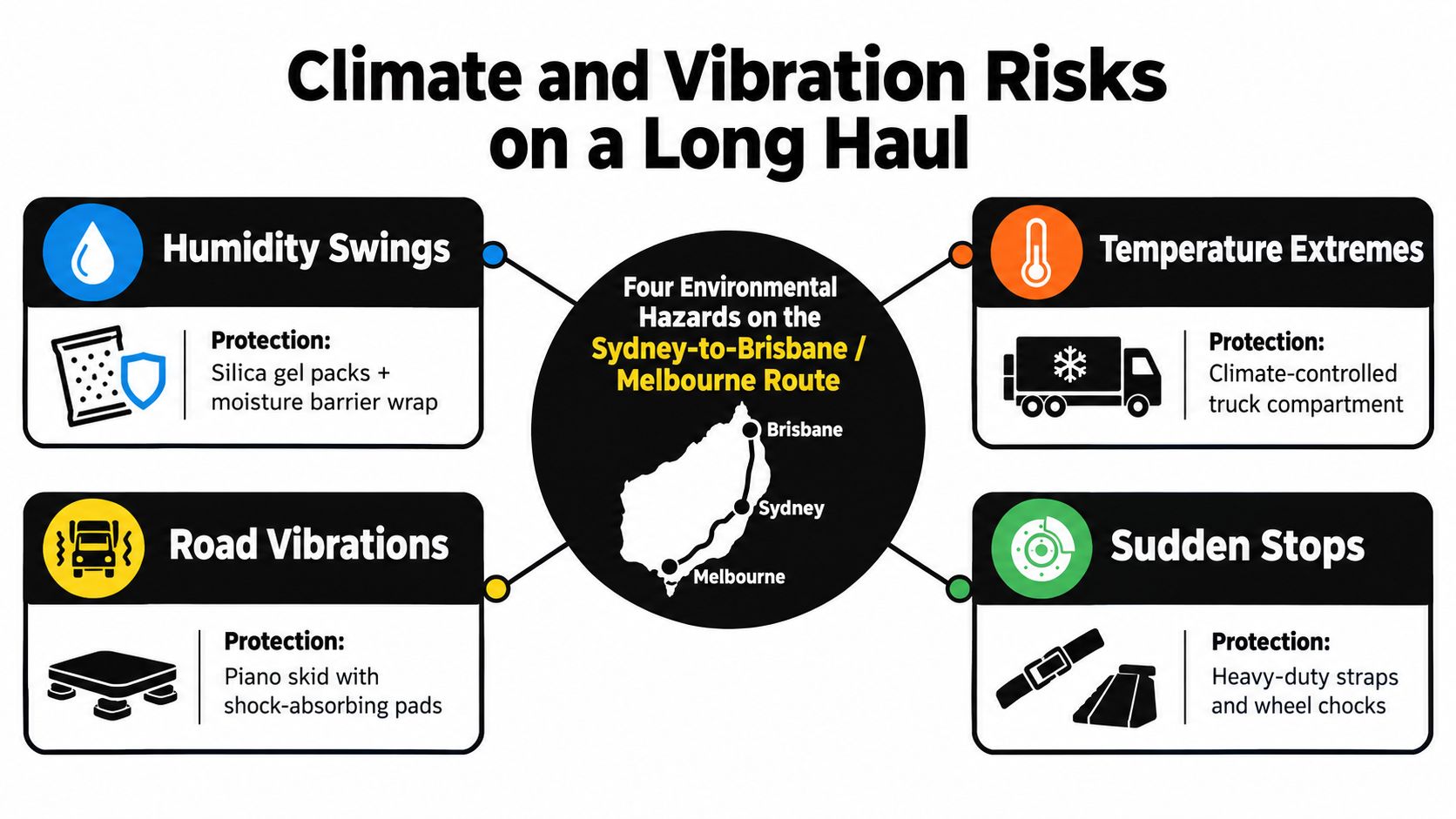
The long-haul part of the move is where most owners think about damage first. They usually imagine a bad bump in the road. That risk is real, but climate change across the route can be just as important.
Pianos are built from materials that react to moisture. According to Piano Harbour's piano care guidance, the optimal relative humidity range is about 40 to 50 per cent, with 42 per cent often cited as ideal. Their guidance also notes that after a move, many specialists recommend leaving the instrument to settle for 2 to 6 weeks before tuning, depending on the humidity swing and destination climate.
The four risks that matter most
Humidity swings can make timber and felt swell or shrink. That can lead to pitch drift, sticking keys, and uneven tone. A piano moving from one climate pattern to another should be packed and delivered with acclimation in mind, not rushed straight into tuning.
Temperature extremes inside a truck can affect glue joints, finish stability, and felt behaviour. Even when the instrument is wrapped well, prolonged heat can still create stress if the load space isn't managed sensibly.
Road vibration works away in the background for the whole trip. It doesn't need one dramatic impact to cause trouble. Repeated minor movement can unsettle tuning stability and put strain on the action if the piano isn't secured properly.
Tilt and angle changes are most dangerous during loading, unloading, and awkward home access. A piano that leans too far at the wrong point can put stress where it shouldn't.
Why climate comes before freight
A lot of competitor content treats interstate piano removals as a transport problem first. In practice, they're often a climate-acclimation and access-engineering problem first. The freight portion only works if the instrument is loaded, supported, and delivered in a way that reduces environmental stress.
A well-moved piano may still need time before it sounds settled. That doesn't always mean something went wrong. It often means the instrument is adjusting to a new environment.
This matters for Sydney households heading inland, north, or south. The route changes. The truck changes. The destination conditions change. The piano notices all of it.
How Professional Piano Removalists Handle the Move
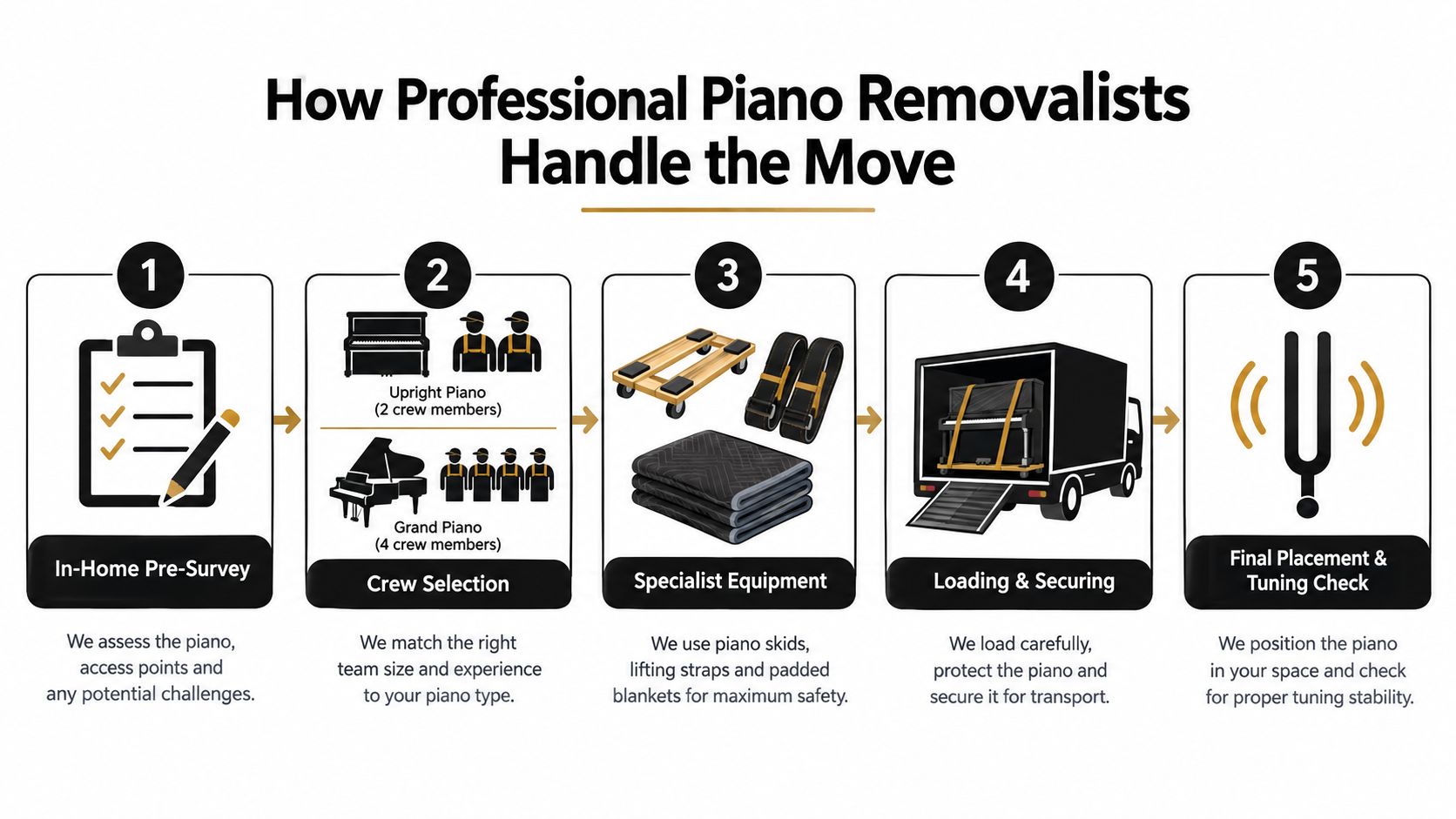
Moving day starts before anyone touches the piano. The lead crew member checks the path again, confirms the destination room, and inspects the instrument's existing condition. Photos and notes matter because they create a clear handover record and help the team protect known weak points such as chipped corners or loose panels.
For handling guidance, one useful Australian reference is Get N Go Removals' piano removal and storage advice. It recommends keeping the piano upright, using a piano board or dolly, rubber matting, wall padding, and straps secured through the frame rather than across the lid. It also notes a minimum four-person crew for controlled ramp and threshold transitions and special caution where gradients exceed 5 degrees.
What the crew actually does on site
The sequence is controlled and usually slower than homeowners expect. That's a good sign.
- Access is cleared and protected. Door leaves may come off temporarily. Floors, wall edges, and tight corners get padded.
- The piano is wrapped and stabilised. Blankets, corner guards, straps, and boards are fitted based on the instrument type.
- Transitions are handled carefully. Thresholds, ramps, steps, and turns are where balance can shift.
- Truck loading is planned, not improvised. The piano is placed where weight distribution and restraint points make sense.
- Delivery mirrors pickup. The same care applies at the second address, often with a fresh access assessment before unload.
Equipment matters more than brute force
The right gear changes the move. A piano board, heavy-duty dolly, skid plates, ratchet straps, padding, and threshold bridges all reduce shock and uncontrolled movement. If your pickup or delivery includes stairs, it's worth understanding how specialist stair equipment works. This guide to a dolly for heavy loads on stairs gives a useful visual example of the kind of problem-solving serious crews think about.
A provider such as Home Removals Sydney's grand piano removals service is one example of a company that assesses piano type, access conditions, and route planning before the move rather than treating the instrument as a standard furniture item.
Here's a practical look at handling workflow in action:
Keep an eye on how often the crew stops to reset hand positions and check clearances. Controlled pauses are part of safe handling, not a delay.
Why supervision matters
The best crews have one person calling the move. That supervisor watches angles, confirms each transition, checks restraint points in the truck, and records condition at pickup and delivery. Without that oversight, a technically strong crew can still lose control in a cramped hallway or rushed unload.
Pricing and What Really Drives the Cost
While interstate distance often appears to be the main reason piano quotes vary, the biggest cost jumps usually come from access difficulty, labour, and protection level.
Australian guidance on piano mover quotes and typical price ranges suggests local upright moves often start around A$300, while interstate grand-piano moves can reach A$1,500 to A$2,500+, with cost driven by access, labour, and protection requirements rather than distance alone. That's the part many quote pages don't explain well enough.
Interstate piano removal cost drivers by instrument type
| Cost Driver | Upright Piano | Grand Piano | Specialty/Antique |
|---|---|---|---|
| Access difficulty | Important, especially stairs and tight turns | Major factor due to footprint and disassembly | Major factor because awkward handling can damage fragile parts |
| Labour requirement | Usually moderate, but rises fast with poor access | Higher due to size, setup, and reassembly | Often higher because slower handling is safer |
| Protection method | Blanket wrap and securing are often enough | More extensive protection and component handling | May require custom wrapping or crating |
| Storage or transfer handling | Can add complexity if truck changes are involved | Often needs more controlled storage and reload | Usually planned conservatively to reduce handling risk |
| Final placement | Important for flooring and wall protection | Critical due to bulk and turning radius | Critical because finishes may mark easily |
Why labour often beats distance
A piano on level access at both ends can be simpler than a shorter move with a steep front path, several stairs, a narrow terrace hallway, and no close truck parking. That's why two Sydney households moving to the same city can receive very different interstate removal quotes.
Some of the hidden multipliers include:
- Stair carries that need more hands and slower movement
- Long carries from house to truck when parking is restricted
- Tight access through older homes, units, or split-level layouts
- Extra protection such as crating or specialised wrapping
- Second crew or transfer handling if the route or schedule requires it
If you want a broader non-Australian explainer on how movers discuss costs and insurance for piano moves, it can help frame the right questions, even though local terms and cover structures differ.
How to read a quote without guessing
A useful quote should tell you whether the price includes packing materials, special handling equipment, pickup and delivery labour, and any likely extras related to stairs or difficult access. If you're comparing offers, a dedicated breakdown is more helpful than a single total.
For Sydney households wanting to sanity-check line items, piano removalist costs can help you compare what's usually included versus what may be added later.
Insurance, Liability, and Accreditation
Insurance is where many piano moves become unclear. Owners often assume their household cover applies automatically or that any removal company's general policy covers every stage of the job. That assumption can go wrong quickly.
CHOICE notes in its guidance on moving house that AFRA-accredited removalists may be authorised to provide transit insurance, but cover depends on accreditation and policy structure. The same guidance also highlights that transit or moving insurance may need to be purchased separately and may not automatically cover every loading, unloading, or in-transit scenario (CHOICE moving house insurance guidance).

The questions that matter more than do you offer insurance
Don't stop at “yes, we're insured”. Ask what part of the move is covered and what isn't.
- Pickup phase. Is damage during lifting and loading included?
- Transit phase. Does the policy cover movement inside the truck, transfers, or storage stops?
- Delivery phase. Is placement into the room covered, or only delivery to the property boundary?
Those distinctions matter because a piano's highest-risk moments often happen at doorways, ramps, and room placement.
Common gaps people miss
Three areas regularly create confusion:
Pre-existing damage exclusions mean old chips, finish wear, or prior structural issues should be documented before the move.
Humidity or cracking clauses matter because not every policy treats climate-related change the same way.
Room-of-choice versus door delivery can affect who carries responsibility once the instrument reaches the address.
Ask one plain question: “Who is liable if the piano is damaged at pickup, in transit, or at delivery?” If the answer is vague, keep asking.
Keep your own records
Before handover, keep a folder with dated photos, serial number details, tuning records, and the mover's condition report. If you're reviewing cover options for a long-distance move, interstate moving insurance is worth checking so you can compare transit cover terms in plain language.
Preparing for a Stress-Free Interstate Piano Move
Good preparation lowers risk before the truck arrives. It also prevents the last-minute surprises that cause delays, extra labour, and rushed decisions.
Australia has a large cross-border relocation market, which is one reason this preparation matters. The Australian Bureau of Statistics reported 104,100 people moved interstate in the March 2021 quarter, which was 19 per cent higher than the March 2020 quarter, and more recent national modelling estimated 362,891 interstate moves in the 2025 calendar year, while the long-run share of Australians moving interstate is projected to decline from about 2 per cent in the 1990s to 1.5 per cent in 2027-28 (ABS regional internal migration estimates). For Sydney households planning interstate removals, that means piano jobs are part of a steady national movement pattern, not a rare special case.
Your pre-move checklist at home
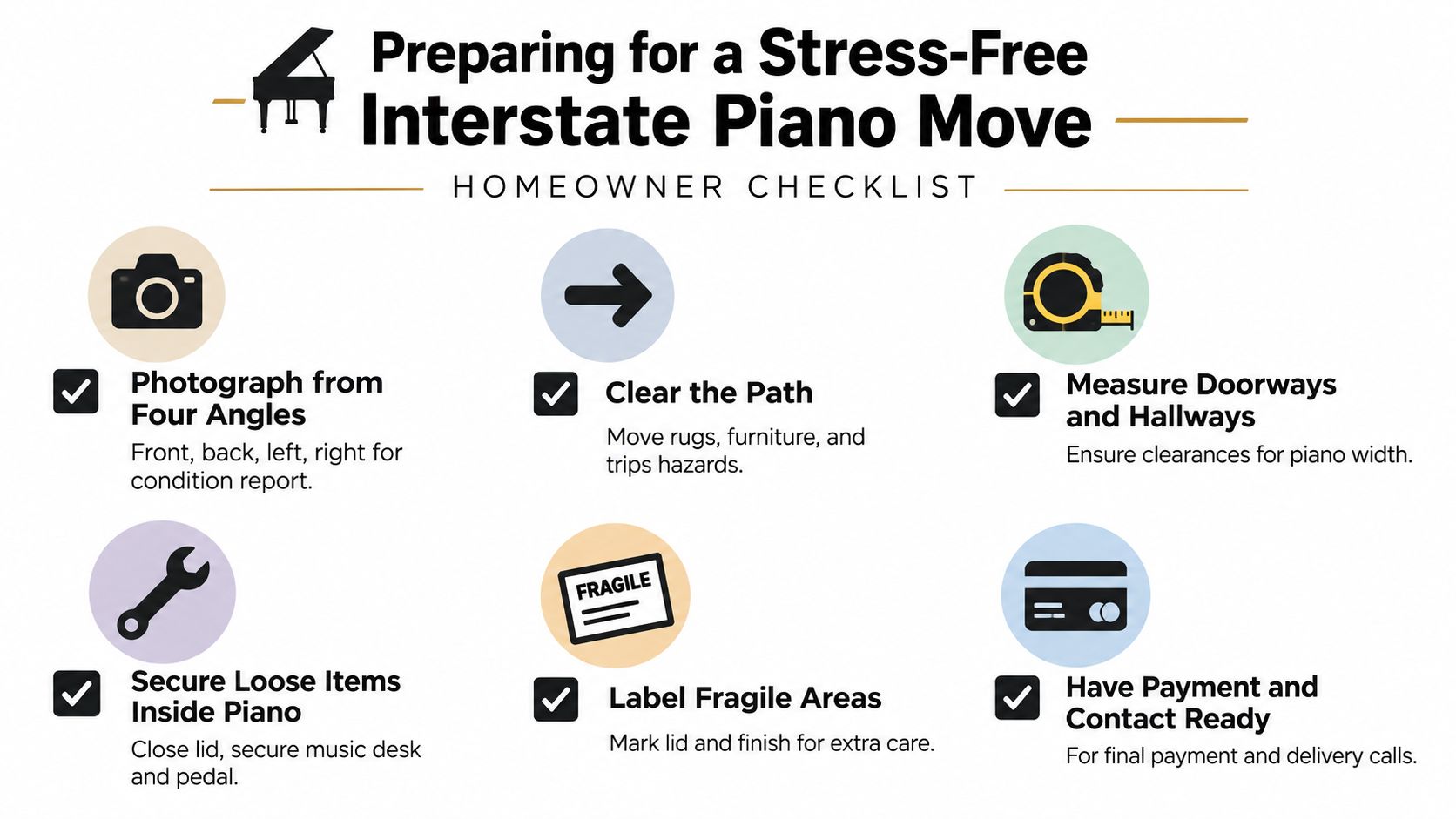
Start with documentation. Take clear photos from the front, back, and both sides. Then photograph any existing scratches, worn edges, loose trim, or pedal marks. Write down the serial number and keep it with your moving paperwork.
Sort out the access path next. Clear rugs, furniture, pot plants, and anything that narrows the route. If the truck needs street access in a tight part of Sydney, organise permits or building approvals early. Tell the removalist about stairs, sharp turns, low awnings, lifts, and sloping driveways at both ends.
Timing the tuning properly
Don't book a tuning for the day after delivery. The instrument needs time to settle into the new environment. A practical approach is to have the piano in stable condition before the move, then wait until it has adjusted at the destination before arranging the next tuning appointment.
That doesn't mean silence for weeks. It means understanding that the pitch and feel may shift while the timber and action acclimatise.
Questions worth asking before you book
Use the quote stage to pin down the details that change risk and cost.
- Who handles disassembly. If it's a grand, ask who removes and refits legs and pedal components.
- What padding is used. Blankets alone may not answer every risk on a long-haul move.
- How does the piano travel. Ask whether it stays upright, rides on a skid, or involves transfers.
- What valuation or transit cover is included. Get this in writing.
- Will storage or an extra crew change the fee. Better to know before moving day.
Small preparation steps that help a lot
Some jobs run smoothly because the homeowner did a few simple things well.
- Confirm the final room: Decide exactly where the piano will sit before delivery starts.
- Keep the path quiet: Children, pets, and visitors shouldn't be near the carrying line.
- Secure loose parts: Close the lid, remove loose items, and mention any sticky panels or weak casters.
- Trim outdoor obstacles: Hedges and branches can interfere with side access.
- Be reachable all day: The driver or supervisor may need quick decisions en route.
The calmest move is usually the one with the fewest unanswered questions at 7 am.
Handover day routine
When the crew arrives, walk them to the piano first. Point out existing marks and any known quirks with pedals, lids, or keys. Confirm the destination address, room placement, and who signs off at delivery.
For home removals Sydney, furniture removals Sydney, office relocations, or full interstate removals, that same principle holds. The better the access information, the better the plan. A piano just makes that truth impossible to ignore.
If you're planning an interstate piano move from Sydney or anywhere in NSW, Home Removals Sydney can assess the instrument, check access at both ends, and provide a quote that reflects the actual handling requirements rather than treating the piano like standard furniture. To see how the team approaches piano transport, storage, and wider interstate removals, visit Home Removals Sydney.
