


A 4.5 tonne truck is the largest vehicle you can drive on a standard car licence in Australia, provided its GVM is no more than 4.5 tonnes. For Sydney moves, it's often the right fit for a typical three-bedroom home, offering useful capacity without automatically requiring a heavy-vehicle licence.
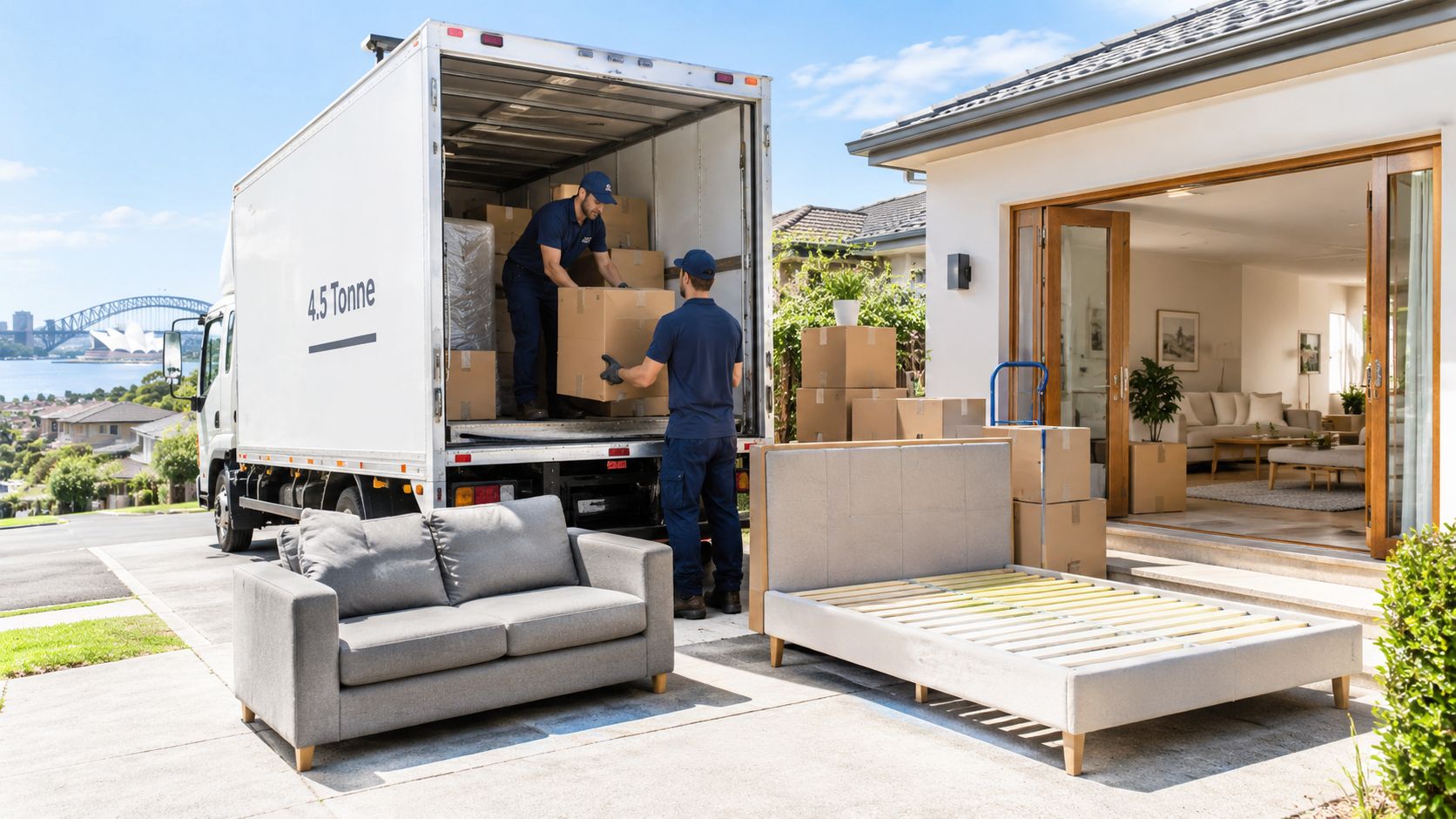
A Saturday move in Parramatta or Burwood often starts the same way. The sofa is ready by the front door, the queen bed has been dismantled, boxes are stacked in the hallway and the appliances are waiting for their turn. The challenge isn't just finding a vehicle that looks large enough. You need one that can carry the load, reach suburban streets and stay within the legal limit that affects licensing and compliance.
Why the 4.5 Tonne Truck Is Sydney's Most Popular Moving Solution
The 4.5 tonne truck sits in a practical part of the Sydney removal market. It's more capable than a compact moving van, but it remains easier to use around residential streets than a much larger rigid truck. For many Home removals Sydney customers, that balance matters more than choosing the biggest vehicle available.
A well-planned load can accommodate the furniture, whitegoods, packed cartons and loose household items from a medium-sized move without relying on repeated trips. It's particularly useful for homes where the inventory has been sorted before moving day. A garage full of unwanted furniture, an overloaded storage cage or a large collection of dense books can change that calculation quickly.
The legal line behind the vehicle choice
In New South Wales, a vehicle becomes a heavy vehicle when its Gross Vehicle Mass exceeds 4.5 tonnes, making the boundary important for registration, inspection and licensing decisions. The NSW Government registration guidance also explains that registration requirements change above this threshold.
That distinction affects both customers and removalist businesses. A homeowner may only be thinking about whether the wardrobe will fit, while an operator must also consider the truck's GVM rating, driver licence, registration category and route conditions. A truck that looks similar from the outside can fall into a different regulatory class if its rated mass is higher.
Practical rule: Choose the truck by the complete inventory and the vehicle's legal GVM, not by its external appearance.
For Sydney removalists, the appeal is straightforward. The truck can handle substantial furniture removals while remaining suitable for many suburban access points. The sections below explain how to judge the available space, confirm the licence position and decide when a smaller or larger vehicle makes more sense.
Understanding the Real Capacity and Dimensions of a 4.5 Tonne Truck
A truck's 4.5 tonne GVM is not the same as its available payload. GVM is the maximum permitted mass of the loaded vehicle, including the truck, driver, fuel, equipment and belongings. The remaining allowance is the payload, and it can be reduced by the truck body, tail lift, blankets, trolleys and other moving gear.
That's why removal jobs are often limited by volume before they reach the legal mass limit. Furniture such as lounges, bed frames and wardrobes occupies substantial space without always being exceptionally heavy. Dense cartons of books, gym equipment, tiles, tools and commercial stock create the opposite problem. They may fill less room but use the available payload quickly.
How to visualise the load bay
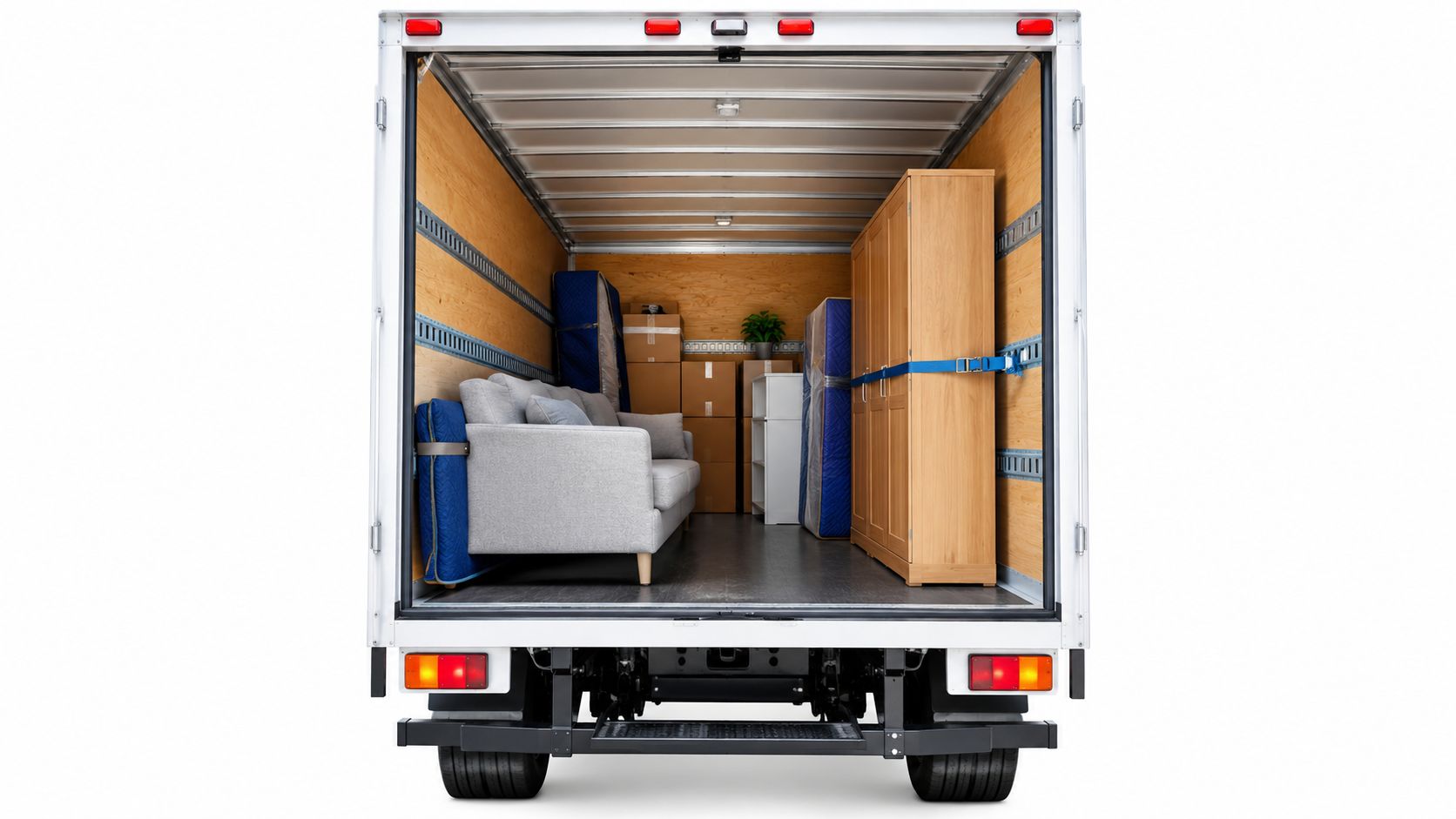
Start with the largest items. A king-size bed base may need to be dismantled, protected and loaded flat or on its side, depending on the truck body and the frame design. Sofas need careful measurement because armrests, reclining mechanisms and awkward corners can prevent efficient stacking. Tall wardrobes and refrigerators also need a clear loading plan so they aren't trapped behind smaller cartons.
Standard moving boxes should be loaded after the major furniture has been positioned. Removalists generally protect the walls of the truck first, secure tall pieces and then use cartons to fill safe spaces around the main items. A rough box count without an inventory is unreliable because a compact apartment load and a spread-out family home can use the same number of cartons while requiring very different floor space.
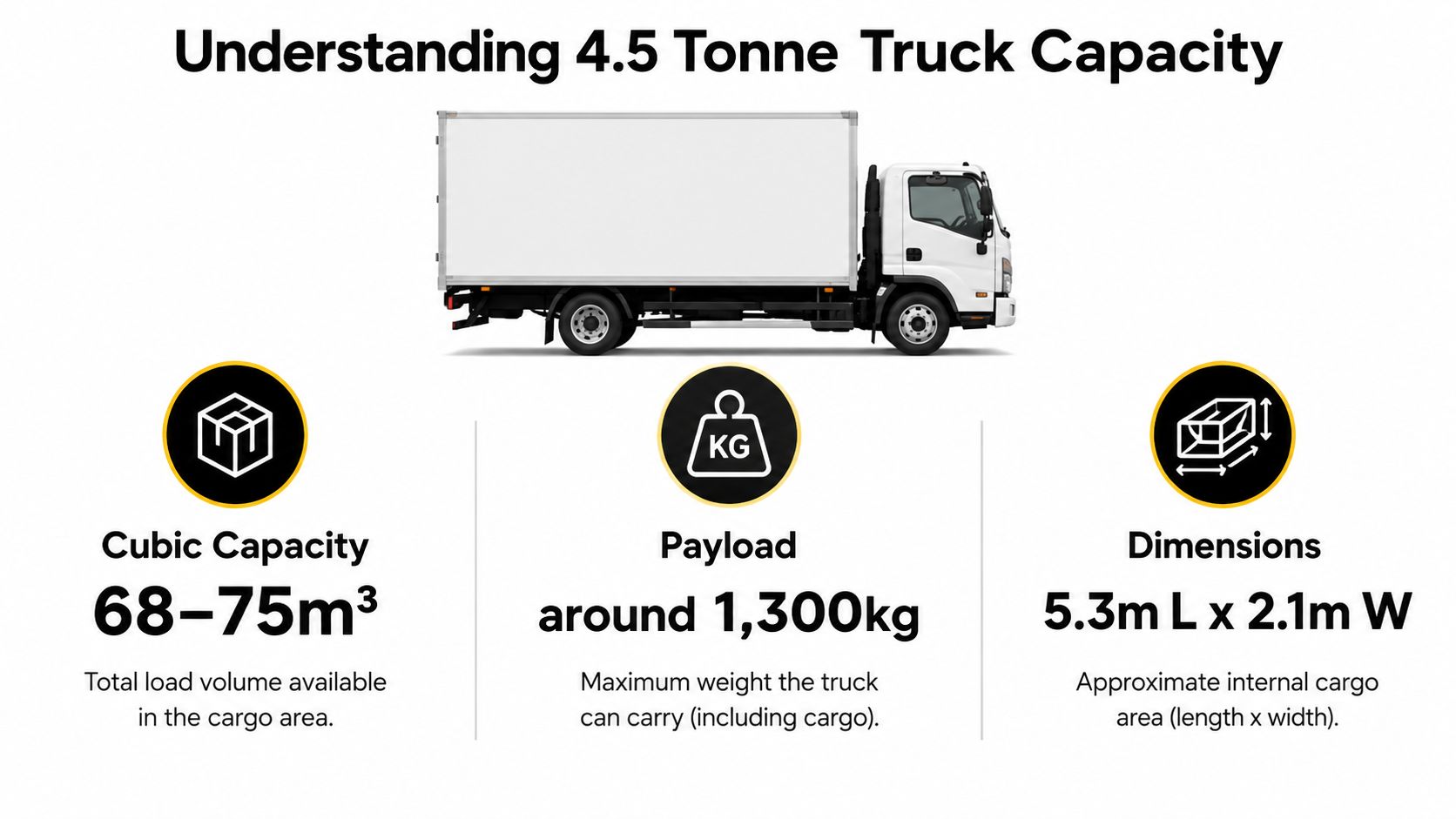
For an early estimate, use a cubic metre calculator for household removals and then check the result against the actual inventory. Treat that calculation as a planning aid, not a guarantee. Access, protective packaging, irregular furniture and the need to keep items stable can reduce the usable space.
Transport for NSW describes standard heavy vehicles as generally limited to 12.5 metres in length, 2.5 metres in width and 4.3 metres in height, as set out in its guidance on heavy vehicle dimensions and oversize movements. Those are road-vehicle limits rather than guaranteed internal truck-body dimensions, so customers should ask the removalist for the actual cargo-bay measurements.
NSW Licensing Rules and the 4.5 Tonne Regulatory Boundary
The licence question comes down to the truck's GVM rating, not just what the vehicle weighs when it's parked empty. A truck may look lightly loaded and still require the licence class that applies to its manufacturer-rated mass.
In NSW, a Class C licence covers vehicles up to 4.5 tonnes GVM. A Class LR licence is required for rigid vehicles over 4.5 tonnes and up to 8 tonnes GVM, according to the NSW road access and licence guidance. The exact boundary is therefore important when a business is hiring staff, planning a fleet or deciding whether an owner-driver can complete a job.
Check these details before booking
Read the compliance plate. Confirm the truck's GVM rating rather than relying on a sales description such as “medium truck”.
Match the driver to the vehicle. A driver with a Class C licence may drive a vehicle at or below the applicable GVM limit, but a vehicle above that line can require the appropriate LR authority.
Separate payload from licensing. Reducing the household load doesn't necessarily change the truck's GVM classification. The rating and legal category remain central.
Ask about the operator's checks. NSW registration requirements differ once a vehicle is above the threshold, with heavier vehicles subject to additional identity, design and safety checks under the NSW registration process.
A heavier rigid truck may be the right choice for a warehouse, a large office or a move involving dense stock, but the licence requirement then becomes part of the staffing plan. If you're considering a larger option, review the practical differences in a 6 tonne truck before selecting the vehicle.
The boundary also affects road behaviour. In NSW, trucks over 4.5 tonnes GVM must use marked truck lanes where provided and must not stop on roads outside built-up areas except on the shoulder, as explained in the NSW heavy vehicle parking and truck-lane rules.
Comparing Truck Sizes for Your Sydney Move
A smaller vehicle can be the efficient choice for a compact apartment, while a larger rigid truck can prevent multiple trips for a substantial relocation. The 4.5 tonne option is useful when the inventory is too large for a panel van but doesn't justify moving into a heavier vehicle category.
| Truck Size | Typical Use Case | Driver Licence |
|---|---|---|
| Smaller panel van | A lightly furnished apartment, a room move or a small furniture collection | Check the vehicle's GVM and licence requirements |
| 4.5 tonne truck | A medium home removal, selected furniture removals or a modest office relocation | Class C up to 4.5 tonnes GVM |
| Rigid truck over 4.5 tonnes and up to 8 tonnes | A larger home, warehouse contents or a substantial office move | Class LR |
The NHVR explanation of heavy vehicles confirms that the legal classification depends on GVM, not the casual labels people use in the marketplace. “Small”, “medium” and “large” can mean different things between suppliers, so ask for the rated mass and the truck's internal measurements.
When each option works
A panel van may be adequate when there are no bulky wardrobes, only a limited number of cartons and convenient access at both addresses. It becomes inefficient when the crew must leave furniture behind or make another trip across congested roads.
The 4.5 tonne truck is generally the sensible middle ground for a furnished home. It can handle a coordinated load while remaining more manageable around older terraces, narrow driveways and suburban kerbs than a heavier rigid vehicle.
A larger truck becomes worthwhile when the inventory is bulky, the move includes commercial equipment or the cost of an extra trip outweighs the additional vehicle and labour requirements. It may also require a different driver licence and stronger route planning, so the decision should be made before moving day.
Ideal Use Cases for a 4.5 Tonne Truck in Sydney
A furnished three-bedroom home in Sydney often suits a 4.5 tonne truck when the owners have already removed unwanted items and packed efficiently. That might include lounge furniture, beds, dining furniture, appliances, cartons and outdoor items from an Inner West property. Narrow streets and limited kerb space make a manageable truck preferable, but the crew still needs enough room to complete the load safely.
It also suits selected office relocations. Desks, chairs, boxed files, monitors and small storage units can be loaded in a planned sequence, especially when the business has already separated items for disposal, storage and transport. A CBD move needs more than truck capacity. Building loading rules, lift bookings, access windows and the distance from the kerb can determine how smoothly the job runs.
Interstate work needs a closer check
A 4.5 tonne truck can be a practical option for a smaller interstate move from Sydney when the household inventory is controlled and the route is suitable. It's not automatically the right answer for every long-distance relocation. A large home, heavy machinery or a combined household and storage load may need a heavier vehicle or a staged transport plan.
The important distinction is the vehicle's legal status. Under the Heavy Vehicle National Law framework, a vehicle over 4.5 tonnes GVM becomes a heavy vehicle, affecting compliance, access and fatigue-management responsibilities in NSW and other participating jurisdictions. That's why an interstate operator should confirm the truck rating, licence class and operating requirements before accepting the booking.
A useful way to judge suitability is to sort the inventory into three groups:
- Essential furniture: Beds, sofas, dining furniture and appliances come first.
- Cartons and loose items: Clothing, kitchenware and books fill the remaining safe spaces.
- Optional or dense items: Tools, gym equipment and large quantities of books may justify a different truck.
For a visual example of loading order and furniture placement, this moving truck loading video shows the practical value of protecting and securing items as the load builds.
Cost Expectations and Pricing for 4.5 Tonne Truck Removals
A 4.5 tonne removal quote usually reflects more than the truck itself. The final price can depend on the number of removalists, estimated working time, travel, access at each property, packing requirements and whether furniture needs dismantling or reassembly.
For a local Sydney booking, ask whether the quote is charged by the hour, whether travel time is included and whether there's a minimum booking period. A labour-only service may suit a customer who has hired a vehicle independently, while a full-service removal normally includes the truck, crew, blankets, trolleys and handling. The cheaper-looking option can become less economical if you need to organise equipment or make additional trips.
Charges that change the estimate
- Stairs and difficult access: Multiple flights, narrow stairwells and long carries increase handling time.
- Packing and materials: Boxes, paper, bubble wrap and protective materials add preparation costs but can reduce damage risk.
- Parking and building requirements: A loading-zone restriction, lift booking or long walk from the truck can affect the crew's working time.
- Interstate distance: Longer routes require a different quote structure, with distance, travel planning and fuel-related costs considered together.
- Storage or staged delivery: A move involving temporary storage needs separate handling and scheduling.
Use a detailed furniture removal price guide as a starting point, then provide an honest inventory for a customized estimate. Photos of stairs, driveways, lifts and oversized furniture help the removalist identify problems before the booking is confirmed.
NSW registration charges for heavy vehicles are calculated using the vehicle type, axle count, GVM and nominated configuration. The government's heavy vehicle registration cost guidance states that the charges are effective from 1 August 2025. For operators, staying at the 4.5 tonne boundary can avoid some of the higher fees associated with heavier combinations, but customers should still compare the complete service price rather than focusing only on the truck category.
Preparing for Your 4.5 Tonne Truck Move in Sydney
Good preparation gives the crew room to work and makes the truck's capacity more useful. A customer in a Burwood terrace may have enough furniture for the vehicle, but an unplanned wardrobe, loose rubbish and unlabelled cartons can slow the loading sequence and create avoidable handling.
Begin with an inventory. Mark what is moving, what is going to storage and what will be donated or disposed of. Measure bulky furniture, check whether bed frames and tables can be dismantled, and tell the removalist about fragile artwork, pianos, antiques, gym equipment or unusually heavy cartons.
A practical moving-day checklist
- Confirm access: Check driveways, gates, lifts, stairs and loading areas at both addresses.
- Arrange parking: Contact the relevant council or building manager about parking restrictions and loading permissions.
- Pack consistently: Use strong cartons, close the tops securely and label each box with its destination room.
- Prepare appliances: Empty and disconnect refrigerators, washing machines and other appliances before the crew arrives.
- Protect pathways: Clear hallways, remove trip hazards and keep children and pets away from the loading area.
- Keep essentials separate: Carry medication, documents, chargers, valuables and basic overnight items independently.
For interstate or time-sensitive work, route planning deserves attention before the truck leaves. Tools such as best truck route planning tools can help operators consider vehicle restrictions and organise a more suitable journey. The removalist should still verify the route and local access conditions rather than relying on an app alone.
Send the removalist a clear list of rooms, furniture and access conditions when requesting a quote. That information helps match the job with the right truck, crew and equipment, whether you need local Home removals Sydney, furniture removals Sydney, interstate removals or an office relocation.
Home Removals Sydney can organise Sydney home, furniture, office and interstate relocations with truck and removalist options matched to the size and access requirements of your move. Visit Home Removals Sydney to request a custom quote and provide your inventory, addresses and access details.
