


A Sydney business can have a signed lease, a booked removalist and a carefully packed office, yet still face disruption because its relocation notice was treated as a quick email. Staff arrive at the wrong site, suppliers send invoices to an old address, mail is redirected late and a regulator's record no longer matches the business's operating details. The physical move may be straightforward, but the administration around it rarely is.
An effective office relocation notice gives every person a shared reference point. It confirms the new address, the effective date, the effect on daily operations and the action expected from each stakeholder. For NSW businesses, it also helps connect lease obligations with updates to the Australian Business Register, ASIC, the ATO, licences, mail services and internal systems.
The practical lesson from coordinating office relocations across Sydney is simple: issue the notice early, make it specific and use it as the control document for the move. A useful starting point for the physical planning side is this Sydney office move guide, particularly when furniture, IT equipment and staff access need to be coordinated across more than one site.
Why Your Office Relocation Notice Is the First Step to a Stress-Free Move
A professional services firm in Sydney's inner west once approached its move as a weekend logistics exercise. The team booked trucks, told a few employees informally and assumed the new premises would become the official address on moving day. By the time the trucks arrived, staff had different versions of the timetable, the IT contractor was working from an outdated access plan and several suppliers still had the former office listed as the delivery point.
That situation is common because businesses see relocation as a physical event. In reality, it's a coordinated change involving people, records, contracts, technology and customer expectations. An office relocation notice brings those strands together before the first desk is lifted.

Treat the notice as a control document
The notice should identify:
- The new premises: Include the complete street address, suite or floor details and any relevant entry instructions.
- The effective date: Distinguish between the final operating day at the old office, the move period and the first operating day at the new site.
- Operational impacts: Explain temporary closure periods, altered phone access, delivery changes, parking arrangements and visitor procedures.
- Responsibilities: Name the person managing staff questions, the IT cutover, landlord communication and supplier updates.
The Australian Bureau of Statistics recognises that businesses may operate across multiple geographical locations and takes care to avoid double counting multi-location businesses. Its methodology also captures movement between locations as inflow and outflow over a financial year. That context matters because an office move can affect how a business is classified, reported and tracked across records, rather than being merely an administrative address change. The ABS background on Australian business location data supports the practical need for consistent updates across regulators, customers, suppliers and internal systems.
Practical rule: If a removalist, employee, landlord or regulator could interpret the move differently, the notice needs another line of detail.
A vague announcement creates questions. A structured notice answers them before they interrupt the move. That reduces anxiety for employees and gives Removalists Sydney teams, IT specialists and building managers a common timetable to work from.
Navigating NSW Lease Obligations and Landlord Requirements
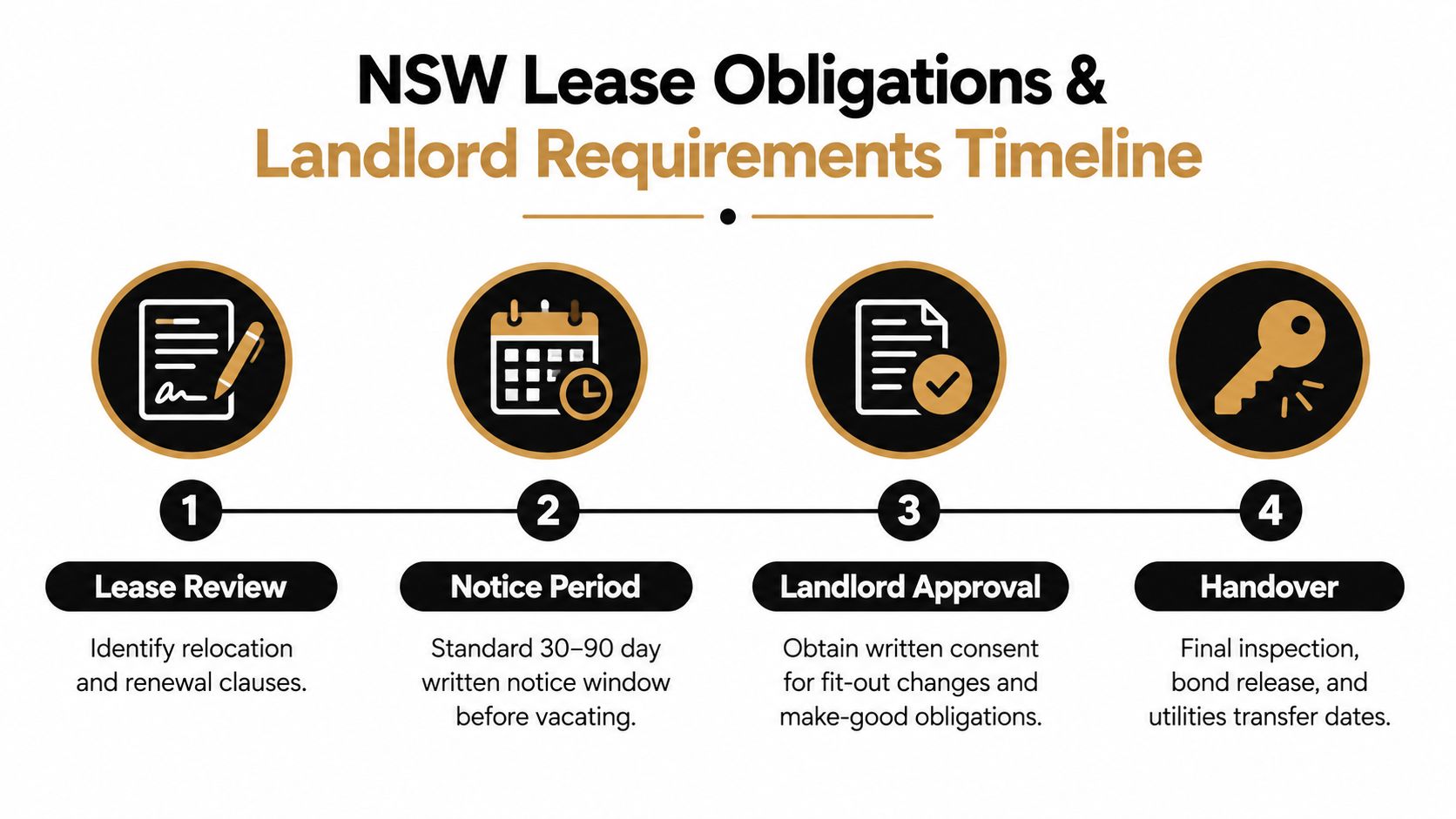
The lease controls the starting point for any office relocation in NSW. Before announcing a move, read the clauses covering relocation, assignment, termination, make-good work, access, fit-out changes and handover. A business that sends an internal announcement before confirming its contractual position can create confusion about whether it's leaving voluntarily, accepting alternative premises or responding to a landlord-initiated relocation.
Where a NSW commercial lease contains a relocation clause, the landlord must give at least three months' written notice, and the lessee has one month to reject the proposed new premises. If the lessee rejects them, the lease ends at the conclusion of the original three-month notice period, unless the parties agree to an earlier date. These requirements are outlined by Small Business NSW guidance on managing a lease.
Build the decision window into the move plan
The notice date should be recorded as a project milestone, not filed as correspondence. Create a simple register showing:
- Date the notice was served
- Date the notice period starts
- Last date to reject proposed premises
- Lease end or handover date
- Make-good inspection and access arrangements
NSW guidance on notice periods confirms that periods are counted in calendar days, not working days. The day the notice is served isn't counted, while weekends and public holidays are included. If a termination notice is posted to a tenant, the landlord or agent must allow an additional seven working days for delivery. The commercial lease clause and the relevant notice rules must be checked together, because a project can be delayed by relying on a standard business-day assumption.
Give the landlord a complete notice pack
A useful pack includes the proposed vacate date, forwarding address, access requirements, removalist details, lift bookings, make-good responsibilities and the person authorised to coordinate the handover. Keep evidence of delivery, including email read receipts or another agreed written method, and ask the landlord to confirm any building requirements.
The mistake that causes the most trouble is treating the office relocation notice as an employee announcement only. A move can affect statutory records, mail routing and the condition obligations attached to the former premises. The new address, effective date and office-function impacts should be consistent across the lease file, regulator updates and stakeholder communications.
Essential Notifications for Government Bodies and Regulators
Changing an office address can affect several government records at once. Business.gov.au guidance explains that a business changing address may need to notify the Australian Taxation Office, the Australian Securities and Investments Commission and the Australian Business Register.
The order matters. Start with the records that carry a defined deadline, then reconcile the result with licences, finance systems and external communications. A business with several sites should identify exactly which location is changing, rather than replacing every address automatically.
Use three compliance streams
ABR and ATO details
The ATO requires changes to registered business details to be reported to the Australian Business Register within 28 days. Check whether the move affects the physical street address, postal address or an additional business location. The ATO update-your-details guidance makes this address-type distinction operationally important.
ASIC company and business-name records
Companies and business names must update address records within 28 days. Delays can create late-fee or breach exposure, particularly where a registered office, principal place of business or service address changes. Confirm which ASIC record is affected and retain the submission confirmation.
NSW licences and registrations
Some NSW services require a name or address change to be reported within seven days, and a company or partnership contractor licence contact-detail change may also need updating within seven days. Check each licence rather than assuming the ABR or ASIC update will flow through automatically. The relevant NSW licence change guidance sets out examples of these faster requirements.
Keep a notification register
| Party | Action | Control point |
|---|---|---|
| ATO and ABR | Update registered details and map the affected location | Within 28 days |
| ASIC | Update company or business-name address records | Within 28 days |
| NSW licence bodies | Check the individual licence requirement | Some changes within 7 days |
| Landlord or agent | Serve or acknowledge lease-related notice | Follow the lease |
| Customers and suppliers | Issue the new address and effective date | Before the move |
| Bank, insurer and legal advisers | Update correspondence and policy records | Before and after handover |
For businesses also managing residential moves, the administrative discipline is similar to what's set out in this commercial office relocation resource. Keep one owner responsible for the register, attach evidence of each update and reconcile the effective date across every channel.
Coordinating with Removalists, IT Teams, and Operations
The relocation notice becomes useful when it drives a shared operating schedule. Removalists need loading access and floor plans. IT teams need a cutover window, equipment inventory and secure handling instructions. Operations managers need to know when reception, deliveries, phones and customer service will change.

Create one timeline with separate owners
The compliance workflow should keep three streams visible: ABR and ATO details, ASIC records, and landlord or lease notices. The ATO and ASIC each have a 28-day address-update requirement, while the ABR distinguishes between a physical business location, postal address and additional locations. Check each record before submission, then match the effective date against the office relocation notice.
Operationally, the sequence works best when the notice is issued before the physical move. After that, the project lead should confirm:
- Removalist access: Loading zones, lifts, security procedures and arrival instructions.
- IT handling: Asset labels, packing responsibility, server or network dependencies and testing at the new premises.
- Utilities and facilities: Electricity, internet, phones, access cards, cleaning and waste services.
- Storage decisions: Items moving immediately, items going into secure storage and items being disposed of or donated.
- Downtime communication: The hours when staff, clients and suppliers should expect limited access.
The guide to change management in offices is useful when the move also changes how teams use meeting rooms, shared areas or workstations. A relocation is easier to manage when the physical plan and people plan are treated as one programme.
For a coordinated Sydney or interstate project, office move management can include the practical scheduling needed to align packing, furniture handling and placement. The key is not just booking a truck. It's giving every contractor the same approved address, date and access instructions.
Crafting the Perfect Relocation Notice for Employees and Stakeholders
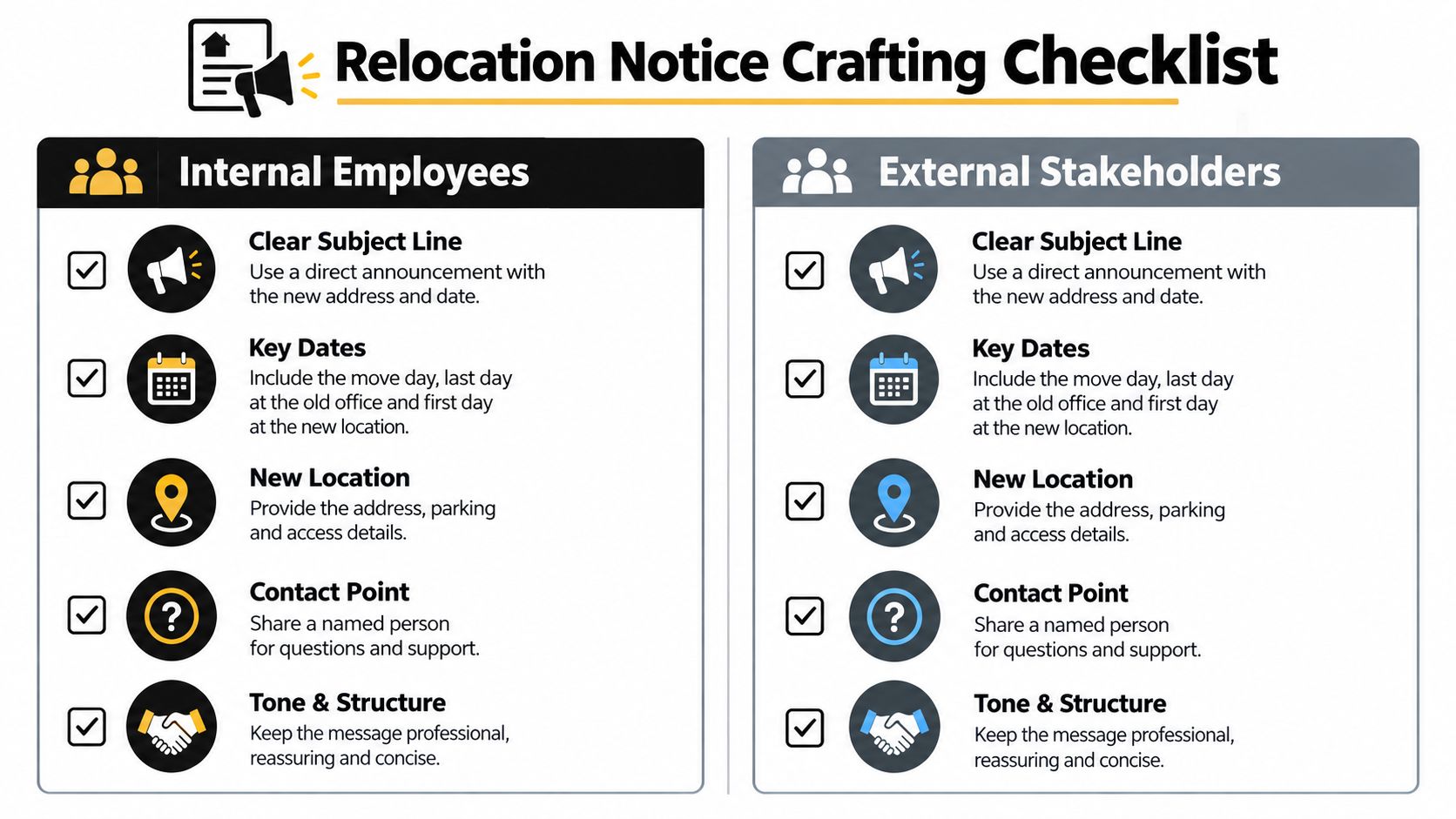
Employees and external stakeholders need the same facts, but not the same message. Staff want to know how the move affects their commute, workday, access, equipment and routines. Customers, suppliers, couriers and professional advisers need the new address, effective date, contact details and any delivery or service changes.
A single generic email rarely handles both audiences well. Send an internal notice through email and the intranet, then provide a concise external version for customers and vendors. Physical signage at the former premises can catch visitors who haven't seen the digital communication.
Compare the message by audience
| Audience | Include | Tone and channel |
|---|---|---|
| Employees | Move dates, access, parking, travel changes, packing instructions and questions contact | Reassuring, practical, email, intranet and briefing |
| Customers | New address, service continuity, contact details and appointment instructions | Clear, confident, email, website and direct account contact |
| Suppliers | Delivery address, loading instructions, invoice details and effective date | Precise, operational, email and supplier portal |
| Landlord and building manager | Vacate arrangements, access, insurance, make-good and handover details | Formal, documented, written notice |
The reason for the move deserves space in the message. CBRE reports that among tenants relocating in 2025, 52% expanded their footprint and 14% downsized. Its 2025 Australian Office Occupier Survey found 77% of respondents considered improved amenity and services essential when considering relocation. Those figures appear in CBRE's Australian office commentary, and they support a practical communication point: explain what the new office improves, not just where it is.
Put the essentials near the top
Use a subject line such as “Our Sydney office is moving to [new suburb]”. Open with the effective date and complete address, then explain access, downtime and the contact person. Finish with a short action list, such as updating delivery records, saving the new address and checking visitor instructions.
Post-Relocation Verification and Compliance Follow-Up
Moving the last chair into the new office doesn't finish the project. The first working days expose the gaps that weren't visible during packing: a courier arrives at the old building, an invoice uses the former address, a phone greeting gives outdated directions or a regulator's confirmation goes to a mailbox no one checks.
Use the office relocation notice as the reference record for the final audit. Compare its address and effective date with the lease file, ABR and ASIC submissions, banking records, insurance policies, contracts, invoices, website, email signatures, Google Business Profile and supplier portals.
Check the old site and new site separately
At the former office, confirm that:
- Mail handling: Redirection or halt services have the correct address and date.
- Building handover: Keys, access cards, utilities, signage and inspection requirements are complete.
- Physical records: Files, cabinets, equipment and confidential waste have been accounted for.
- Customer visibility: Temporary signage provides the new location and contact point.
At the new premises, test internet connectivity, phones, security access, printers, meeting-room equipment and delivery procedures before normal operations resume. Ask department leads to verify that their teams can find essential equipment and understand the revised layout.
NSW notice guidance confirms that notice periods use calendar days, exclude the day of service and include weekends and public holidays. Where a notice is posted to a tenant, allow an extra seven working days for delivery. Keep those mechanics in the project record, especially where a landlord notice, handover date or posted document affects the move sequence.
Keep communication open after opening day
Send a short confirmation to customers, suppliers and staff once the new office is operating. Invite reports of missing deliveries, access problems or incorrect records, then assign each issue to a named person. For sensitive technology and furniture, use a documented office equipment relocation service that records what was moved, where it was placed and whether it arrived in working condition.
Ready to Move? Get Expert Support for Your Office Relocation
A well-prepared notice reduces uncertainty, but it doesn't carry desks, protect monitors or coordinate a difficult loading dock. Office relocations require a practical sequence covering packing, furniture disassembly, secure transport, placement, storage and the final handover. The right removalist should understand how those tasks interact with lease dates, IT access and business continuity.
Home Removals Sydney provides office relocation support across Sydney and for interstate removals, with services that can include professional packing and unpacking, furniture assembly and secure storage. Its fleet ranges from 4-tonne vans to 62-tonne trucks, allowing businesses to match vehicle capacity to the size and access conditions of the move. Those specifications are supplied by the business and should be confirmed when requesting a quote.
Choose support that matches the move
A small office with limited furniture may need careful packing, transport and placement. A larger workplace may need staged loading, equipment labelling, storage and coordination with building management. A warehouse relocation brings different risks again, including inventory control, pallets and heavier equipment.
Ask for a written scope that identifies:
- What gets packed: Workstations, archives, kitchen equipment, IT hardware and specialist items.
- What gets assembled: Desks, shelving, cabinets and other furniture at the destination.
- What gets stored: Items held temporarily or long term, with access arrangements confirmed.
- How access works: Lift bookings, loading zones, stairs, security and parking restrictions.
- How pricing is presented: A custom quote that reflects the actual inventory, distance and services.
For planning discussions, this resource on timelines and costs for office relocation Sydney can help businesses frame the questions they need to ask before appointing a provider. The most reliable process combines that preparation with a precise office relocation notice, because the moving crew can only work efficiently when the address, access plan and timing are settled.
Request a quote before you send the final notice. That allows the removalist schedule, packing requirements and any storage needs to be reflected in the communication given to staff, landlords, suppliers and customers.
Home Removals Sydney offers packing, furniture assembly, secure storage and coordinated office relocations across Sydney and interstate. Visit Home Removals Sydney to request a custom quote and organise practical support for your move.
