


By Friday morning, most facilities managers have already made the big decisions. The lease is signed, the new floor plan is approved and a removalist booking is in the diary. What remains are the details that determine whether the business opens normally on Monday or spends the first working day looking for missing cables, waiting for a lift and explaining why the phones don't work.
An office moving day in Sydney is a coordinated building, transport and technology operation. It is not just a larger version of home removals Sydney. Loading zones, dock access, strata rules, truck dimensions, lease obligations and IT cut-over windows can all affect the schedule. The practical plan below focuses on the decisions that keep office relocations moving when the CBD, inner-west streets and commercial buildings create little room for improvisation.
The Sydney Office Move That Almost Fell Apart
At 7 am on a Friday, a facilities manager arrived at a Fairfield industrial unit expecting a straightforward transfer. Forty staff were due to be operational in a Pyrmont office by Monday morning. The desks were labelled, the servers had a shutdown plan and the removalist crew was already on its way.
The first problem appeared when she called the new building. The lift booking hadn't been confirmed. Building management had no record of the requested arrival window, and the dock coordinator couldn't release a loading slot without written approval. At the old site, the loading dock was already double-booked with a courier, so the truck couldn't begin loading without blocking another tenant.
Then the driver checked the route. The truck was over the 3.5-tonne threshold relevant to the residential street around the corner. That meant the team couldn't treat the kerbside as a convenient overflow area. Furniture had to move through the approved access point, or the operator needed a different vehicle and a revised loading plan.
Practical rule: A booking in the removalist's diary isn't the same as a confirmed booking with both buildings.
The scramble exposed four decisions that should have been settled before move week:
- Lease timing: The relocation date needed to be planned around the lease expiry, make-good work, fit-out and approvals, not selected in isolation.
- Written access confirmation: The Pyrmont lift, loading dock, old-site access and any after-hours arrangements needed named contacts, times and email confirmation.
- Vehicle selection: The truck had to match the street, building and loading arrangement. Bigger isn't automatically better in dense Sydney areas.
- One accountable contact: The facilities manager needed authority to make decisions, keep a live snag list and coordinate the building, IT team and removalist lead.
This pattern is common because office moving day compresses several independent schedules into one morning. A courier, strata manager, telco, lift operator and removalist can each be ready on their own terms while the move still fails as a combined operation.
Australia has a substantial relocation ecosystem. Australia Post says about 1.14 million Australians move house each year, and around 84% use its Mail Redirection service. The national removals industry is cited at about A$2.6 billion, with 8,310 businesses operating in the sector, which shows that address changes, transport and scheduling are established operational services, not occasional afterthoughts. The Australian office relocation market context makes the same point for businesses planning continuity-focused moves.
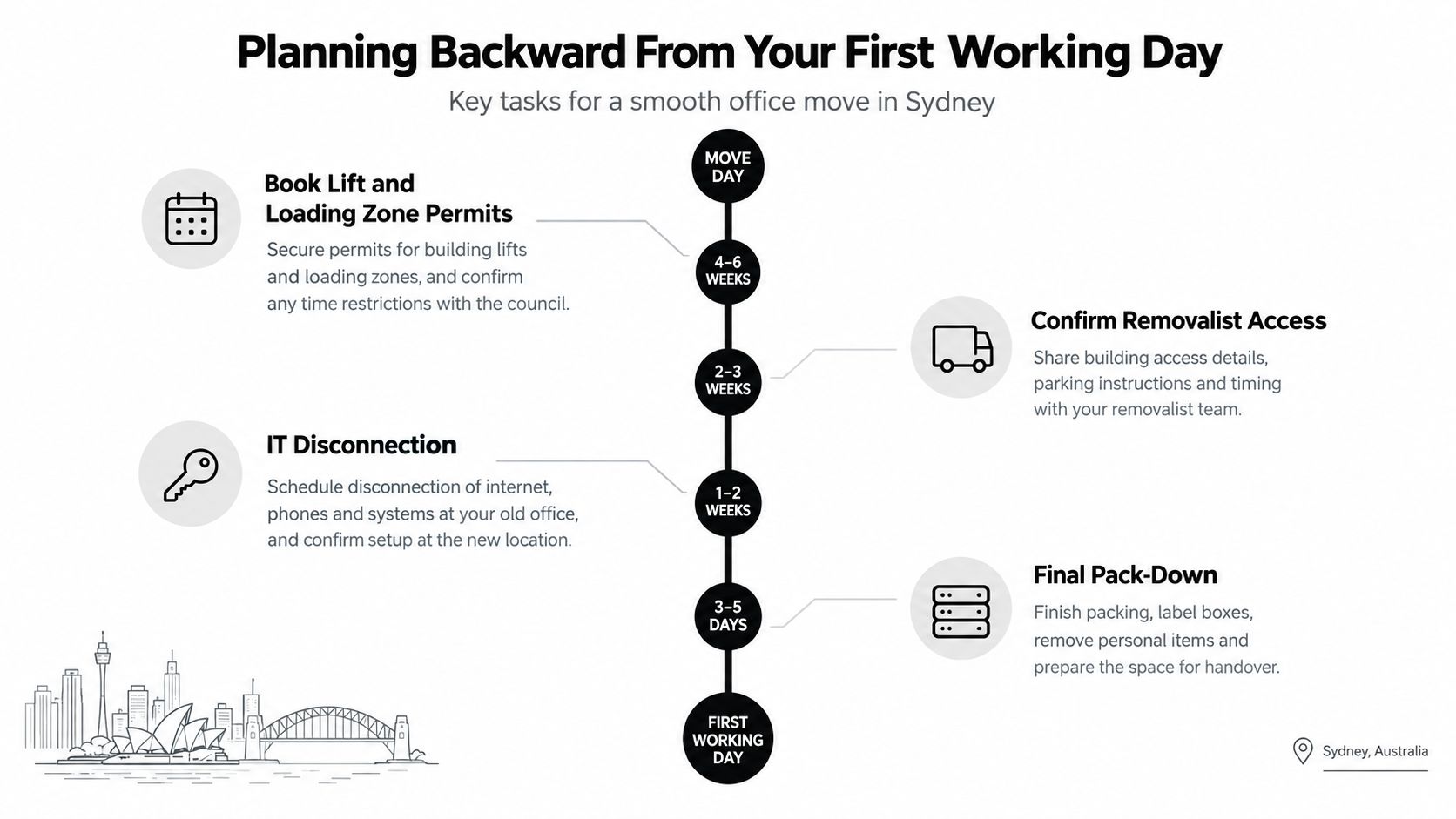
Planning Backward From Your First Working Day
Start with the first morning staff must work productively, then work backwards. If employees need access to desks, phones, printers and shared drives on Monday, the move schedule must leave enough time for delivery, placement, reconnection and testing before that point.
Australian relocation guidance recommends protecting the first working day by confirming building access, lift bookings, loading dock times, utilities, security and cleaning before the truck arrives. It also recommends business address and registry updates 6–8 weeks before the move, with vendor bookings and loading dock arrangements confirmed 2–4 weeks ahead. This Australian office relocation timeline provides a useful planning reference for those dependencies.
Put commercial dates before packing dates
Lease timing controls far more than the move itself. Office relocation guidance notes that businesses commonly relocate about every 7 years, while fit-outs can take 6–12 weeks on site plus 4–8 weeks for design and approvals. The Australian office relocation guide from COS explains why a late fit-out decision can push the physical move into a dangerous gap between lease obligations and operational readiness.
Sydney tenants also face a constrained property market. Australian office leasing enquiry volumes were up 19% in H1 2026, and market commentary says limited new supply until 2028 is encouraging tenants to secure space early. Sydney net effective rent growth was 10.2% over the year to Q1 2026, with no new Sydney completions forecast in three of the next five years. CBRE's Sydney office market commentary puts the lease-driven risk into context. These are market conditions, not reasons to rush, but they are strong reasons to start the relocation decision before the desired moving Friday.
Build a confirmation calendar
Give every item an owner, deadline and proof of completion. The confirmation should be an email, booking reference, signed approval or test result, not a verbal assurance.
- Building access: Confirm lift protection, access cards, dock times, security procedures and loading routes at both premises.
- Utilities and connectivity: Record the electricity, internet, phone and cleaning cut-over dates, then assign a person to verify each service.
- Furniture and packing: Schedule dismantling, crate delivery, labelling, disposal and reassembly separately.
- IT: Set the shutdown window, transport method, rebuild sequence and testing owner.
- Stakeholder updates: Notify staff, clients, banks, suppliers and registries before the move, then repeat the new address after occupancy.
A good calendar exposes clashes early. A poor one lists “book movers” and assumes the rest will resolve themselves.
Running the Day With Clear Roles and Responsibilities
The smoothest office moving day has three named leads, even when one person performs more than one role. Without that separation, everyone assumes someone else has checked the dock, collected the keys or tested the network.
The three leads
The move supervisor owns the building relationship. They collect keys or access cards, confirm the dock and lift, speak with strata or security, keep the snag list and decide when a loading stage can proceed.
The removalist lead controls the physical sequence. They brief the crew, set the truck zones, direct furniture disassembly and ensure labels match the destination floor plan. They should also be the person who stops unsafe or unauthorised loading rather than allowing the crew to improvise.
The IT lead controls technology. They coordinate workstation shutdown, server power-down, phone cut-over, network equipment transport and testing at the new site. IT shouldn't be treated as a final unpacking task because a misplaced switch or missing patch lead can hold up an entire department.
For a more detailed continuity approach, use this guide on minimising downtime during an office move in Sydney.
A practical day sequence
| Time | Move supervisor | Removalist lead | IT lead |
|---|---|---|---|
| 7 am | Walks both access routes, checks keys, lift protection and dock clearance | Inspects truck, tools, labels and loading order | Confirms shutdown status and secures the technology area |
| 8 am | Keeps the building contact informed and manages the snag list | Starts priority furniture and crate loading | Supervises equipment shutdown and separates sensitive items |
| 11 am | Confirms old-site exit checks and receiving readiness | Secures the load and travels with the inventory | Travels or monitors the transport plan, depending on equipment |
| 1 pm | Releases the new dock and directs floor access | Unloads by destination and protects common areas | Starts the rebuild in parallel with furniture placement |
| 3 pm | Resolves access issues and updates stakeholders | Reassembles priority workstations and shared furniture | Tests network, phones, printers and core systems |
| 5 pm | Leads the final walkthrough and sign-off | Confirms inventory, damage notes and completed placement | Gives the technical sign-off or records open faults |
Keep the schedule visible at the old site and new site. The supervisor should update it when the truck is delayed, the dock is occupied or a lift restriction changes the sequence. A short, factual update prevents staff from creating their own version of the plan.
IT, Servers and Workstations on Moving Day
A server rack arriving before its cooling, network or power setup is ready can hold up the whole Sydney move. Treat each technology group according to its owner, handling risk and test conditions. Give every workstream a pre-move action, a transport action and a clear verification result.
| Workstream | Pre-move task | Day-of task | Verification |
|---|---|---|---|
| Server and data centre relocation | Photograph cabling, record rack elevations and document switch port maps | Shut down in sequence, protect hardware and transport patch leads in labelled crates | Confirm power, cooling, network reachability and service availability |
| Workstations | Asset-tag monitors, docks and peripherals, then photograph cable layouts | Pack screens and accessories separately by desk or department | Confirm login, display output, keyboard, mouse and local peripherals |
| Telephony and VoIP | Confirm the telco window, handset list and call-routing plan | Power down handsets and reconnect them after network services are ready | Test internal calls, external calls and VoIP registration |
| Printers and shared devices | Record device locations, network settings and consumables | Move devices upright with trays and accessories protected | Reassign or confirm printer access and run a test print or scan |
Protect the server room and network rebuild
Create an asset register before disconnecting anything. Include serial numbers, rack positions, cable labels and photographs. A rack elevation and switch port map gives the rebuild team a reliable reference when equipment reaches the new comms room.
Confirm after-hours access with building management, including riser rooms, restricted plant areas and loading routes. Heavy UPS units may need a dedicated lift booking and a different handling method from ordinary office furniture. The available dock and lift window also matters. A truck delay can shorten the time available for a controlled shutdown, so coordinate telco and cloud cut-over windows with building access, not only the removalist's arrival.
Teams changing hosting arrangements during the relocation should plan a compliant data migration separately from the physical move. Keep data integrity, access controls and continuity decisions outside the furniture schedule. For practical handling of servers and workstations, use this office equipment relocation guide.
Rebuild in parallel, verify before release
Use anti-static protection where suitable, and place every patch lead, power cable and small accessory in a labelled crate. A loose bag marked “miscellaneous” creates avoidable delays. At the new office, IT can rebuild the network and server environment while the removalist places desks in their final positions.
Staff return only after the technical checks are complete. The IT lead should record ping tests, VoIP registration, printer access, workstation login and shared-drive availability, then issue a named sign-off. Put open faults on the snag list with an owner and next action. A workstation that powers on but cannot authenticate is still unavailable.
Furniture, Packing and Sydney Loading Zone Rules
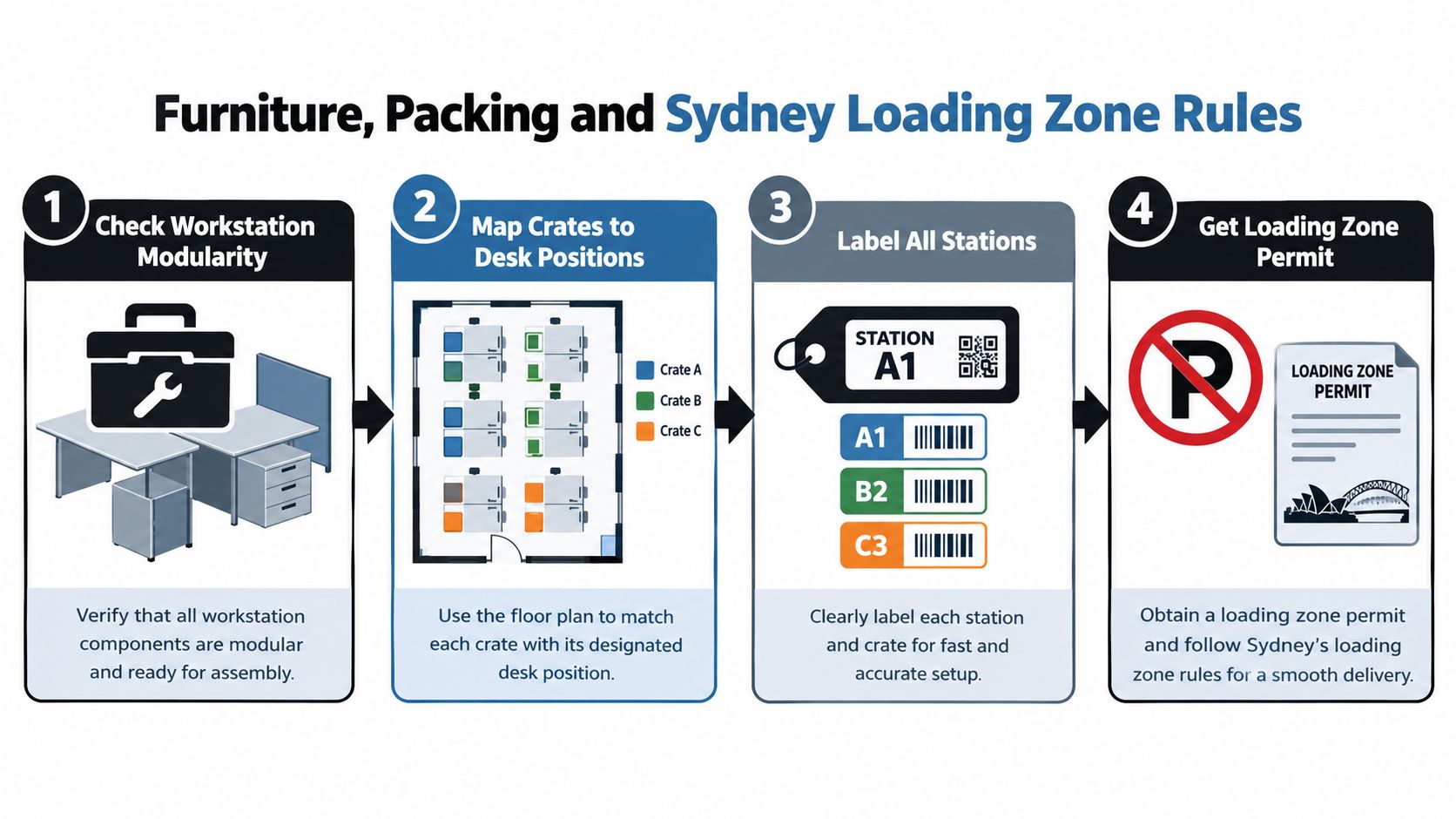
Furniture should leave in an order that supports the new floor plan, not in the order that makes the old office look empty. Begin with a modularity check. Some workstations separate cleanly at the frame, while others need panels, brackets and cable trays removed in a particular sequence. Photograph unusual assemblies before dismantling and place fixings in bags labelled with the workstation number.
Use a colour-coded floor plan that connects each crate, desk and chair to a destination position. A label such as “Finance, desk 14, east wall” is more useful than “Box 32”. Apply the same code to monitors, docking stations, pedestals, whiteboards and glass-top desks.
Pack the awkward items first
Monitors need corner protection and should be separated from loose metal hardware. Glass-top desks need edge protection and a stable vertical position where the mover's handling method allows it. Whiteboards should be wrapped so the writing surface doesn't rub against brackets or other boards.
Small items cause disproportionate delays:
- Cables and adapters: Use individual cable bags or department crates, with destination labels visible.
- Keyboards and mice: Keep them with the assigned workstation rather than putting them into a general IT carton.
- Lock cylinders and keys: Record who holds them and which cabinet or pedestal they operate.
- Signage: Remove door signs, reception panels and directional signs carefully, then group them by installation location.
Treat kerbside space as regulated, not spare space
In NSW, a goods vehicle may stop in a loading zone for up to 30 minutes while actively picking up or dropping off goods. NSW parking rules make clear that this isn't general parking. The vehicle must be built to carry goods, and the stop must be for loading or unloading.
The City of Sydney also confirms the 30-minute goods-handling window and describes controlled loading zones as spaces reserved under NSW road rules for goods vehicles. The City of Sydney central Sydney parking policy is useful when coordinating arrival in a busy street. Check the signs and building requirements rather than assuming a loading zone can replace a booked dock.
Truck size matters too. The City of Sydney doesn't provide business parking permits for trucks or buses exceeding 3.5 tonnes gross vehicle mass. The City's business parking permit guidance sets that threshold, so confirm the vehicle, street, dock and permit pathway before finalising the fleet.
Load heavy furniture and protected equipment according to the removalist lead's plan, with priority items accessible for the first unload. The move supervisor keeps the dock clear, watches the booking clock and prevents a parked vehicle from turning an active loading operation into a street obstruction.
Insurance, Removalists and Compliance in NSW
A removalist's insurance does not automatically cover your office contents. NSW consumer guidance says removalists are not legally required to provide insurance for property during a move, so the business should arrange suitable protection. NSW guidance on choosing a removalist notes that AFRA-accredited removalists may hold public liability insurance and can offer transit insurance for goods, including storage cover where required.
That distinction matters for servers, fragile screens, specialist equipment and items packed by staff. Review insurance for removalists to compare carrier liability with full-value protection, then ask the removalist what the policy covers, who is insured and which exclusions apply. Confirm whether cover applies to goods in transit, temporary storage, handling, installation and the wider relocation activity.
Separate the cover types
Carrier liability usually concerns the operator's responsibility under the contract and applicable law. It may not provide full replacement protection, particularly where declared values, packing conditions, exclusions or client handling affect a claim.
Full-value protection is based on the repair or replacement value of listed goods, subject to the policy terms. It may suit expensive hardware, specialist furniture and equipment that would be difficult to replace quickly.
Contractor's all-risk cover can address risks during handling, installation and reconfiguration. The wording determines whether it includes data, pre-existing defects, temporary storage and client-packed goods.
Check the removalist's certificate of currency, subcontractor arrangements, public liability limits and responsibility for reassembly. The written quote should identify the work included, access assumptions, exclusions and possible additional charges. Keep the contract, inventory and insurance documents together for the move coordinator and facilities team.
Record condition before the truck leaves
Use condition reports for valuable furniture and technology. Photograph existing marks, seal sensitive crates where appropriate, and record driver details, vehicle details and the time each item leaves and arrives. Report incidents while the facts are clear, with photographs and the relevant inventory reference.
The practical choice is straightforward:
- Self-insure: Use this only if the business can absorb repair, replacement and downtime costs without disrupting operations.
- Upgrade cover: Select broader protection for high-value, fragile or business-critical equipment.
- Negotiate: Confirm exclusions, packing responsibilities, storage periods and reconfiguration work before accepting the quote. Insist that agreed changes appear in writing.
Post-Move Checks and Next Steps
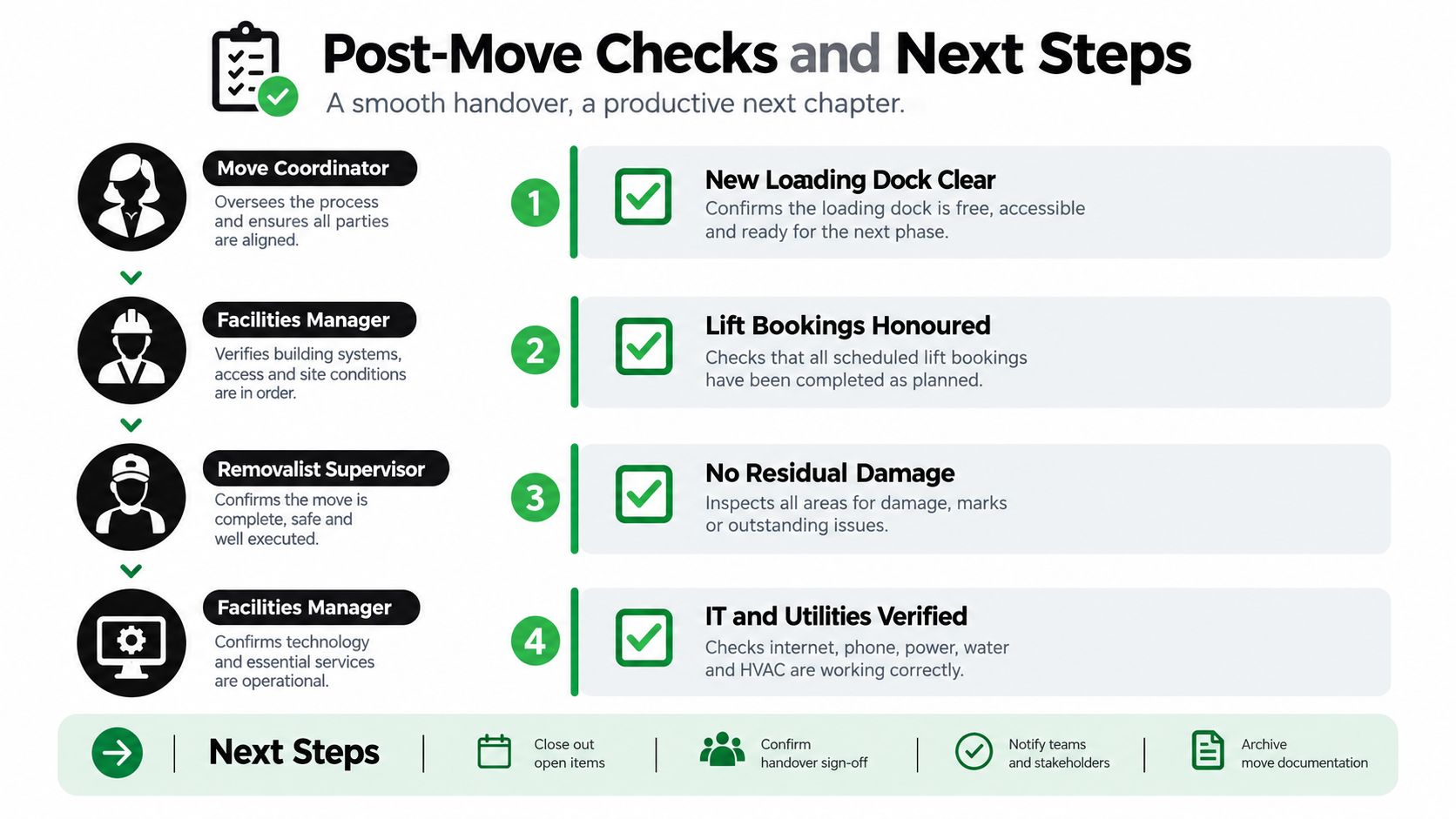
The truck leaving the site isn't the finish line. The move coordinator, facilities manager and removalist supervisor should complete the final walkthrough together while access to the crew, inventory and building contacts is still available.
Start outside and work inwards. Check that the new loading dock is clear, the lift booking was honoured, protective materials have been removed and no council property or common-area fixtures were damaged. Then walk the office room by room with the floor plan and inventory.
Use a live snag list
Record each issue with a location, photograph, owner and action. Separate urgent operational faults from cosmetic work so the team can restore service first.
- Missing items: Compare crates, desks, chairs and equipment with the inventory before the removalist signs off.
- Damage: Photograph furniture, walls, doors, lifts and flooring before the crew departs.
- IT gaps: Test workstation login, shared drives, printers, scanners, Wi-Fi access and phone calls.
- Facilities faults: Check lighting, power, access cards, security, cleaning, meeting-room equipment and signage.
- Placement errors: Match desks and storage to the approved floor plan, then record any requested changes rather than moving items repeatedly.
The IT lead should verify that printers map to the network and that phone lines work with external calls, not just internal extensions. The facilities manager should confirm utilities and security. The removalist supervisor should acknowledge damage or missing-item records before the crew leaves.
Update the address and keep the follow-up visible
Update the business address with ASIC, the ATO, the ABR, banks, suppliers and Google Business Profile within 48 hours. Also review invoices, email signatures, website contact details, delivery instructions, directories and building reception information so customers and couriers don't keep arriving at the old premises.
Submit insurance notifications promptly when damage is identified. Keep copies of photographs, inventory sheets, incident notes and correspondence. Schedule a 7-day follow-up with the three leads to close outstanding snags, review the floor layout and confirm that the first week has not exposed a hidden access, IT or furniture problem.
For Sydney businesses, Home Removals Sydney offers office removals with packing, furniture dismantling and reassembly, IT equipment handling, labelling and flexible after-hours or weekend scheduling. Request a custom quote through Home Removals Sydney and discuss your building access, truck requirements and first-working-day deadline before the schedule is locked.
