


A typical three-bedroom interstate move from Sydney generally costs A$5,500 to A$10,000. The final price isn't set by the number of bedrooms alone, because cubic volume and route distance usually matter more than the label on your floor plan.
You may be staring at a half-packed lounge room, comparing removalist quotes on your phone while also trying to line up settlement dates, school arrangements, pets and time off work. That uncertainty is normal, but a suspiciously cheap estimate won't make the move affordable. It usually means the quote hasn't captured the volume, access conditions or transport distance properly.
For Sydney homeowners, renters and businesses, the sensible way to budget is to separate the move into three parts: the volume of goods, the distance between properties, and the services required on moving day. Once those variables are clear, interstate removals become much easier to compare.
Realistic Interstate Moving Price Ranges
Budgeting for an interstate move is difficult when one website quotes a few thousand dollars and another suggests a much higher figure. The difference often comes from the size of the home, the amount of furniture being transported and whether the estimate includes packing, insurance, storage or other services.
For a practical starting point, broader Australian market guidance places interstate moving costs at the following levels: a studio or one-bedroom move often falls between A$2,000 and A$4,000, a two-bedroom move between A$3,500 and A$7,000, a three-bedroom move between A$5,500 and A$10,000, and a four-bedroom or larger home between A$8,000 and A$15,000. These benchmarks are published in the interstate moving cost guide.
Those figures are useful for planning, but they aren't a quote. A lightly furnished three-bedroom rental may occupy less truck space than a full two-bedroom apartment packed with large wardrobes, outdoor furniture and stored boxes. A family with a piano, workshop equipment or extensive shelving can also move well beyond the typical volume for their home size.
Use the ranges as a budget filter
If you're moving from Sydney to another state, treat the relevant range as a budget filter, not a promise. A quote at the very bottom of the range deserves careful checking. Ask whether it includes loading, unloading, transit, fuel, tolls, stairs, long carries, packing and insurance.
A transparent interstate moving cost calculator can help you build a more realistic first estimate by considering the route and the amount you're taking. It won't replace a properly assessed inventory, but it can show whether your savings plan is broadly sensible before you start booking services.
Practical rule: If a quote is dramatically lower than the market range for your home and route, ask what the mover has left out before you compare it with other offers.
Families often make the mistake of budgeting only for the truck. The actual relocation may also involve packing materials, temporary storage, cleaning, furniture assembly, pet transport and travel for the household. If your car is travelling separately, researching transparent flat-rate auto transport from National Car can help you assess that part of the move without mixing vehicle costs into the removalist estimate.
The best budget is the one that reflects what you are moving. Count the contents, not just the bedrooms.
How Distance and Volume Drive Your Final Bill
Professional removalists don't price an interstate job by bedroom count alone. They look at the amount of truck space required, the route, the access at both properties and the labour needed to handle the load.
That is why a compact two-bedroom apartment can cost more than a sparsely furnished three-bedroom house. The apartment may contain dense furniture, packed storage cupboards and bulky items that consume more cubic space. A larger home may cost less than expected if the owners have already sold, donated or left behind much of its contents.
Cubic metres are the useful measurement
Cubic metres describe the physical space your belongings occupy in the truck. Sofas, beds, bookcases, appliances, boxes and outdoor items all contribute to that total. Every extra item has a freight consequence, particularly when it prevents the load from being stacked efficiently.
Recent Australian data places per-cubic-metre pricing at roughly $150 to $190 per m³ for routes under 1,000 km, rising to about $230 to $290 per m³ for routes over 3,000 km. The figures are outlined in this Australian interstate removalist cost analysis. Longer routes cost more because the truck travels further, consumes more fuel and may face a greater risk of returning without a useful backload.
For route context, the following benchmarks use average home volumes and route-specific estimates from an Australian pricing guide covering interstate removalists in Sydney and other cities:
| Route | Estimated volume | Typical cost range | Approx. cost per m³ |
|---|---|---|---|
| Sydney to Melbourne | 13.6 m³ | A$1,550 to A$1,850 | About A$130 to A$135/m³ |
| Sydney to Brisbane | 18.3 m³ | A$2,000 to A$2,400 | About A$130 to A$135/m³ |
| Perth to Sydney | 17.5 m³ | A$2,500 to A$2,950 | About A$169/m³ |
These interstate removalist route benchmarks show why a longer route can cost more even when the estimated volume is similar. Perth to Sydney involves a substantially longer linehaul, with fuel, driver time and backhaul conditions affecting the rate.
Ask how the estimate was built
Before accepting a quote, ask the removalist to explain:
- Estimated volume: How many cubic metres has the team allowed for?
- Truck allocation: Is the vehicle dedicated, shared or based on available space?
- Route assumptions: Does the price account for the exact suburbs, tolls and delivery conditions?
- Inventory changes: What happens if the final load is larger or smaller than estimated?
Use a cubic metre calculator to prepare an inventory before requesting quotes. Measure large furniture, list appliances and count packed boxes. You don't need perfect measurements, but a considered list is far more useful than saying, “It's a normal three-bedroom home.”
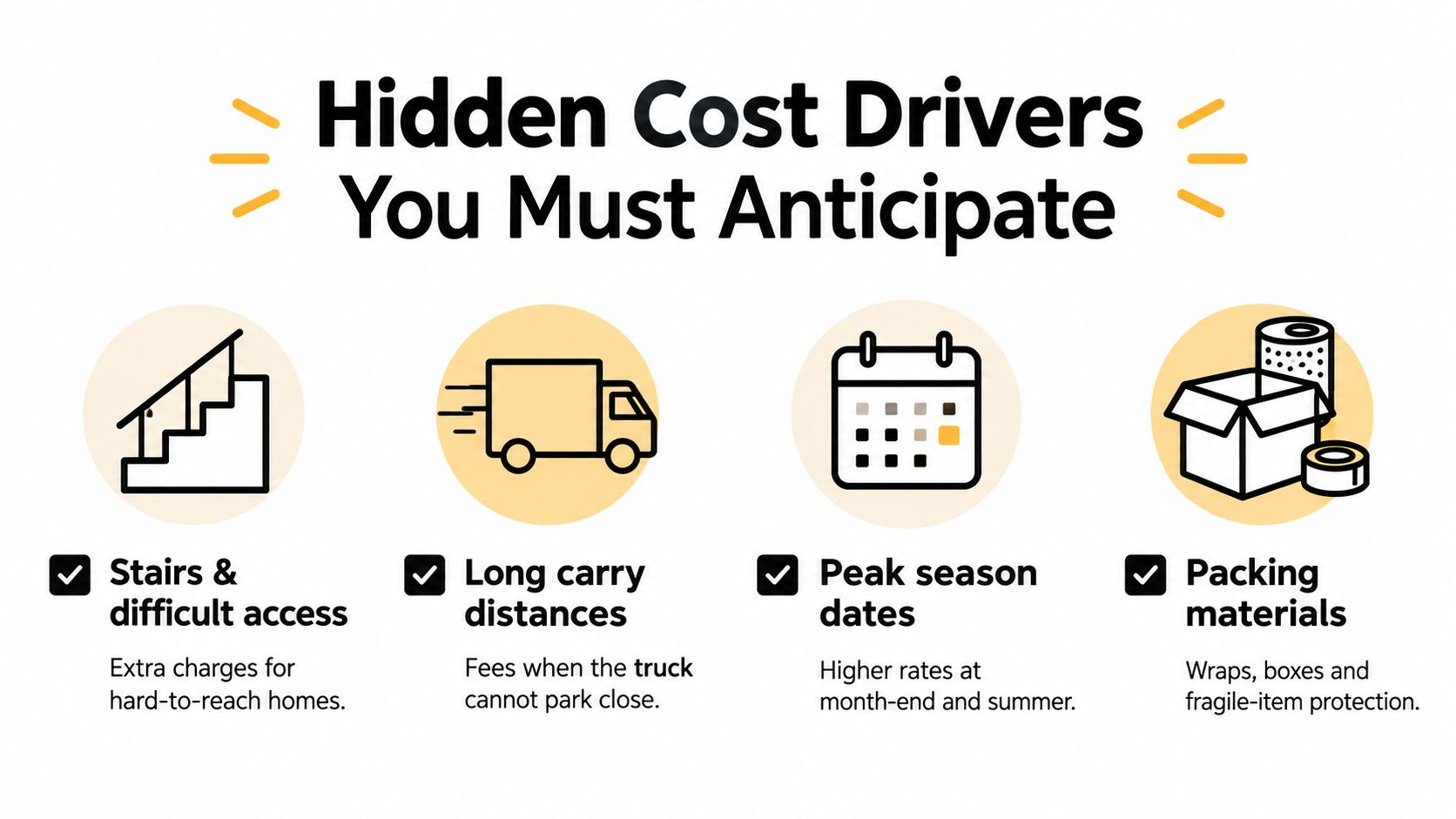
Hidden Cost Drivers You Must Anticipate
The linehaul rate is only one part of an interstate moving bill. The final cost also reflects access, labour time, equipment and the way the removalist measures your volume. A transparent hourly or cubic metre estimate should show how route conditions and handling requirements affect the price.
Sydney access causes many avoidable surprises. A truck may not stop outside a terrace, apartment building or steep suburban driveway. Narrow stairwells, lift booking restrictions, security gates and long carries from the kerb add handling time during both loading and delivery.
Check the property before moving day
Walk through both properties and record anything that could slow the crew or require extra equipment. Give the removalist these details:
- Stairs and difficult access: Include internal staircases, external steps, narrow hallways and steep driveways.
- Parking limitations: Mention loading zones, apartment restrictions and whether a parking permit may be needed.
- Long carry distances: Explain if the truck must park away from the entrance or if goods must pass through shared areas.
- Ferry or restricted-route requirements: Flag island, rural or difficult-access destinations early so the route can be planned accurately.
Parking arrangements matter in dense Sydney suburbs. If the truck cannot park near the door, each item takes longer to carry. That is a labour cost, not an arbitrary surcharge. Ask whether the estimate allows for that time, or whether it changes the quoted hourly rate or cubic metre calculation.
Specialty goods create a separate cost category. Pianos, antiques, artwork, heavy safes, commercial equipment and fragile glass may need extra protection, specialised lifting or custom crating. Provide photographs and dimensions instead of assuming these items fit a standard household allowance.
Confirm inclusions in writing
Packing materials, wrapping, dismantling, reassembly, storage and insurance should appear clearly in the quote. Read this guide to hidden costs of moving for expenses beyond the removalists. Ask whether boxes and bubble wrap are supplied, charged separately or available as an optional service.
Ask how timing changes are handled. Last-minute bookings, tight settlement windows and peak moving dates can reduce scheduling flexibility and create extra labour or storage requirements. The quote should state its assumptions, exclusions and approval process before any additional work begins.
Comparing Fixed Quotes and Transparent Hourly Rates
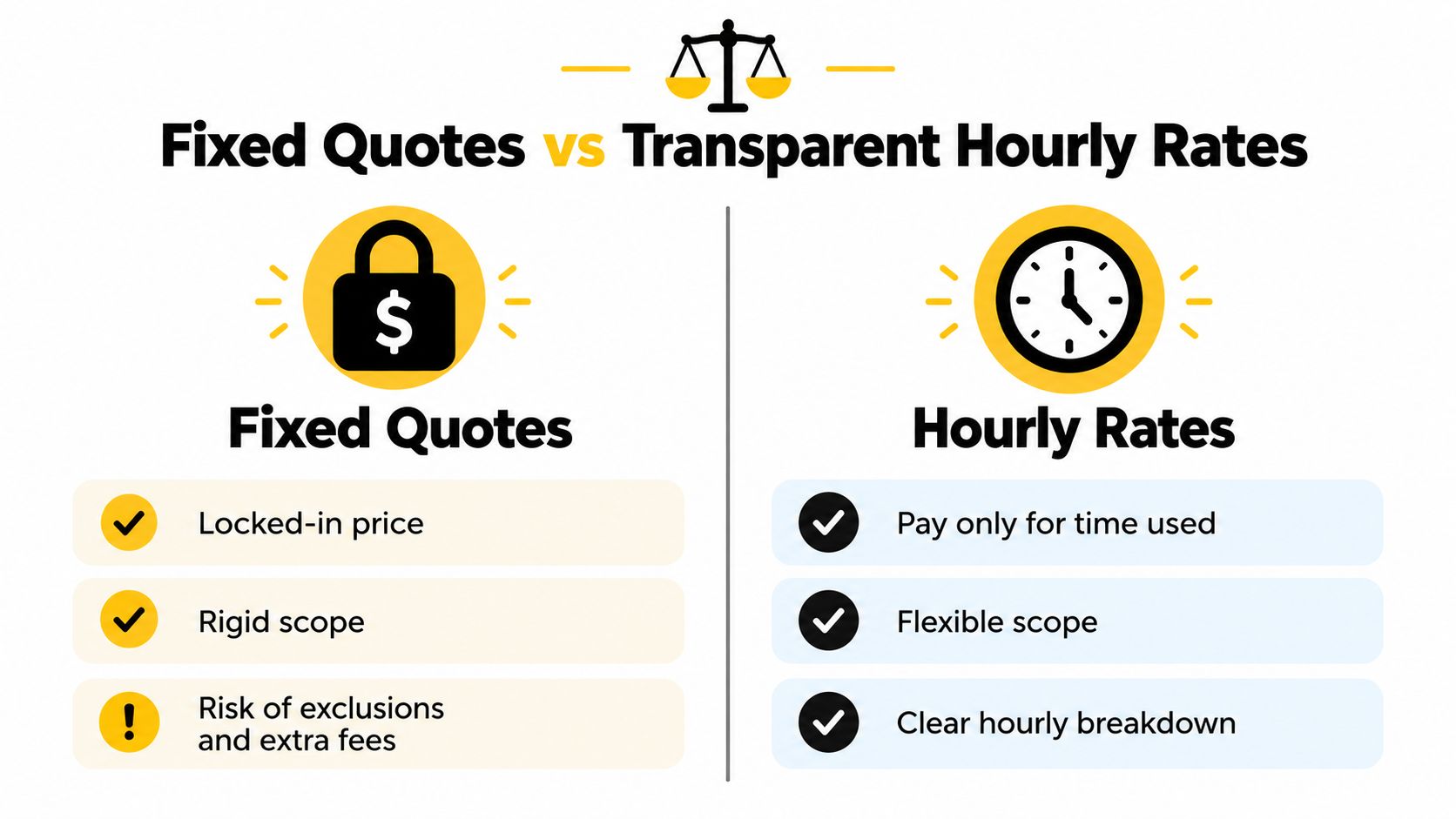
A fixed quote looks simple because it presents one figure. The problem is that a fixed figure can hide the assumptions behind it. If the mover hasn't inspected access, verified the inventory or clarified the delivery conditions, the “fixed” price may protect the provider more than it protects you.
An hourly or volume-based model gives you a different kind of transparency. You can see the labour component, understand what the team is doing and adjust the scope by packing some items yourself, removing unwanted furniture or adding help when speed matters.
Fixed pricing can still be appropriate
A fixed quote works well when the mover has accurate information and clearly defines the scope. For example, you may prefer a locked price for a straightforward move where the inventory, access, packing requirements and delivery timing have all been confirmed.
The risk appears when the quote uses broad wording. Check for clauses covering stairs, waiting time, extra items, disassembly, difficult access, storage, tolls and changes to the delivery date. A low headline price can become expensive if every practical detail sits outside the base scope.
Hourly pricing rewards clarity
Transparent hourly rates are useful for the Sydney loading or unloading component, particularly when the work can be measured by crew size and time. The interstate transport itself should still be explained through route and volume assumptions, rather than hidden inside an unexplained lump sum.
Ask for a written breakdown showing:
- Crew size: How many removalists will attend, and what work will they complete?
- Time basis: When does the clock start and stop?
- Travel treatment: Are travel, tolls or vehicle charges separate?
- Volume basis: How has the interstate freight component been calculated?
- Change approval: Who authorises additional work if conditions differ?
A direct conversation with the actual removalist team usually gives you better information than a generic online form passed between brokers. The right comparison isn't fixed price versus hourly price. It's clear scope versus unclear scope.
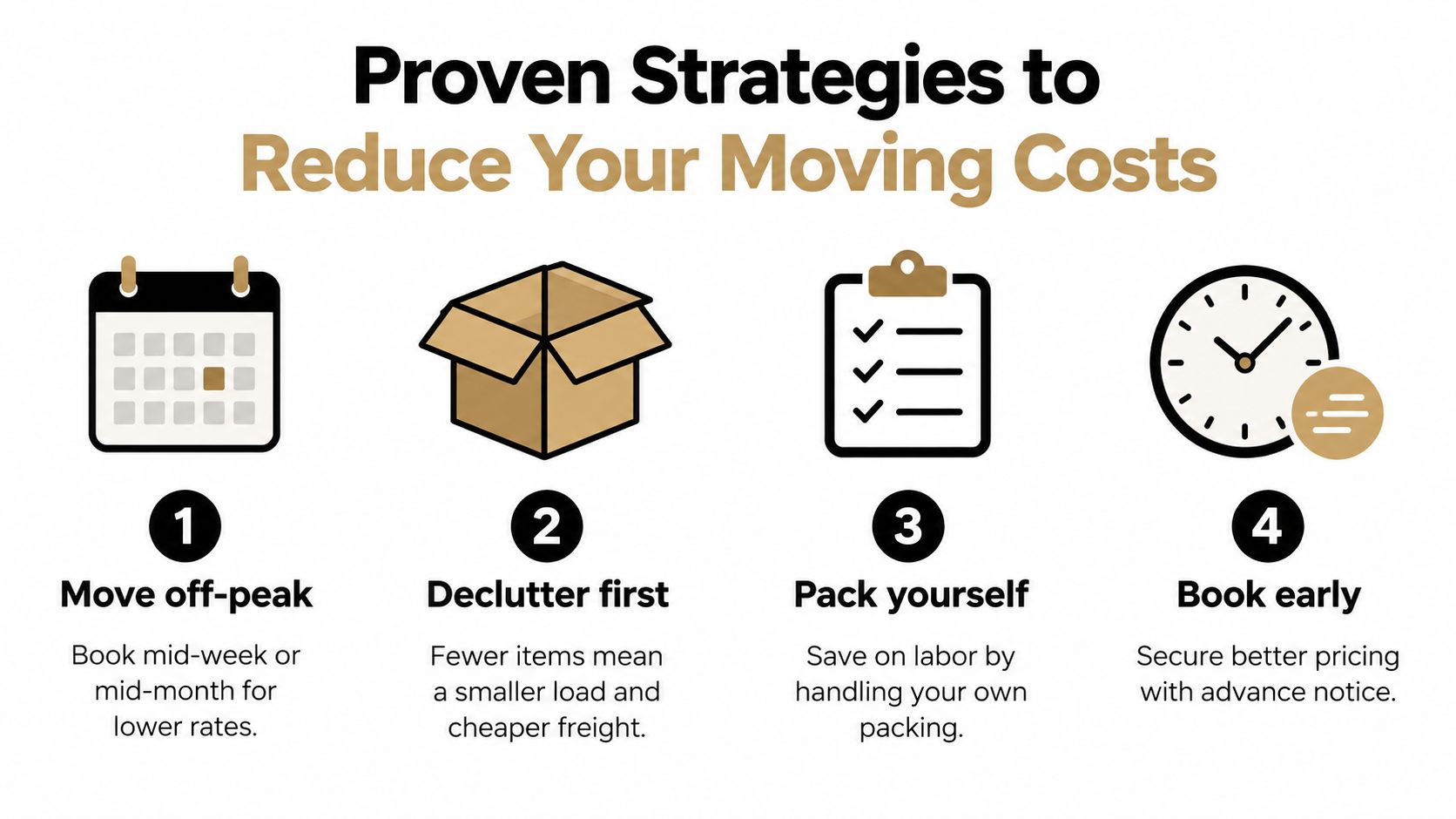
Proven Strategies to Reduce Your Moving Costs
The cheapest move isn't always the one with the lowest advertised rate. It is the move that controls volume, avoids preventable labour and doesn't create a second bill through damaged goods, rushed packing or unnecessary storage.
Start with the items you won't use in the new home. Sell, donate or dispose of unwanted furniture before the removalist assesses the load. Reducing a bulky bookcase or spare room contents can be more valuable than arguing over a small difference between quotes, because a smaller load may require less truck space and less handling.
Make the move easier to price
Use a simple inventory with three categories:
- Taking: List furniture, appliances, boxes and special items that must travel.
- Selling or donating: Remove these goods before the quote or site assessment.
- Deciding later: Resolve uncertain items before moving day, not while the truck is waiting.
Pack ordinary, non-fragile items yourself if you have the time and can label every box clearly. Leave heavy furniture, awkward appliances, fragile pieces and complex disassembly to trained removalists. A mixed-service move often gives you more control without forcing you to manage the most hazardous work.
Choose dates strategically. Mid-week and mid-month bookings can offer more flexibility than busy weekends, month-end settlement periods or high-demand holiday windows. You should also avoid building the entire move around a single narrow delivery date unless settlement requires it, because inflexible timing can create extra handling or storage requirements.
Keep packing organised
Use consistent labels showing the room, contents and whether a box is fragile. Keep screws, brackets and remote controls in clearly marked bags attached to the relevant item. Photograph valuable or delicate goods before loading, and make a separate essentials box for the first night.
Cleaning deserves attention too. A practical collection of move-in cleaning insights from Top Cleaners can help you organise the old and new properties without leaving the work until the final hours.
The following video can also help you think through the practical preparation involved in moving:
Book early enough to discuss access, inventory and timing properly. Advance planning gives the removalist more opportunity to match the right vehicle and crew to the job, rather than forcing a rushed solution.
Securing a Tailored Quote with Home Removals Sydney
A useful quote begins with accurate information. Don't submit only a suburb, destination and number of bedrooms, then expect the removalist to predict the contents of your home. List the large items, describe access at both addresses and identify anything requiring extra care.
Home Removals Sydney uses a short online form that takes about 60 seconds to complete, with responses within 30 minutes during business hours. That gives you a fast starting point, but you should still provide enough detail for the team to assess volume and logistics properly.
Prepare the information the estimator needs
Have these details ready:
- Collection and delivery suburbs: Include the state, property type and access conditions.
- Inventory: List beds, lounges, dining furniture, appliances, boxes and outdoor items.
- Special handling: Identify pianos, antiques, artwork, safes, pallets or commercial equipment.
- Service level: State whether you need packing, unpacking, furniture assembly or labour only.
- Timing: Provide your preferred dates and explain any settlement or lease deadlines.
- Storage needs: Mention whether collection and delivery dates don't align.
A custom quote should explain what the price includes. Confirm whether professional packing, boxes, bubble wrap, transit protection, furniture assembly and additional removalists are available. If you want the loading completed faster, adding crew can change the labour plan, but the decision should be discussed before the booking is confirmed.
Secure storage can also prevent a settlement mismatch from turning into a crisis. Ask about storage access, handling arrangements and the process for releasing goods when your new property is ready. Options with 24/7 access can be useful for customers who need controlled access during a staged relocation.
Compare the answer, not just the price
When quotes arrive, place them side by side. Compare the volume allowance, vehicle type, crew, packing scope, access assumptions, insurance, storage terms and payment conditions. A quote that explains its method gives you a better chance of staying within budget than one that offers only a low total.
Plan Your Stress-Free Interstate Relocation Today
The answer to “how much does it cost to move interstate” depends on the load you take and the road it travels. Bedroom count gives you a starting point, but cubic metres, route distance, access and service extras determine whether the final figure stays near the lower end or moves towards the upper end of the range.
Sydney customers should be especially careful with access details. Apartment lifts, terrace staircases, narrow streets and limited kerb space can affect the loading time even before the truck leaves NSW. Businesses also need to account for office furniture, warehouse stock, pallets, equipment, document handling and downtime when comparing office relocations or furniture removals.
Choose transparency over an attractive guess
A dependable interstate removalist should be willing to discuss:
- The load: What is being moved, and how much space will it occupy?
- The route: What distance, tolls, fuel conditions and delivery requirements apply?
- The service: Who packs, loads, transports, unloads and assembles the goods?
- The exceptions: What happens with stairs, long carries, storage, delays or extra items?
- The protection: How are fragile, valuable and specialised items handled?
A modern fleet can support different job sizes, from a small apartment through to a family home, office or warehouse relocation. That flexibility matters when your inventory changes during decluttering or when a business needs pallets and equipment moved alongside furniture.
Don't choose a mover solely because an online estimate looks cheap. Choose a team that gives you a clear basis for the estimate, answers questions directly and records the assumptions before moving day. You should know what you're paying for, what could change and who will contact you if the plan needs adjusting.
Homeowners, renters and businesses can make the process far less stressful by preparing an inventory, reducing unwanted volume, checking access and requesting a custom quote before dates become urgent. The earlier you clarify those details, the easier it is to select the right combination of packing, labour, transport and storage.
Home Removals Sydney provides Sydney and interstate relocation support with volume-based planning, professional packing, furniture assembly, secure storage and handling for household or business items. Request an obligation-free quote through Home Removals Sydney, share your inventory and route, and get a clear plan for moving your goods without hidden surprises.
