

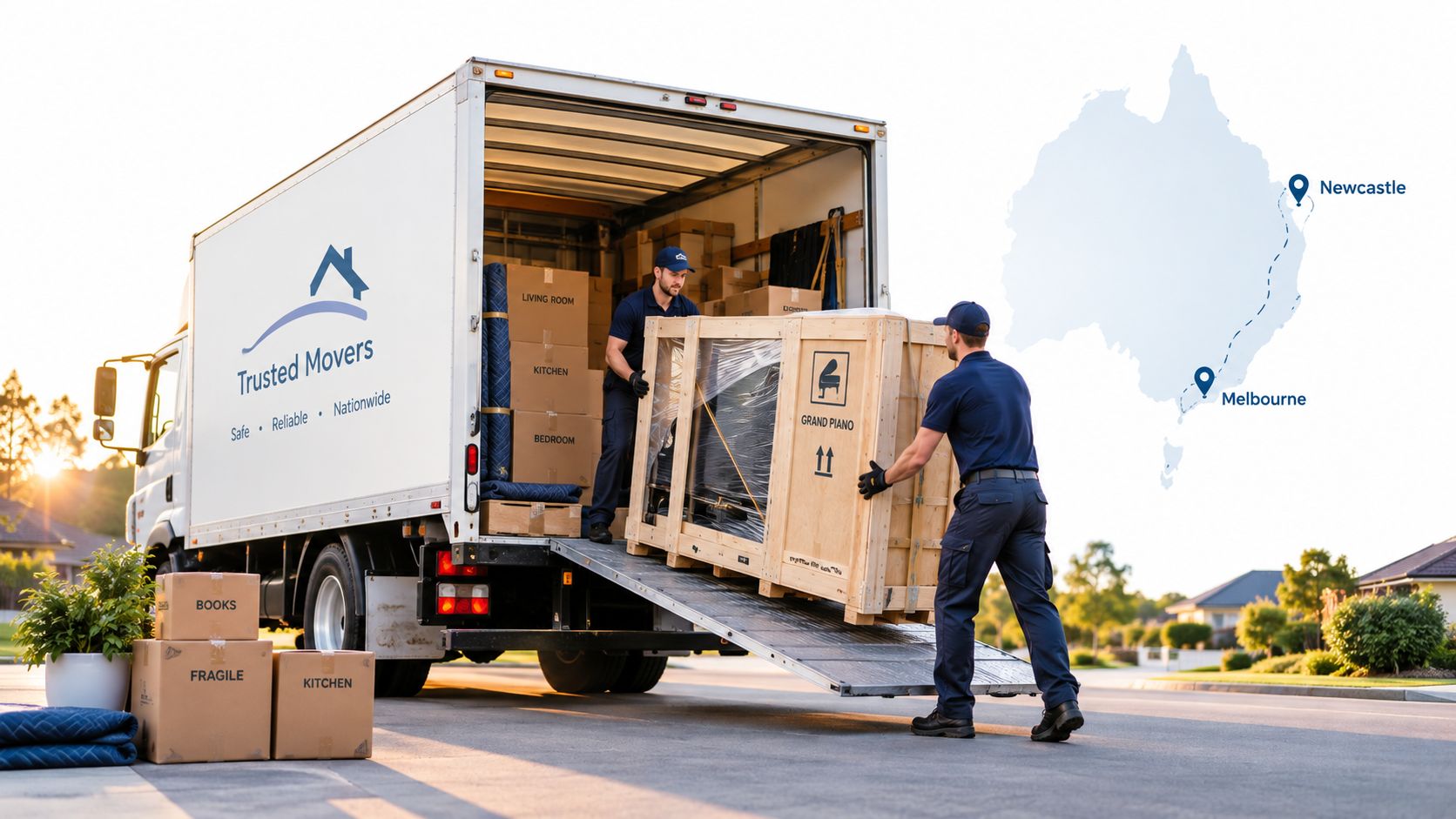
The boxes are half-packed, the Newcastle lease ends on Friday, and the Melbourne keys may not be available until the following week. Then the cheapest quote arrives with a surprisingly small truck, no clear storage policy and vague wording about delivery access. That's when a simple household move starts looking like a logistics problem.
Choosing interstate removalists from Newcastle to Melbourne isn't just about comparing a headline price. Your operator must match the vehicle to the packed load, plan access at both properties, manage a state-border route and protect you against the gap between vacating Newcastle and taking possession in Melbourne. The broader NSW and Victoria relocation market is substantial. In the year ending June 2024, NSW recorded 81,732 interstate arrivals and 112,597 departures, while Victoria recorded 74,731 arrivals and 74,067 departures, according to the Australian Bureau of Statistics population figures.
Why the Newcastle to Melbourne Move Deserves More Than a Quick Quote
A family moving from Newcastle may assume the truck loads at the front door, follows the Hume Highway and unloads in Melbourne. In practice, the Newcastle origin can involve narrow suburban streets, steep driveways, local parking restrictions or a loading point that a large vehicle can't reach. At the other end, a Melbourne apartment may require a booked loading bay, lift protection, a smaller shuttle vehicle or a delivery window set by building management.
The route also covers roughly 1,000 kilometres across NSW and Victoria, so small errors at collection become expensive problems later. A missing inventory item, an oversized wardrobe or a truck that can't turn into the Melbourne street can lead to reloading, extra handling or storage. The right quote reflects those risks before moving day.
Practical rule: Choose the removalist that can explain the vehicle, access plan, delivery window and storage fallback, not merely the one with the lowest number.

A calm plan from confirmation to arrival
If your move is confirmed eight to ten weeks out, start with the inventory rather than cartons. Record furniture dimensions, heavy items, fragile pieces, stairs, lifts, driveway gradients and the likely parking position at both addresses. Send that information to removalists and request a written survey-based quote.
Six to eight weeks before collection, reserve the removalist and confirm whether the move is direct, scheduled within a delivery window or dependent on a shared route. Booking early is wise because truck availability tightens around month-end and end-of-lease periods. At this point, confirm the Melbourne property's settlement, tenancy approval, key collection and building access arrangements.
Four to five weeks out, arrange utilities, redirect mail and check whether you need to update licences, vehicle details, school enrolments or pet transport. Two to three weeks out, declutter, order packing materials and begin with books, seasonal clothing, decorations and other non-essentials. Keep a photo record of valuable goods before wrapping.
During the final week, finish the inventory, label cartons by room and prepare a first-night box with medication, chargers, basic cookware, linen, toiletries and documents. Confirm collection parking in Newcastle and delivery access in Melbourne. If your dates don't align, decide before loading whether storage-in-transit or split delivery is safer than forcing a direct move.
What Actually Drives the Cost of an Interstate Move
A Newcastle to Melbourne quote should reflect volume, packed mass, travel, labour and access, not just the number of bedrooms. A two-bedroom home filled with books, tools and appliances can place more pressure on the truck than a larger home with lightly furnished rooms. Stairs, long carries, narrow driveways, lifts, parking permits, packing services and special handling all change the labour required.
Be wary of a low hourly rate that excludes interstate travel, fuel levies, GST, waiting time, storage, redelivery or difficult access. A quote can look cheap until the crew spends extra time carrying goods from a distant parking point or waits for a Melbourne loading bay. Compare written quotes line by line, using the same inventory and access information. This guide to interstate moving costs in Australia is useful for understanding which inclusions to check.
| Cost driver | Why it matters | How to manage it |
|---|---|---|
| Packed volume and mass | Determines vehicle suitability and legal loading limits | Supply an itemised inventory with heavy goods identified |
| Distance and route | Influences line-haul planning, fuel and delivery scheduling | Confirm whether the quote includes direct transport |
| Access at both ends | Stairs, lifts, parking and narrow streets increase handling time | Provide photos, measurements and building requirements |
| Packing and protection | Fragile or valuable items need additional labour and materials | Decide whether to self-pack, use partial packing or book full packing |
| Storage and redelivery | A move-in delay can create separate handling and access charges | Get storage, redelivery and waiting terms in writing |
| Special items | Pianos, artwork, safes and antiques need suitable equipment and crew | List them separately during the survey |
A realistic Australian quote for a two- or three-bedroom home should be treated as a customized logistics estimate, not a universal room-based price. The cheapest quote is usually the least useful when it leaves key assumptions unstated.
Choosing the Right Vehicle and Crew for the Job
The vehicle should fit the load and the addresses. It shouldn't be selected just because a larger truck sounds more economical.
A 4-tonne-class vehicle can suit a smaller household or a carefully measured residential consignment. A 6 to 12-tonne rigid truck is often the practical middle ground for a typical two- to four-bedroom Newcastle home, especially when access is straightforward. Larger articulated combinations make sense for high-volume household moves, offices or warehouse stock, but they can create access and compliance problems that outweigh the benefit of fewer trips.
Australian heavy-vehicle guidance generally limits standard heavy vehicles to 2.5 metres wide and 4.3 metres high, while a truck-and-trailer or articulated combination generally has a 19-metre maximum length, as set out in the NSW heavy-vehicle legislation. The NHVR mass information also shows that axle limits depend on configuration, authorisation and route. A truck's advertised capacity doesn't prove that it can legally carry your particular load.
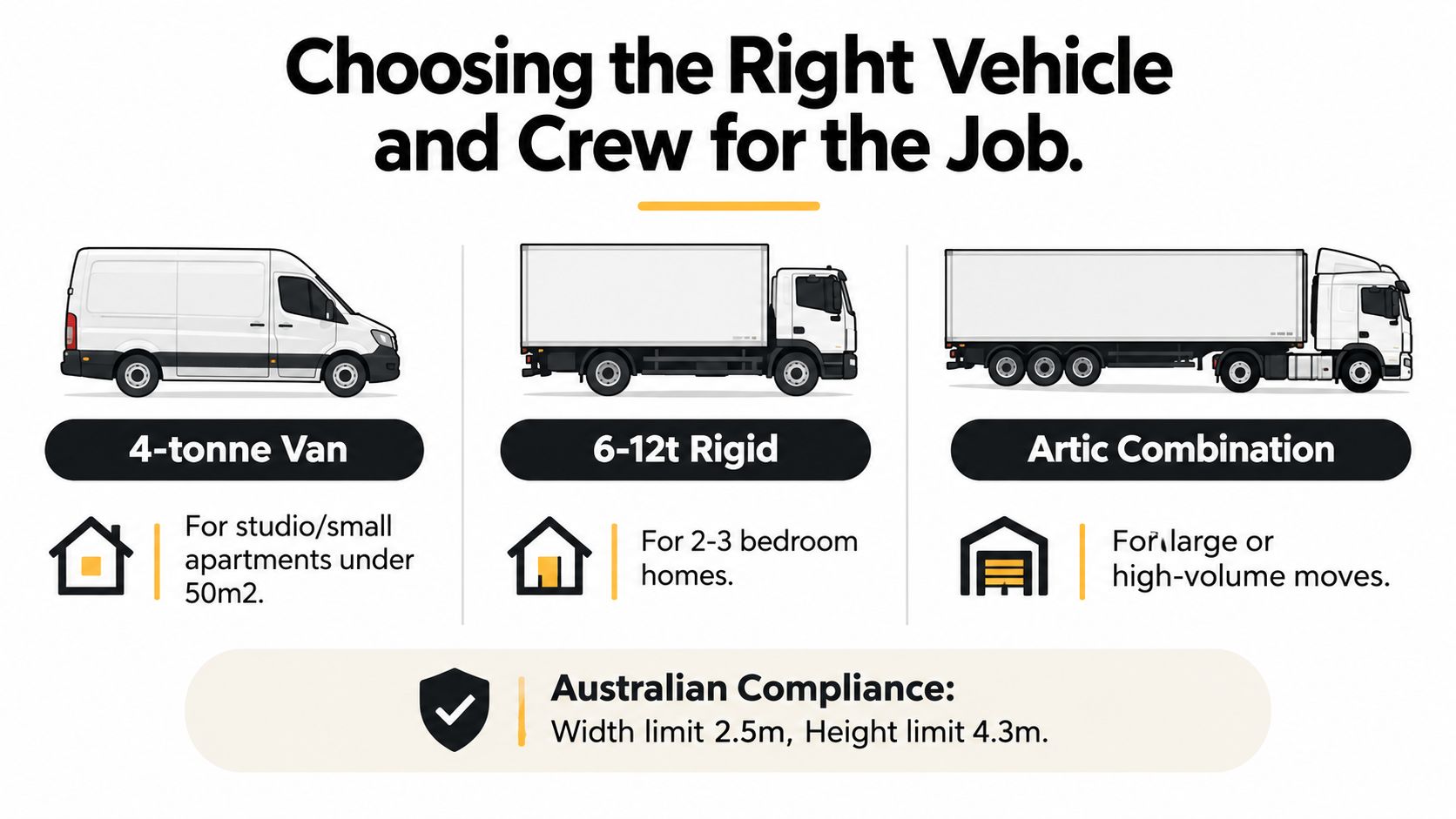
A bigger truck can reduce trips, but it can also force a smaller access vehicle, a permit or double handling. That isn't a saving.
For pianos, antiques and artwork, prioritise a crew with the right handling experience rather than upgrading the truck. Ask how they protect stairs, doors, floors and the item itself. For offices and warehouses, identify pallets, machinery, filing cabinets and concentrated stock separately because axle loading can become the limiting factor before the body looks full.
For a practical explanation of vehicle selection, see this moving truck size guide.
Packing, Labelling and Handling Special Items
Good packing is a chain-of-custody system. It gives the crew a clear record of what was collected, protects goods during loading and line-haul travel, and makes reconciliation at the Melbourne address much easier.
Start two to three weeks before collection. Declutter first, then pack items you won't need immediately. Work room by room, use double-wall cartons for fragile goods and write the room, contents and handling instruction on at least two sides of each carton. Avoid vague labels such as “miscellaneous”. “Kitchen, glassware, open first” gives the crew useful information at both ends.
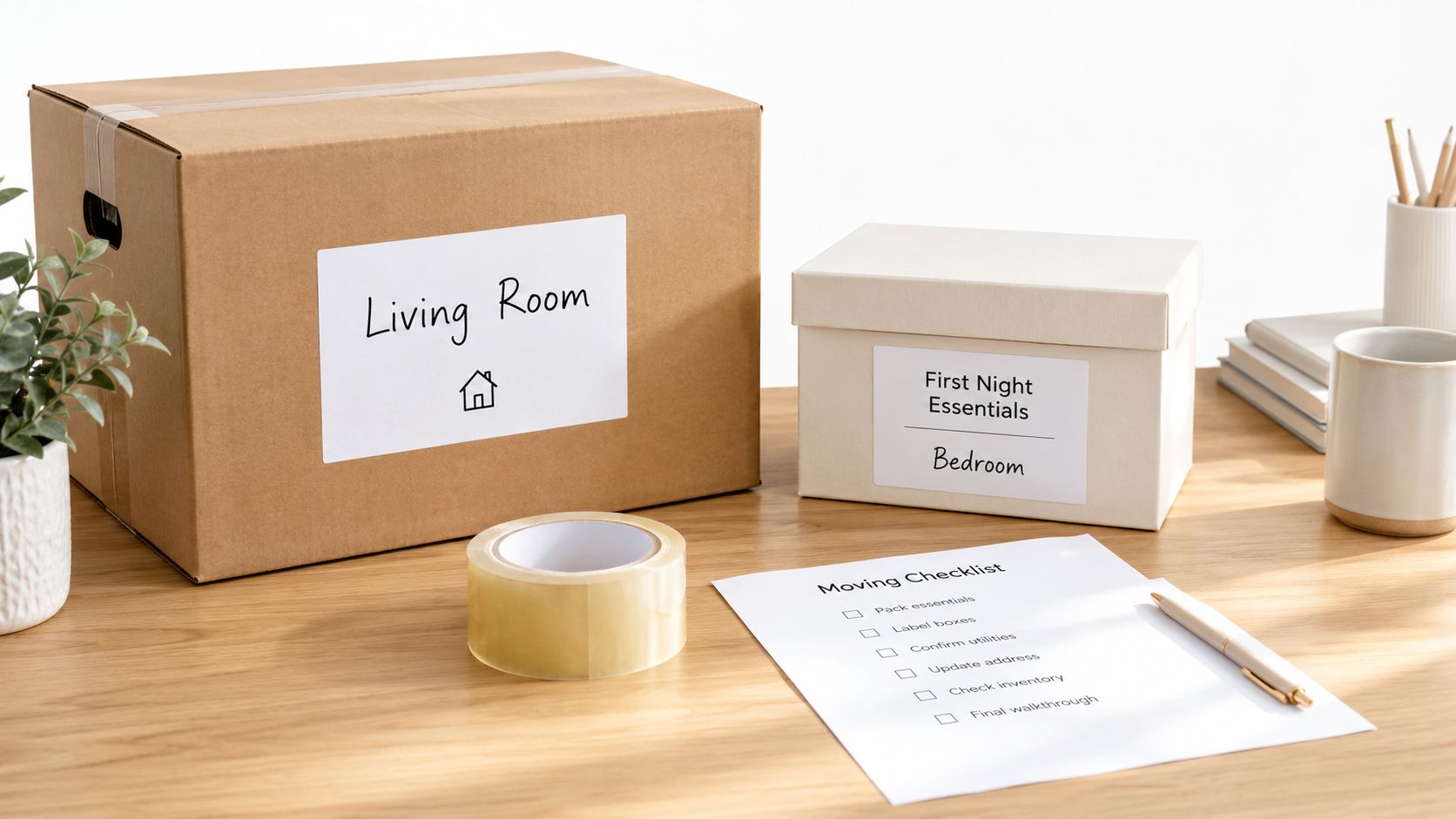
Use a room-coded system
Keep a written inventory with carton numbers and photograph valuable goods and existing marks before wrapping. Protect artwork with suitable edge protection or custom crating, wrap upholstered furniture against moisture and immobilise drawers, doors and appliance components. Heavy goods should be packed low and protected from shifting.
Electronics need original packaging where available, or firm cartons with void protection. Antiques should be blanket-wrapped and secured without placing pressure on delicate surfaces. Upright and grand pianos require specialist equipment, route planning and a crew that understands the instrument's weight distribution. A bigger general-purpose truck won't solve poor piano handling.
Your first-night box should travel in an identified access zone. Include documents, chargers, toiletries, medication, basic cleaning supplies, a kettle, cups, linen and clothing for the first day.
For fragile packing methods, use this fragile-items packing guide. If a pet is travelling separately or needs specialised support, Passpaw pet moving advice provides useful preparation guidance.
Storage, Transit Insurance and the Tricky Move-In Date
The hardest part of many interstate moves is the date gap. You may have to hand back the Newcastle property before the Melbourne tenancy is approved, settlement completes or keys become available. Treating that gap as an afterthought is how families end up paying for rushed redelivery, unsuitable waiting arrangements or multiple handling stages.
Storage-in-transit is the clean solution when the dates don't align. Ask whether the removalist stores the load securely between collection and delivery, whether access is available when needed and whether the price separates transport, storage, redelivery and access charges. A facility with round-the-clock access can help with urgent retrievals, but 24/7 access doesn't mean your goods can be delivered instantly. The operator still needs to schedule a vehicle and crew.
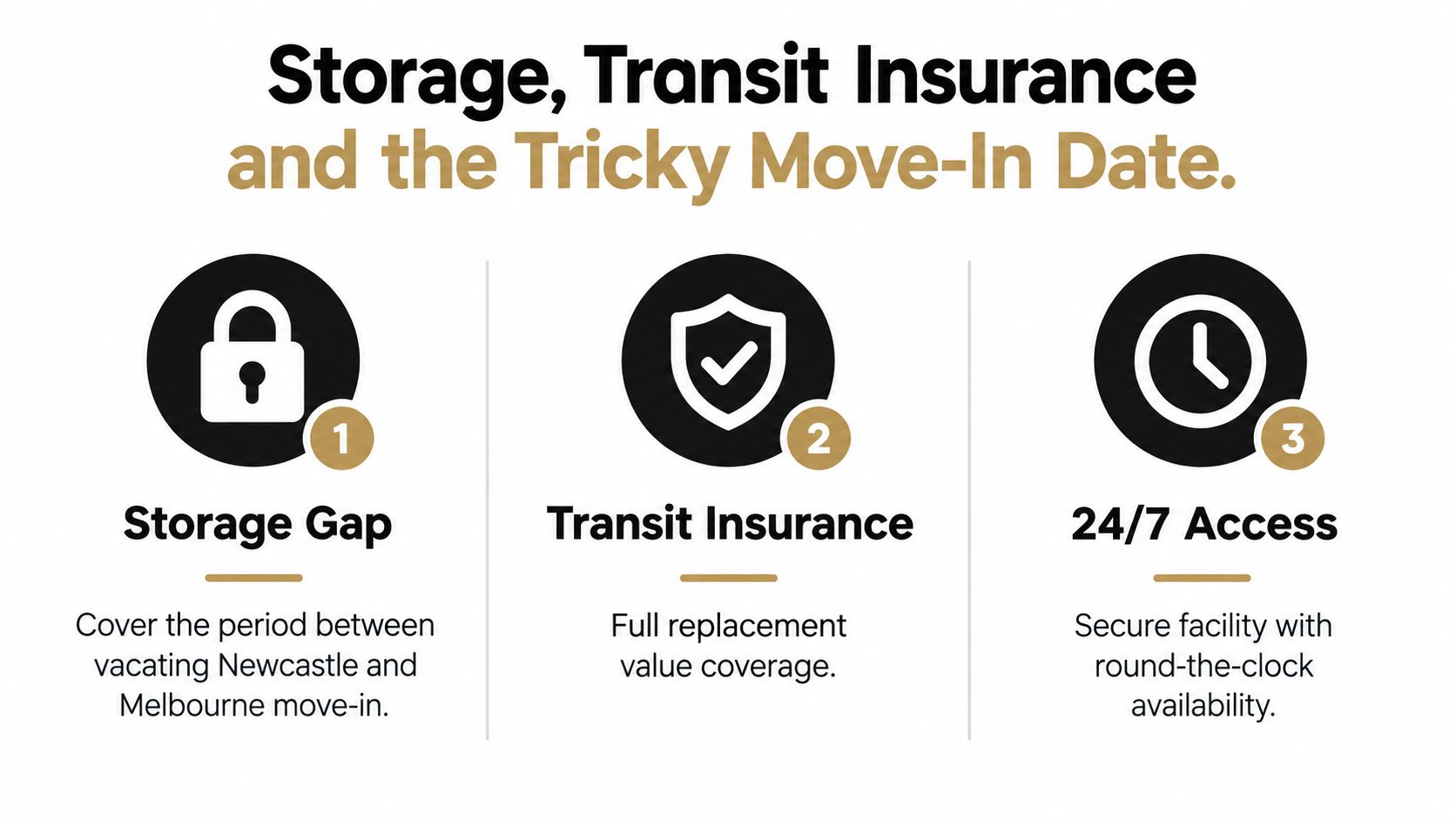
Don't accept “fully insured” as an answer
Ask what the policy covers during packing, loading, transit, storage, unloading and final placement. Check whether cover is based on declared value, replacement value or depreciated value, and identify exclusions for self-packed cartons, pre-existing damage, fragile items, mechanical goods and insufficient packaging.
Photograph high-value items and existing marks before the truck leaves. Keep the inventory, quote, policy wording and condition notes together. Then ask about the excess, claim notification period and evidence required. A certificate labelled “fully insured” is not a substitute for reading the exclusions.
Current movement patterns make flexible scheduling less predictable. Government population data recorded 358,000 interstate moves in the year to September 2025, down 5.7% from the prior year, while capital-city-to-rest-of-state moves declined 12.7%, according to the September 2025 population report. Don't assume a backload or delivery slot will automatically be available when your lease ends. Build a contingency plan and get the delay policy in writing.
Paperwork, Permits and Cross-Border Practicalities
Household goods don't pass through a border checkpoint between NSW and Victoria, but the move still has paperwork and access obligations. Redirect mail, arrange utilities, confirm school enrolments and check the requirements for updating your Victorian driver's licence and vehicle registration. If you're leaving or entering an apartment, confirm strata or body corporate rules, lift protection, loading-bay bookings and permitted delivery hours.
The truck also needs to suit the route. NSW heavy-vehicle guidance lists general-access trucks at 12.5 metres, truck-and-trailer combinations at 19 metres, with a 2.5-metre width and 4.3-metre height limit, as explained by Transport for NSW general-access guidance. A vehicle exceeding ordinary mass or dimension limits may need restricted-access approval or route-specific arrangements.
Ask the removalist these questions before dispatch:
- Vehicle class: What truck and axle configuration are you proposing?
- Route access: Have you checked bridge, height, length, turning and local street restrictions?
- Permit responsibility: Who obtains approvals if the vehicle or load needs them?
- Delivery method: Is the quote direct door-to-door, or could it involve trans-shipment?
- Business access: Can the crew work around pallet counts, OHS requirements and after-hours building access?
For offices and warehouses, the inventory should separate pallets, machinery, records, appliances and loose cartons. Concentrated loads can create axle problems even where there appears to be spare space. The NHVR Higher Mass Limits permit information confirms that travel outside an approved HML network requires the appropriate permit.
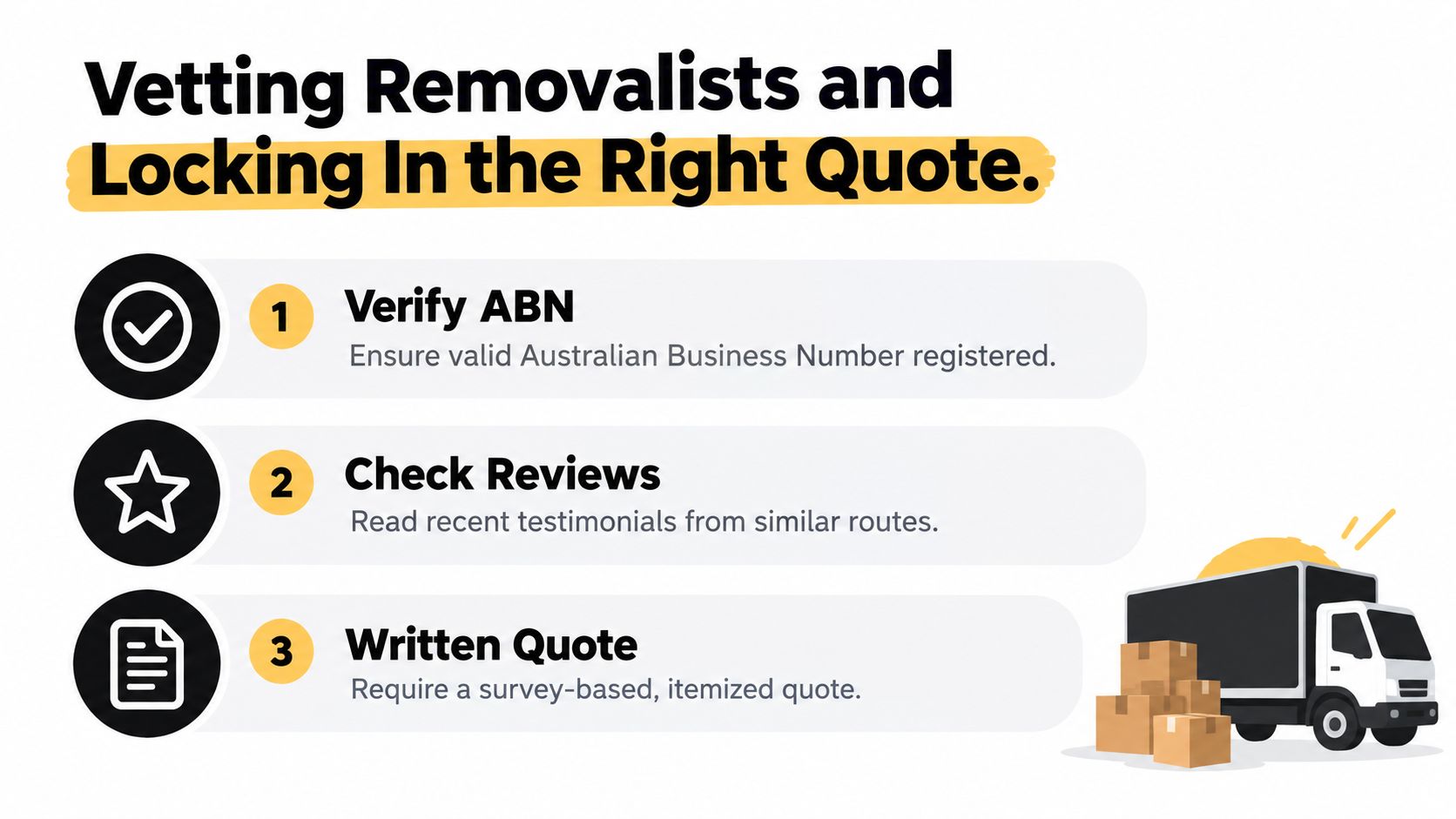
Vetting Removalists and Locking In the Right Quote
Start with the operator, not the advertised rate. Verify the business's ABN, confirm current insurance and read recent reviews from customers who completed comparable interstate, office or warehouse moves. A phone estimate based on “a standard three-bedroom house” isn't enough for a Newcastle to Melbourne relocation.
Request a written quote based on an inventory and access survey. The document should identify the proposed vehicle class, crew size, collection and delivery arrangements, packing scope, storage terms, waiting charges, redelivery conditions and the treatment of special items. It should also state whether the price includes GST and any fuel or access charges.
Questions that expose a weak quote
Ask who will be responsible if the truck can't reach either property, whether your goods stay on one vehicle, how the crew records pre-existing damage and what happens if Melbourne keys are delayed. For a piano, artwork, safe or antique, ask whether the quoted crew has the equipment and experience to handle it.
Walk away when the operator refuses to provide written inclusions, pressures you to pay before confirming the inventory, gives no clear storage terms or treats access as your problem. A trustworthy removalist will ask about stairs, lifts, parking, narrow driveways, truck dimensions and delivery permissions before promising a price.
Home Removals Sydney is one option for customers comparing providers. Its services cover interstate household moves, office relocations, warehouse and pallet movements, packing, furniture assembly, specialist handling and secure storage with 24/7 access. The company operates from Fairfield, NSW, and can quote against the actual inventory and access requirements rather than relying only on room count.
Request a tailored interstate quote from Home Removals Sydney with your Newcastle inventory, access details and Melbourne move-in date. Their team can help plan the vehicle, packing, specialist handling and storage arrangement so your belongings arrive when the property is ready, not merely when the truck is available.
