

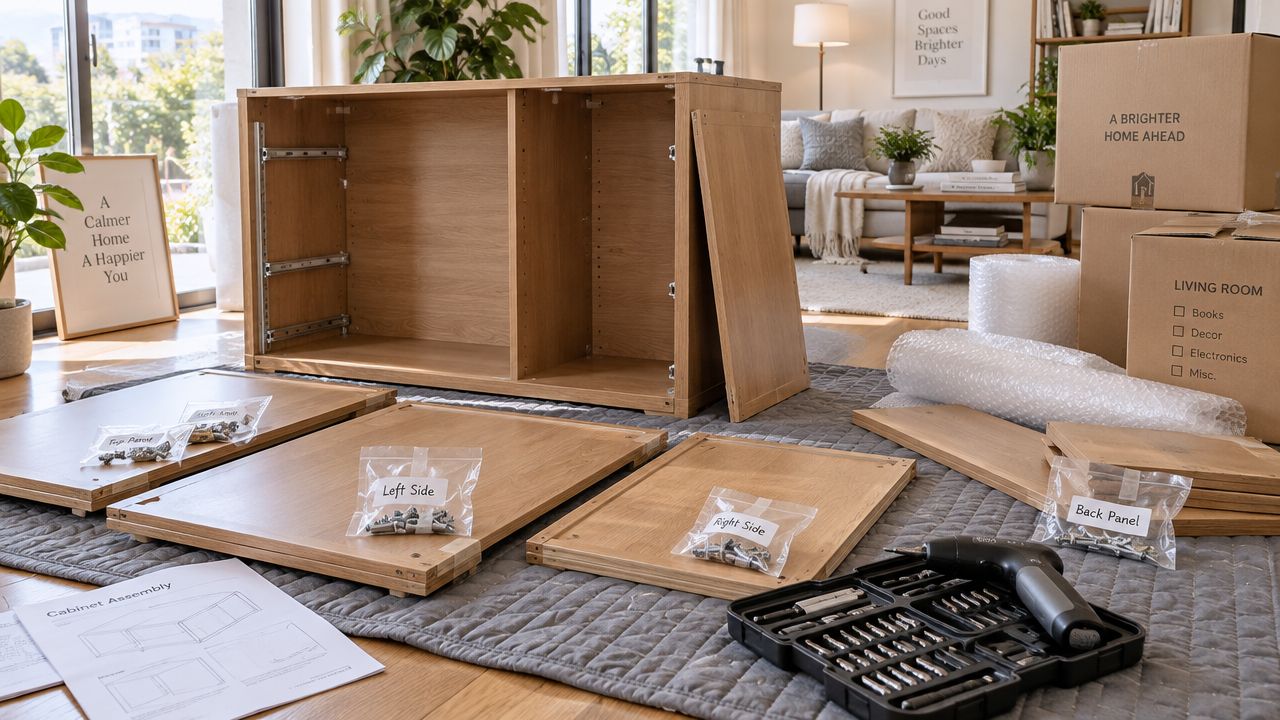
You're halfway through moving day in Sydney when the wardrobe reaches the apartment doorway and stops. The bed frame has already scraped the hall wall, the lift booking is running down, and nobody is sure which Allen key fits the remaining bolts. A furniture disassembly service can prevent a manageable move from becoming a costly delay.
Disassembly isn't automatically the right answer, though. A dining table that clears every doorway may be safer left assembled, while a tall wardrobe facing a sharp stairwell turn usually needs a planned teardown. The useful decision starts with measurements, not assumptions.
Introduction to Furniture Disassembly Service in Sydney
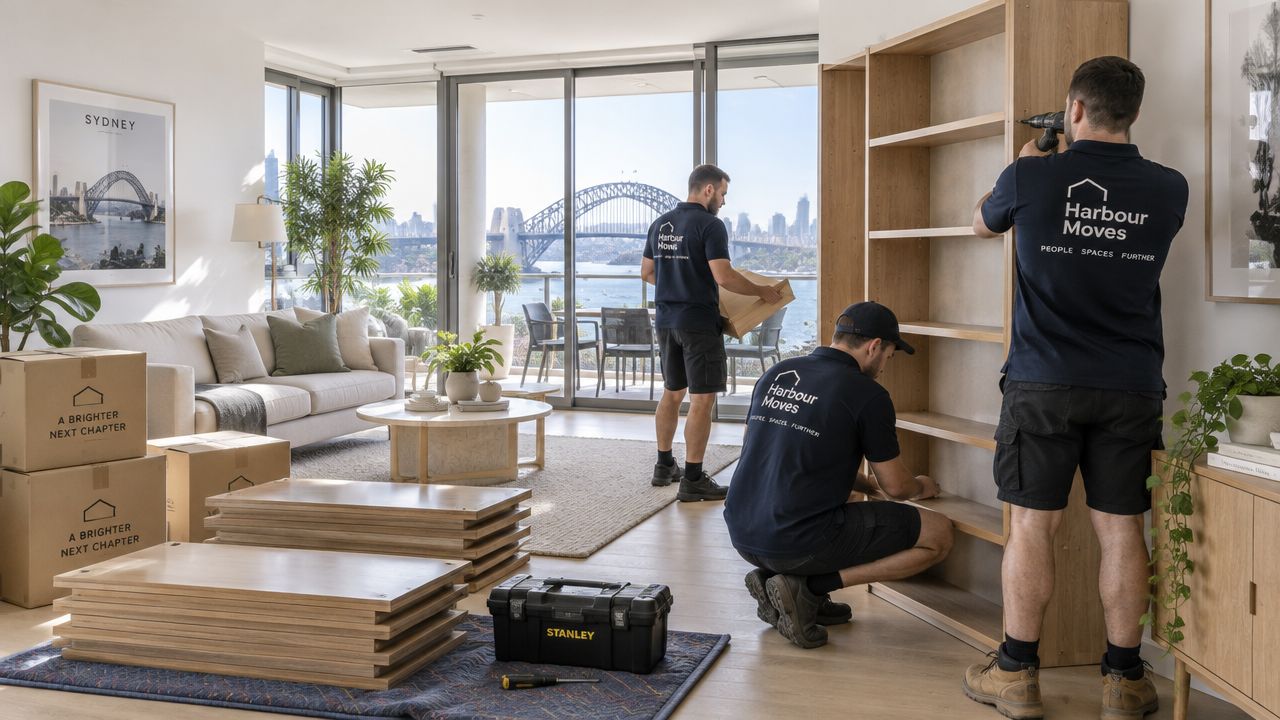
A Sydney move has its own access problems. Older terraces can have narrow halls and tight stair turns, apartments may involve lifts and shared corridors, and office relocations often include desks, partitions and shelving that were never designed to pass through a doorway in one piece. Interstate removals add another layer because every panel, bracket and fastener must survive loading, transport and unloading before reassembly at the destination.
Common candidates for disassembly include bed frames, large wardrobes, modular sofas, desks, dining tables, bookshelves, entertainment units and flat-pack storage. Removing drawers, shelves, legs and other loose components can reduce weight and make panels easier to protect. It can also support reuse rather than disposal when a large item needs to be donated, resold or transported to another home.
The environmental context matters. Australians discard an average of 24 kg of wooden furniture per household each year, which equates to about 48,000 tonnes annually across Greater Sydney's roughly 2 million households, while around 75% choose to reuse furniture rather than dispose of it, according to Australian furniture waste information. Careful dismantling helps keep salvageable items in circulation, provided the furniture is suitable for reuse and the parts are kept together.
The practical aim is simple: identify what needs to come apart, prepare it properly, and confirm what the removalist will handle. By the end, you'll know how to measure access, label hardware, compare DIY with professional work, and request a quote that spells out disassembly, reassembly and exclusions.
When You Actually Need Disassembly and When to Leave It Intact
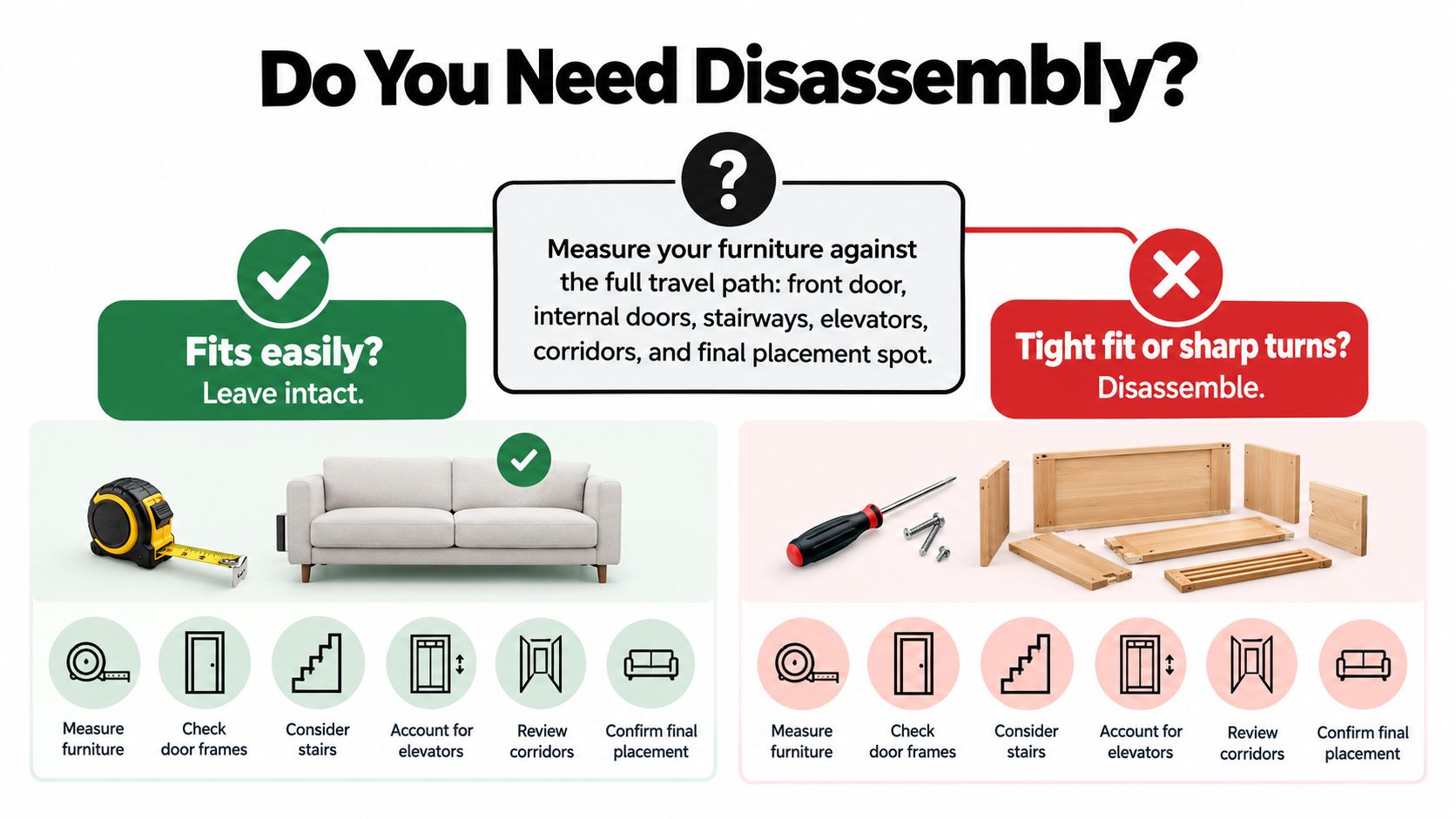
The common assumption is that every bulky item should be dismantled before the removalists arrive. That approach often creates unnecessary labour and more loose parts. The better rule is measure first, then disassemble only where the route or the item makes it worthwhile.
Measure the furniture itself and the complete path:
- External access: Check the front door, kerbside approach and any gates or narrow entries.
- Internal route: Measure internal doors, hallways, corners and the final room entrance.
- Vertical access: Record stairwell clearance, landings and lift dimensions.
- Turning space: A piece can fit through a doorway but still fail at a sharp turn or narrow landing.
A wardrobe that fits through the front door but cannot rotate at the top of a terrace staircase should be dismantled before the crew starts carrying. A desk that clears the lift, corridor and room entrance may be better moved intact, especially if its construction uses fragile particleboard joints. Selective work saves handling and reduces the chance of lost hardware.
Measure the route, not just the doorway. The tightest turn usually decides whether an item travels assembled.
Use the guide to moving heavy furniture when you're checking lifting positions and access risks. For beds, small removable parts such as legs and slats may be all that's needed. If you're also changing linen or protecting a bed base, Protect-A-Bed's valance guide offers useful context on handling bed valances without catching or tearing them.
There's a commercial reason to make the decision early. Furniture disassembly demand is reported as trending up 15%, with typical task pricing around $105-$225, as outlined in Australian moving guidance. That doesn't mean every item deserves a paid teardown. It means you should give the removalist accurate measurements and ask for the cost of the specific work rather than accepting a vague “disassembly included” promise.
How to Prepare and Label Items Before the Crew Arrives
The night before a move is when a little organisation pays off. Clear the furniture, document the connections and make the small parts impossible to confuse. Crews can work around some household clutter, but they can't safely dismantle a loaded wardrobe or search through mixed screws while a hallway is being used as a carrying route.
Clear the item and the path
Empty drawers, cupboards, shelves and wardrobes completely. Remove cushions, glass shelves, removable doors, bedding and loose fittings, then place them together rather than leaving them scattered around the room. Clear a working area around each item and keep pets, children and moving boxes away from the route.
Measure the access path again if anything has changed. Lift padding, balcony access, building rules and kerbside restrictions can all affect the plan, particularly for apartment moves and office relocations.
Keep hardware with its furniture
A practical Australian workflow is to remove loose components first, work from the top down, wrap panels before loading, and bag every fastener by item and part. Use a separate resealable bag for each bed, wardrobe, desk or shelving unit. Write the item name, room and assembly order on the bag, then tape it directly to a matching panel.
Photograph brackets, hinge positions and unusual joints before separation. Mark the back of panels with removable tape rather than permanent ink. These small records matter when similar panels look identical at the destination.
For flat-pack furniture, an electric screwdriver with an adjustable clutch helps prevent stripped pre-drilled holes in particleboard and MDF. Don't force a stuck screw with the wrong bit. Stop, check the head and use the correct tool. Large wardrobe panels also need support from a second person during separation, because twisting or allowing a panel to drop can snap the board or damage the edge.
Small-parts rule: one item, one labelled bag, one matching panel. Never place hardware from several pieces in a shared container.
Protect floors and walls before work begins. Use moving blankets, cardboard or suitable packing paper around corners and finished surfaces. If you're packing the rest of the home yourself, these packing paper tips from Packaging Panda can help you choose paper for wrapping furniture surfaces and fragile components. The guide to packing for a house move also covers the wider preparation job, including keeping packed boxes away from access routes.
What the Crew Will Do On Site From Disassembly to Reassembly
A good crew starts with access, not a drill. They check the item, measure the route from the room to the truck, and confirm whether the furniture should stay intact. If a bed frame, wardrobe or desk can clear doorways, stairs, lifts and corners without drama, there is no point paying for teardown that adds labour without reducing risk.
Arrival and protection
Once the plan is clear, the crew protects floors, walls, door edges and exposed corners before touching the furniture. Drawers, shelves, cushions, glass and legs come off first, then the work follows the unit's build instead of forcing a joint that was never meant to move that way.
Disassembly usually runs from the top down and in reverse order of assembly. Each fastener goes into a labelled bag, and that bag is taped to the matching panel or secured with the item. Panels are wrapped before they leave the room, which cuts down on scratches and keeps edges from knocking against the truck or other items.
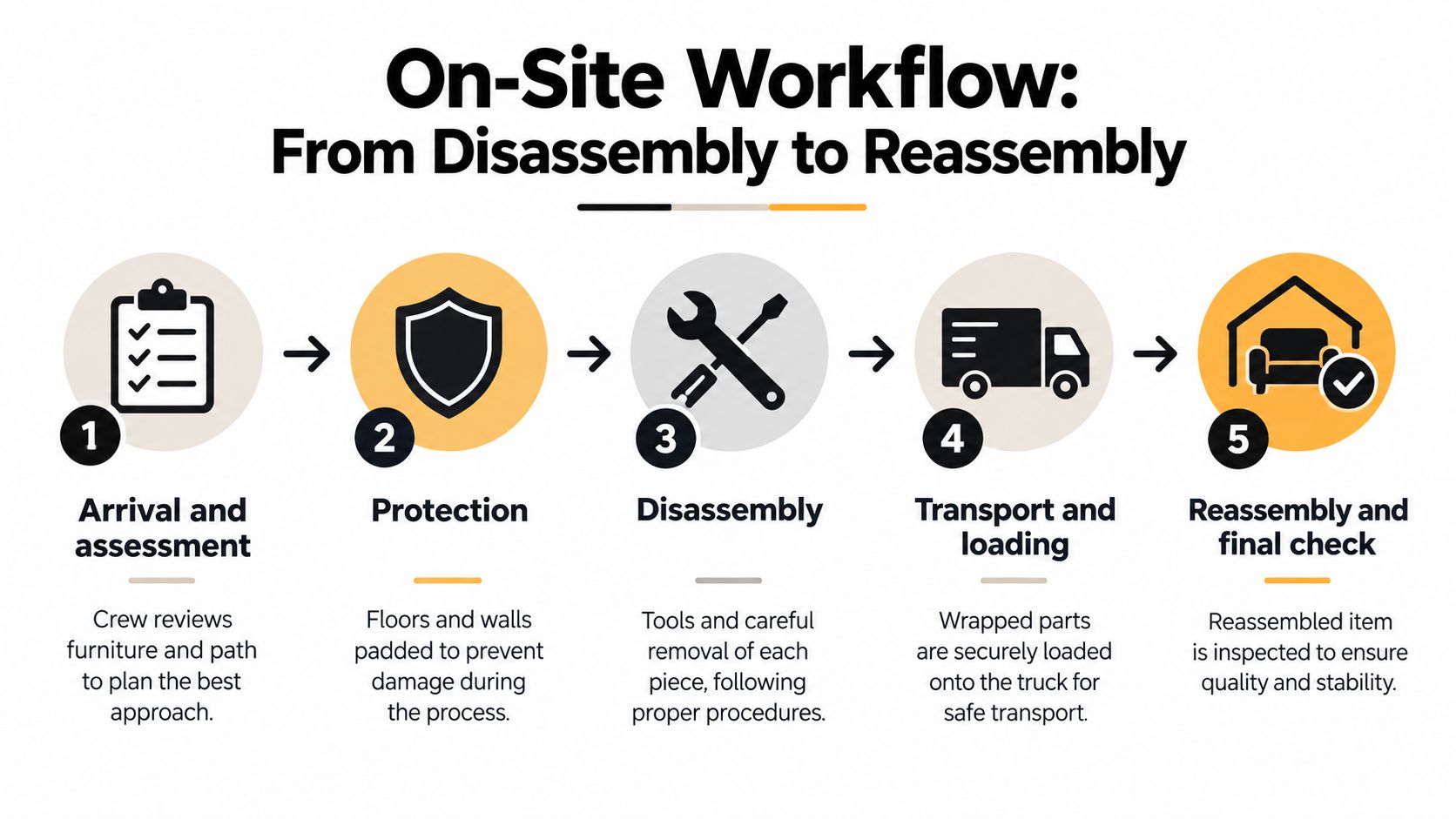
The crew then moves the separated pieces through the measured route. In an apartment, that may mean working around a lift, protecting shared areas and keeping panels upright through tight turns. For office relocations and warehouse moves, the same method applies at a larger scale, with desks, shelving, partitions and equipment separated in the order that suits loading and the room they are heading to.
Loading and destination setup
Wrapped panels should be loaded so they do not slide, rub against metal, or carry the weight of unrelated items. Hardware stays with the furniture, not in a general toolbox. Clear direction helps here. Tell the crew which room each item belongs in, and flag anything that should not be stacked, tilted or placed near moisture.
Industry guidance notes that leaving teardown until the last minute increases handling time and the chance of losing hardware. Measuring the access path first avoids that problem, and it also shows when the furniture should stay assembled. That is the sort of check that saves money on labour and keeps the move simpler.
At delivery, reassembly happens in the room where the furniture will be used. That avoids rebuilding a wardrobe in a hallway and then finding it will not turn into the bedroom. The crew works back through the recorded assembly order, tightens the joints, checks doors and drawers, and confirms that moving parts open and close properly.
Before the crew leaves, walk around the reassembled item. Check that the joints feel tight, the doors line up, the drawers run smoothly and the furniture sits where you agreed. Raise any problem straight away if a panel, fitting or function looks off.
Time and Cost Estimates and DIY Versus Professional Trade Offs
A flat-pack bed or a small cabinet can be worth doing yourself if you have the right bits, the instruction sheet, and enough room to work. Once access gets tight, the item is heavy, or the fittings are worn and unfamiliar, the job can chew up time fast and raise the chance of damage.
Start with the access path before you book anyone. Measure doorways, stair turns, lifts, hallway corners, and the room at the other end. If the furniture clears those points intact, disassembly may be unnecessary, and that saves labour you do not need to pay for.
Quoted rates vary by item and scope. NSW disassembly pricing and service benchmarks can help set a starting point, but the final quote still depends on the furniture, access, crew requirements, and whether reassembly is included.
| Factor | DIY Approach | Professional Service |
|---|---|---|
| Tools | You need the right screwdrivers, Allen keys, sockets, and enough space to keep parts organised. | The crew brings the tools and protection materials needed for the job. |
| Time | You avoid the labour charge, but unfamiliar construction can slow everything down. | An experienced team follows a set sequence while managing the move. |
| Damage risk | Stripped holes, cracked panels, and mixed hardware become your problem. | Careful handling lowers avoidable damage, within the provider's terms and exclusions. |
| Access | You have to judge whether the item will clear turns, stairs, and lifts. | The crew can inspect the route and advise on intact transport or selective teardown. |
| Reassembly | Photos and labels are your only guide at the new address. | Reassembly and a function check can be part of the quote if agreed upfront. |
For a simple item that already fits through the access path, paying for disassembly can add cost without saving much risk. For a tall wardrobe that has to turn through a narrow stairwell, professional work is usually cheaper than repairing a crushed panel or losing time on the truck. Specialist pieces such as pianos, antiques, motorised recliners, and custom-built furniture need a specific discussion, not a standard furniture line item.
If you are fixing a loose fitting or worn component before the move, Meliusly's furniture fix tips can help you spot problems early. A repair guide is not a green light to pull apart an item you cannot put back together cleanly.
Before you confirm the booking, ask what is covered. Tools, wrapping, reassembly, floor protection, wall protection, and damage cover should all be clear in writing, because the price only makes sense when the scope is set.
Choosing Your Removalist and Final Checklist for a Smooth Move
A suitable removalist should discuss the furniture, the access route and the destination room before confirming the job. For Sydney home removals, furniture removals, office relocations and interstate removals, check that the provider can handle the item type and has a vehicle suitable for the load.
Current Australian guidance warns that “included” disassembly may not clearly explain whether it covers straightforward pieces only, whether reassembly is guaranteed, or how specialist furniture and insurance are treated. Confirm these points in writing before booking, as recommended by Australian removalist advice on disassembly scope.
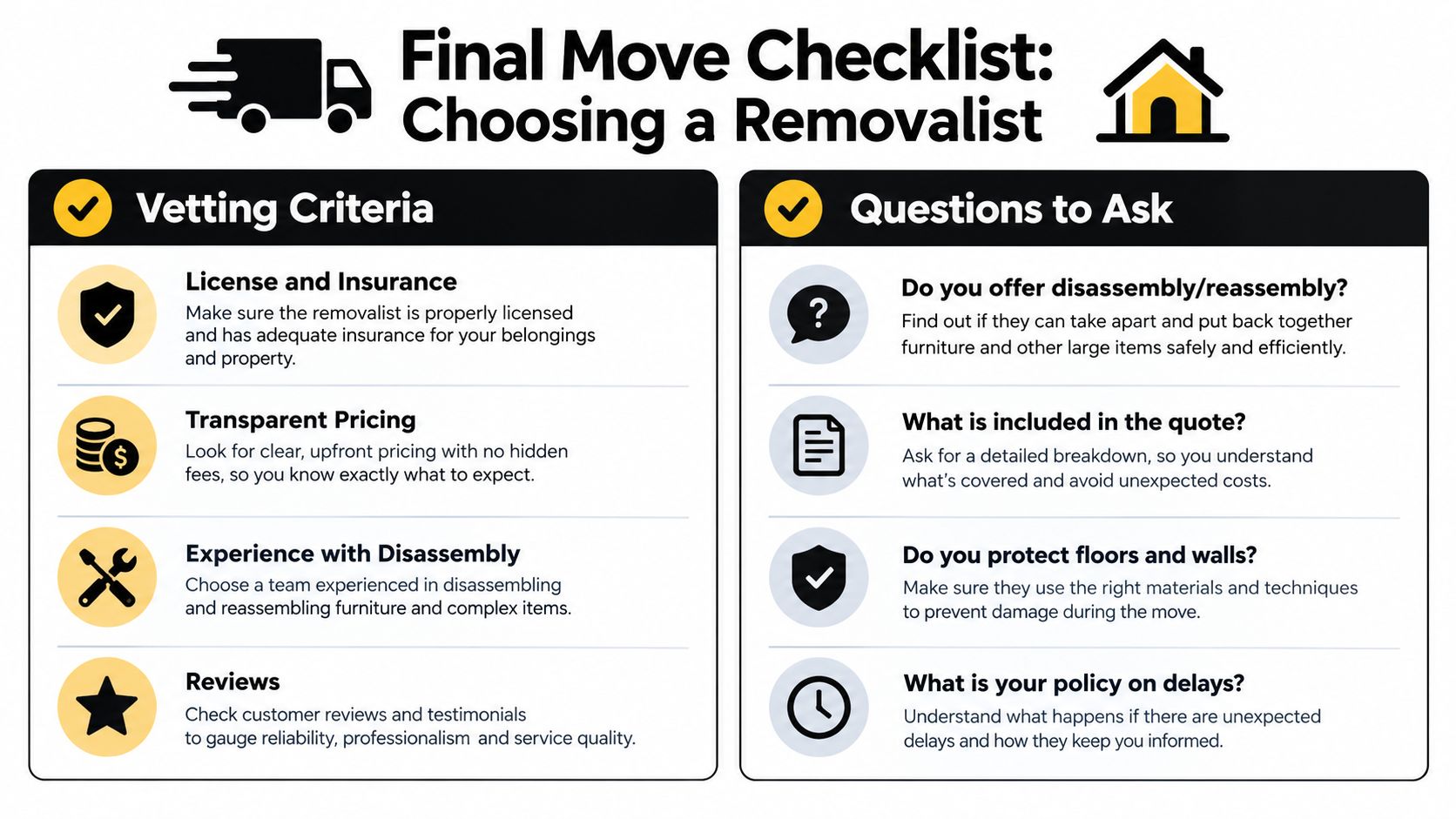
Questions to settle before booking
- Scope: Which items will be dismantled, and which will stay intact?
- Reassembly: Will the crew rebuild each listed item and check its function?
- Specialist pieces: Are pianos, antiques, artwork, built-ins or motorised furniture excluded?
- Tools and protection: Are suitable tools, wrapping, floor protection and wall protection supplied?
- Cover: What insurance or damage cover applies during disassembly, transport and reassembly?
- Access: Have stairs, lifts, turns, parking and building requirements been included in the assessment?
- Pricing: Are disassembly and reassembly included in the quoted rate or charged separately?
Use this guide to choosing a removalist company when comparing providers. A transparent quote should name the furniture, access constraints and exclusions rather than relying on a broad promise.
Your final move-day check
The day before, empty furniture, photograph connections, label hardware and clear the paths. On the morning, confirm lift access, parking and the destination rooms. At handover, check panels, joints, doors, drawers and glass before the crew packs away its tools.
Home Removals Sydney provides furniture disassembly and reassembly for Sydney home, office and warehouse moves, with packing, transport and placement coordinated as one service. Request a quote through the fast form at Home Removals Sydney, and describe the furniture, access points and whether you need local or interstate removals.
