

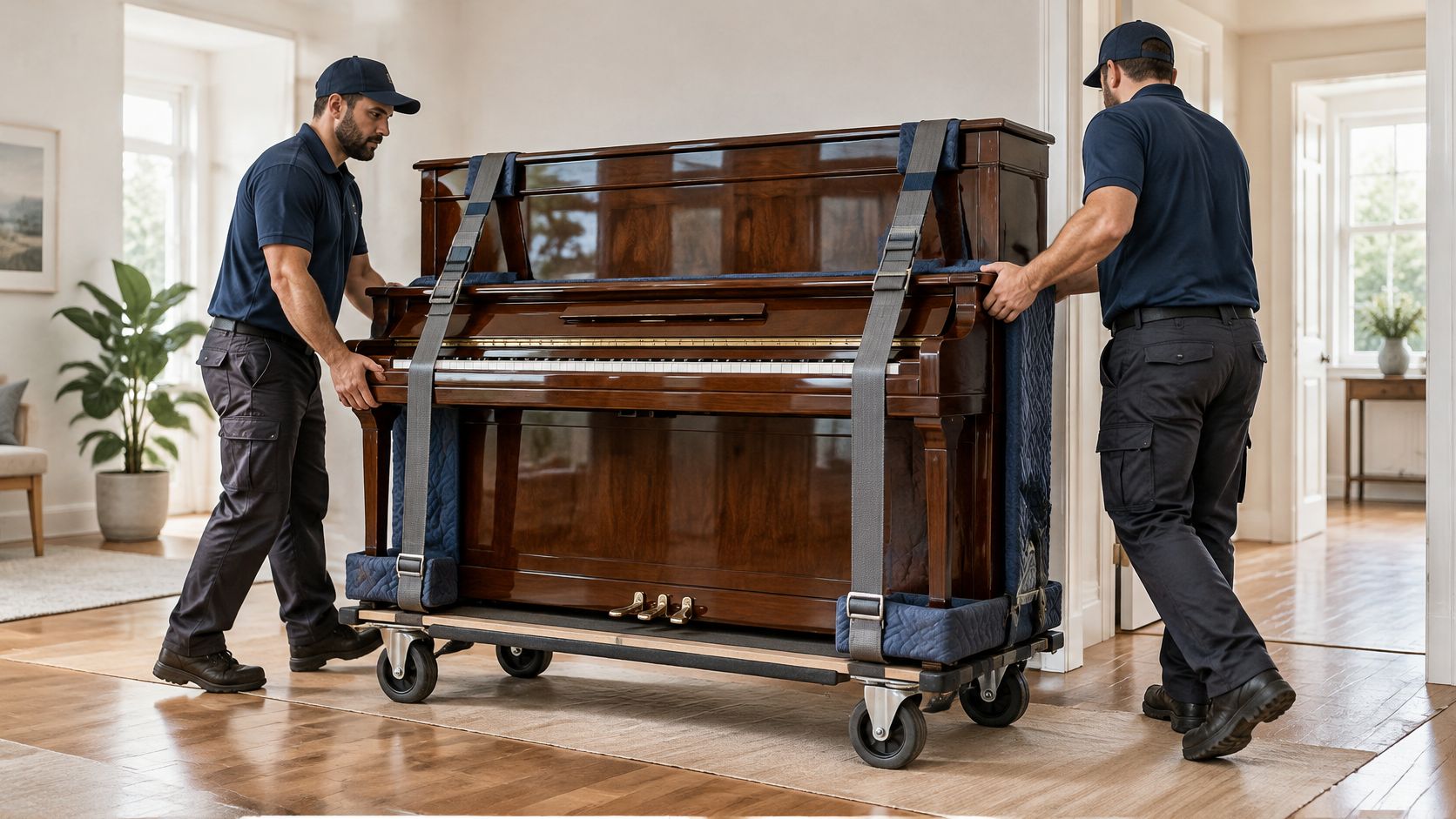
The most repeated advice about moving a piano is to buy the heaviest-duty trolley you can find and strap the instrument to it. That advice has one flaw. A trolley's rating tells you what its frame and wheels will carry, and nothing about whether the piano will still be upright when a castor meets the lip of a tiled threshold.
A piano's mass, its centre of gravity and the actual route through your house decide which trolley you need. A piano moving trolley used well is a risk control: it takes a concentrated load off human backs and puts it on wheels at a height low enough to steer. Used badly, it's the fastest way to put a $20,000 instrument on its side in a hallway.
This guide works through the four pieces of kit, the mass of each piano type, the wheels that suit Sydney floors, and the point where the trolley stops helping. That point arrives earlier than expected.
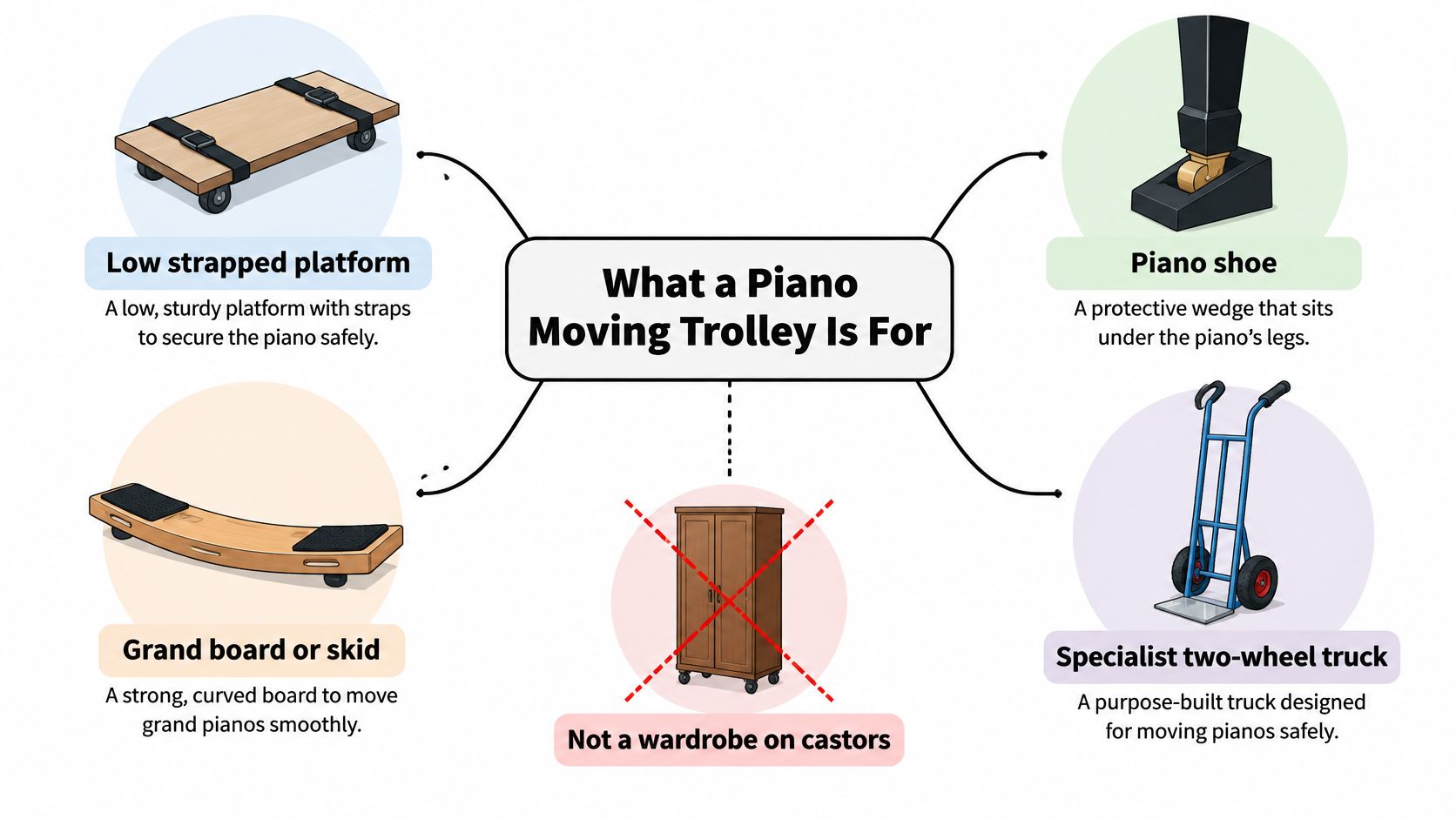
What a Piano Moving Trolley Is For
A piano is not a wardrobe on castors, and that difference is the reason the equipment exists. A wardrobe is a hollow box with a low, predictable centre of gravity. A piano is dense, front heavy or back heavy depending on the model, finished in a lacquer that marks under a watch strap, and full of internal parts that don't enjoy a jolt.
A piano moving trolley is what puts that mass onto wheels at a low height so a crew pushes instead of carries. Four forms turn up on Australian moves.
Four pieces of gear, four different jobs
- Low strapped platform. A flat deck, usually on four castors, with a strap or cradle to hold the instrument down. This is the workhorse for an upright on one level.
- Piano shoe. A wedge that sits under a leg or corner so the piano can pivot or slide a short distance. Handy for fine adjustments, not for a trip to the truck.
- Grand board or skid. A long, felt-lined board that carries a grand body once its legs and pedal lyre come off. It spreads the load and keeps the lid and soundboard clear of the deck.
- Specialist two-wheel truck. A tall frame with a lip and a strap, used where a wide platform won't fit through a doorway.
The first three keep the mass low and spread. The fourth buys clearance at the cost of a higher centre of gravity.
Piano relocation has been an Australian logistics problem for more than two centuries. The country's first piano arrived with the First Fleet aboard HMS Sirius in early 1788, and the Museum of History NSW records one instrument that left the John Broadwood & Sons workshop in London on 8 February 1837, travelled more than 500 kilometres to a farm in south-west Scotland, was shipped out, reached Sydney in early March 1843, and then went through Parramatta and across the Blue Mountains to Lithgow. Every leg of that journey needed coordinated lifting, packing and route planning, with no castors and no ramps.
Modern Sydney hands you a shorter route with more obstacles per metre. A Paddington terrace hallway barely wider than the piano, a lift lobby with a 20 mm lip, a tiled entry that hides a step, a concrete drive falling away towards the street.
What it does well and what it costs you
On flat ground the gains are real. Less carrying means less strain on backs and shoulders. Less floor drag means fewer scratched boards. A strapped load is easier to control than a piano balanced on two hands and a knee, and keeping the instrument low is exactly where you want the mass when a doorway is tight.
The costs are less obvious. Loading onto the deck is still a lift, and for an upright or a grand that lift is the riskiest minute of the whole job. Unpadded webbing can print a line into bare timber. A high load rating creates a confidence the rest of the setup may not deserve.
A trolley does not climb stairs, load itself or choose your route. It replaces the carrying, not the planning.
Match Trolley Capacity to the Piano
Find your instrument in the table, then read the caveats underneath. The capacity column is often overlooked.
| Piano type | Typical mass | Suitable trolley | Capacity to look for | Wrong tool when |
|---|---|---|---|---|
| Portable digital | 11.1 to 22 kg | Two-person carry or light dolly | Rated above the piano mass | Stairs or a long carry alone |
| Cabinet digital | 88 to 90.5 kg | Low strapped piano trolley | Well above 90.5 kg | A narrow unstrapped dolly |
| Upright acoustic | 200 to 350 kg | Purpose-built piano trolley | Up to the 800 kg class | A standard appliance dolly |
| Grand | 250 to 600 kg | Grand board, skid or specialist dolly | A clear margin above 600 kg | An upright shoe used alone |
| Hybrid | 239 to 338 kg | Rated piano trolley, load centred | Well above 338 kg | Treating it as a portable keyboard |
Read the table as a starting point, not a verdict. An individual instrument can sit at the top of its row, or outside it altogether.
Pianos still move even when the market is soft. The Australian Music Association's 2024 market report recorded a 3.3% increase in total pianos and keyboards units compared with 2023, while the category stayed 25.7% below its five-year average and 23.0% below its ten-year average. The same report cites estimates of about 2,500 and 3,000 pianos entering Australian waste facilities in a year. That is what happens when a move starts to look more expensive than disposal.
Australian equipment specifications put a purpose-built piano trolley at up to 800 kilograms of rated load, well clear of the approximate ranges reported alongside it of 200 to 350 kilograms for uprights and 250 to 600 kilograms for grands. The margin exists because the trolley carries more than the instrument.
Why the margin matters
A rating that sits close to the piano's mass leaves nothing for the working load you add and the forces the route creates. SafeWork NSW advises identifying an object's weight, size and handling instructions, then matching the trolley to those characteristics, and notes that larger wheels improve movement over uneven ground. The gap between a nominal label and a measured mass is easy to see: a digital cabinet piano listed by Yamaha Australia weighs 88.0 kg, or 90.5 kg in polished finish, at roughly 1,461 mm wide by 477 mm deep (SafeWork NSW).
Add blankets, straps, ramps and any temporary supports, then add the jolt of a wheel meeting a raised paver. Turning at the end of a hallway multiplies all of it. That's the working load, and it's the number the trolley has to survive.
Read the plate, not the brochure
Use the model plate on the back of the piano, or the maker's published specification, rather than a guess based on how heavy it feels. Yamaha Australia's published figures run from 11.1 to 22 kg for a portable digital up to 239 to 338 kg for full-size acoustic and hybrid models (Yamaha Australia). A hybrid looks domestic and moves like a full-size instrument, so handle it that way.
Two habits prevent most capacity failures. Centre the load over the axle or the middle of the deck instead of letting it hang forward, and reject a standard appliance dolly for any tall acoustic, whatever its advertised limit. Our guide to how to move heavy furniture covers the strapping and route planning that go with the trolley.
There is no single best trolley. There's a trolley that suits this piano, this route and this many people, which is why the wheel and surface decisions matter as much as the rating.
Safety Features That Stop a Tip
Tip risk is a geometry problem before it's a weight problem. A piano on a deck carries its mass high, sometimes a metre above the wheels, so any sideways force at the top of the cabinet acts on a long lever. A narrow deck, a sharp turn at the end of a hallway or a driveway falling to one side creates a tipping moment even when the trolley is nowhere near its rated load.
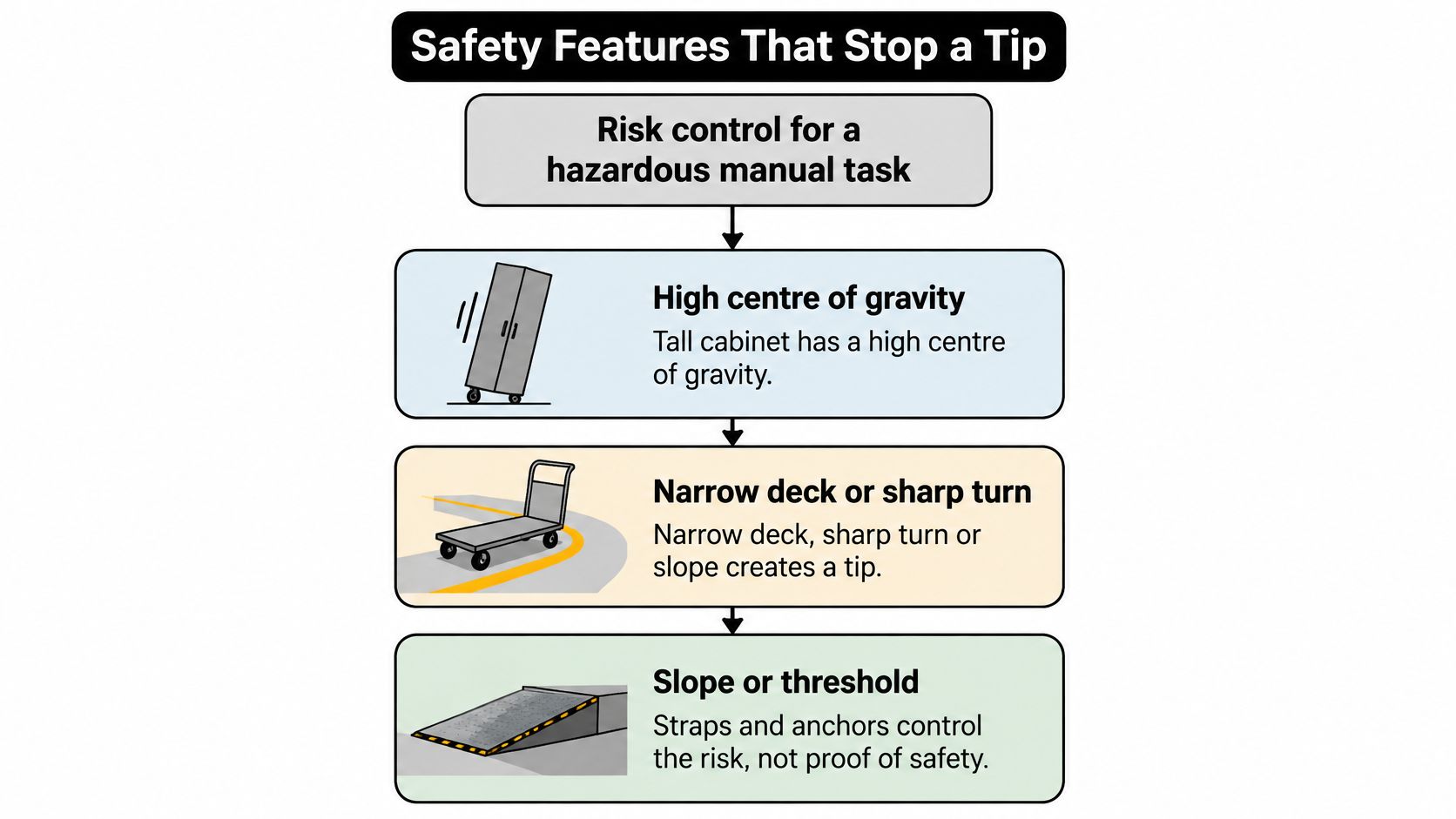
The trolley is a risk control, not a certificate. SafeWork SA's hazardous manual tasks guidance treats mechanical aids as a control that must be designed for the load, and warns that operators still face hazards while loading, steering and negotiating the workplace.
The features that actually control it
- A wide, low platform. Deck width is your anti-tip margin. A deck that barely covers the piano's depth gives you nothing to correct with.
- A readable working-load limit. If the plate is gone, the trolley is unrated, full stop.
- Ratchet straps or a cradle. Two straps minimum, over padding, pulling the cabinet down onto the deck rather than sideways across it.
- Large wheels. Diameter is what gets you over a threshold instead of into it.
- A brake or a chock. Anything on a sloping route needs a way to stop that doesn't depend on somebody's grip.
Match the aid to the weight and the dimensions, strap the load, and push at a controlled speed rather than relying on a sudden brake or a hard pull.
Momentum does the rest. Even a compact cabinet piano, the lightest thing most crews will ever load, becomes dangerous once traction goes, because a high centre of gravity turns a small slip into a large fall. An upright or a grand multiplies the same error by three or four times the mass.
Where stairs change the job
A standard two-wheel appliance dolly is not stair equipment, and no rating plate makes it one. On a flight or a steep ramp, use purpose-designed stair gear or a different method with enough operators and restraint. That decision belongs before the piano is strapped, not halfway up a landing.
SafeWork NSW treats lifting, lowering, pushing, pulling, carrying and restraining as manual tasks, and a task becomes hazardous when it brings in sustained or high force, repetitive movement, awkward posture or vibration (SafeWork NSW). A piano move usually hits three of those at once. The business running the job has to identify the hazards, minimise them through the hierarchy of controls, and keep those controls in place for the whole route. For our own crews, that means the trolley is chosen and inspected before the piano leaves the wall it stands against, and anything past a level roll goes to our piano removal specialists with stair gear, extra crew and restraints.
Choosing Wheels for Sydney Floors and Drives
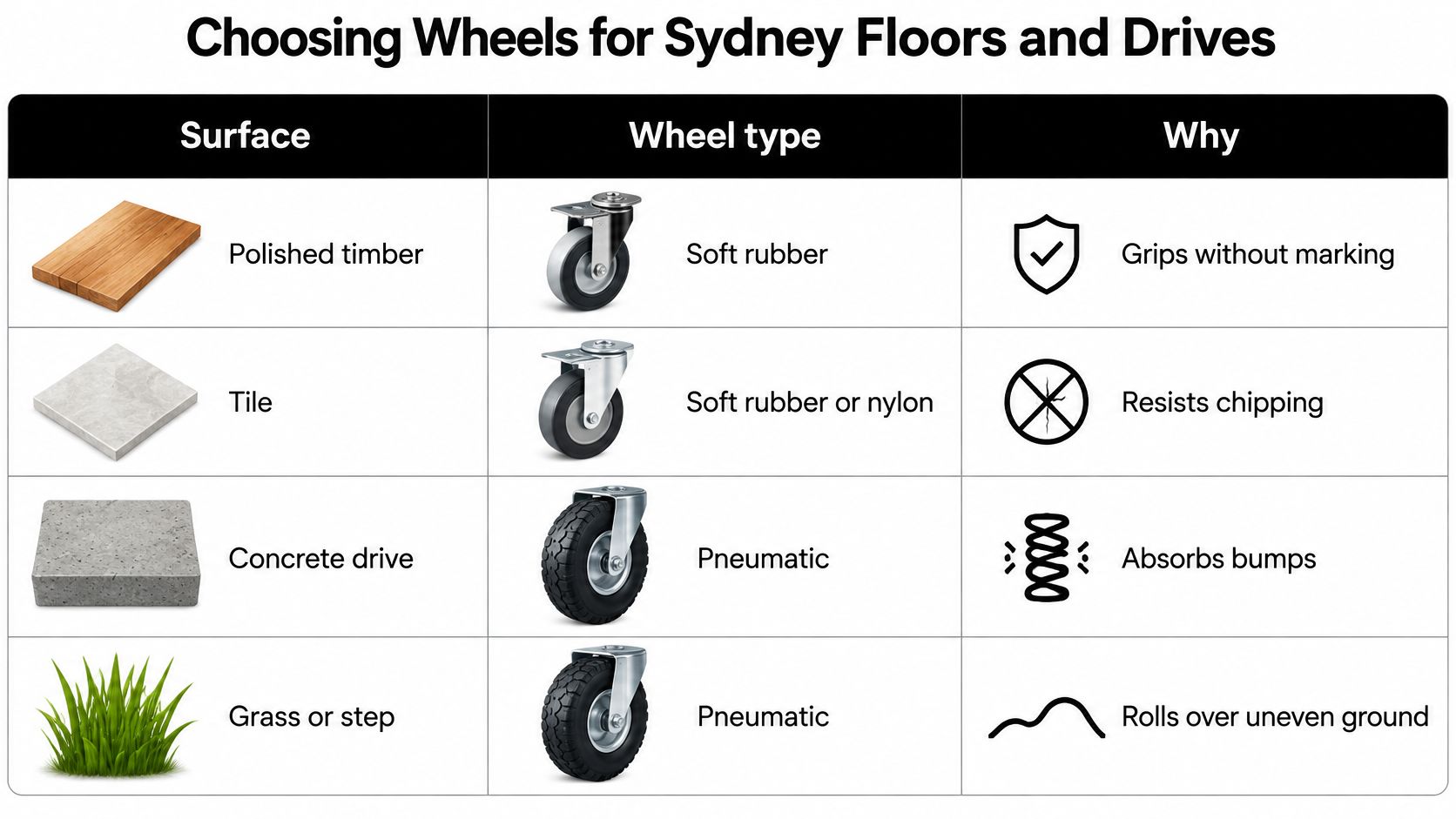
The instrument sets the trolley. The surface under it sets the tyre, and Sydney homes serve up four or five surfaces in a single run.
| Surface | Wheel | Protection | Crew note |
|---|---|---|---|
| Polished timber, level | Soft rubber | Blankets plus a hardboard runway | Push, do not drag |
| Tiles and thresholds | Larger pneumatic or semi-pneumatic | A short ramp over the lip | Slow the wheel onto the ramp |
| Dry concrete driveway | Rubber with a brake | Hardboard or plywood over loose grit | Extra person on a slope |
| Wet drive or grass | Do not roll | Postpone or use a firm track | Traction is the limit |
| Stairs or a steep ramp | Not a standard trolley | Purpose-built stair gear or a hoist | Enough people and restraints |
AFRA's recommended industry standards suggest removing castors where the maker allows it or raising the piano on blocks, protecting polished surfaces, and rolling the instrument onto a slipper or piano trolley before it heads for the truck. Rubber-tyred wheels earn their place because they grip smooth floors, spread load and absorb minor irregularities, and a steep driveway may need extra crew and working brakes rather than a braver push.
Soft versus hard is a real trade-off
A softer wheel protects flooring and raises rolling resistance, which makes the load harder to start and harder to steer in a tight hallway. A harder wheel rolls easily and sends every bump straight up into the case, and it can mark a vulnerable surface.
On level timber, blankets alone will bunch under a loaded tyre. Lay them as a first layer, then run hardboard or plywood so the wheel travels on a hard surface and the finish never sees the tread. On tile, ramp the lip instead of bouncing a wheel over it, because a chipped tile is a repair you'll be asked to pay for. If you want more detail on protecting a finished floor during a move, this guide to prevent scratches on refinished floors is worth reading before moving day.
A short clip is often easier than a paragraph for seeing how a strapped load behaves once it's rolling.
The wet-weather stop rule
Rain is a scheduling decision, not a technique problem. Wet grass and a slick drive steal traction, and a softer tyre that grips a dry path becomes the reason a load won't stop on a wet one.
If the drive is wet, the move waits. Rescheduling costs an hour. A piano that slides costs a soundboard.
Steep drives need more people, not a heavier slogan printed on the trolley frame. One person steers, one person takes the downhill side and one spotter watches the wall, the gutter and the truck lip.
Photograph the floor before it moves
Walk the route with a phone before anything is lifted. Photograph the floor surfaces, the castors on the piano's own legs, every threshold and any board you already know is loose. Then agree, in writing, who is responsible if a lip chips or a floorboard creaks afterwards.
Once the piano is aboard, the practice that keeps it intact is straightforward: keyboard facing the truck wall, double padding at the corners, and tie-downs to the wall so nothing shifts into it in transit.
Care Checks Before Every Move
A rated trolley becomes an ordinary risky dolly the moment a wheel flat-spots, a side rail bends or a strap frays. None of those failures announce themselves. They show up as a wobble at the third doorway, a load that drifts left, or a brake that holds on the flat and lets go on the slope.
The two-minute pre-use check
- Rating plate. Confirm the working-load mark is still legible. A trolley with no readable limit is unrated.
- Frame and rails. Look for bends, cracks at the welds and side rails that have been pushed inward by a previous load.
- Axles. Spin each wheel. A bent axle shows as a wobble you can see and hear.
- Tyres. Check for flat spots, splits and stones wedged in the tread.
- Brakes. Set them on a gentle slope and try to push. If it creeps, it won't hold on a drive.
- Straps. Run the webbing through your hands. Cuts, glazed patches and loose stitching all mean retirement, not a backup plan.
What each fault means
A flat spot hammers the case at every rotation, so a two-minute roll across a lobby becomes a few hundred small impacts into the soundboard area. A distorted frame shifts the load away from the axle, which is the same as narrowing the deck. A brake that slips on a gentle slope will fail on a steep one, and a frayed strap is the only thing between the piano and the floor.
After the move
Wipe the rubber, pick grit out of the treads and dry the deck so timber boards don't swell. Hang straps loose and out of sunlight, because UV degrades webbing faster than load does. Retire the trolley when the frame is cracked, the rating plate is missing or a wheel won't track straight.
None of this raises the rated load, and no amount of maintenance turns a platform into a stair climber. If a check fails, the piano stays where it is until the part is replaced.
How to Roll a Piano on the Level
Everything below assumes a level run: a hallway, a lobby, a flat driveway. The sequence stops the moment a stair, a hoist or a steep grade enters the route.
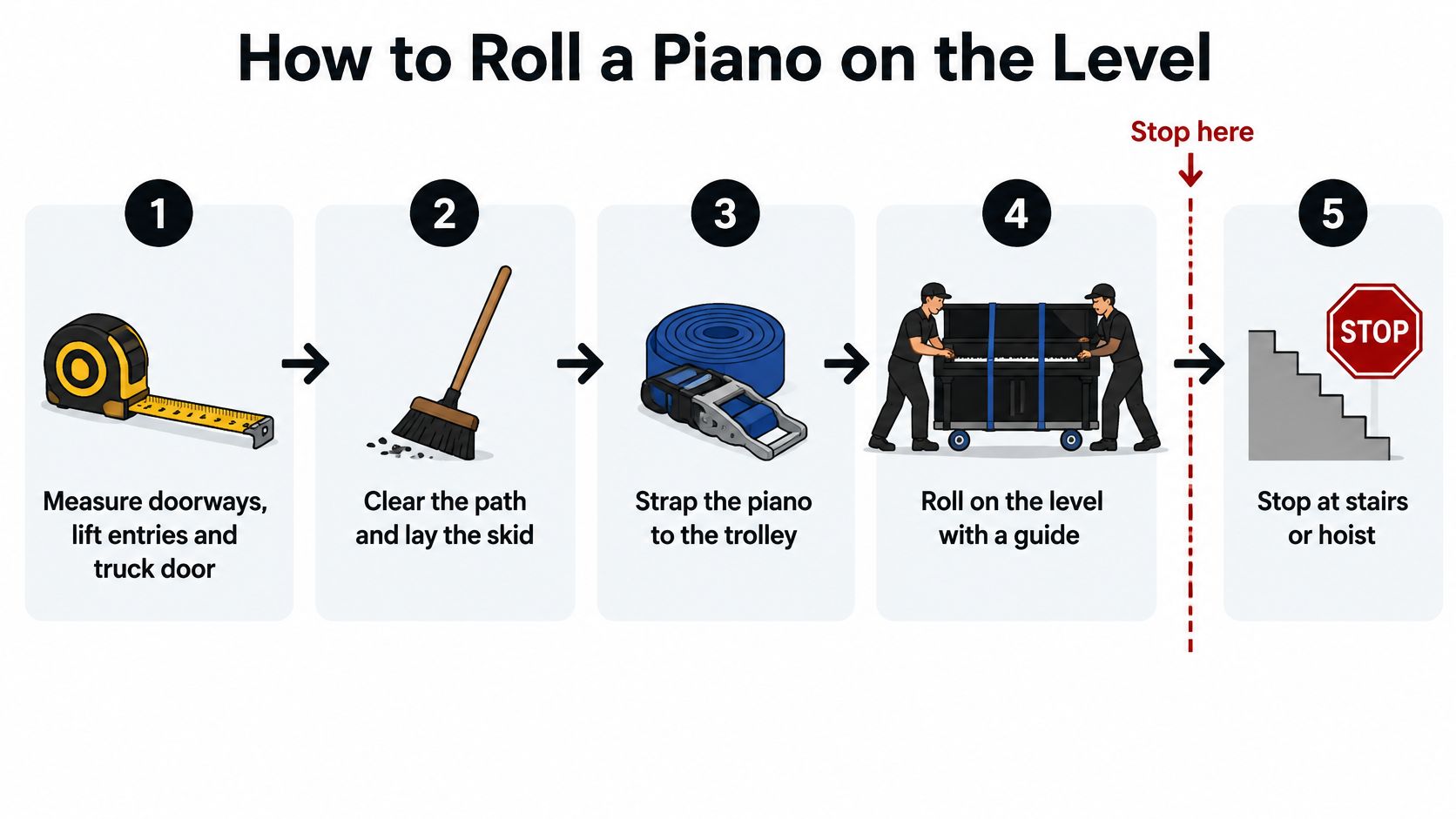
- Measure before you lift. Door widths, lift entries, turn radii and the truck door. Note every stair and every steep drive in the run.
- Clear the path. Move rugs and furniture, then lay the floor protection that matches the surface you identified.
- Remove only what the maker allows. Music desks, loose panels, and on a grand the legs and pedal lyre. Bag the hardware and tape it to the piano.
- Pad the corners, the keyboard lid and any polished cheek. Webbing goes over padding, never directly on lacquer.
- Set the trolley square and low. A deck sitting at an angle to the case puts the mass off the axle before you've moved a metre.
- Load with a ramp or with enough people. Nobody should jerk the instrument up onto the deck.
- Centre the weight over the axle and strap it down. Low load, firm straps, no sideways slack.
- Test stability with a short push. A metre and back tells you more than a confident opinion.
- Push from behind. Positioning the operator behind the trolley keeps the route visible and puts body weight into the load.
- Pause at every threshold. Guide the wheel over the lip rather than letting it drop.
Why pushing beats pulling
SafeWork Australia recommends pushing rather than pulling because pushing uses body weight more effectively, puts less work on the lower-back muscles, supports a forward-facing posture and gives the operator a clear view in the direction of travel (SafeWork Australia). The same guidance suggests motorised tugs or electric pallet jacks where starting force is the problem, aligning trolley wheels with the direction of travel, and keeping hand trucks maintained and correctly matched to the load. In a narrow Sydney hallway, starting and stopping forces climb fast, so wheel alignment and a clean floor matter more than a bigger frame.
Where this procedure stops
SafeWork NSW is direct that the load still has to be manoeuvred onto the trolley and then moved through the workplace, and that the transfer onto the deck can be more hazardous than rolling an already-secured load (SafeWork NSW). That's why the stages above are separated. Prepare, position, load, secure, test, then roll.
A stair, a tight turn or a ramp where traction is lost ends the procedure. Change the method, add people, or bring in a crew. One line on the vehicle: the truck has to suit the street, and NSW applies general-access limits of 12.5 metres in length and 4.3 metres in height to heavy vehicles (NSW legislation).
Book a Sydney Piano Move with a Quote
Turn the checks into a decision. Hire a crew for an upright, a grand or a hybrid; for any move with stairs, a lift or a sloped drive; and for any piano whose mass and clearances you can't confirm. A portable digital on one level can stay a careful two-person job with blankets and a clear path.
When a crew is the right call
Three conditions settle it. The instrument is too heavy to lift onto a deck without risking a back. The route has a feature that needs equipment you don't own. Or the piano's value makes a mistake unrecoverable. Any one of those is enough.
What to send with your enquiry
- The instrument. Make, model and serial plate photo, so the mass comes from the maker rather than an estimate.
- The route. Photos of the path, the floor surfaces, every doorway, the stairs or lift, and the parking situation out the front.
- The destination. Steps, lift dimensions and whether the piano arrives into a house or an apartment building with a loading zone.
- The load. Whether the piano travels alone or shares the truck with a household.
Our team is trained to handle large and delicate items, including pianos, antiques and artwork, and all moving services are fully insured to protect belongings in transit. We provide detailed quotes suited to each customer's specific moving needs, so the trolley, the crew and the truck are chosen once, before the piano is strapped. Request a piano mover quote with those four details and you'll get an accurate answer rather than a guess.
Ask before moving day. Discovering a stair problem with the piano already on a dolly at the bottom of the stairwell is the most expensive way to learn how much a trolley can't do.
Home Removals Sydney moves pianos across Sydney and interstate with crews trained for large and delicate items, and every job is fully insured from collection to placement. Send us the piano type, its mass and a few photos of the route, and we'll build a detailed quote around the trolley, the crew size and the truck that the move needs. Visit Home Removals Sydney to book your piano move or to request a quote before moving day.
