


You've signed the lease or settled on a settlement date, and now the work starts. Boxes are piling up in the hallway, the strata manager wants a lift booking, and you're trying to work out whether a truck can even stop outside your building in Macquarie Park, West Ryde or Eastwood. That's the moment people start comparing Ryde removalists, usually by hourly rate first.
I'd start somewhere else. Access, vehicle size and timing decide whether moving day runs smoothly or turns into a rushed, expensive scramble. A cheaper quote that ignores parking limits, loading windows or wet weather isn't cheaper if the crew has to wait, shuttle loads from down the street, or come back for a second trip. Get those decisions right first, and the price becomes much easier to judge.
Which Ryde Removalist Service Fits Your Move
What kind of move is this? That question sets your crew size, truck size and time allowance. A two bedroom flat in West Ryde and a four bedroom family home in Eastwood rarely need the same setup, and quoting them as if they do is where underestimates start.
Ryde isn't a small or uniform market. The Australian Bureau of Statistics 2021 Census QuickStats for Ryde recorded 100,021 residents and 43,226 private dwellings, with an average household size of 2.5 people. It counted 26,091 family households, representing 68.7% of occupied private dwellings, alongside 10,031 lone-person households, or 26.4%. That mix explains why one booking might be a fast unit move and the next involves children's furniture, a full garage and short term storage.
Match the Service to the Inventory
Full-service removal suits households that want packing, transport and placement handled together. Loading and unloading only can work well if you've packed properly yourself and your boxes are sealed, labelled and liftable. Packing and unpacking, furniture disassembly and reassembly, office relocations and interstate removals each change labour, materials and scheduling, so don't treat them as small add-ons.
| Move type | Typical service | Crew and vehicle considerations |
|---|---|---|
| Apartment or unit in Ryde suburbs | Full-service local removal | Two removalists; van sized to lift access and stairs |
| Family house or townhouse | Full-service with packing and unpacking | Two to three removalists; larger truck for multi-room loads |
| Self-packed home | Loading and unloading only | Two removalists; lower labour cost where you pack yourself |
| Furniture-heavy or fragile items | Furniture disassembly and reassembly | Extra crew; specialist padding for pianos and antiques |
| Office or warehouse | Commercial relocation with pallet handling | Pallet jacks, racking and out-of-hours scheduling |
| Interstate move from Sydney | Interstate removal | Larger truck and load planning for long distance |
| Short-term storage between homes | Secure storage with access | Confirm access hours and item list before booking |
Before you request quotes, count your boxes and large items room by room. Note stairs, lift distance, parking distance and anything that needs dismantling. Then find your row in the table and quote from that starting point, not from bedroom count alone.
Questions to Ask Before You Book a Removalist
The cheapest quote isn't always poor value, but it's poor evidence on its own. Useful answers show you what's included, who carries the risk, and what happens when the plan changes. If a provider can't answer those points clearly before booking, don't expect clarity on moving day.
Start with insurance. Ask for a certificate of currency, confirm whether goods in transit are covered, and check the excess before you assume your furniture is protected. Details about standards and accreditation, including what to check with AFRA accredited removalists, can help you frame those questions, but you still need answers specific to your booking.
How Pricing Is Usually Built
Most local quotes are built on an hourly rate by crew size, with travel, stairs, packing, storage and any parking or loading zone costs listed separately and GST shown on top. The biggest cost drivers, in order, are usually crew size and hours, inventory volume, stairs or lift time, distance between addresses, packing materials and storage days.
That's why a self-packed one bedroom move costs less than a full-service family home. You're buying fewer labour hours, fewer materials and a smaller vehicle. A fixed price quote is only safe when the inventory list is complete, because omitted furniture, extra boxes or poor access can turn a firm number into a dispute. We use trained staff and the latest equipment for loading and unloading, and we offer insurance options to protect your belongings during a move.
Compare quotes only when every provider has priced the same inventory, access conditions and inclusions.
| Question | Good answer | Red flag |
|---|---|---|
| Are goods in transit insured? | Yes, with a certificate of currency and a stated excess | Vague answer or no cover offered |
| How is the quote calculated? | Written hourly rate by crew size, with inclusions listed | Verbal estimate only, no breakdown |
| Are stairs, travel and packing extra? | Itemised list of what is and is not included | Extra charges appear after the job |
| Who handles parking and loading access? | Provider explains loading-zone and road-space steps | Left entirely to the customer |
| What happens if weather postpones the move? | Clear rescheduling or storage option in writing | No policy given |
| How are damage claims handled? | Written process with timeframes | Reluctance to discuss claims |
| Are crew members employed directly? | Trained staff using current equipment | Unclear subcontracting arrangements |
Collect at least three written quotes using the same inventory list. Ask each provider who manages parking and loading access, how weather postponement works, whether crew members are employed directly or subcontracted, and what the damage claim process and timeframes are.
Ryde Access Rules Every Booking Must Check
A truck's size decides where it can legally stop, not just how quickly it unloads. That's the rule that catches Ryde bookings out, especially outside apartments, townhouses and narrow residential streets where a big vehicle looks efficient on paper but creates a compliance problem at the kerb.
The City of Ryde heavy vehicles page states that vehicles over 4.5 tonnes GVM or longer than 7.5 metres may park in a built-up area for only one hour. It also notes that roads with three-tonne load limits can restrict access unless the destination is on that road and no alternative route exists. A resident parking permit doesn't automatically authorise a removal truck to occupy road space or overcome those restrictions.
Physical Limits Matter Too
For larger Sydney and NSW moves, the Legal Aid NSW heavy vehicles FAQs explain that standard limits generally include a maximum width of 2.5 metres and a maximum height of 4.3 metres, with a usual maximum length of 19 metres, depending on vehicle type. The NSW Heavy Vehicle National Regulation sets out that a B-double may be up to 25 metres, while combinations other than B-doubles, road trains or certain vehicle-carrying combinations must generally be no longer than 19 metres.
| Limit | Threshold | What it means for a Ryde move |
|---|---|---|
| Heavy vehicle classification | GVM above 4.5 tonnes | Heavier trucks trigger heavy-vehicle rules and route checks |
| Parking time in built-up area | Over 4.5 t GVM or longer than 7.5 m | One-hour parking limit; plan a short, booked loading window |
| Maximum width | 2.5 m | Check narrow driveways, strata gates and street clearance |
| Maximum height | 4.3 m | Check basement carparks and low building entries |
| Standard maximum length | 19 m | Check turning space at both the origin and destination |
| B-double combination | Up to 25 m | Rarely needed for Ryde homes; confirm approved routes first |
| Load-limited local road | 3-tonne limit | Access only if the destination is on that road and no alternative route exists |
Say a five tonne truck is booked for a West Ryde townhouse on a tight street. If it can't legally stay long enough or can't turn without blocking neighbours, I'd switch to a smaller van shuttle, staged loading, or a booked private driveway. That can look slower, but it's often faster than moving the truck, arguing about access, or carrying furniture further than planned.
Your access plan should check truck dimensions, load limited roads, private driveways, strata loading areas and whether a council road use or occupy road space application is needed. Settle the vehicle choice before you lock in a date, because those findings shape the arrival window, crew plan and quote.
Schedule Around Ryde Traffic and Loading Windows
Victoria Road, Epping Road and Lane Cove Road carry much of the traffic linking Ryde's residential streets with Macquarie Park, West Ryde and regional freight routes. If your truck arrives at the wrong time, you're not just late. You can miss a lift booking, lose a loading dock slot or run into a street already full of parked cars.
City of Ryde council data records 93,673 registered vehicles in April 2025, up from 90,943 in April 2024. The same data shows the heavy-vehicle share of traffic increased from 5% in 2009 to 8.5% in 2021 before reaching 7.8% in 2022. More vehicles and a meaningful heavy vehicle presence mean peak period arrival increases travel time variability, loading window risk and parking conflicts.
The timeline below shows how to work backwards from moving morning instead of hoping the road cooperates.
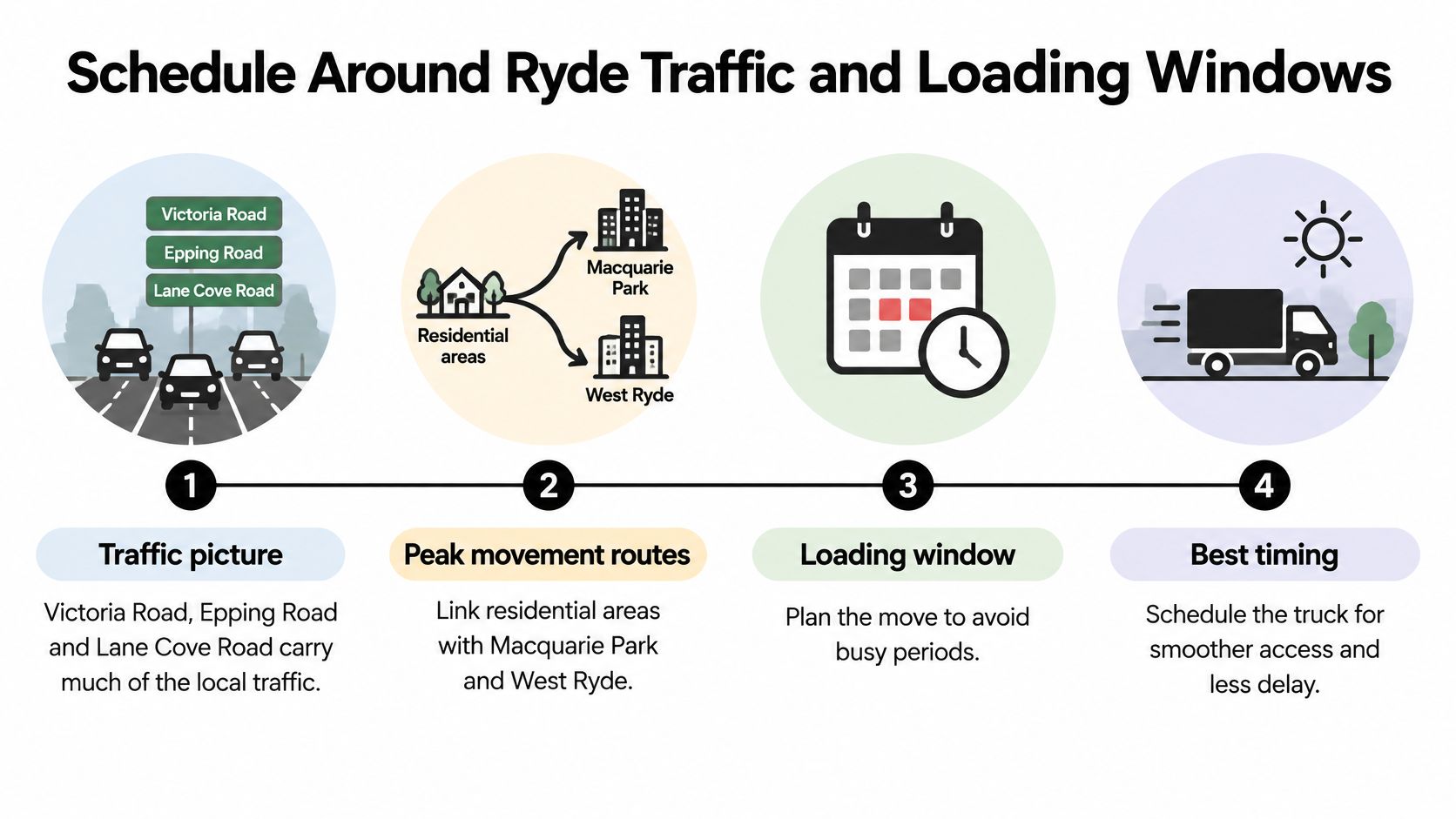
Work Backwards From Moving Day
- 14 days before: Confirm building loading access, lift rules and strata requirements in writing.
- 7 days before: Check the selected truck against street width, turning space and driveway geometry.
- 1 day before: Confirm the arrival window, contact numbers and exact loading point with your removalist.
- On the day: Allow a parking buffer and have the first load ready near the entry.
Compare two Macquarie Park apartment starts. A 7am arrival can let the crew secure the loading area and start before heavier commuter and commercial traffic builds. A 10am arrival may suit the building but land after school run congestion and compete with deliveries, trades and other residents moving through shared access points.
Neither time is automatically right. The best arrival time is the one the building and the road both allow, with enough buffer for the slowest part of the route. Choose vehicle size for street geometry and site constraints, not maximum available capacity.
How to Plan Safe Lifting on Moving Day
Safe lifting isn't a poster in the truck. It's the difference between a controlled move and a tired crew rushing a wardrobe down stairs because the load plan was wrong. Bulky, heavy or repeated loads through narrow corridors and uneven access routes create risk for people first, and damaged furniture usually follows the same poor handling.
The Safe Work Australia model code of practice for hazardous manual tasks recommends reducing load size, shifting larger loads mechanically, and using purpose-specific grip devices. It identifies pushing as preferable to pulling because it generally reduces lower-back muscle effort, permits greater use of body weight, supports a more forward-facing posture and improves visibility in the direction of travel.
The process below sets out the controls to arrange before the first box moves.
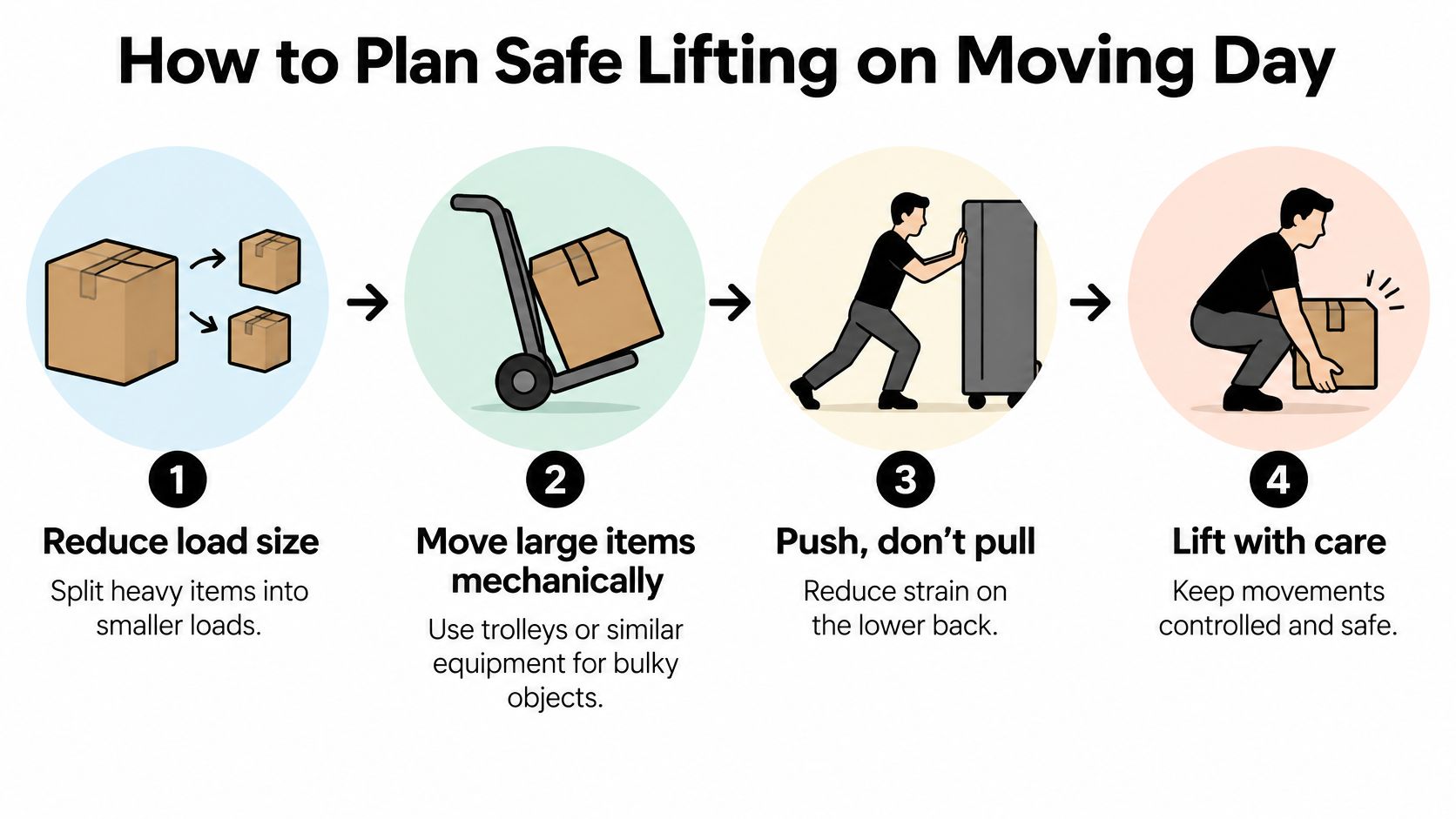
Six Steps That Prevent Most Problems
- Survey every item first: Record dimensions, mass, stairs, lift access, turning space and floor changes, because those details decide crew size and equipment. The common slip is measuring furniture but not the tightest doorway or stair landing.
- Break dense cartons down: Split books, tools and kitchenware into smaller units so no single box invites an awkward lift. A box that one person can barely raise shouldn't be carried just because it's already sealed.
- Set up the equipment: Place trolleys on maintained paths, prepare straps for furniture and arrange lift assistance for oversized pieces. Don't drag a trolley across broken pavers or loose thresholds and call it mechanical handling.
- Push wheeled loads where conditions permit: Keep the load ahead of you, maintain a forward facing posture and preserve a clear view of the route. Pulling around a blind corner saves seconds and creates exactly the twisting movement you're trying to avoid.
- Team lift with agreed signals: Decide who calls the lift, who leads on stairs and where the item will be set down before anyone picks it up. Practical guidance on how to move heavy furniture is useful, but oversized pieces may still need extra crew rather than extra effort.
- Protect the route: Cover corners, doorframes and floors, then mark one clear stair and hallway path for the whole crew. Changing routes midway leads to overreaching, sudden movements and furniture being turned in spaces that weren't checked.
Practical rule: If a lift needs speed to succeed, the load, crew or equipment choice is wrong.
Reducing awkward postures, repetitive bending and overreaching lowers musculoskeletal risk and also reduces dropped or impact damaged furniture. Success looks unremarkable. The crew finishes without strain, the route stays clear, and your furniture arrives without scuffed corners or a last minute repair conversation.
Office, Warehouse and Interstate Moves from Ryde
Commercial and long distance moves fail in different ways from home removals. The furniture still matters, but records, stock weight, operating hours and route approvals can matter more. Treat those items as part of the quote, not as details to sort out while the truck is being loaded.
For office relocations, start with physical records. The NSW Government recordkeeping guidance for relocating records says organisations should assess the physical records affected by the move, determine how those records are controlled and check whether they are covered by a current disposal authority. Inventory and classify files before packing, label boxes to match, and keep control of sensitive client information during loading, transport and any move into commercial secondary storage.
Weight, Routes and Destination Access
Warehouse quotes should list pallet jacks, racking handling and out-of-hours scheduling explicitly. A vehicle can have enough floor space for pallets and still be unsuitable if the load exceeds its rated mass or axle conditions.
Transport for NSW mass limits guidance states that General Mass Limits are the default mass limits applying to heavy vehicles unless an accreditation or exemption applies, and operators travelling outside the approved heavy vehicle network must obtain a permit. Carton weight, appliances and stored stock can therefore change both truck selection and route approval.
For interstate removals, ask the removalist to confirm that the chosen combination suits the Sydney pickup, the destination address and any approved route requirements before the quote is final. The process for interstate moving with Sydney's trusted removalists should make those checks explicit, including turning space, driveway access and loading zones at both ends.
Plan for Weather, Delays and Failed Access
The cheapest or earliest moving slot isn't automatically the lowest risk option. Heavy rain changes grip underfoot, weakens cardboard, makes ramps and trolleys harder to control, and can turn a marginal loading area into an unsafe one. A decision to proceed should be deliberate, not driven by the fear of losing a booking.
The weather scenario pictured here is exactly when a backup plan needs to already exist.
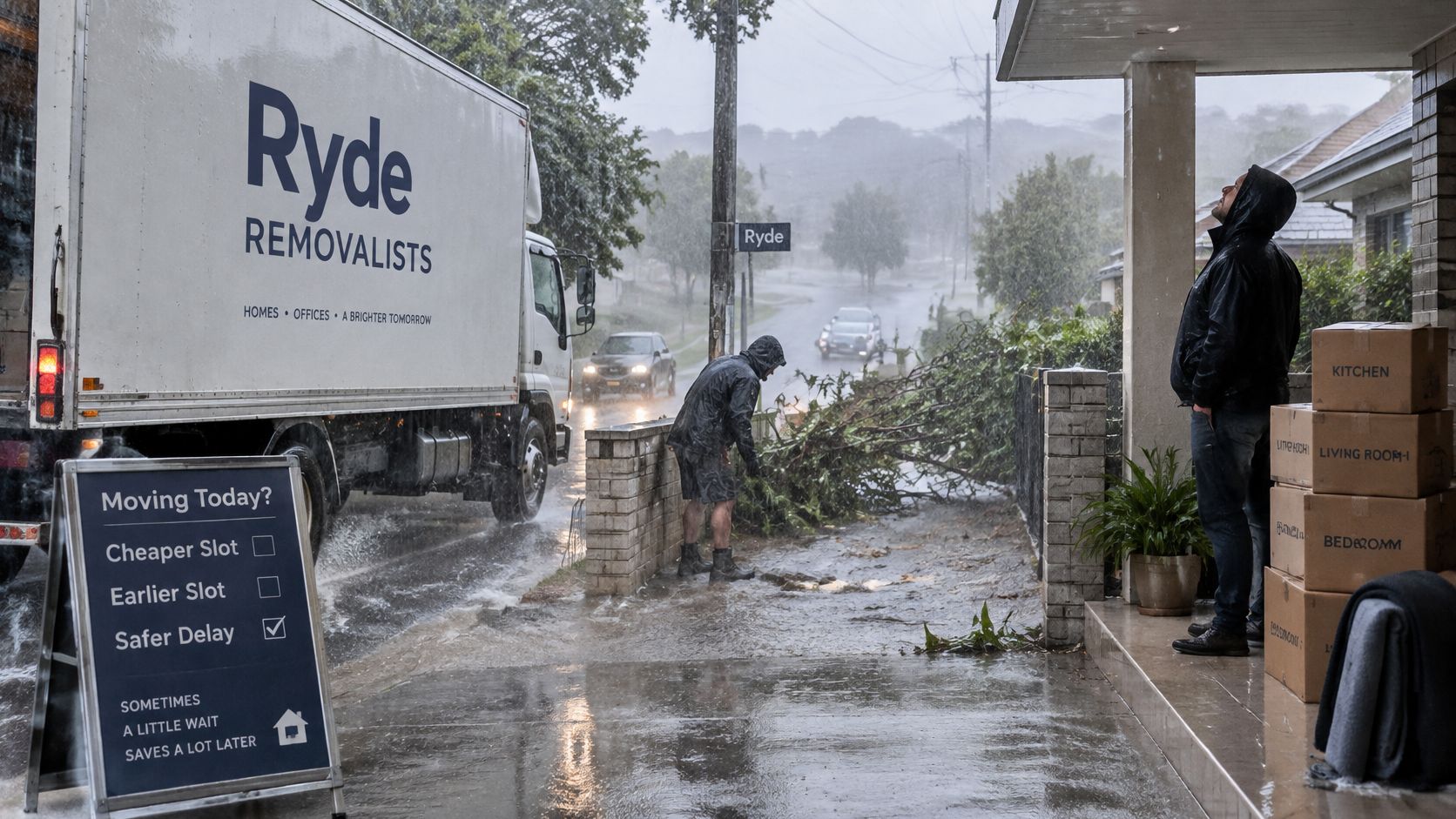
The City of Ryde guidance for heavy rainfall and floods advises residents during heavy rainfall to remain inside, avoid unnecessary travel, and follow current SES warnings. A severe weather warning covering your route should trigger a review with your removalist, not an automatic go ahead.
Set Your Postponement Triggers Early
- SES warning on the route: Pause and reassess timing, route and whether travel is necessary.
- Unsafe building access: Postpone if stairs, ramps or loading areas can't be used safely.
- Flooded or blocked loading area: Switch to an agreed alternative access point or reschedule.
- Delayed settlement or lease handover: Use temporary storage as the buffer instead of unloading into an unavailable property.
If the move proceeds in wet conditions, protect floors and lift walls with waterproof covers, seal electronics and books inside dry boxes or plastic tubs, and stage items inside rather than on wet ground. Agree in writing how many hours' notice either side needs to postpone, who makes the call, and whether storage is available that day.
Ryde's Park'nPay live parking availability, including accessible parking data for Macquarie Park, Eastwood and West Ryde, can help you check parking conditions near the destination. It won't reserve a loading zone for you, but it can warn the crew that the planned area is already under pressure. Before moving day, ask one direct question. What's the plan if access or weather stops us?
Request Your Ryde Removal Quote Today
You've now made the three decisions that shape a reliable quote. You've identified the service type, checked the vehicle against access, and chosen a timing window that the building and road can support. The quote request should use those details rather than starting again with a vague bedroom count.
Home Removals Sydney offers a free online quote, and a specialist gets in touch shortly after the form is filled in. Our pricing has no hidden costs. For context, a 1 Bedroom Home move costs $120/hr + GST with 2 removalists, an 18-23m capacity and a 4.5t truck, while your final figure depends on inventory and access.
Include your bedroom count, stairs or lift details, parking and loading zone needs, packing requirements and any storage between homes. Add pianos, antiques, large appliances and items needing disassembly, because those details affect crew and equipment more than another small box does.
Compare the itemised quote against the vetting questions on insurance, inclusions, claims, weather postponement and crew arrangements. Once access and timing are confirmed, lock in moving day with the details in writing. Request your Ryde removal quote today so your date, vehicle and loading plan can be matched properly across Sydney or interstate.
Ready to book Ryde removalists who plan around your building, street and moving window rather than just quoting an hourly rate? Visit Home Removals Sydney to request your free online quote for home removals Sydney, furniture removals Sydney, office relocations, storage or interstate removals, and a specialist will contact you to confirm the right crew and truck for your move.
