


A Sydney household can do everything right and still be startled by an interstate removals quote. The house is packed, the destination is known, and yet the price sits well above what a local move would cost. That reaction is understandable because interstate pricing combines distance, volume, access, labour, truck availability and timing in ways that aren't obvious from a short online estimate.
A budget move doesn't mean accepting careless handling or an unreliable arrival date. It means deciding where flexibility matters, removing items you don't need, comparing like-for-like quotes and paying for protection where a mistake would cost more than the saving. The following guide focuses on the decisions that make the biggest difference for Sydney homeowners, renters, businesses and anyone arranging furniture removals or office relocations interstate.
Why Interstate Moves Cost So Much and Where the Money Goes
A family moving from western Sydney to Melbourne might start with a simple assumption: the removalist is charging for the hours spent carrying furniture. In reality, the quote also reflects the truck's route, the amount of space reserved, loading and unloading conditions, the return journey, fuel, scheduling risk and whether the crew is handling a full-service move or only transport.
Distance is the least flexible part of the calculation. Load size, service level, access and dates are the levers customers can influence. A household that removes a bulky spare-room suite and packs its own books may need less truck space. A customer who can accept a pickup within a wider window may make a shared truck practical. Someone who needs a guaranteed date, packing, storage and specialist handling will pay for that certainty.
Road-tested advice: The cheapest quote is rarely the one with the fewest dollars printed at the top. It's the quote that matches the actual job and leaves the fewest expensive surprises for moving day.
The biggest overpayments usually come from avoidable mismatches. A small load booked as a dedicated truck pays for unused capacity. A vague inventory leads to a revised estimate when the crew sees extra furniture. A fixed Saturday pickup can remove the scheduling options that make a backload affordable. Customers also sometimes compare a transport-only figure with a quote that includes packing, stairs, protection and placement inside the new property.
For a useful explanation of the main cost components, see this guide to interstate moving costs in Sydney. Use it as a starting point, then ask each removalist to explain how the same five questions affect your own move: How far is it going? How much is being moved? How difficult is access? What service do you want? How flexible are your dates?
A lower budget should remove waste, not care. The practical aim is to spend on the parts that protect your furniture and schedule, while taking control of the parts that don't need to be outsourced.
Understanding What Shapes Your Interstate Removals Quote
A quote can look cheap until the job is priced properly. Distance sets the route cost, volume determines truck space, access affects labour, and service level determines how much work the removalist performs. A ground-floor townhouse with a compact load is a different job from a large home with narrow stairs, a long carry and fragile artwork.
Your transport arrangement also changes the price. A truck travelling between major cities may have room to combine loads, while a dedicated vehicle is reserved for one customer and scheduled around that customer's requirements. Backloading generally requires more flexibility around pickup and delivery. A dedicated truck gives you greater control over timing, but you pay for the reserved capacity.
A 2026 Australian pricing guide puts interstate moves broadly between A$2,500 and A$9,500 or more, depending on the route and volume, as outlined in this Australian interstate removal pricing guide. Its route benchmarks include:
- Sydney to Melbourne flexible backload: about A$1,400 to A$2,200.
- Sydney to Melbourne fixed-date dedicated truck: about A$2,600 to A$4,200.
- Smaller flexible east-coast to Perth load: about A$3,200 to A$4,800.
- Larger dedicated east-coast to Perth move: about A$9,000 to A$14,000.
- Removalist labour: generally A$111 to A$200 per hour, with fuel levies of 5% to 20% often added.
These figures are benchmarks, not promises. Your inventory, access conditions, packing requirements and delivery arrangements can shift the final amount substantially. The main decision is whether you want to trade date control for available truck space.
Interstate moving options and typical price bands
| Option | Typical Price Band | Best For | Trade-off |
|---|---|---|---|
| Flexible backload | A$1,400 to A$2,200 for Sydney to Melbourne | Smaller loads and customers with adaptable dates | Pickup and delivery timing may be less precise |
| Fixed-date dedicated truck | A$2,600 to A$4,200 for Sydney to Melbourne | Full homes, firm settlement dates and businesses | You pay for reserved capacity |
| Smaller flexible long-distance load | A$3,200 to A$4,800 for east-coast to Perth | Customers moving fewer possessions over a long route | Flexibility is needed to match available space |
| Larger dedicated long-distance move | A$9,000 to A$14,000 for east-coast to Perth | Larger homes and tightly controlled schedules | Highest transport commitment |
| Full-service option | Varies with route, volume and inclusions | Customers needing packing, loading, transport and placement | More labour and services increase the quote |
Before accepting a figure, ask whether the hourly rate covers loading and unloading only, or also travel and waiting. Check whether the fuel levy is included, and whether stairs or difficult access add labour. Confirm whether dismantling, reassembly, packing materials and storage are separate line items.
Insurance deserves the same attention. Ask what protection is included, what exclusions apply, and whether you need extra cover for fragile or high-value items. A clear quote shows where you can reduce the job, without discovering the true cost after the truck arrives.
Timing Your Move to Gain Backloading Savings
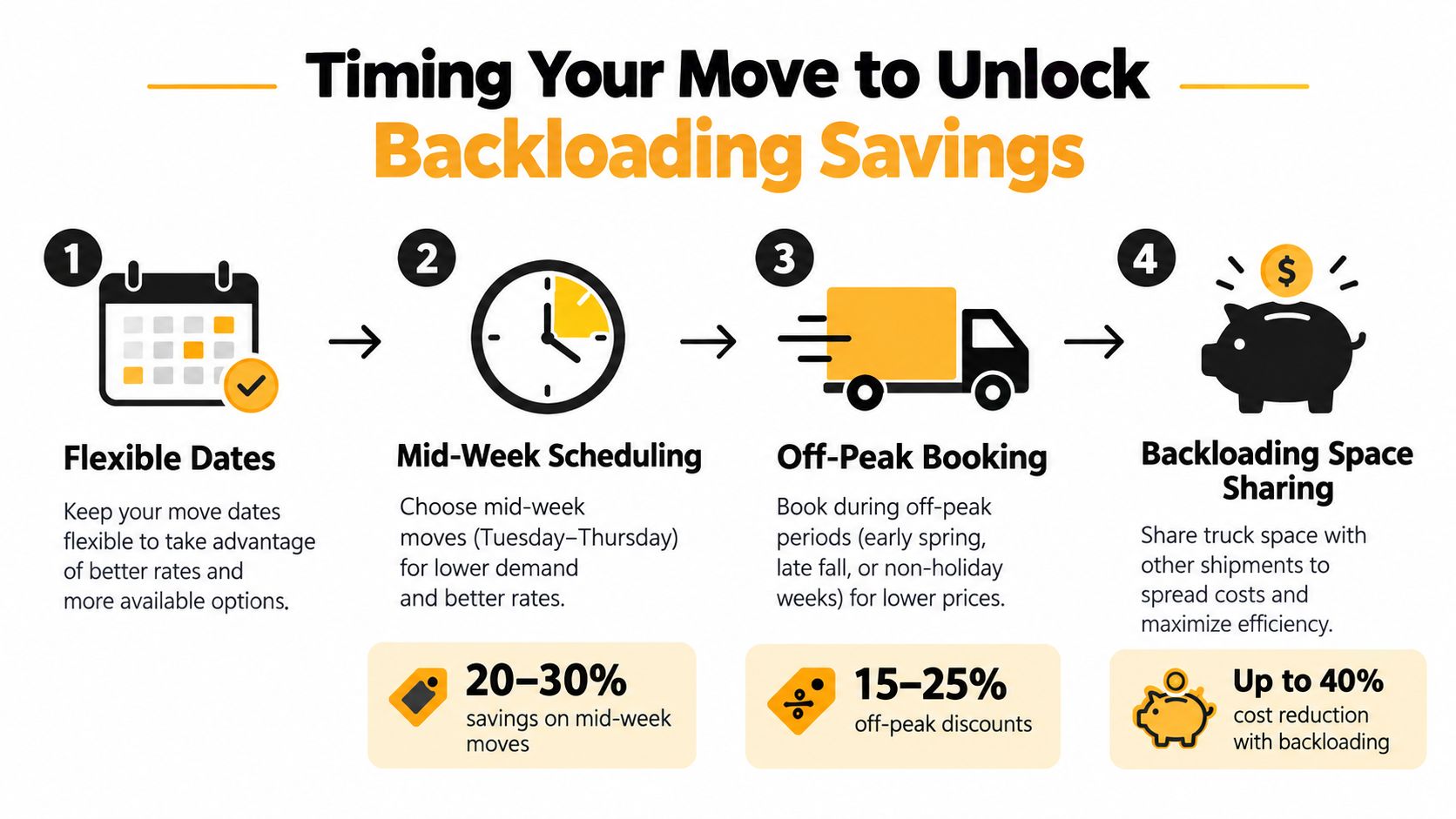
A fixed settlement date can force you into a dedicated truck, even when a shared load would cost less. If your dates have room around them, that flexibility can match your furniture to a truck already travelling between cities. The saving comes from using available capacity, but the trade-off is less control over pickup and delivery timing.
The latest population figures show why route-based scheduling can work for Sydney customers. In the 12 months to March 2026, NSW recorded 85,880 interstate arrivals and Queensland recorded 98,121, according to the Australian Bureau of Statistics population release. At the same time, between 2016 and 2021, only 10.9% of Australians who changed address moved to a different state. Interstate moves are a minority of all address changes, so removalists must match loads carefully rather than assume a return trip will be available.
A practical timing sequence
Start with a date window, not one date. Give the removalist the earliest and latest acceptable pickup and delivery dates. A wider window creates more opportunities to place your load on an existing route.
Ask about mid-week availability. Weekend bookings suit many households, but weekdays may fit truck movements more easily. Request a clear comparison rather than assuming a particular day will cost less.
Discuss quieter periods. If your lease, settlement and work commitments allow some movement, ask whether another period offers a suitable shared-load option. The saving comes from better truck utilisation, not from cutting loading standards.
Define “backload” before booking. Ask whether your goods share space with another consignment, how the pickup order works, how much delivery notice you receive and what happens if the route changes. A low quote is only useful when the service window works for your household.
A Sydney to Melbourne customer with a small, measured load might see a dedicated-truck quote in the A$2,600 to A$4,200 range, while a flexible backload benchmark sits around A$1,400 to A$2,200, based on the 2026 pricing guide. That gap is not a guaranteed discount. It reflects the difference between paying for reserved capacity and cooperating with the carrier's existing route.
Insurance can expose a second budget gap. Shared transport may suit the price, but check what happens if goods are delayed, damaged or excluded under the carrier's standard cover. Ask for the protection details and exclusions in writing before choosing the cheapest option.
For further route-planning ideas, compare the practical options in this guide to the cheapest way to move interstate. Put the agreed service window and insurance terms in writing before paying a deposit.
Decluttering and Packing to Shrink Your Load
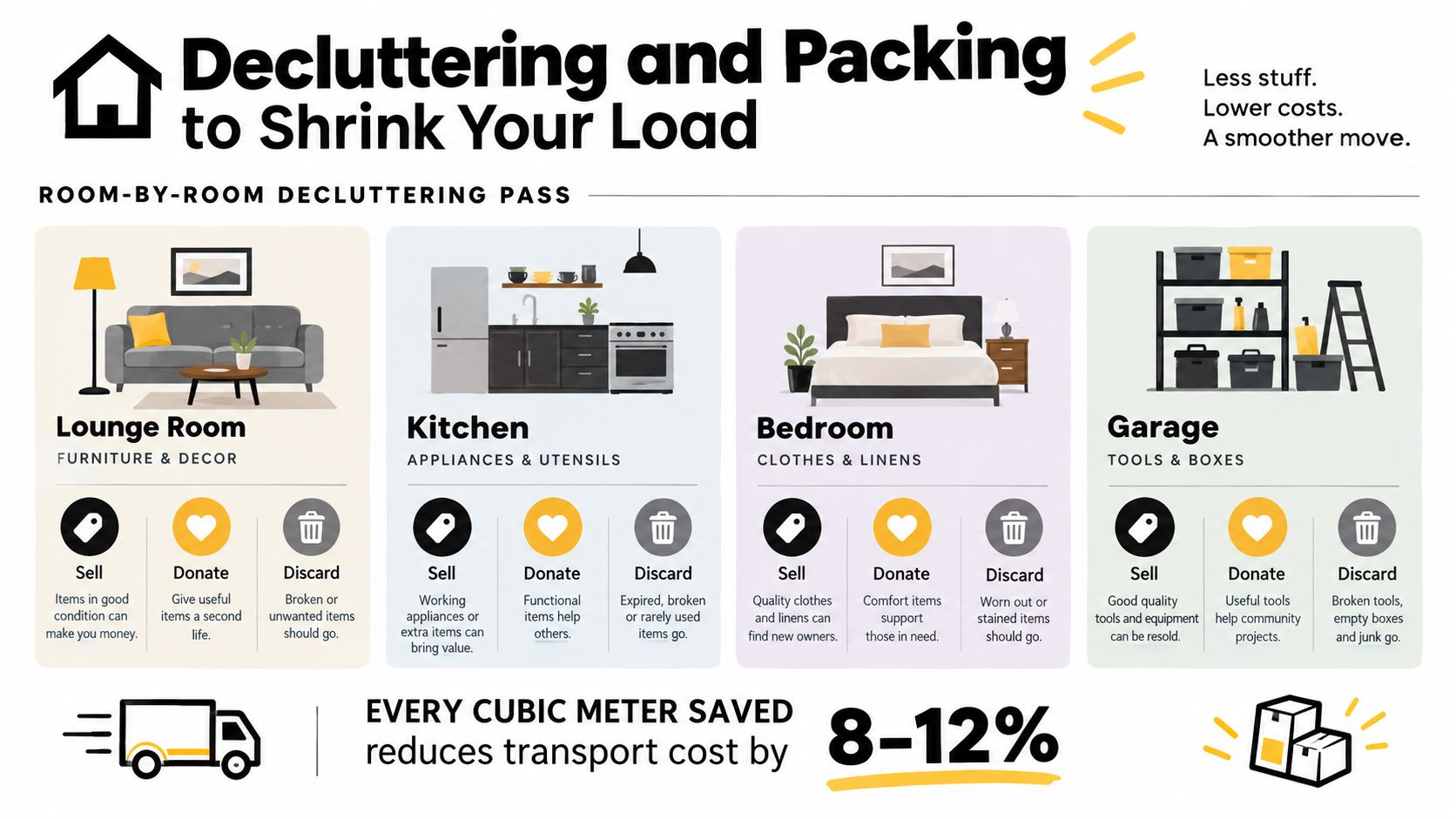
The best time to save on transport is before you contact removalists. Walk through the property with a phone camera and a simple list. In each room, separate items into sell, donate, discard and move. Don't pack something just because you've owned it for years. If it no longer fits the next home, moving it interstate only transfers the disposal problem and adds handling to the job.
In the lounge room, review spare chairs, unused side tables, old entertainment units and decorative items. The kitchen often contains duplicate appliances, chipped crockery and utensils that haven't been used for a long time. Bedrooms call for a firm look at clothes, linen and bulky storage pieces. Garages are where customers often find incomplete tools, empty boxes and items kept for a future project that never started.
The ABS recorded that 1.14 million Australian households, or 12% of all households, moved at least once in the previous 12 months in 2019–20, while 7% of those recent movers came from a different state or territory, according to the ABS housing mobility data. That creates a substantial moving population, but interstate capacity still has to be matched to the size and timing of each load.
A packing plan that protects the budget
- Pack ordinary items yourself: Books, clothing, towels and non-fragile kitchenware can usually be organised at your own pace. Use strong cartons, avoid overfilling them and keep heavy contents in smaller boxes.
- Use household materials intelligently: Towels, blankets and jumpers can cushion suitable items, while labelled cartons make unloading faster. Ask your removalist whether boxes and bubble wrap are available before buying supplies elsewhere.
- Label for the destination: Mark each box with the room, contents and priority. “Kitchen, everyday items” is more useful than “miscellaneous”.
- Separate essentials: Keep medication, documents, chargers, basic toiletries and a change of clothes with you. That reduces pressure to unpack every carton immediately.
- Pay for specialist packing where mistakes are costly: Pianos, antiques, artwork, glass and unusual furniture may need experienced handling, purpose-built protection or a different loading position.
A room-by-room decluttering guide before moving house can help you keep the process objective. Photograph valuable or delicate items before packing, and tell the removalist about anything that needs disassembly or special protection. Self-packing saves labour, but poor packing can increase breakage risk and make a claim harder to assess.
Comparing Interstate Removalists Quotes the Smart Way
A quote comparison only works when every removalist prices the same job. Send each company the same inventory, route, access notes and preferred date window. Include lifts, stairs, loading zones, long carries, parking restrictions, fragile items, storage needs and whether you want packing or furniture assembly.
Request at least three itemised quotes. The aim isn't to create a race to the lowest number. It's to identify what each provider has included and which costs are merely sitting outside the headline figure.
What to put in a useful quote request
A good request can be short, but it must be specific:
- Property details: suburb, property type, floor level, stairs, lifts and access restrictions.
- Inventory: major furniture, appliances, cartons and items requiring dismantling.
- Route: Sydney pickup suburb, destination suburb and whether delivery access differs.
- Timing: fixed date or flexible window, plus any settlement or lease deadline.
- Service level: transport only, loading and unloading, packing, unpacking, storage or placement.
- Special handling: pianos, antiques, artwork, glass, commercial equipment or office technology.
A fast quote form is useful when it captures those details instead of producing a generic figure. A short online form, followed by a prompt conversation about inventory and access, is more valuable than days of back-and-forth emails that never clarify the assumptions.
Biggest red flag: A quote that is dramatically cheaper but won't explain what happens with fuel, stairs, waiting time, insurance, storage or extra volume isn't a bargain yet. It's an incomplete comparison.
Ask whether the price is fixed, estimated or calculated hourly. Confirm cancellation terms, payment timing, delivery conditions and the procedure for damage or missing items. Read the written terms before paying a deposit, particularly if the quote uses phrases such as “subject to inspection” or “from”.
Insurance deserves its own line in the comparison. Customers reviewing cover and exclusions may also find this moving insurance resource from My Policy Quote useful when deciding whether their existing policy is adequate. Don't assume a household contents policy automatically covers goods in transit or storage. Ask the insurer and the removalist to state the position clearly.
Insurance and Storage Trade-Offs Worth Paying For
Insurance is where a cheap interstate move can become expensive after the fact. In NSW, removalists aren't legally required to provide insurance for a customer's property during a move, and the NSW Government recommends arranging your own cover. An AFRA-accredited removalist may be able to arrange public liability and transit insurance for goods in the truck, including goods held in storage, but a storage extension is usually charged as a separate premium. The NSW Government's removalist guidance sets out this distinction.
That means “insured removalist” and “your belongings are fully insured” aren't automatically the same statement. Public liability insurance may protect against particular liabilities involving people or property, while transit cover relates to the goods being moved. Ask who provides the policy, what value basis applies, what exclusions exist, whether an excess applies and how storage changes the cover.
CHOICE also warns that removalists don't have to insure possessions and that AFRA-accredited operators may arrange transit insurance, with an extra premium needed when goods remain in storage. Treat cover as a separate buying decision, not a line you can safely ignore because the company has insurance of some kind.
When storage earns its place
Storage can be budget-smart when it prevents a rushed sale, allows a settlement gap to close or gives you time to prepare the destination. It can also suit a staged office relocation, downsizing project or household moving into temporary accommodation. In those situations, paying for secure handling may avoid hiring a second truck, replacing furniture bought in haste or forcing a move into an unsuitable property.
Storage is less useful when the new property is ready, access is confirmed and the move can be completed directly. Unnecessary storage adds handling, transport coordination and another point at which goods need protection. Ask whether access is available when you need it, how the goods are wrapped or stored, and whether insurance continues during the storage period.
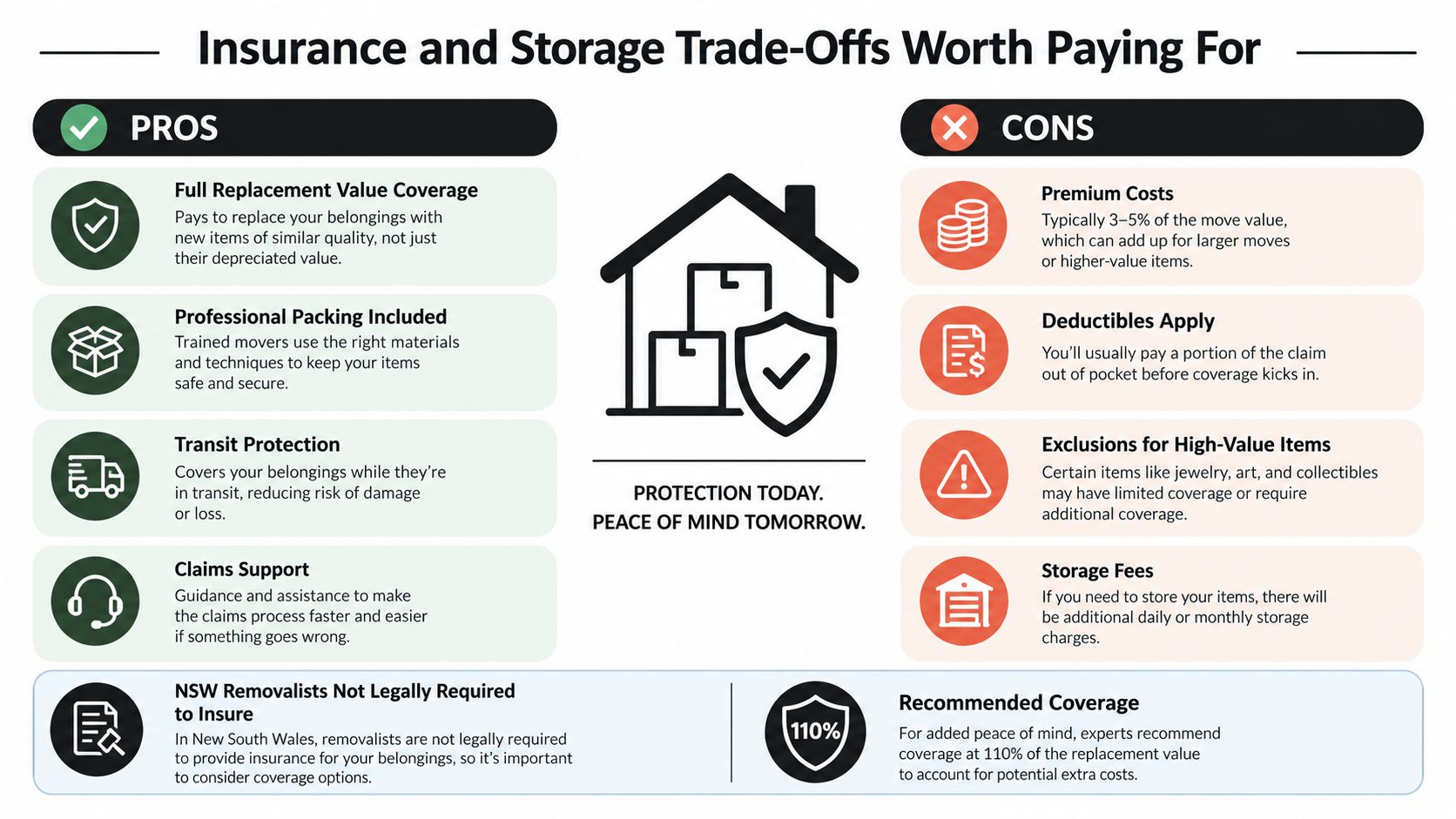
The sensible budget decision isn't always “take the cheapest cover” or “skip storage”. It's to match protection to consequence. A low-value, replaceable load with a direct move may need a different approach from a home containing irreplaceable artwork, antiques, business records or equipment that can't be replaced quickly.
Your Budget Interstate Move Action Plan
Start with the load, not the truck. Declutter each room, sell or donate suitable items, and create an honest inventory before requesting prices. Pack ordinary belongings yourself if you're comfortable doing so, but identify fragile and specialist items early.
Then set your scheduling position. If you can accept a flexible pickup and delivery window, ask for backload options and compare them with a dedicated vehicle. If your settlement or office opening date is fixed, price the certainty rather than assuming a flexible service will meet it.
Use this order:
- Prepare the inventory and access details.
- Request three itemised quotes using the same information.
- Check labour, fuel, stairs, packing, storage and delivery assumptions.
- Choose transit cover and confirm exclusions in writing.
- Book the service, date window and payment terms only after reviewing the written quote.
For Sydney homeowners, renters, businesses and office managers, the right budget interstate removals plan is transparent about both savings and trade-offs. A reliable quote should tell you what the crew will do, when they'll do it and what protection applies if the plan changes.
Home Removals Sydney provides Sydney-to-interstate moving support with flexible scheduling, packing and unpacking, furniture assembly, specialist handling and secure storage options. Request a customised quote through Home Removals Sydney and share your inventory, access details and preferred date window so the team can price the move accurately.
