

You're probably standing in a hallway right now, looking at a grand piano and wondering how on earth it's going to get out of the house without damage, drama, or a blown-out quote. In Sydney, that's the right instinct. A grand piano isn't just another bulky item, it's a specialist move, and the difference between a clean job and a disaster usually comes down to access, preparation, and the right crew.
If you're comparing Removalists Sydney, Home removals Sydney, or Furniture removals Sydney providers, treat a grand piano like its own category. The instrument's weight, shape, finish, and internal mechanics make it closer to a controlled handling job than a standard lift, and that's especially true in older Sydney homes, terraces, and apartment blocks. A general moving team can do fine with boxes and couches, but a grand piano asks more from the team, the gear, and the plan.
Why Grand Piano Removals in Sydney Are Their Own Specialist Job
A family in the Inner West can have everything else packed and ready, then hit one object that changes the whole moving day, the grand piano wedged at the top of a narrow terrace stairwell. That's the moment people realise this isn't a normal furniture move. The piano doesn't forgive rough handling, and Sydney properties don't always give you much room to work with.

Why general furniture movers get this wrong
A grand piano is not just heavy, it's awkward in all the wrong ways. In Sydney and NSW, grand pianos commonly weigh 300 to 600 kg, which is exactly why specialist handling, extra labour, and access planning matter so much, especially in homes with stairs or tight circulation space, as outlined in this NSW piano removal guide. The polished finish can scratch, the action can shift, and the casework can rack if the load isn't controlled properly.
Practical rule: if a mover talks about “just lifting it carefully”, that's not enough. A grand piano needs a plan before the first hand touches it.
This is why grand piano removals Sydney jobs sit above ordinary household moves. The work is closer to a small engineering task than a standard carry. You need the right people, the right equipment, and a crew that can read the staircase, the doorway, and the floor plan before they commit to a route.
What you should expect from a proper specialist
A competent team will ask about access first, not price first. They'll want to know where the piano sits, how many steps are involved, whether there are turns, and whether the move is ground-floor, upstairs, or a long carry from kerb to door. That's not overcautious, it's how they avoid damage and surprises.
For Sydney homeowners, the key takeaway is simple. If a removalist treats a grand piano like any other object, keep looking. A proper specialist treats the move as a controlled operation, because that's what it is.
What the Grand Piano Removal Process Looks Like
The job starts before anyone touches the piano. A serious removalist checks access, measures the turning points, and decides whether the piano can be carried straight through or needs a hoist or crane solution. That first assessment sets the pace for the day, and inexperienced crews usually get caught by it.

The physical sequence on moving day
First, the crew checks the room, the exits, and the truck path. They remove the legs and pedal assembly from the grand piano before lowering the main body into a transport-safe position, which reduces height and makes the instrument easier to control through narrow Sydney doorways, as described by Delivery Kings' Sydney piano handling guidance. After that, the body gets wrapped, padded, and secured to a skid board or piano board, which keeps the load rigid while it is moved.
That stage earns its cost. The piano has to stay stable while it is angled, rolled, and guided around obstacles. If the crew rushes, the frame takes torsion, the casing gets bumped, or the finish picks up a scrape. Good removalists move in short, controlled stages, with one person calling the lift and the others keeping the piano balanced.
A proper crew pauses before every major turn and checks the line again. If nobody is calling the next move, they are improvising.
For a local Sydney job, the on-site handling is usually a short, concentrated window rather than an all-day affair. The risky moments stay the same, the first lift, the doorway, the staircase or ramp, and the final placement in the new room. Once the piano is off the truck and back on a level surface, the crew still has to place it without twisting the frame or knocking the action out of alignment.
If the access is severe, the removal changes shape fast. Tight stairs, awkward landings, or a difficult first-floor exit can push the job into a different handling method, which is why crews that know difficult Sydney properties use the assessment phase to decide the route before they commit to the move. More detail on those kinds of access jobs is covered in this dedicated Sydney piano removals guide.
How Much Grand Piano Removals Cost in Sydney
A quote for a grand piano move in Sydney changes fast once access gets difficult. For a local metro move, grand piano removals are typically $500 to $800+, while a baby grand is usually $300 to $600, and interstate grand piano jobs from Sydney to Melbourne or Brisbane often sit around $1,100 to $1,500, according to Home Removal Sydney's pricing guide. Airtasker's 2026 Sydney data also places piano removals in a broad specialist band, with Sydney estimates of $500 to $900 and local moves of 0 to 70 km commonly costing $150 to $650 depending on access and labour time, as shown on Airtasker's piano removals cost page.
What changes the quote
The biggest price swing comes from access geometry, not distance alone. Stair flights, tight turns, low overhead clearance, and narrow doorways all slow the job down and raise the risk. NSW pricing guidance says stairs commonly add $50 to $150 per flight, and more complex grand piano work can rise to $550 to $900 locally, which lines up with The Quote Yard's NSW piano removalist cost guide.
That is why two Sydney suburbs can produce very different numbers. A ground-floor move with a short carry is straightforward. A terrace house with a narrow stairwell and a sharp turn at the landing is not. If a quote ignores those details, treat it as incomplete.
Read the quote like a removalist would
Ask for a breakdown of stairs, dismantling, access, travel time, and any hoist or crane requirement. Australian pricing guides note that extras can add 20% to 50% to the final removal cost, which is why the cheapest quote is often the least useful one. Compare the assumptions behind each price, not just the headline number.
| Move Type | Typical Price Range (AUD) | Notes |
|---|---|---|
| Sydney baby grand, straightforward local move | $300 to $600 | Lighter than a full grand, still specialist handling |
| Sydney grand piano, local metro move | $500 to $800+ | Standard specialist band for grand pianos |
| Sydney grand piano, interstate move | $1,100 to $1,500 | Higher labour, distance, and protection requirements |
| Local piano move with easy access | $150 to $650 | Broad range for short moves, depends on labour and access |
For a practical starting point, use Home Removal Sydney's piano removal pricing guide and then test each quote against your actual access. If your stairs are tight or your entry has a hard turn, the number will climb fast. If access is clean, the price stays closer to the lower end.
Specialist Equipment and Handling Methods That Protect the Instrument
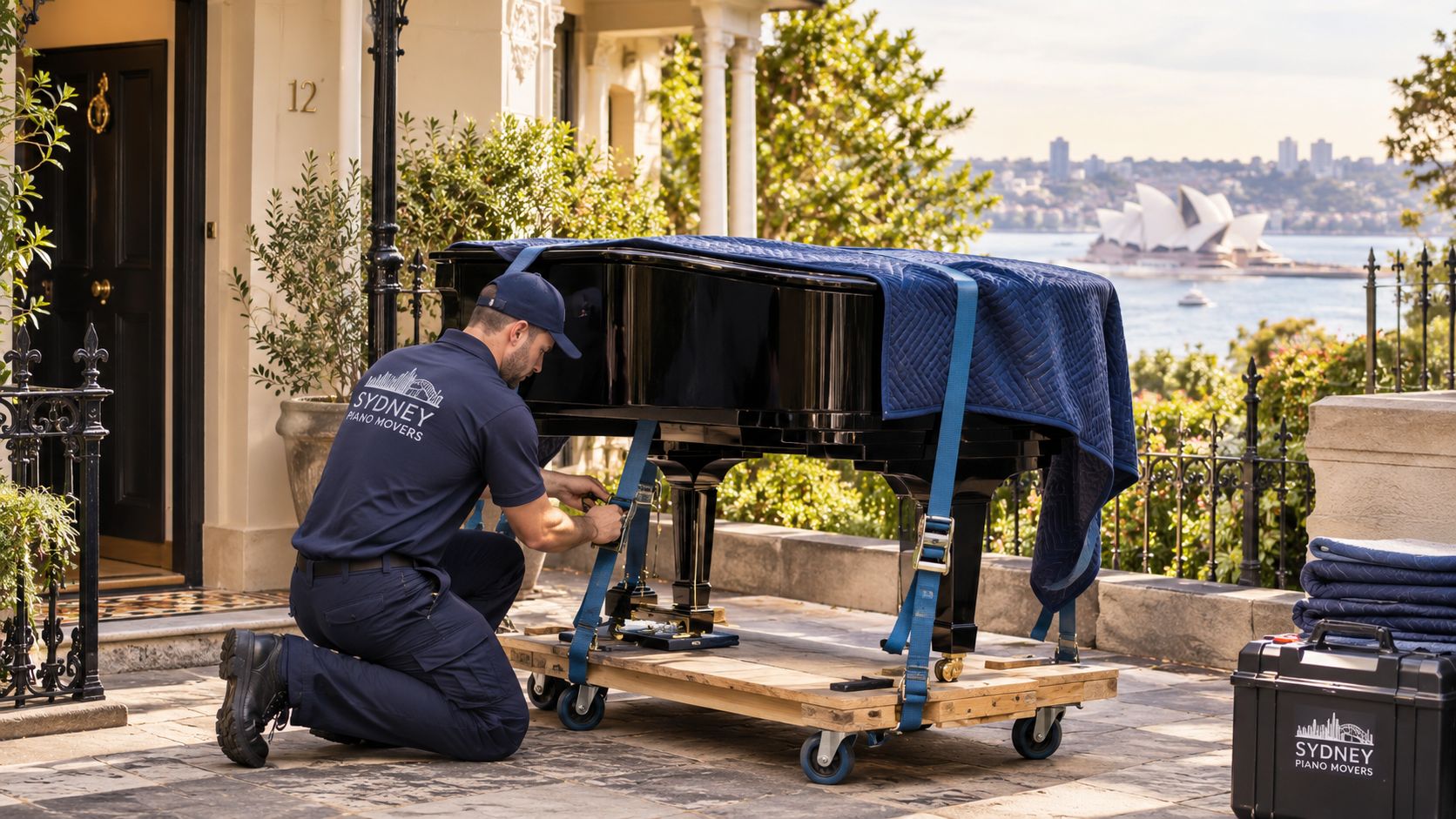
The gear matters because the piano can't absorb mistakes. A specialist mover uses a piano board or skid board, heavy-duty straps, quilted moving blankets, edge protectors, and often ramps or dollies to keep the load stable and the finish intact. Those tools aren't decorative extras, they're what stop the instrument from shifting under load or scraping against a doorway.

How the protection system works
The board gives the movers a rigid base. The straps lock the body into place. The blankets absorb contact and reduce abrasion, while edge protection keeps corners and polished surfaces from taking the hit when the piano passes through tight spaces. That combination is what keeps load distribution under control.
A grand piano should travel as one stabilised unit, not as a loose object held together by muscle.
Lowering the piano onto its side, after the legs and pedal assembly are removed, changes the centre of gravity and makes the instrument safer to transport through narrow access. That's also why the truck loading needs to be deliberate. The body must be braced so it can't shift during transit, especially on uneven Sydney streets where vibration can work against poor packing.
What competence looks like on the day
Watch the padding before the lift. It should stay tight, not sag halfway through the move. Watch the straps too, they should be tensioned properly and checked before loading. Most of all, listen for communication. A good crew talks before each lift and before each change of direction.
If the team is quiet and guessing, that's a bad sign. If they're calling the next move clearly, they're doing the job properly.
For homes with severe access issues, the right equipment still may not be enough on its own. That's where planning and specialist handling intersect, and it's why some Sydney jobs need more than just strong hands. You can see how that plays out in this extreme piano removals page.
When Moving the Piano Is the Wrong Financial Decision
Some grand pianos are worth moving. Some aren't. That's the hard truth most homeowners only reach after they've paid for quotes or started measuring stairwells they should have ignored.

Run the value test before you book
Start with the instrument itself. Is it tunable and structurally sound, or are you already facing repairs, humidity damage, or a case of “it's always been a bit rough”? Then compare that condition against the moving cost. Sydney removal guides put grand piano moves around $500 to $900 for many local jobs, with more complex access pushing it higher, as noted in Airtasker's Sydney piano removals data and Home Removal Sydney's cost page.
If the piano is old, damaged, or hard to access, the better financial decision may be to stop thinking about relocation altogether. A grand piano can be sold on Australian marketplaces, donated to a school, church, or community group, recycled for timber and metal components, or disposed of in a compliant way if it's beyond useful life. That's especially relevant when the removal cost starts eating into, or exceeding, what the instrument is worth.
The decision most people avoid
People get emotionally attached to a piano, and I understand that. But sentimental value doesn't change the handling bill. If the piano is structurally tired and the access is ugly at both ends, paying to move it can be the wrong call.
If the instrument won't justify the move, don't force the move.
A sensible Sydney household will compare the removal quote with realistic resale or donation options, then decide whether the piano deserves a new home or a final exit. That decision is often smarter than paying for a difficult move just because the piano has always been there.
Access, Permits, Insurance and Storage for Sydney Properties
In Sydney, access geometry is the main cost driver. Stairs, narrow terraces, apartment corridors, low clearances, and long carries from kerb to door can change the whole job, and NSW pricing guidance says stairs add $50 to $150 per flight. For many piano moves, the issue isn't miles on the road, it's whether the instrument can physically get out of the building without damage.

Where access turns the job
Older Inner West terraces often create the worst problems, because a few centimetres of clearance can decide whether the piano can be carried or needs a hoist. Apartment buildings can be just as difficult once you add lifts, loading docks, and building rules. If a removalist thinks the staircase is too tight, a crane or hoist is often the safer answer, because it keeps the load off the stairs and reduces the risk of railing damage or tip-over.
Council and building approvals can also matter when a crane is involved. Sydney streets sometimes need parking arrangements or local permissions, and apartment managers may require booking approval for common areas or loading zones. Sort that out early, because it can delay the move more than the piano itself.
Insurance and storage should be confirmed before move day
Insurance is not a checkbox you leave to chance. Ask what's covered, whether the mover relies on carrier's liability or broader transit cover, and how they document the piano's condition before transport. I'd also take clear photos from every side before the crew arrives, because that gives you a baseline if anything gets disputed later.
If you need short-term storage because settlement dates don't line up or renovations are running late, use secure storage with 24/7 access so the piano isn't stranded when the schedule changes. Home Removals Sydney offers fully insured moves and secure storage, which is worth considering if your piano has to sit between addresses, as outlined on its insurance page.
How to Choose the Right Grand Piano Removalist in Sydney
Pick the mover the same way you'd pick a surgeon for a delicate procedure, by evidence, not by a glossy ad. A true Sydney piano specialist should show published experience with grand pianos specifically, carry specialist equipment on arrival, provide insurance documents without fuss, and quote transparently on access variables.
Compare the three options you'll actually see
A dedicated piano mover gives you the most specialist handling, but it can cost more. A generalist home removalist with piano experience can be a good middle ground if they can prove they've done grand piano work before. A marketplace task can look cheaper, but you usually give up accountability, consistency, and proper equipment.
Ask who will actually turn up, what gear they're bringing, and how they price stairs before you accept the quote.
The questions that matter
Ask this on the phone. “Have you moved grand pianos in Sydney before, what equipment will you bring, how do you price stairs and long carries, and what insurance covers the move?” If they dodge any of that, move on. Also ask for recent local reviews that mention piano work by name, not just generic moving jobs.
One workable option in this mix is Home Removals Sydney, which provides home, office, and specialist moves in Sydney and interstate, with insured handling and storage support. Use that as a comparison point, not a shortcut, and still ask the access questions that matter for your property.
Your Pre-Move Checklist and Common Questions
The right prep makes a grand piano move far easier, and the wrong prep drives the price up fast. Start with access at both ends, because stairs, doorway widths, turns, landings, and tight stair geometry usually shape the quote more than the travel distance across Sydney. Measure the route from the truck to the piano, take clear photos of the instrument and the access points, confirm insurance, clear furniture and loose items from the path, and tell the crew exactly how the lid, legs, and pedal assembly are set up.
If your property has narrow internal stairs, a steep rake, or a bend that forces the piano to pivot mid-flight, bring that up before the booking is locked in. That is the sort of detail that turns a straightforward job into a crane or specialist-lift job, and it changes the cost immediately.
FAQ
How far ahead should I book? Book as soon as the move date is firm. If the job needs a crane, especially in parts of the Inner West where access is tight and streets can be awkward for set-up, get the booking in early so the crew can line up the equipment, permits, and crew size without rushing. Last-minute crane work is where delays and higher pricing show up.
Will the piano need tuning after the move? Yes, in most cases. A grand piano settles after it has been moved into a different room or house, and Sydney humidity shifts can make the strings and soundboard react once the instrument sits in its new environment. Give it time to acclimatise, then book the tuning once it has stabilised.
How do I measure a staircase for piano clearance? Measure the clear width of the stair, the landing size, the height under any ceiling or overhang, and the tightest turn on the route. Then check whether the piano can be tilted and rotated without the case or legs hitting the wall, rail, or balusters. If you cannot describe the turning point clearly, send photos and measurements to the removalist before moving day.
What if access is tighter than expected? Stop and let the mover reassess. Forcing the piano through a route that does not fit is how dents, cracked casters, and damaged trim happen. A good Sydney removalist will change the method, call for extra hands, or tell you straight if the access no longer suits the original plan.
How long does a local Sydney grand piano move take? A local move is usually a same-day job, but the handling time depends on the access, stair layout, and whether the piano needs to be pivoted, lifted, or carried over a longer distance from the truck. A short trip with difficult stairs can take longer than a longer trip with clean ground-floor access.
If the cost to move the piano starts climbing because the staircase is awkward, the doorways are tight, or crane access is the only safe option, compare that number with donation or disposal. For a piano that no longer suits the home, the wrong move can be a waste of money, and a clean handover is the better call.
If you've got a grand piano to move in Sydney, do not guess your way through it. Home Removals Sydney can quote on the access, the instrument, and the storage or interstate side of the job, so you know what you're paying for before moving day starts. Visit Home Removals Sydney to request a quote that matches your piano, your property, and your timetable.
