


A $750-a-week Sydney unit can require up to $4,500 in bond and rent in advance before you pay for the truck, cleaner or utility connections. Your moving out budget also needs enough cleared cash for any lease overlap, quoted moving costs and a reserve, without relying on your old bond arriving first.
You might already have the new keys organised while boxes fill the hallway at your current place. The awkward part isn't necessarily what the move costs overall. It's that several payments fall due before any money comes back.
Why a Sydney Move Needs Separate Cash
Say you're changing Sydney units during the same month. The new agent needs the tenancy payments before releasing the keys, your end-of-lease cleaner expects payment on handover morning, and you've arranged electricity at the new address. Your former bond is still tied up in the old tenancy.
Your bank balance has to cover those commitments together. An expected refund won't pay an invoice that's due today, and a credit card limit isn't the same as money available for rent.
A moving out budget is a cash-flow plan, not a line tucked inside weekly rent or a mortgage repayment. It records what must be paid, when it leaves your account and whether you can reasonably expect it back.
Separate the money before booking
Keep the budget in distinct envelopes, even if you manage them in a spreadsheet rather than separate bank accounts.
- Refundable money: The new rental bond belongs here. It's money you need access to now, although a refund may follow when that tenancy ends, subject to any legitimate deductions.
- Launch costs: Rent in advance, cleaning and utility connections help you finish the old tenancy and start the new one. Advance rent pays for occupancy; it isn't another refundable deposit.
- Variable costs: Packing, transport and storage change with your belongings, access arrangements and how much preparation you handle yourself.
This separation prevents a common mistake: treating every payment as a permanent moving expense, then assuming every eventual refund is immediately available.
Cash-flow rule: Build the booking decision around money already available or reliably arriving before payment is due, not money you hope to recover later.
Different moves need different commitments
Homeowners need the same discipline around settlement dates, transport, cleaning and temporary accommodation. Their budget won't necessarily contain a rental bond, but it can still involve overlapping property commitments.
Businesses moving within Sydney or interstate should separate premises payments from the cost of moving furniture, equipment and stock. Office and warehouse leases follow different rules from residential tenancies, so don't apply a renter's bond or notice assumptions to commercial premises.
Keep your current weekly rent, the new asking rent and any written quote beside you. For a unit move, the useful figure is the cash that must be cleared before taking possession, not just the removalist's estimate.
Cash You Need on Move-In Day
Move-in cash for a $750-a-week Sydney unit
| Item | Rule or basis | Amount at $750 a week | Cash type |
|---|---|---|---|
| Rental bond | Up to 4 weeks' rent | $3,000 | Refundable |
| Rent in advance | Up to 2 weeks | $1,500 | Launch cost |
| Holding fee | Up to 1 week and credited if the lease is signed | $750 | Credited to rent |
| Bond plus rent in advance | Statutory maximum before other costs | $4,500 | Mixed |
| One-week lease overlap | Extra rent while two leases run | $750 | Launch cost |
| Two-week lease overlap | Stress test if keys or the old bond are late | $1,500 | Launch cost |
| Contingency | 10–15% of the quoted move | Set after the quote | Cash reserve |
| Former bond | Paid after the old tenancy ends | Don't spend it before it arrives | Later refund |
The question this table answers is how much must be available when payments fall due, even if the former bond is refunded later. The tenancy calculations use the NSW limits, with the official guidance linked in the inventory routine below; the overlap rows are worked scenarios, not additional statutory charges.
Don't add the holding fee to the full advance-rent amount again after it's credited. Record the payment when it leaves your account, then subtract that credit from the rent still payable.
The bond row also needs careful reading. Refundable doesn't mean guaranteed in full, and it doesn't mean accessible during the move. Keep the former bond outside your available-cash total until the refund arrives.
Why the asking rent matters
These aren't low-rent assumptions: Domain's Sydney rental report put median asking rents at $800 a week for houses and $750 for units by December 2025, with unit rents up 7.1% and house rents up 3.9% year on year; the accompanying affordability context records ABS Australian rent growth of 3.8% annually in February 2026.
Use the property's actual asking rent for your own calculation. A citywide median is context, not a quote for the unit you've applied for.
For help organising the recurring side, Fintrack's guide can help you estimate rent and utility expenses. Keep those ongoing bills separate from the money required to complete the move.
Test the payment dates, not just the total
A delayed former-bond refund and overlapping leases are different problems. The delay reduces cash available temporarily; overlapping leases create extra rent that won't come back.
Write the new bond's due date beside the old tenancy's handover date. Then add the cleaner, connection charges, packing, transport and any necessary storage using actual bookings or quotes.
The contingency is cash protection, not a spending target. Don't allocate it to optional purchases before moving day.
Eligible tenants may apply for a Rentstart loan. Public-housing bond arrangements are separate: the Homes NSW rental-bond policy describes a $1,400 cap for public-housing tenants, adjusted annually, which must not be mistaken for the private-rental maximum.
Use the guide to costs beyond the removalists to check for missing invoices. Before accepting the budget, circle the refundable rows and mark the payments that are gone once the service or occupancy has been provided.
How to Build the Budget from the Inventory
Start with the belongings you intend to move. This visual checklist helps you identify the items that change the labour and truck requirements.
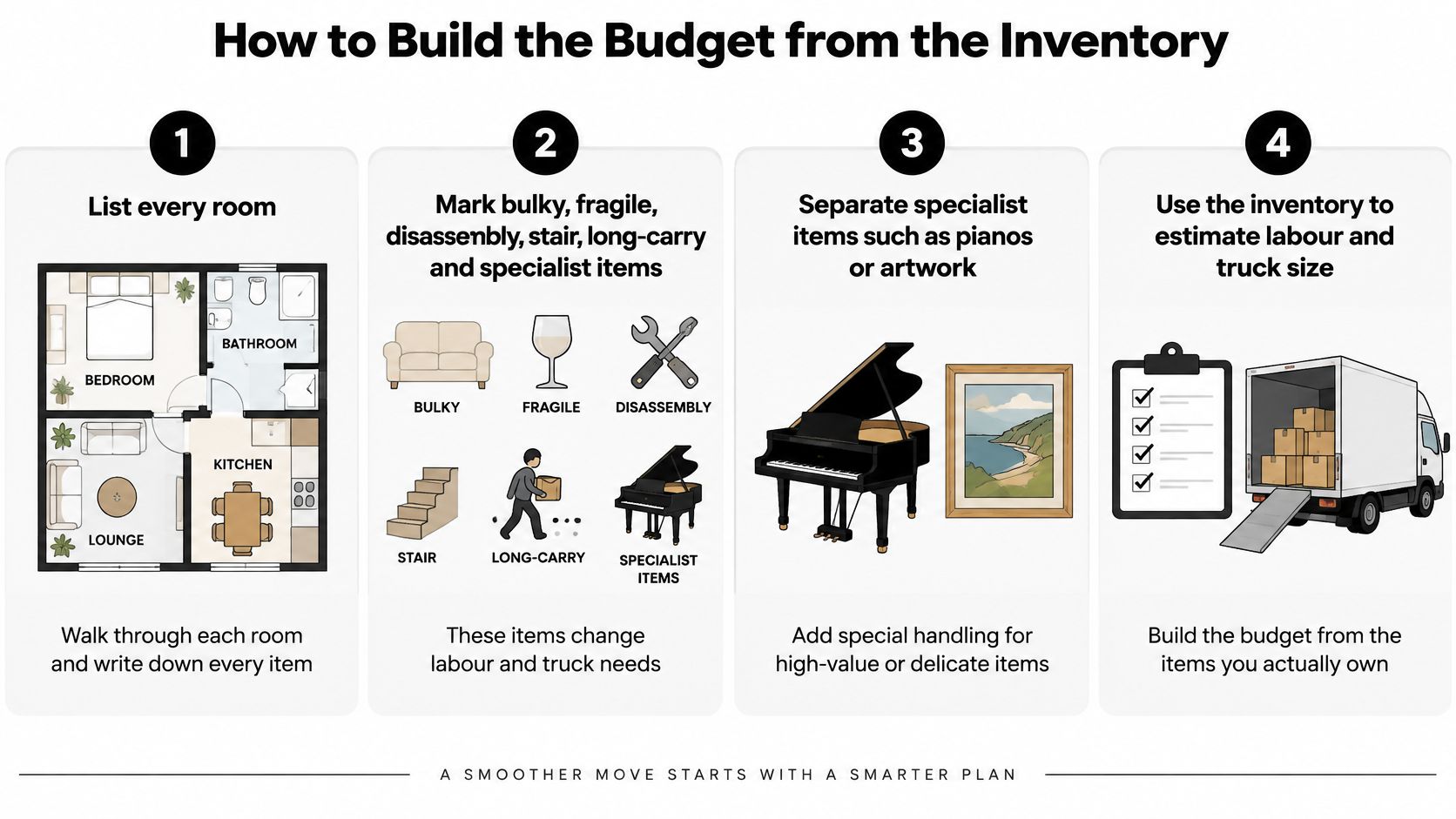
Build the estimate in order
List every room. Walk through bedrooms, cupboards, balconies, garages and storage cages with a spreadsheet or phone checklist. Mark bulky, fragile, disassembly, stair, long-carry and specialist items, including pianos and artwork, because they change handling time and truck needs.
Protect the tenancy cash first. The NSW Government's lease and moving guidance sets maximums of four weeks' bond, two weeks' rent in advance and a holding fee of one week's rent credited towards rent if you sign, and identifies Rentstart assistance for eligible tenants. Record the bond, advance rent and holding-fee credit separately so you don't count the same payment twice.
Build the labour allowance. Include loading, travel, unloading and reassembly, with room for access delays. Driving time alone doesn't account for carrying furniture through corridors or dismantling a bed.
Get the scope in writing. We provide a detailed quote before the move with no hidden fees. Reconcile hourly labour, minimum charges, travel or fuel, GST, materials, waiting time, storage, insurance limits and cancellation terms against your inventory.
Add the other bookings. Enter cleaning, connections and short-term storage as separate lines. Confirm whether each service is already included elsewhere before adding it again.
Make the approve-or-wait decision. Only proceed when the quoted move plus a 10–15% contingency leaves the bond, advance rent, utilities and essential living money untouched, using the budgeting allowance described in the ABS household-spending context. For office relocations, build hours around furniture, goods and downtime, and check the commercial lease independently.
Sample moving-out budget template
| Category | How to estimate it | Cash type | Your figure |
|---|---|---|---|
| Rental bond | Up to 4 weeks' rent | Refundable | _____ |
| Rent in advance | Up to 2 weeks' rent | Launch cost | _____ |
| Holding fee | Up to 1 week, credited if the lease is signed | Credited to rent | _____ |
| Removalist labour | Loading, travel, unloading and reassembly hours from the quote | Variable | _____ |
| Travel and fuel | Itemised separately in the quote | Variable | _____ |
| GST | Confirm whether the quote includes it | Variable | _____ |
| Packing materials | Itemised in the quote | Variable | _____ |
| Waiting time and storage | Quoted per hour or per week | Variable | _____ |
| End-of-lease cleaning | Booked for handover morning | Launch cost | _____ |
| Utility connections | Lodge requests two weeks out as a planning target | Launch cost | _____ |
| Contingency | 10–15% of the quoted move | Cash reserve | _____ |
| Total and decision | Quote plus contingency compared with cash available | Decision | Yes / wait |
Use the same inventory while reviewing the practical moving walkthrough.
Don't assume the lift or loading zone is available because the building has one. Confirm access, check GST treatment and enter lease overlap before approving the total.
If the final amount reaches into essential living money, mark wait. A cheaper-looking hourly rate doesn't solve a budget built on missing hours.
Stay Put Move Locally or Leave Sydney
Stay, local Sydney move or interstate move
| Scenario | Weekly housing | Upfront hit | When it can pay off |
|---|---|---|---|
| Stay | About $780 a week for a Sydney house in the late-2025 comparison | No relocation bill if the lease continues | Best when the gap to a cheaper city disappears once commuting is counted |
| Move locally in Sydney | Similar capital-city asking rents | Bond, rent in advance, cleaning, connections and a local truck | Pays off only if the new rent or a shorter trip beats that cash |
| Move interstate, Melbourne house example | About $580 a week, roughly $200 less than a Sydney house at $780 | Removal, travel, connections, furniture and possible storage as well as bond | A $2,000 relocation bill is about 10 weeks of the $200 before extra commuting |
The figures in this comparison come from Domain's late-2025 rental-market reporting, which compared Sydney houses at about $780 a week with Melbourne houses at $580, alongside a hypothetical $2,000 relocation bill recovered in about ten weeks from the approximately $200 weekly rent difference.
A cheaper interstate listing can make leaving Sydney look obvious. But the rent gap isn't pure savings if you spend more getting to work, replacing furniture or travelling back to see family.
Separate cash affordability from payback
Start by asking whether you can fund the move at all. Then calculate whether the non-refundable relocation costs are worth paying.
A new bond affects your immediate cash requirement, but it isn't automatically a permanent expense. Transport, connection fees and furniture replacement usually belong in the payback calculation because you won't recover them merely by ending the tenancy.
Use this working formula:
Break-even time = non-refundable relocation costs ÷ weekly savings after additional recurring costs.
If your net weekly savings disappear once commuting is included, there isn't a rent-based break-even point. You might still choose the move for family, space or lifestyle, but call it that rather than describing it as a financial saving.
Compare the journeys as well as the addresses
Staying avoids a relocation bill when the lease continues. It can be the stronger short-term choice if another property's modest rent reduction comes with a longer commute.
A local Sydney move can pay off through lower rent, a shorter trip or both. However, you still need tenancy cash and the cost of cleaning, connections and home removals Sydney households must arrange.
Interstate removals introduce longer transit and potentially a gap before delivery. Price necessary accommodation, storage and replacement furniture rather than assuming that selling bulky items makes every part of the move cheaper.
Run the alternatives using your actual rents and quote. Compare annual transport spending and the time each journey takes, including household members whose travel changes.
Reject a plan that only works if you spend the old bond before receiving it. A move can offer worthwhile long-term savings and still be unaffordable on the day you need the keys.
Cuts That Shrink the Variable Costs
Start with volume, not the legally required tenancy payments. The City of Sydney moving and waste guide says residents can book a free weekly bulky-waste collection for furniture, mattresses, whitegoods and electronics, booking before placing items outside and generally putting them out only the night before collection.
Apartment residents should check with their building manager because the building may coordinate the collection. Other councils have different rules, resource-recovery centres may charge, and some Community Recycling Centres accept nominated household waste free, so confirm eligibility, quantity limits and timing.
Don't leave unwanted belongings for the next occupant. Tenants can be responsible for the cost of storing or disposing of abandoned goods.
Trim the job before reserving the truck
Use these cuts to reduce what needs packing and carrying.
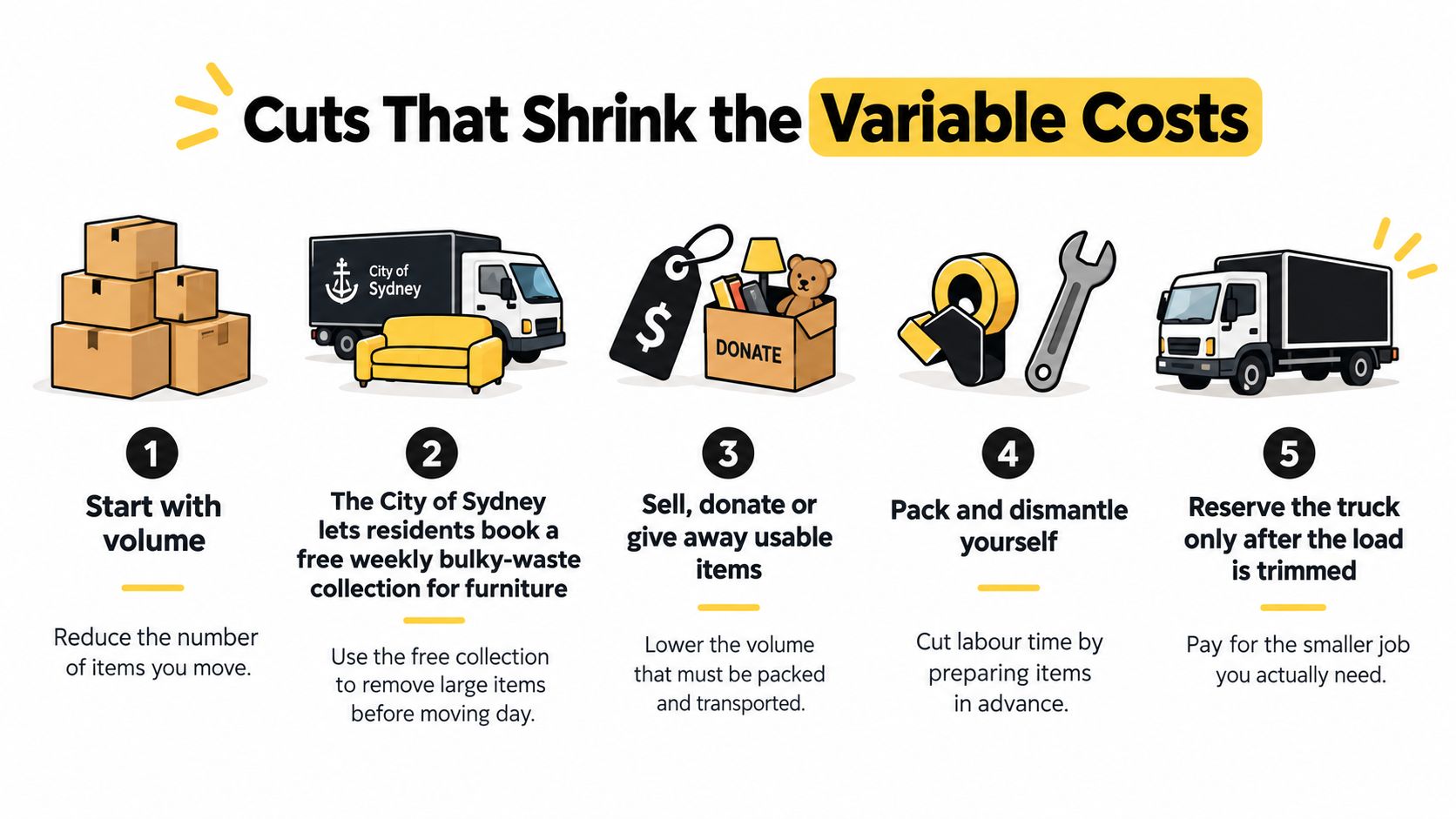
- Sell or give away low-value furniture: Arrange collection before quote day so the inventory reflects the smaller load. For interstate moves, compare the cost of transporting an item with the cost of replacing it at the destination.
- Prepare the straightforward rooms yourself: Pack books, linen and sturdy kitchenware securely, label the destination room and keep boxes manageable. Leave uncertain wrapping jobs involving artwork, glass or antiques to trained handlers.
- Remove avoidable waiting and storage: Have keys ready, clear the carrying route and confirm access. Use storage only when the handover or delivery schedule requires it, then compare the full storage arrangement with extending occupancy.
Check the free moving boxes guide before buying cartons. Reject damp, torn or weakened boxes, particularly for heavy contents.
Every item you don't move is handling you don't buy. Reduce the load, but leave the bond envelope intact.
Ask for materials, waiting time and travel to be visible in the written breakdown. That makes it easier to cut a real cost rather than choose a low hourly rate attached to a larger job.
Apply the approval test to the trimmed quote. If the move and its reserve still consume essential living money, delay the booking rather than removing the protection.
A Timeline Before You Book the Truck
Use this countdown as a suggested working schedule, not as a substitute for your tenancy's notice requirements. Adjust it to the dates on your agreement and the availability of the new property.
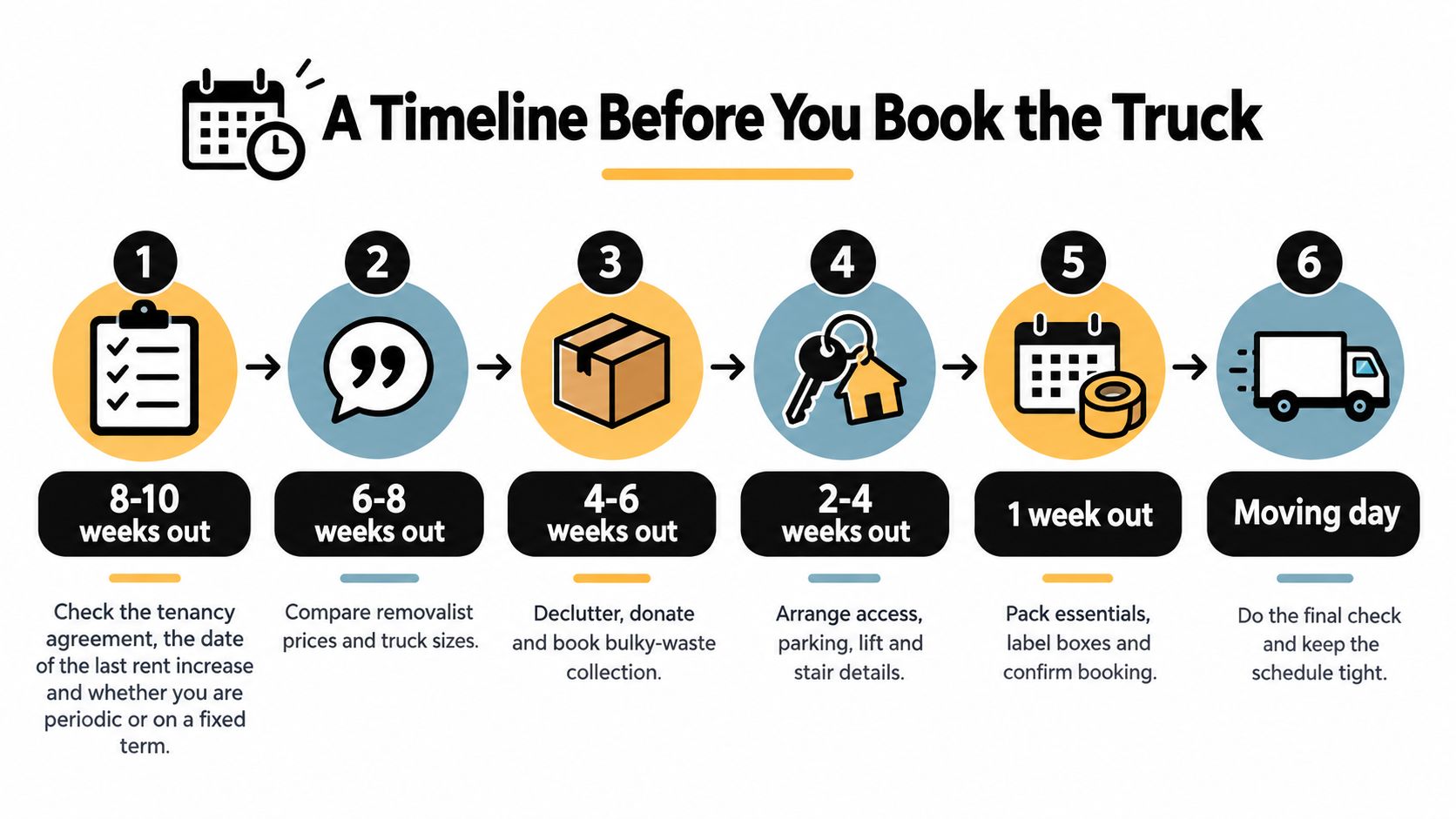
About eight to ten weeks out
Check your agreement, the last rent-increase date and whether you're on a periodic agreement or a fixed term lasting two years or more. For those agreements, the NSW landlord information statement requires at least 60 days' written notice of a rent increase and restricts increases to once in a 12-month period.
That rent-increase notice isn't your notice to leave. Confirm your own obligations before committing to another lease.
Use the available planning window to compare removalists Sydney quotes, discuss truck requirements and start selling items you won't take. If you're leaving NSW, confirm delivery timing before arranging travel.
Around six weeks out
Coordinate the new lease with the end of the existing tenancy. Giving notice too early can leave you paying overlapping rents; leaving arrangements too late can force urgent packing, emergency furniture moves and storage.
Don't give notice solely because an application looks promising. Check that the new tenancy and access arrangements are confirmed.
Around four weeks out
Confirm parking, loading-zone access, lift bookings and building restrictions. Book the end-of-lease cleaner for handover morning only if the property will be empty and the schedule leaves enough time for the clean.
For furniture removals Sydney apartment moves, describe the route from the truck to the front door. Include stairs and any loading dock restrictions.
Around two weeks out
Lodge utility connection requests and confirm the service dates. Freeze the inventory where practical, then tell the crew about additions or removals that affect the quoted job.
Businesses should confirm make-good obligations, access and operating restrictions in the commercial lease. Residential tenancy notice rules don't automatically apply to offices or warehouses.
Final week and moving day
Pack an essentials bag, label boxes and confirm the booking details. Keep the reserve untouched for unexpected waiting, replacement keys or extra handling.
Write down the new bond's payment deadline. That's the date your required cash must already be cleared, even if the truck arrives later.
Get a Written Quote Before You Commit
Book only when the final quote and contingency leave your tenancy payments, utilities and essential living costs protected, and your chosen location still makes financial sense after commuting and relocation expenses.
Run the approve-or-wait test against the actual written amount before paying a deposit. Confirm that the cash required for taking possession is available, rather than counting an expected bond refund.
Turn the inventory into a confirmed scope
We provide a detailed quote before the move, with no hidden fees. Request a free custom quote through our move-in quote form, using the 60-second online process.
Select your move size, from a one-bedroom home or unit through to four or more bedrooms, or choose office or warehouse. Include your inventory, access details, preferred date and the cash figure you've calculated.
For reference, our one-bedroom home rate is $120 an hour plus GST, with two removalists, an 18–23m capacity and a 4.5-tonne truck. Larger homes are quoted from the inventory rather than treated as a flat package.
Send your inventory today so the written quote can be checked against your move date and the amount you can safely commit.
Home Removals Sydney offers customized quotes for local and interstate moves, helping you match the moving job to your available budget. Visit Home Removals Sydney with your inventory and preferred date to request a free custom quote before committing your moving funds.
