

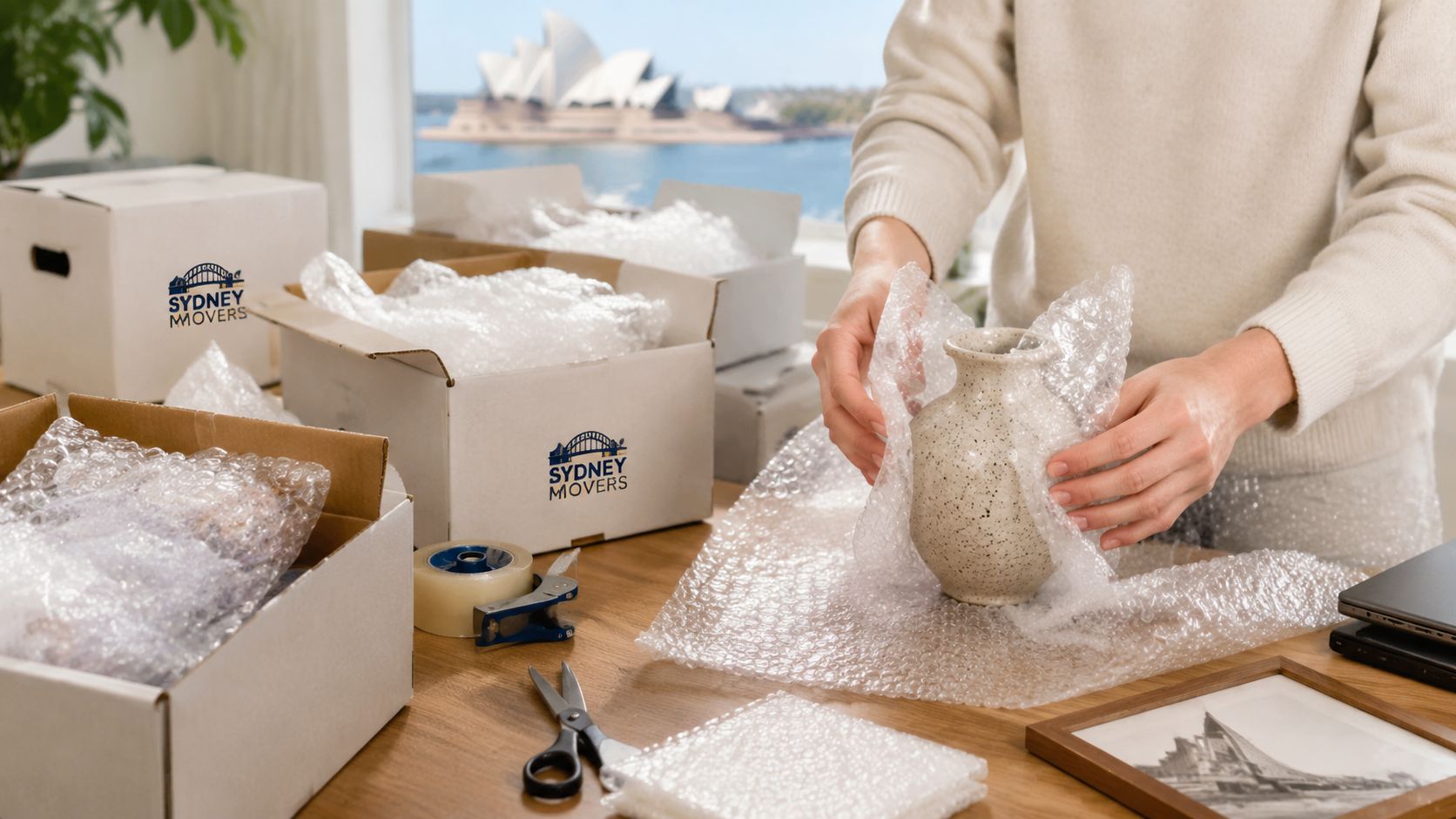
You've just arrived at your new Sydney home. The boxes are stacked in the hallway, the kettle is somewhere near the back of the truck, and the kitchen carton makes a worrying rattle when you move it. That sound usually means the packing method, not the road, has caused the problem.
Bubble wrap for moving is useful, but it isn't a universal answer. The right bubble size, a firm wrap, and proper void filling protect fragile belongings far better than covering everything in plastic. For local home removals Sydney customers often have enough control over the packing process to get this right. Interstate removals and office relocations demand even more care because boxes may spend longer in transit and face more handling.
Why Proper Bubble Wrap Selection Matters
A fragile item can survive ordinary movement inside a carton when it has been packed to prevent shifting. It can also fail before the box leaves the driveway if it's wrapped loosely, placed against an unprotected edge, or surrounded by empty space. Bubble wrap cushions impact, but it can't stop a plate, vase, or electronic device from moving repeatedly inside a poorly packed box.
Removalists Sydney teams see the same avoidable errors regularly. People use a thin wrap for a heavy ceramic piece, cover only the visible surface, or tape the bubble wrap directly to a polished finish. Those shortcuts leave corners, handles, screens, and rims exposed. The result may be a chip, a crack, a scratch, or damage to an item that can't be replaced.
Match protection to the risk
Start by identifying what could damage the item:
- Impact: Use air-cell cushioning for ceramics, glass, electronics, and exposed edges.
- Movement: Fill hollow spaces with packing paper before wrapping the item. Australia Post's recommended sequence for glasses and vases is to fill voids first, then wrap each item individually, as outlined in this fragile packing guidance for Sydney moves.
- Pressure: Keep fragile goods away from the top and bottom of cartons, and don't allow heavy boxes to rest on them.
- Surface contact: Put clean paper or a soft barrier between bubble wrap and delicate finishes, particularly polished furniture and artwork.
The wrapping material is only one part of the protection system. A box needs a cushioned base, snugly wrapped contents, paper or other suitable void fill, and enough strength to tolerate stacking. A carefully selected smaller bubble can work better than a bulky roll that forces you to use an unstable carton.
Practical rule: If the item can move when you gently shake the closed box, it isn't ready for the truck.
Correct selection also protects more than the replacement value. A cracked family platter, framed photograph, or inherited ornament may carry memories that money can't restore. Good packing takes a few deliberate minutes before loading, rather than leaving the outcome to road vibration and luck.
Choosing the Right Bubble Size for Your Items
Bubble size changes how the material behaves. Small bubbles give close surface coverage and take up little room. Larger bubbles absorb stronger knocks and protect corners, but they can make a carton unstable when used around small items.
Australian packing guidance identifies 10 mm bubbles for scratches and small delicate goods, 20 mm bubbles for general cushioning, and 32 mm bubbles for void-fill and corner protection. It also warns that oversized bubbles can overpack cartons and reduce stability during stacking. The following guide puts those grades against common moving situations.
Bubble wrap size guide for common household items
| Bubble Size | Best For | Examples |
|---|---|---|
| 10 mm | Surface protection and light cushioning | Picture frames, polished furniture, small ornaments, delicate surfaces |
| 20 mm | General household protection | Appliances, electronics, crockery, glassware, boxed décor |
| 32 mm | Impact absorption, void-fill, and corners | Bulky appliances, large vases, lamp bases, cabinet corners |
Use 10 mm wrap where scratches are the main concern. A framed print, mirror frame, or polished timber surface usually benefits from a smooth protective layer that doesn't create unnecessary bulk. Put paper between the surface and the plastic if the finish is sensitive, then secure the wrap around itself rather than taping onto the item.
20 mm wrap is the practical all-rounder for many furniture removals Sydney jobs. It suits appliances and electronics because it adds cushioning without making cartons difficult to close. For crockery, wrap each piece separately and use paper to stop items touching one another.
Choose 32 mm wrap for larger exposed edges and irregular shapes. A large vase, lamp base, or appliance corner needs impact absorption where a small bubble may compress too quickly. Don't use large bubbles as a substitute for filling the carton. They protect best when combined with paper or cardboard that stops the item shifting.
The best material is the one that protects the specific weak point without making the box harder to handle.
Combining sizes can make sense. Use small bubbles against a scratch-sensitive surface and a larger grade around corners or protruding parts. For a fragile office monitor, for example, protect the screen with a clean inner barrier, add suitable bubble cushioning, and reinforce the corners with cardboard before boxing.
Wrapping Techniques for Different Household Items
Technique matters more than buying the thickest roll. Clean the item first, place bubbles towards the item where that gives the most direct cushioning, and wrap every exposed edge. Tape the overlap, never the surface itself.
Begin with hollow items. Fill vases, glasses, bowls, and decorative vessels with crumpled packing paper so their walls aren't taking the full force of movement. Australia Post's method for glasses and vases follows this order, void fill first and individual wrapping second, because internal movement is one of the easiest causes of breakage.

Use a different method for each category
- Plates and bowls: Wrap each item separately, then place plates vertically in the carton rather than laying a heavy stack flat. Add paper between wrapped pieces and test the box for movement before sealing it.
- Glassware: Pack paper inside the glass, wrap it diagonally so the material follows the bowl and stem, then add extra paper around the stem and rim. Stand glasses in a fitted carton with no empty pockets.
- Electronics: Remove loose accessories, protect screens and corners, and use anti-static wrap where appropriate. Keep cables separate in labelled bags and prevent the device from pressing against the carton walls.
- Mirrors and artwork: Cover the surface with clean paper, protect every corner with cardboard, and add bubble wrap over the full face. Carry and transport large glass pieces vertically, not flat, to reduce pressure across the pane.
- Vases and lamp bases: Use a “burrito roll”. Place the item near one edge, roll it snugly through several layers, fold the ends over, and tape only the wrap. Add paper around the finished bundle so it can't roll in the box.
High-value pieces deserve a box-within-a-box arrangement. The inner package absorbs contact around the item, while the outer carton provides space for cushioning and reduces direct impact. A quick hand test helps. Press the wrapped item gently from several directions. If you feel a hard edge, hear movement, or see a corner exposed, add protection before loading.
For customers arranging shipping personal belongings abroad, the same principles become more important because extended handling leaves less room for weak packing. A professional packing team can also separate fragile goods from general household cartons, which simplifies loading and unpacking.
This guide to packing fragile items for moving provides another practical reference for preparing breakable belongings.
Estimating How Much Bubble Wrap You Need
A single roll can run out halfway through packing the kitchen, leaving fragile items exposed or forcing a rushed trip to buy more. Estimate from the actual contents, not the number of bedrooms. Item shape, overlap, double wrapping, and protection inside cartons all change the amount required.
Walk through the property with a notepad. Count glassware, ceramics, framed items, electronics, lamps, mirrors, and furniture with exposed corners. Separate items needing close surface protection from those needing thicker impact cushioning, then measure each group.
Build the estimate from the contents
Use these checks:
- Count individual fragile items, not only cartons. A cabinet of glasses can use more wrap than several ordinary boxes.
- Allow for shape. Cylinders, lamps, and large vases need extra material because the wrap must overlap around their ends.
- Include carton protection. Add wrap at the base, around the sides, or over sensitive contents where the box needs added cushioning.
- Allow for cuts and overlaps. Some material is lost around corners and during trimming.
- Keep a reserve. Clean leftovers are useful for later shipments, while running short during packing causes delays.
A simple contents-based estimate is more useful than a home-size label. For example, a kitchen with 20 pieces of crockery typically uses approximately 8–12 metres of 20 mm bubble wrap, depending on the item shapes and how much overlap each piece needs.
| Fragile items to wrap | Small bubble, 10 mm | Large bubble, 20 mm |
|---|---|---|
| 10–20 items | 5–8 metres | 3–5 metres |
| 20–40 items | 10–16 metres | 6–10 metres |
| 40–80 items | 20–32 metres | 12–20 metres |
These ranges are planning guides, not a fixed quote. Flat plates usually sit near the lower end, while stemware, lamps, vases, and irregular ceramics push usage higher. Use small bubble for surface protection and large bubble where the item needs more impact cushioning.
To avoid overestimating, group similar items and calculate one representative bundle before multiplying it across the group. To avoid underestimating, add the material needed for carton bases, sides, and overlap, then keep a reserve for awkward shapes. Show the removalist the actual contents before ordering, especially for interstate removals, office relocations, or warehouse moves where equipment and boxed stock vary widely.
Environmental Considerations and Alternatives
Bubble wrap protects fragile goods, yet Australia's soft-plastics recovery system makes disposal difficult. Australians generate over 1.3 million tonnes of plastic packaging annually, while only 19% is collected, according to this Australian packaging overview on bubble wrap's history and environmental context. Much of the balance reaches landfill or litter streams.
National reporting recorded 16% of plastic packaging recycled or composted in 2019–20, down from 18% in 2018–19, against a government target of 70% by 2025. A separate Australian factsheet reported that 62% of soft plastic packaging placed on the market was recyclable in 2021/22, while less than 2% was collected for recycling after a decade of REDcycle operations. For Sydney households, a recyclable label does not guarantee a practical recovery route.

Match the material to the item
Paper wrap suits many dishes, books, décor pieces, and voids. Moving blankets protect furniture and can be used across multiple jobs. Cardboard sheets work for flat artwork, tabletops, and mirrors when paired with proper corner protection. Dividers and moulded pulp inserts separate glassware while reducing the amount of plastic around each item.
Bubble wrap earns its place around crystal glassware, antique ceramics, screens, electronics, and pieces with exposed corners. Its air cells cushion impacts where paper may compress. Selective use is the sensible approach. Paper and blankets handle many household items, while bubble wrap remains useful for high-value or corner-exposed pieces. For more options, see these alternative packing materials for your move.
Australian-made products may improve the material choice. Phoenix bubble wrap is reported as containing 50% recycled content, divided into a minimum of 25% post-consumer and 25% post-industrial material. The product is described as 100% recyclable, with recycled material sourced and produced locally in Australia, according to this Australian product listing. Another packaging source connects Phoenix's 50% recycled content with APCO's projected 2025 National Packaging Target of 50% average recycled content across all packaging, in its discussion of lower-impact packaging choices.
For a practical material comparison, read these bubble wrap alternatives explained. Sydney movers can also ask suppliers about take-back arrangements. Do that before ordering, rather than assuming a yellow-lid bin can accept the used wrap.
Proper Disposal and Reuse Strategies
The most responsible piece of bubble wrap is usually the one you use again. Keep clean sheets flat, dry, and away from sharp tools. Once your move is complete, offer surplus material through Gumtree, Facebook Marketplace, or a local Buy Nothing group. Other residents, online sellers, and small businesses often need protective packaging.
Some local councils may operate dedicated soft-plastics collection points, but availability changes. Check your council's current instructions before making a trip, and confirm that bubble wrap is accepted rather than assuming every soft-plastics bin takes every product. Australia's recovery position has changed since REDcycle operations, so old supermarket advice may no longer apply.
Follow a simple end-of-life order
- Reuse first: Keep undamaged sheets for future moves, postage, storage, or protecting items in a shed.
- Pass it on: List usable material as free packing supplies for neighbours and community groups.
- Check specialist options: Paid services such as TerraCycle may accept flexible plastics through specific programmes, subject to the current product and location rules.
- Dispose only when necessary: If the wrap is dirty, torn, or contaminated and no approved pathway exists, follow your council's general-waste guidance.
Never place loose bubble wrap in a yellow-lid kerbside recycling bin. It can contaminate paper and container streams and create problems at sorting facilities. Don't put it in a recycling bin just because the packaging carries a recycling symbol.

Clean bubble wrap also has useful second lives around the home. Cut it to pad tool drawers, wrap plant pots during cold weather, protect stored ornaments, or separate furniture surfaces in a storage unit. These small choices extend its useful life and reduce the amount sent directly to landfill.
Retail listings show that locally made options are available. PPS bubble wrap is listed as 100% Australian made with a minimum of 15% recycled content by Kmart Australia, and an Officeworks listing gives the same minimum recycled-content claim and identifies Australia as the country of manufacture. Ask what can be reused before buying more.
Home Removals Sydney can supply packing materials such as boxes, bubble wrap, and tape, and can pack fragile household goods for local Sydney, interstate, office, and warehouse relocations. Request a personalised quote and visit Home Removals Sydney to organise careful packing and transport for your move.
