

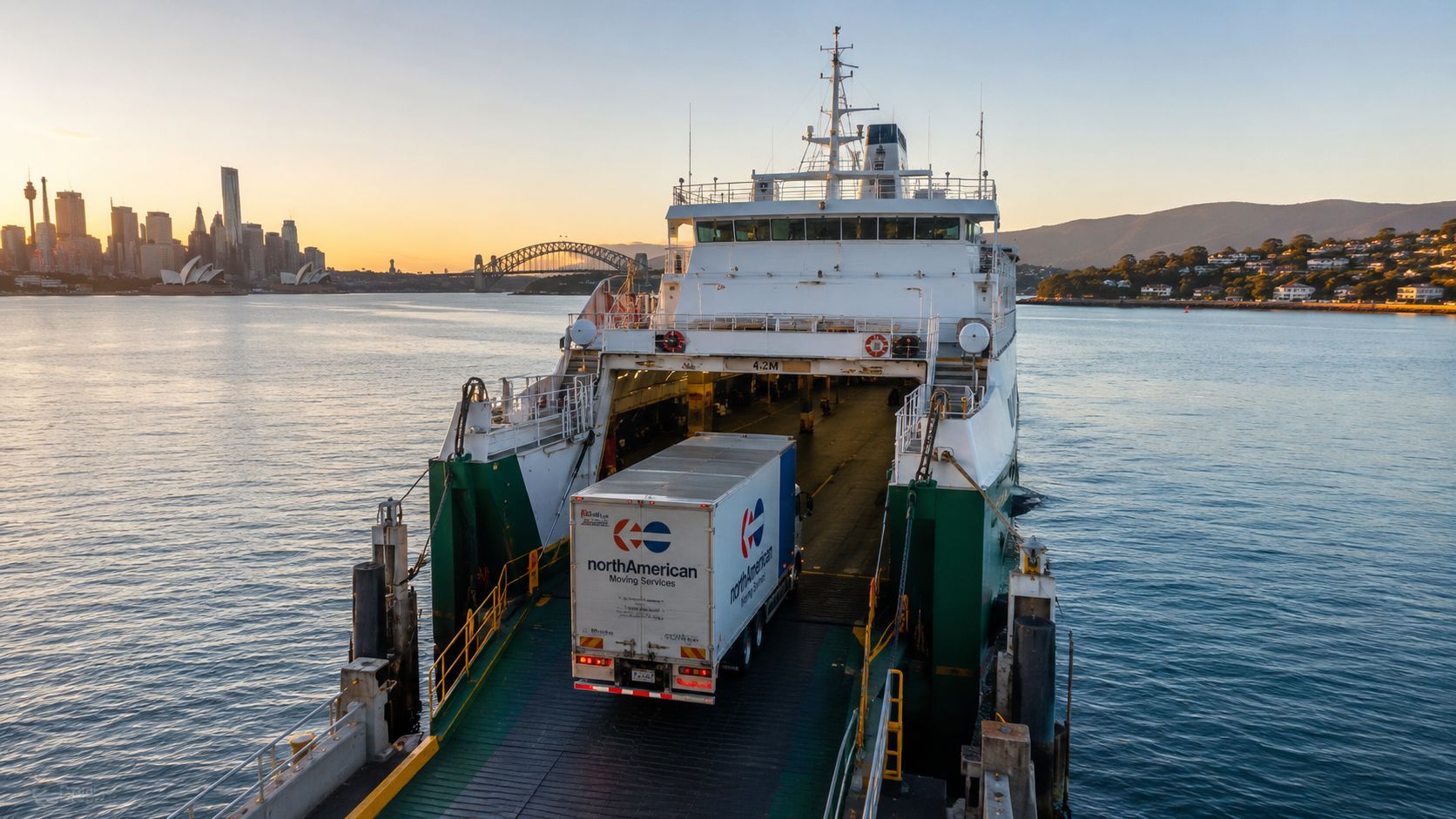
You've booked the removalist, arranged the Sydney handover and started sorting the garage. Then someone asks whether your garden tools are clean, whether your furniture is travelling on a ferry, and whether your delivery date depends on a port check-in window. A move from Sydney to Tasmania can look straightforward on a quote, but Bass Strait removals involve a tightly connected freight, ferry and biosecurity chain.
That chain affects your packing schedule, your travel plans and the final price. The most reliable approach is to treat the move as a sea freight operation from the first conversation, not as an ordinary interstate move with a short ferry ride added at the end.
Why Bass Strait Removals Are Unlike Any Other Interstate Move
A family leaving Sydney can have the house packed, the truck loaded and the route planned, yet still miss the delivery sequence. The shipment must reach a Victorian port, meet a ferry freight cut-off, cross Bass Strait and pass Tasmania's biosecurity checks before it can continue to the new address.
Bass Strait is about 240 kilometres of open ocean, which breaks an ordinary road move into separate transport stages. The Sydney line-haul has to match the port booking and sailing schedule. A late pickup, Hume route disruption or unfinished packing can leave a loaded truck outside the freight acceptance window, even when the household is otherwise ready.
Practical rule: Your removal date isn't secure until the line-haul, port booking, ferry check-in and Tasmanian delivery plan all align.
The timing affects the budget as well as the calendar. A missed sailing can mean extra handling, waiting time or storage, depending on how the removalist has priced the shipment and whether another sailing is available. Ask who carries those costs before accepting a quote, and confirm whether any freight equalisation scheme or related transport allowance applies to your circumstances. Eligibility and administration need to be checked rather than assumed.
Tasmania also adds a separate compliance layer. Permanent movers must complete a personal effects declaration before importing goods, with different official forms for a self-managed move and goods transported by a removalist company. Tasmania's moving guidance identifies both declaration pathways. Discuss the correct paperwork before packing begins, particularly if the load includes outdoor equipment, soil-exposed items or other goods that may require inspection.

Why general interstate experience isn't always enough
A Sydney-to-Melbourne move can usually be managed through road scheduling and depot coordination. Bass Strait removals require a controlled handover between road freight and roll-on, roll-off sea freight, with port congestion, sailing availability and weather disruption included in the plan.
A common failure is simple: packing runs late, the truck leaves behind schedule, and the driver reaches the port after freight acceptance closes. The goods may then wait for another sailing, while the customer pays for revised delivery arrangements or short-term storage. That outcome is avoidable when packing completion, truck departure and port acceptance are treated as linked deadlines.
For today's customer, the practical lesson is clear. The crossing is a managed logistics stage, not a short ferry ride added after the road move. A removalist must coordinate the handover, declarations and delivery sequence before the truck starts south. The National Museum of Australia's account provides historical context for Bass Strait as a transport corridor, while the modern removal requires careful control of each freight stage.
Choosing the Right Freight Option for Your Move
The right freight method depends on volume, fragility, timing and how much control you need over the shipment. A studio apartment, a family home and an office relocation shouldn't be priced or planned in the same way.
| Freight Method | Best For | Transit Time | Cost Level | Flexibility |
|---|---|---|---|---|
| Roll-on, roll-off ferry freight | Full removal trucks and well-organised household loads | Set by sailing schedule | Medium to high | Moderate |
| Dedicated container shipping | Larger homes, vehicles, commercial equipment and staged deliveries | Depends on container and vessel coordination | High | High once packed |
| Consolidated freight | Smaller homes, partial loads and customers seeking shared capacity | More variable | Low to medium | Lower |
Roll-on, roll-off freight
The Spirit of Tasmania freight service between Geelong and Devonport operates 7 days a week, 365 days a year, with an approximate crossing time of 11 hours. The operator's freight information sets specific receiving requirements, which makes this option efficient when the pickup and line-haul are tightly organised.
Roll-on, roll-off freight suits a complete household where the removalist can stage the truck for a confirmed sailing. It works well for a two- or four-bedroom home when the load is packed, labelled and secured as one coordinated shipment. It's less forgiving if you're still dismantling furniture or waiting for a final garage clear-out.
Dedicated containers
A dedicated container gives you a sealed space for your household goods, vehicle or business equipment. It can suit a large family home, an office relocation or a warehouse move where the load needs to remain together.
The trade-off is handling. Containers reward careful weight distribution, strong wrapping and deliberate loading. Heavy items belong low and near the centre, while fragile cartons need protection from shifting loads. If you're considering this approach, review shipping container moving options before choosing between a dedicated and shared arrangement.
Consolidated freight
Consolidation can make sense for a one-bedroom apartment, a partial office move or a household that's sending only selected furniture. Your goods share transport capacity with other consignments, which can reduce the cost level, but the delivery sequence depends on other freight and available space.
Pianos, antiques and artwork need a specialist assessment regardless of method. The cheapest freight option isn't useful if a delicate item requires extra crating, special lifting or a direct delivery plan. Ask for the handling method, not just the transport label.
The End-to-End Logistics Timeline Explained
A Bass Strait move can be collected on time in Sydney and still miss its ferry in Geelong. The working schedule must connect collection, line-haul, terminal acceptance, sailing, Tasmanian handling and final delivery, with room for delays at each handover.
Step one, prepare the booking
Confirm the pickup address, access restrictions, inventory, destination and preferred delivery window. Lifts, narrow driveways, apartment loading zones and long carries can change the Sydney collection schedule, so disclose them before the truck is allocated.
Give the removalist a firm inventory. A late garage clear-out or extra furniture can alter loading time, vehicle capacity and the ferry booking. If you are travelling separately, arrange accommodation and essential items independently. Your vehicle may arrive before the household goods, or the shipment may need a later appointment after port release and local allocation.
Step two, move the goods from Sydney to Geelong
The truck runs from Sydney through Victoria to the Geelong terminal. The line-haul schedule must allow for loading, driver rest requirements, traffic and incidents on the road. A timetable with no working buffer is exposed to a simple problem: the truck reaches the terminal after freight acceptance closes.
Freight units must be received 3 hours before night sailings and 2 hours before day sailings, according to Spirit of Tasmania's freight requirements. Missing that cutoff can push the shipment to a later sailing and may affect labour, storage and delivery appointments.

Step three, cross Bass Strait
The approximate ferry crossing is 11 hours, though the sea freight stage includes port staging, check-in, loading, unloading and onward dispatch. Weather and terminal congestion can change the working sequence even when the published sailing time stays the same.
Biosecurity paperwork also belongs in the timeline. Items requiring declaration or inspection can delay release if they are dirty, incorrectly described or packed where they cannot be checked quickly. Ask the removalist which goods need declaration before collection, rather than treating inspection as an issue for arrival day.
Step four, deliver from Devonport
After arrival, the shipment needs Tasmanian handling and a delivery allocation. Devonport to Hobart is a different final leg from Devonport to Launceston, the north-west coast or a regional property. Destination access, parking and carrying distance matter just as they did in Sydney.
Build buffer time into every transfer point. Do not book flights, cleaners or a lease handover around the narrowest delivery promise.
Understanding the Costs and Pricing Drivers
A Bass Strait removal can look straightforward until a booked sailing is missed. The invoice reflects more than the mainland distance. Sea freight, terminal handling, additional handovers, available vessel capacity and the cost of holding a load for the next sailing all shape the quote.
The Tasmanian Freight Equalisation Scheme, or TFES, is intended to offset part of the higher sea-freight cost for eligible non-bulk goods moving across Bass Strait. BITRE's monitoring material covers freight moving between Tasmania and the mainland from 2019–20 to 2022–23, and records $101.0 million spent on the Bass Strait Passenger Vehicle Equalisation Scheme in the two years to June 2023.
TFES assistance is not automatically a discount on a household removalist's invoice. Eligibility, freight classification, travel direction, transhipment status and the claim process all affect whether support applies. The Australian Parliament's overview describes the variable rate for northbound and southbound goods. It is based on the difference between sea freight and notional road freight costs, adjusted on a sliding scale to a maximum of $855 per TEU. Ask the removalist whether the quoted service includes any eligible adjustment, rather than assuming the scheme reduces your final bill.

Capacity affects certainty
BITRE's monitoring material records $181.9 million in TFES payments in 2022–23, covering the equivalent of 232,520 TEUs, 11% higher than four years earlier. The same monitoring discussion identifies seasonal peaks where average utilisation rose above the 85% target, along with years recording 2,626 vessel visits and limited competition among a small number of operators.
Capacity pressure affects timing first, then price. A summer move may need earlier booking, tighter load consolidation and flexibility around the preferred sailing. If a truck reaches the terminal after the freight cut-off, storage, rehandling or a later departure can change the original estimate.
Costs you can influence
- Volume: Remove unwanted furniture before the inventory is finalised.
- Access: Reserve loading zones and disclose stairs, lifts, restricted parking and long carrying distances.
- Timing: Keep the delivery date flexible where possible, particularly around busy sailing periods.
- Preparation: Complete packing and biosecurity cleaning before collection to reduce avoidable delays.
- Special items: Declare pianos, artwork and antiques early so the handling plan matches the shipment.
For a separate vehicle shipment, check National Car Transport rates and compare that figure with including the vehicle in the broader relocation plan.
Packing and Biosecurity Preparation That Prevents Delays
Tasmania's biosecurity rules treat contamination seriously. Household items must be washed to remove every trace of soil, seeds, plant material, food and other debris, and items contaminated with plant material, seed or soil aren't permitted under the stated household-item guidance. The official household-item rules should be treated as a packing checklist, not background reading.
Start with the items most likely to carry organic material. Garden equipment, outdoor furniture, camping gear, bicycles, potting supplies, shoes and garage storage need attention well before the removal truck arrives.
Clean by room, not at the last minute
Kitchen: Empty crumbs from drawers, wipe the underside of appliances and check barbeque equipment for food residue. Clean fridges, freezers and pantry containers before they're wrapped.
Bedrooms: Vacuum mattresses, bed bases and upholstered furniture. Pack bedding in clean bags, especially if it has been stored in a garage or shed.
Garage and outdoor areas: Scrub soil from spades, mower blades, tools, wheelbarrows and outdoor furniture. Brush dirt from tyre treads and inspect camping equipment, hiking boots and sports gear for seeds caught in seams.
Storage cupboards: Open every carton before sealing it. A decorative basket, children's toy box or vacuum cleaner can hold leaves, dust or food particles that are easy to miss during a rushed pack.
Border preparation is part of the move, not a cosmetic clean. If an item has touched soil, inspect it as though it will be checked.

Complete the correct declaration
A permanent move requires a personal effects declaration before goods enter Tasmania. Use the self-move form if you're managing the transport yourself, or the declaration for goods transported by a removalist if a professional company is handling the shipment. Don't sign a form until the inventory and cleaning process have been checked properly.
Plants and related items need special care. If you're researching the preparation of living plants, use this practical guide on packing plants for moving, then confirm whether the items can legally enter Tasmania before including them in the load.
A removalist can help identify likely problem items, but the owner remains responsible for honest declarations and suitable preparation. Photographing cleaned outdoor equipment before packing can also give you a useful record of its condition.
Insurance Coverage and Storage Options During Transit
Sea freight adds handling stages, so insurance needs to follow the goods from the Sydney pickup through line-haul, port handling, ferry transport and Tasmanian delivery. A policy that sounds broad may contain exclusions for fragile goods, owner-packed cartons, mechanical items, pairs or sets, or damage caused by inadequate preparation.
Ask for the policy wording, not just a verbal assurance. Confirm whether cover applies during storage, whether the excess changes for sea freight, and whether high-value items require written declarations before collection.
Match cover to the inventory
Artwork, antiques, pianos and musical instruments should be listed individually where the insurer requires it. Record condition notes and photographs before wrapping, particularly for timber surfaces, glass, framed pieces and instruments that can be affected by vibration or handling.
For a detailed starting point, review interstate moving insurance information and then ask the removalist to explain how its cover applies to this specific route.
Storage can solve a different problem. If your Tasmanian lease starts later than your Sydney handover, secure storage can prevent rushed delivery decisions. You may also need storage if a sailing changes, renovation work runs over or the destination property can't accept a full load.
Sydney storage works well before pickup or during a delayed handover. Tasmanian storage is more practical after the shipment has crossed, especially when you're waiting for keys, tradespeople or access approval. The important question is whether the storage provider manages the transfer without unnecessary rehandling.
Use storage to create breathing room, not as a substitute for a clear freight plan.
Before booking, clarify access hours, inventory control, protection against moisture, delivery booking rules and whether the goods remain sealed. For valuable items, confirm who can authorise access and how condition checks are recorded at each transfer.
Planning Your Bass Strait Move with Confidence
Book early enough to secure a workable sailing and leave room for packing, cleaning and line-haul coordination. The exact lead time depends on household size, season, access conditions and whether you need a dedicated container or shared freight, so a proper quote should begin with an inventory rather than a rough number of bedrooms.
Ask every removalist:
- Route experience: How often do you coordinate Sydney to Tasmania removals?
- Ferry process: Who manages the Geelong freight cutoff and what happens if the truck misses it?
- Biosecurity: Which declaration applies, and how do you record cleaned outdoor items?
- Delivery: Is the Tasmanian delivery direct from Devonport, or does the load enter another depot?
- Protection: What insurance applies to owner-packed cartons, antiques, pianos and storage?
- Pricing: Which charges cover line-haul, port handling, ferry freight, delivery and waiting time?
Be cautious if a company promises a guaranteed same-day arrival without explaining the sailing and port sequence, avoids written answers about biosecurity, or offers a price without checking access and inventory. General interstate removals experience is useful, but it doesn't replace route-specific planning.
If you're comparing providers, practical consumer guidance such as how to avoid moving scams in Boston is also useful for checking contracts, payment requests, business details and unusually vague estimates, even though the location differs.
Home Removals Sydney provides Sydney-based home removals, furniture removals, office relocations and interstate moving support, with a fleet ranging from 4-tonne vans to 62-tonne trucks, fully insured moves and transparent pricing starting at $120 per hour plus GST. Its 60-second quote form can return responses within 30 minutes during business hours, helping you turn a complicated Bass Strait move into a documented plan.
For Bass Strait removals, Home Removals Sydney can coordinate packing, careful furniture handling, freight planning, storage and delivery from your Sydney address to Tasmania. Visit Home Removals Sydney to request a customised quote and start organising your move with a team that understands the ferry, biosecurity and access details that shape the final result.
