

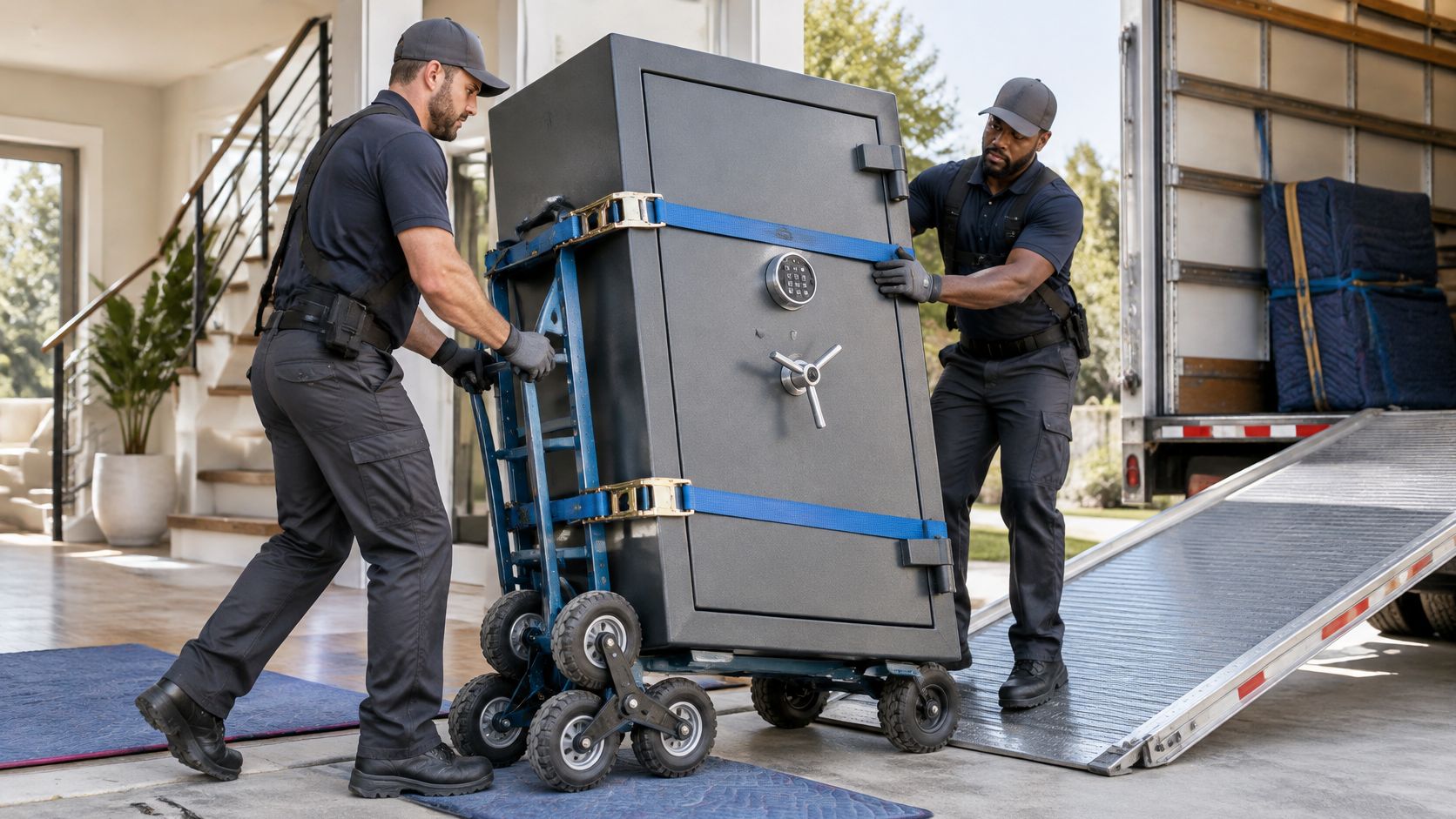
The safe is booked to move on Saturday. It's sitting in the corner of a garage, or bolted to the floor of a second-floor office with a switchback stairwell and a lift that stops at the lobby. You've measured the door once, you think it fits, and someone has already said the sentence that sinks most safe moves: we'll just get a few people and lift it.
Moving a safe isn't a heavier version of moving a fridge. A fridge has handles, a flat back and a predictable centre of gravity that stays put. A safe is dense, hard to grip, and it changes character the moment the door swings open or the contents slide to one side. The job is a site-specific handling plan, not a lift, and the difference between a clean move and a damaged stairwell usually comes down to what you worked out before anyone put a hand on it.
Weigh the Safe and Match It to Equipment
The number on the scale decides the whole job. If the safe is small enough, weigh it on a bathroom scale and write the figure down. If it isn't, get the empty mass from the manufacturer or the manual, then add whatever stays inside and the packaging. A safe's contents can shift the calculation by more than the cabinet itself, and estimates are how a 300 kg safe ends up on a 150 kg hand trolley halfway down a hallway.
Measure height, width and depth while you're at it, and note the door swing. Then think about the centre of gravity. A tall, narrow gun safe loaded with ammunition tins tips far more readily than a squat floor safe of the same mass, and a safe with its door open is a different object entirely from one with the door shut and deadlocked.
Australian workplace-safety guidance doesn't hand you a single safe weight to work to. Safe Work Australia's model code for hazardous manual tasks treats moving, lifting, lowering, pushing, pulling, carrying, holding or restraining a load as potentially hazardous when it involves high or sudden force, sustained or awkward postures, repetitive force or vibration. That describes a safe almost by definition: dense, bulky, difficult to grip and capable of shifting without warning during a tilt. Under the same code, back-injury risk rises significantly once objects pass roughly 16 to 20 kg, and workers generally shouldn't be required to lift, lower or carry loads above 55 kg without mechanical assistance or a team-lifting arrangement.
Neither figure is permission to hand-carry a safe. The code makes risk depend on dimensions, centre of gravity, the route, the starting height, the distance, floor conditions and posture. A 40 kg safe on a flat driveway is a different job from the same safe at the top of a switchback stairwell with a kerbside truck, so read the table below as typical bands and then weigh it against the actual access you have.
Safe weight, handling approach and suitable equipment
| Safe weight | Handling approach | Suitable equipment |
|---|---|---|
| Under 16 kg | Manageable by one trained person with a firm grip, load kept close to the body | Gloves and a sturdy hand truck for the route |
| 16 to 20 kg | At the point where back-injury risk rises, so keep lifts short and upright | Rated sack truck or trolley with ratchet straps |
| 20 kg up to 55 kg | Two-person lift for short flat carries, mechanical aid for stairs or distance | Appliance trolley, stair-climbing trolley or skates |
| Above 55 kg | Mechanical assistance or a planned team-lifting arrangement is required | Pallet jack, ramp, skid boards or tail lift |
| Very heavy or commercial safe | Treat as a controlled lifting operation with a written plan | Licensed crane or lifting contractor |
If the scale reading doesn't match the plan you'd already sketched, stop and rebuild the plan around the measured number. That's the moment to rent the pallet jack or call in a second pair of hands, not after the safe is wedged in a doorway. Where the plan involves a crane, a gantry or overhead rigging of any kind, the people working under the load need the right qualification, and the dogging courses at TP Training set out what a dogging or rigging ticket covers.
How to Move a Heavy Safe Step by Step
Eight steps, in order, each with the reason it exists. Skip one and the risk moves to the next person holding the load.
The sequence below is the short version of the process, and the detail after it is where most DIY attempts come unstuck.
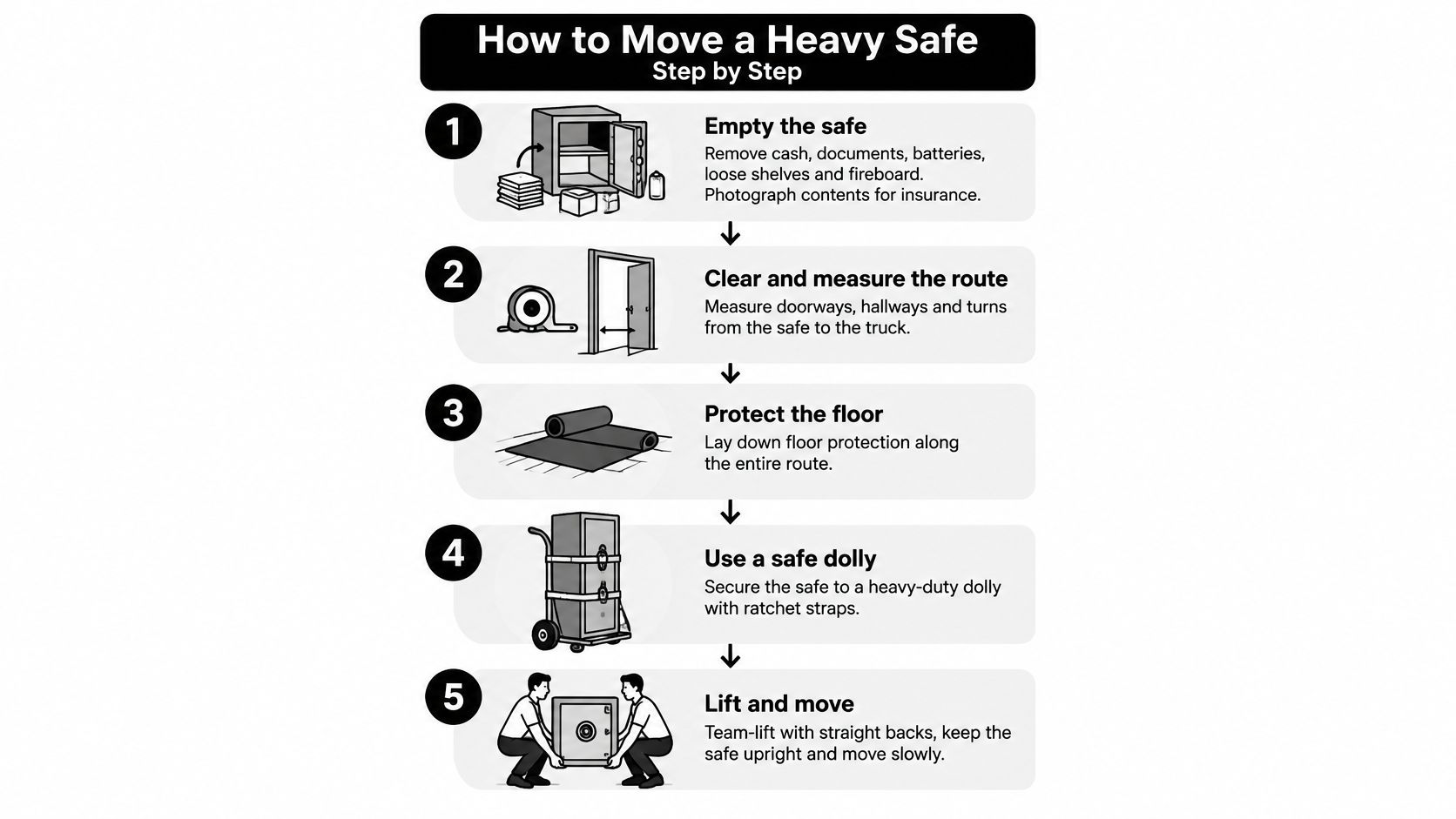
- Empty it completely. Cash, documents, ammunition, batteries, loose shelves and any loose fireboard come out first. Photograph the contents and the interior layout before they do, because that photo record is what an insurer asks for if a lock or panel is damaged in transit.
- Clear and measure the route. Walk from the safe to the truck with a tape measure and check every door width, threshold height, stair turn and floor surface. The measurement that kills a move is usually the diagonal through a doorway with the door removed, not the frame itself.
- Close, lock and tape the door. Retract the bolts, shut and lock the door, then tape the handle down so it can't swing. An open door throws the centre of gravity forward and loads the hinges, the weakest point on any safe.
- Set up the equipment before you lift. Rated trolley or pallet jack, ramp or skid boards, ratchet straps, moving blankets and plywood over the floor. Setting up afterwards means holding the load one-handed while you fetch a strap, which is when fingers get caught.
- Tilt only as far as the manufacturer allows. Tip the safe back just enough to slide the trolley plate underneath, keeping it close to your body, back straight and feet apart, and push up through the legs. Don't twist while loaded, and don't carry on your arms what a trolley can carry for you.
- Walk it, don't drag it. Keep the safe upright and strapped on the trolley, and stop at each threshold to reposition rather than bouncing it over the lip. Drag marks on timber floors and gouges in door frames come from rushing the last metre.
- Strap it down twice. Strap the safe to the trolley for the walk, then strap it to the truck wall or bulkhead at four points and sit it on dunnage boards. That second set of straps is what stops a 200 kg safe becoming a projectile under brakes.
- Re-test the lock at the other end. Set the safe on boards, level it, open and close it, then reload the contents. If the door doesn't swing cleanly at the destination, document it that day rather than discovering it a month later.
A move has gone well when you can see the evidence: no drag marks on the floor, no scraped door frames, no creased skirting, and the safe sitting level on boards in its new spot with the door opening smoothly.
The equipment matters less than the order you use it in, and a dolly is only as good as the straps holding the load to it.
For strap placement on tall gun safes in particular, Webster Moving's heavy safe advice covers the angles that stop a tall unit rocking once it's on the truck.
Bolted or floor-fixed safes need work before moving day. Identify the anchor bolts and the mounting plate, and have a locksmith or safe installer remove them. Dragging an anchored safe damages the floor covering, the slab edge and often the safe's own base, and the repair bill lands on you rather than the installer.
If the safe can't be fully emptied, weigh the remaining contents separately, keep heavy items low and centred, and treat the whole load as higher risk because partial contents shift the centre of gravity in transit. If the safe is one item in a larger relocation, the same principles apply to other dense pieces, and this guide to how to move heavy furniture sets out the sequence for the rest of the load.
Handling Stairs, Lifts and Tight Access
A terrace house stairwell is the scenario that stops more Sydney safe moves than weight ever does. The safe fits the hallway, fits the truck and fits the budget, and then it meets a 90-degree turn at the top of a narrow flight with a handrail bolted to one wall. Access, not mass, decides whether the job is feasible.
Stairs turn a lift into a controlled lowering operation. Use two trained people and a stair-climbing trolley or a lowering strap, keep the safe as low to the treads as you can, and never let it bounce down a step. The person at the bottom sets the pace, because they're the one taking the weight if it slips.
Lifts need three checks before you book anything: the car dimensions, the door opening and the rated capacity. Confirm that capacity with the building manager in writing, book the lift and any protective padding, and check whether the building restricts move times. A safe on a trolley plus two people can be well over the lift's limit even when the empty car looks generous.
Basements and driveways come down to grade and turning circle. A safe on a dolly on a steep ramp can run away from you, and once it's moving, no one stops it by hand. Skid boards, a controlled lowering line and a clear run-out zone matter more than an extra pair of hands in the wrong spot.
SafeWork NSW guidance on hazardous manual tasks recommends mechanical aids that are designed for the load, maintained and adjustable for the person using them, which rules out the bent hand trolley from the garage. The same body of guidance is blunt that more helpers isn't automatically safer: uncoordinated people around a heavy load add pinch points and crush zones rather than control.
Practical rule: one person directs the move. Everyone else stays out of the fall zone until they're told exactly where to stand and what to hold.
Run a survey before moving day and write the answers down: safe weight and dimensions, door and stair clearances, floor and lift ratings, parking access, who controls pedestrians, and where you'd stop the load if it starts to go. For apartment and terrace moves, those answers usually decide the equipment list long before the safe's nominal weight does.
Securing and Transporting the Safe Safely
Vehicle choice comes before tie-down. A truck that can't legally or physically reach the door is no use, whatever its payload rating says.
Under Transport for NSW's general access guidance, a general-access truck may be up to 12.5 metres long, a truck and trailer or articulated vehicle up to 19.0 metres, with a general height limit of 4.3 metres and a width limit of 2.5 metres. The same rules class any vehicle with a Gross Vehicle Mass or Aggregate Trailer Mass above 4.5 tonnes as a heavy vehicle. A safe may sit comfortably inside the body, but the loaded vehicle still has to stay within mass and dimension limits. That's the detail that catches narrow inner-west streets, low-clearance driveways and tight loading zones.
General-access vehicle dimension limits
| Limit | General-access figure | Why it matters |
|---|---|---|
| Truck length | 12.5 m | Check it fits the street and the kerbside parking space |
| Truck and trailer or articulated length | 19.0 m | Needs wider turning space on suburban streets |
| Height | 4.3 m | Clears driveways, carports and low gates |
| Width | 2.5 m | Keeps the vehicle within lane and kerb limits |
| Heavy vehicle threshold | Gross Vehicle Mass or trailer mass above 4.5 t | Marks a vehicle as heavy under NSW rules |
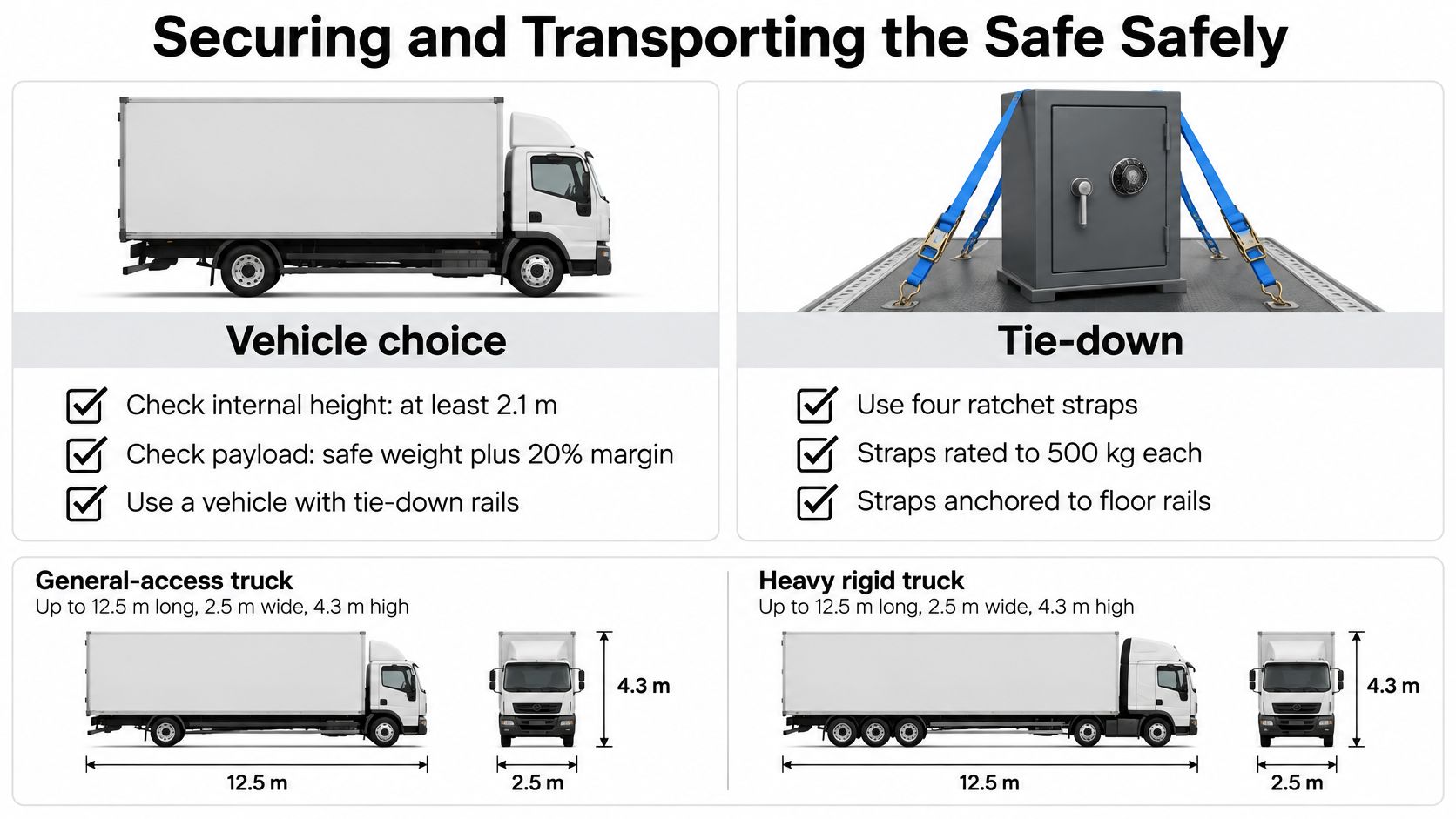
With the truck at the kerb, the load itself needs four checks.
- Weigh the loaded vehicle. Estimate it from the safe's verified mass plus everything else on board, and stay under the vehicle's payload rating rather than its headline capacity.
- Load low and against the bulkhead. Safe forward, on dunnage boards, door facing the wall so it can't swing open into the cargo. A safe carrying loose contents shifts weight mid-transit, so empty it or pack the contents tight before it goes on.
- Four straps, not two. Anchor to floor rails and cross-strap so the safe can't walk under braking. Straps pulling downwards only stop it bouncing, not sliding.
- Ramp, never a drop. Set the ramp at a shallow angle, keep people to the side rather than underneath, and move the safe inch by inch.
Route restrictions can stop the truck even when the vehicle itself is suitable. NSW rules prohibit a vehicle from using a road with a weight-restriction sign when the total weight including the load equals or exceeds the signed limit, and bridge-load-limit and gross-load-limit signs work the same way. Where a 'NO TRUCKS' sign gives no mass or length detail, trucks above 4.5 tonnes GVM generally can't pass unless the destination lies beyond the sign and that road is the only route, under NSW heavy vehicle restrictions and limits. Run the route check with the safe's weight counted in the total, not treated as a separate figure.
Transit cover is the other half of a controlled move. Confirm the details of any goods in transit insurance before the truck arrives: what it covers, what it excludes, and who pays if the safe or the floor takes the damage.
At the destination, unload with the same method used to load: ramp at a shallow angle, straps until the safe is on flat ground, then boards under it. Never drag a safe across the tray or the ramp. For exceptionally heavy commercial units or large interstate combinations, confirm whether the movement needs a transport management plan or an oversize permit under NSW heavy-vehicle rules before the truck is booked.
Common Problems and How to Fix Them
Most safe moves go wrong in the same five ways. All of them appear mid-move, which is exactly when people are least willing to stop.
| Problem | Likely cause | Fix |
|---|---|---|
| Safe slides on the trolley | Loose straps or uneven surface | Re-strap low and tight, and lay plywood over the surface |
| Trolley tips on a step | Centre of gravity too high | Stop, lower the load, then use a ramp or a second trained person |
| Door or lift will not clear | Dimensions not measured before the move | Remove the door, hinges or shelves, then re-measure |
| Floor or lift surface marked | Load concentrated on a small footprint | Spread the load with dunnage boards |
| Electronic lock fails after the move | Vibration or moisture during transport | Let it settle, check batteries, then call a locksmith |
Read the symptom backwards to the step you skipped. A safe sliding on the trolley means step seven's first strap went on loose, or the surface under the wheels was never checked at step two. A trolley tipping on a step usually means the load went up too high before the tilt, and a door that won't clear tells you the doorway was measured without the safe's true width and swing.
If the load shifts and you can't control it, the route changes, the equipment is rated below the load, or anyone is tired or hurt, lower the load to the ground and reassess. Nothing on a safe move is worth a crush injury.
That rule covers more situations than people expect. Fatigue counts. A twisted ankle counts. A strap with a frayed edge counts, because a strap fails progressively and then all at once.
After the move, do four checks before you call it done. Test the lock through two full cycles, check the safe sits level and isn't rocking on a floorboard, look for hidden damage around door frames and along the floor line where the trolley ran, and keep your photo record with any receipts. That record is what supports an insurance claim if a lock or a panel turns out to be damaged.
Decide When to Call Professional Removalists
Some safe moves are a sensible DIY job with a rated trolley and a mate. Others need a crew, a vehicle and a handling plan built around the site as it is. In Sydney that site often means a terrace stairwell, a strata lift on a booking window, or a kerb where the truck gets limited time to load. Five questions draw the dividing line.
- Is the safe over 55 kg with no rated mechanical aid on hand? Then the lift isn't controlled, and the risk sits with whoever is holding the load.
- Does the route include stairs, a restricted lift, a basement or a steep ramp? Any one of those turns the move into a lowering operation with a fall zone.
- Is the safe in an office or warehouse that needs forklift or crane work? A vehicle-loading crane must be checked against its rated capacity at the actual working radius, not the headline rating, and the load must hang vertically rather than be dragged, as Safe Work Australia's vehicle loading crane information sheet sets out.
- Is the move interstate or does it need a heavy vehicle? Then vehicle limits and route restrictions apply on top of the handling plan.
- Does the safe hold valuables that need documenting for insurance? Inventory and photograph everything, keep keys and override codes separate, and record the weight and condition before anyone quotes.
One yes is enough. The Australian Institute of Health and Safety reported in 2024 that manual handling accounted for 41% of years lost from work-related injuries in Western Australia across the 2012-13 to 2021-22 period, and a safe concentrates that risk into a single object with high mass, few grip points and contents that shift if they aren't secured.
A professional crew changes what the job costs you in risk. Trained removalists handle the loading and unloading with the latest equipment, and the load is insured while it is in their hands. The team at Home Removals Sydney is trained to handle large and delicate items, including pianos, antiques and artwork, and every moving service is fully insured to protect belongings during transit.
For pieces that need that level of care, the specialty item moving service covers pianos, antiques and artwork. If your safe answered yes to any of the five questions, visit Home Removals Sydney to request a quote and put the move in trained hands.
