

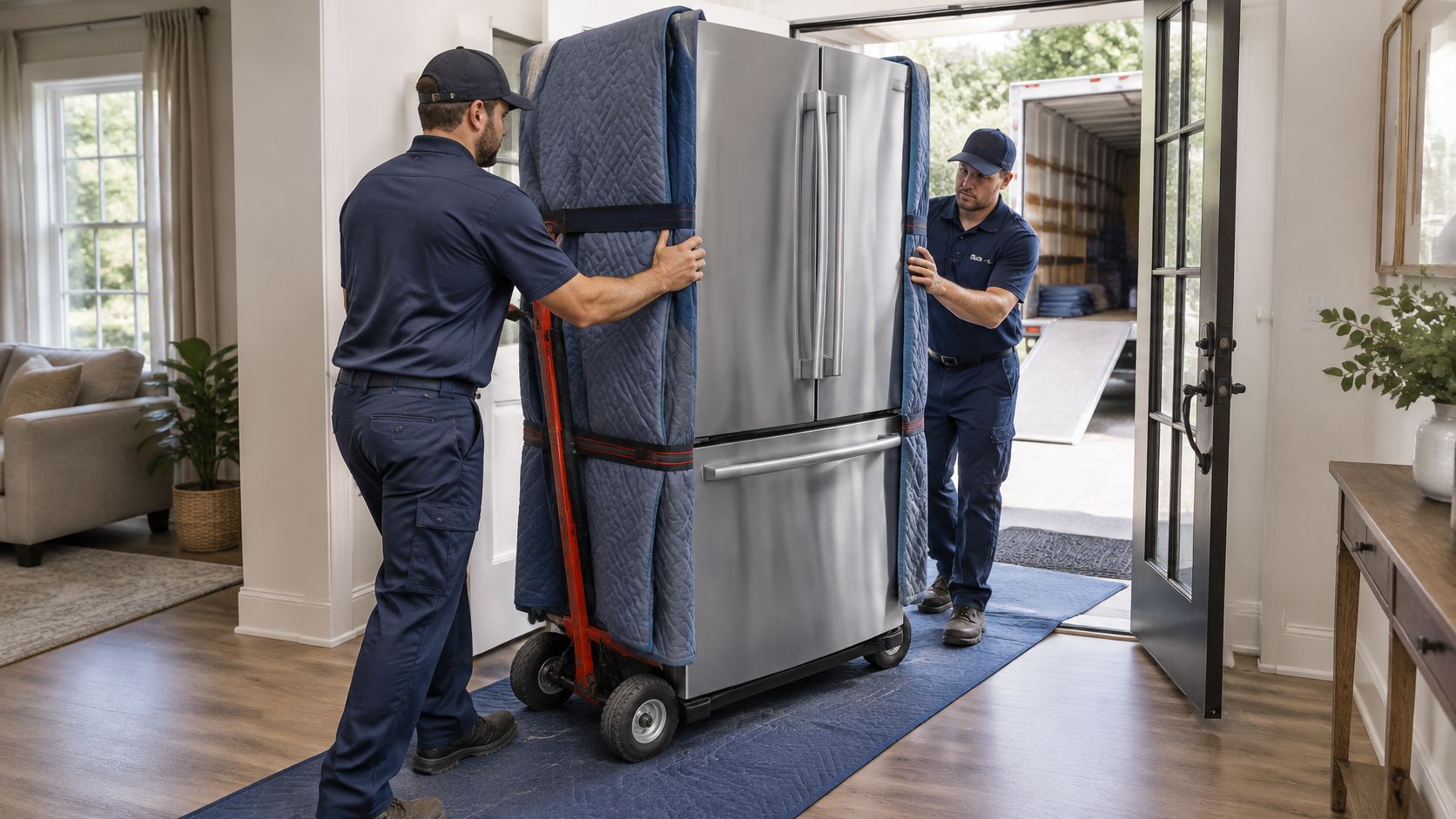
You've cleared the kitchen, moving day is approaching, and the fridge suddenly looks much wider than the doorway. Then there's the apartment lift, the front steps and the question of whether the old unit should come with you at all.
Knowing how to move a fridge starts with the route, not the lifting. For Sydney homes and businesses, the tightest doorway or stair landing deserves as much attention as the truck. Plan the access, prepare the appliance and decide its destination before anyone starts pushing.
Measure, Plan and Gather the Right Gear
A fridge gets stuck when someone measures the kitchen doorway but misses the turn immediately beyond it. Its height, depth, handles and trolley all affect whether you can manoeuvre it through the building.
Record the manufacturer's dimensions, then measure the actual cabinet, including protruding handles and hinges. Compare those measurements with every restriction between its current position and its final kitchen.
Measurements to Take and Equipment to Bring
The table pairs each measurement with the equipment or access check it informs.
| Item | Why it matters | Typical value or check |
|---|---|---|
| Fridge height, width and depth | Decides whether the unit clears doorways and lifts | LG Australia's 590-litre side-by-side listing gives 1,756 mm high, 894 mm wide and 127 kg; record the depth from your own model's specifications |
| Fridge weight | Decides how many people and what equipment are needed | The same LG model weighs 127 kg; check your own unit's label or manual |
| Doorway and hallway width | Must clear the cabinet, trolley and guiding hands | Measure the narrowest point, including door stops and skirting |
| Stair turns and lift interior | Tight turns can force excessive tilting | Compare cabinet depth with lift-car depth and landing width |
| Truck access and parking | Confirms the vehicle can stand close to the entrance | Check the kerb, loading zone and building booking rules |
| Rated appliance trolley | Supports the appliance without loading doors or handles | Choose a suitable load rating and a lip that fits fully beneath the base |
| Moving blankets and rated webbing straps | Protect the cabinet and restrain it in the vehicle | Cover exposed cabinet surfaces and use separate upper and lower restraints |
| Painter's tape and a torch | Secures doors and lights dark corridors | Test tape on the finish; illuminate stairs and thresholds |
A large side-by-side needs a handling team and suitable equipment, not a solo attempt. Weight alone doesn't establish whether a DIY move is manageable: awkward access can make a smaller appliance harder to control.
Bring rubber matting as well, and inspect the trolley's wheels, straps and frame before use. Hire equipment that's suitable for the route rather than assuming any hand truck will do.
Practical rule: If you can't describe how the fridge will negotiate the tightest turn, you're not ready to move it.
Finally, confirm parking at both properties and decide whether the old fridge is staying, travelling or being scrapped. That decision changes the collection arrangements and how its doors must be secured.
Old Fridges, Disposal Rules and Sydney Council Limits
A working fridge is worth relocating. A broken or unwanted unit needs a booked disposal pathway, and leaving it on the footpath creates an illegal-dumping problem for the household.
Keep the sealed refrigeration system intact. The National Environment Protection authorities state that refrigerant must be recovered before recycling, dismantling or destruction, and warn that illegal refrigerant release can attract penalties of up to $660,000 per offence. Recovery is work for an appropriately licensed technician. The householder and the moving crew stay clear of the sealed system entirely.
A unit heading for scrap still travels the same stairs, lift and doorway as one being relocated. Treat the carry-out and the collection booking as a single plan: the service you book decides how the door gets secured, where the unit waits, and whether it qualifies for pickup at all.
Disposal Routes for an Old Fridge in Sydney
| Disposal route | Best for | What to do |
|---|---|---|
| Keep and move | Working fridge going to a new home | Arrange upright transport and manufacturer-directed recommissioning |
| Retailer take-back | Replacing the fridge with a new unit | Confirm collection availability and whether refrigerant recovery is included |
| City of Sydney bulky collection | Unwanted unit within that council area | Book first, remove food, tape the door shut and put it out only the night before |
| North Sydney booked whitegoods | Units meeting the council's weight and size conditions | Use a main-street frontage, secure or detach the door and check eligibility |
| Mosman household clean-up or Kimbriki | Mosman residents | Use the clean-up or drop-off pathway rather than kerbside bins |
| Licensed recycler with refrigerant recovery | Units being scrapped outside a council service | Confirm recovery is included; never puncture, dismantle or vent |
| Other council areas | Residents outside these service boundaries | Check local bulky-waste rules and book before moving day |
The City of Sydney's moving and waste guide accepts fridges through booked bulky-waste collection, requires food removal and taped doors, and treats unbooked street disposal as illegal dumping. Leaving the unit beside communal bins or in an apartment common area does not count as a booking, and no one will collect it.
North Sydney Council accepts booked whitegoods weighing no more than 90 kg, excludes commercial-size fridges, and requires large whitegoods at a main-street frontage rather than a rear laneway. Its door-safety options include taping, tying shut or detaching the door.
Council requirements differ sharply, so read the guide for the property's own area. Shoalhaven City Council's fridge and freezer disposal guide, for example, explains authorised refrigerant handling for residents within that local government area; it reflects one council's pathway rather than a statewide rule. Mosman directs residents towards household clean-up or Kimbriki rather than kerbside bins. Never carry one council's door instructions across to another collection service.
Confirm the handover before vacating
- Council boundary: Check the property's actual local government area.
- Eligibility: Establish the appliance's weight and whether oversized units are accepted.
- Access: Confirm the collection frontage and building-management requirements.
- Door handling: Follow the receiving service's instructions; taping satisfies one council while another asks for the door detached.
- Collection date: Book early enough to coordinate with your lease handover.
For furniture removals Sydney households combine with disposal, keep the collection booking separate from the transport booking. A removalist carrying the fridge downstairs does not automatically arrange its recycling.
How to Prepare and Disconnect the Fridge
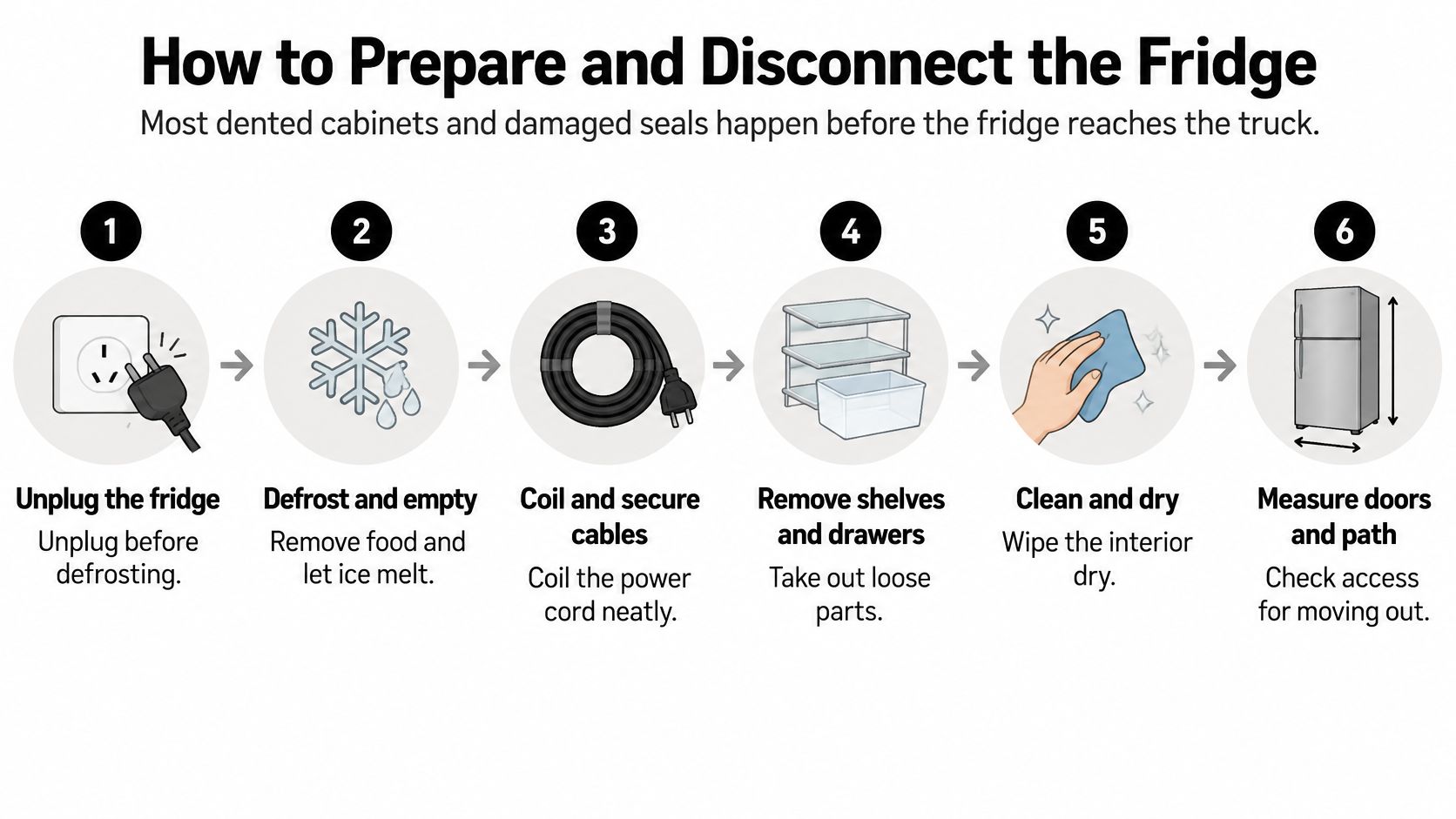
Cabinets and seals can be damaged before the appliance reaches the truck. Preparation removes loose parts, prevents water spills and gives the handling team a protected, controllable load.
WorkSafe WA's goods-handling guidance identifies refrigerators as heavy, bulky and awkward, recommends mechanical aids, and calls for assistance when loading heavy items onto a hand truck. Use a handling partner and a rated appliance trolley, rather than trying to carry the fridge.
Prepare the appliance in order
Unplug before defrosting. Switch off at the outlet and remove the plug without pulling on the cable. Coil the cord loosely and secure it clear of wheels, sharp edges and the floor.
Empty the cabinet. Remove food, shelves, drawers and crispers, then wrap fragile shelves separately. Label the packages so they don't disappear among kitchen boxes.
Defrost completely. Leave enough preparation time for ice to melt naturally, following the appliance manual. Use towels and a shallow tray to catch meltwater, and never chip ice away with a knife or force it with a heat source.
Clean and dry the interior. Wipe the cabinet, seals and drainage areas, then dry them thoroughly. Residual moisture can leak during handling and leave unpleasant smells during storage.
Disconnect the water supply. Close the isolation valve before undoing the water or ice-maker connection, and drain residual water into a bucket. Cap or secure the disconnected line so it can't drip or catch on the route.
Secure the doors gently. Use painter's tape or an appropriate door restraint without crushing the seals. Test adhesive on an inconspicuous area and avoid finishes the manufacturer says shouldn't be taped.
Wrap the cabinet. Fit moving blankets around exposed surfaces and secure them without pressing against vulnerable rear components. Leave the trolley's bearing points accessible so padding doesn't prevent a secure fit.
This visual checklist helps organise the preparation before the handling team arrives.
Avoid the damaging shortcuts
Don't lift by handles, lever against doors or let the trolley bear against condenser coils. Dragging over thresholds and pivoting on the fridge's narrow wheels can damage both the appliance and the floor.
Lay floor protection and clear loose mats, cables and boxes from the route. A ready fridge is empty, dry, secured and wrapped, with its cord restrained and its water line protected.
For a filtered-water model, Water Filter Advisor's guide to how to replace a refrigerator filter can help with separate filter maintenance; it doesn't replace the manufacturer's plumbing instructions. If other connected whitegoods are travelling too, use the appliance-specific guide to moving a washing machine rather than applying fridge preparation to every machine.
Stairs, Lifts and Apartment Access
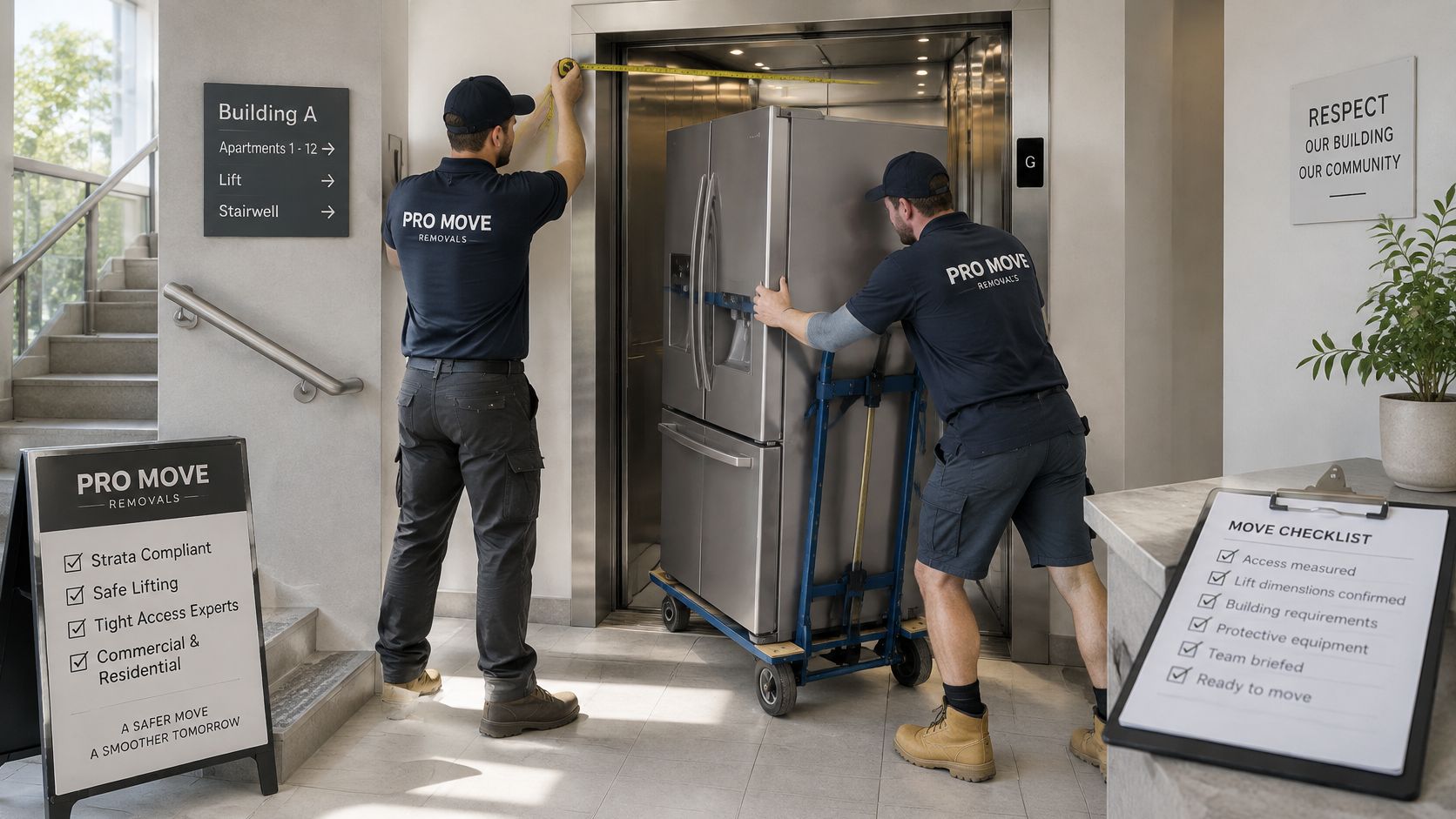
Treat the entrance, stairs and lift as the highest-risk part of the move. These are the places where a tall appliance can lose balance while the people controlling it have little room to reposition.
For a lift, measure the clear door opening and internal width, depth and height. Check the posted capacity against the combined load of the appliance, equipment and accompanying people, then confirm the moving booking with building management.
Walk the route before loading the trolley
- Stairs: Measure the usable landing length at each end and every turn. A trolley needs room to change direction without forcing the cabinet into a steep lean.
- Strata access: Book the lift and loading dock, confirm permitted moving hours, and protect common-area floors and corners.
- Terrace doorways: Establish whether removing the property's door panel would provide safe clearance. Only remove appliance doors or components when the manufacturer permits it.
- Wet entrances: Dry the route or postpone handling where traction is uncertain. Use secure matting without creating raised edges that catch trolley wheels.
Don't shoulder-carry a fridge or attempt an improvised hand-carry up stairs. Stair work needs suitable rated equipment, competent operators and a clear recovery plan; an ordinary trolley and willing helpers aren't automatically enough.
Agree on commands such as “stop” and “lower” before moving. Keep people out of the downhill fall path, and don't try to catch an appliance that has started to topple.
A landing is useful only if there's enough space to stop, stabilise and turn the loaded equipment.
The same route-planning principles apply when moving heavy furniture, but a fridge's tall cabinet and vulnerable rear components need particular care.
How to Load, Secure and Transport the Fridge
A fridge can topple during braking, cornering or an evasive manoeuvre. Laying it down creates a different problem: compressor oil can migrate into refrigeration lines, so upright transport is the preferred arrangement.
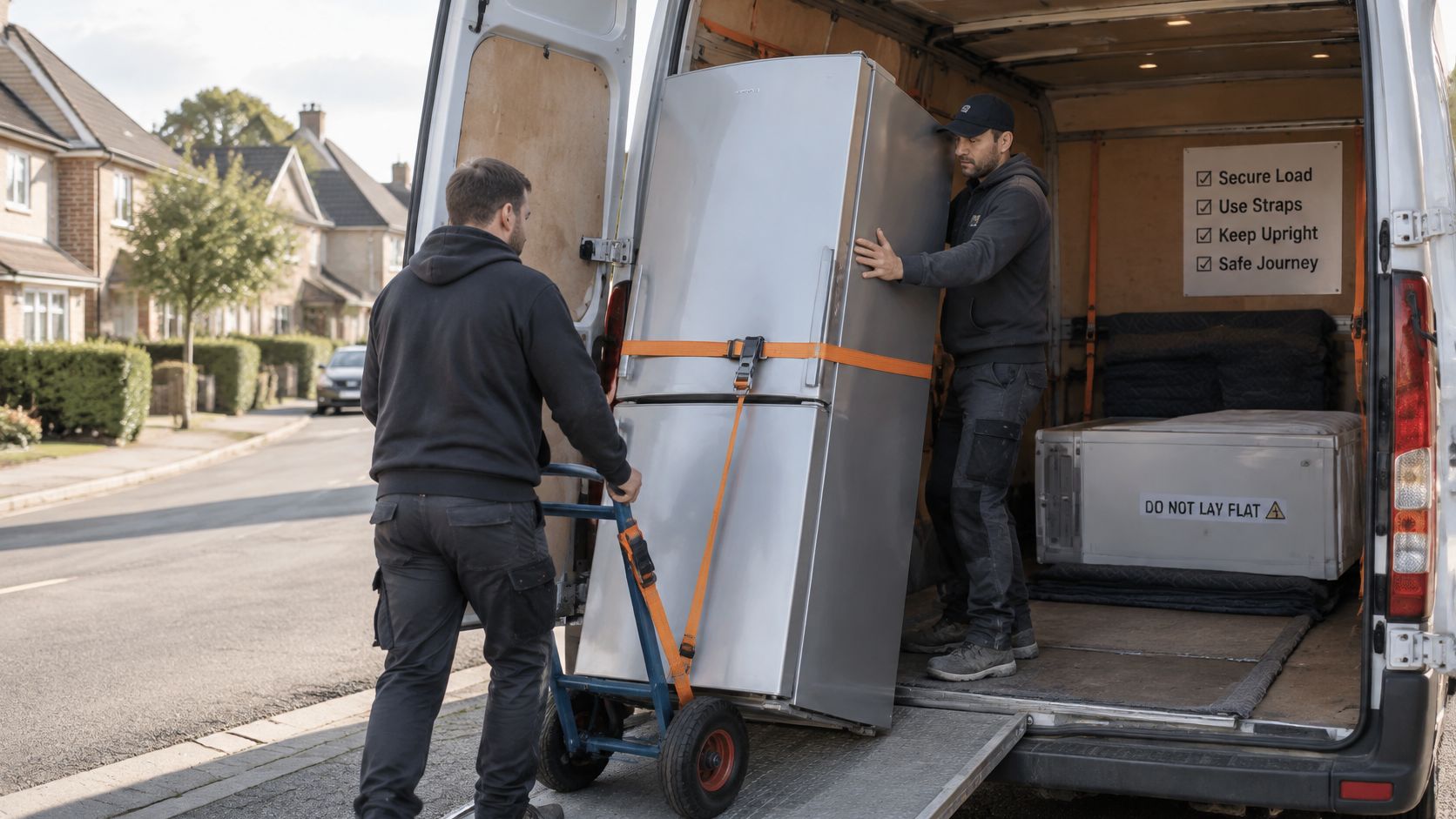
Use an appliance trolley to control the cabinet during the transition between building and vehicle.
Load onto a prepared vehicle
Position the truck safely. Park close to the entrance where permitted, secure the vehicle and prepare a suitable ramp or tail-lift. Lay rubber matting where the fridge will stand.
With assistance, tilt the cabinet only enough to place the trolley lip fully beneath its approved base. Secure the appliance to the trolley before rolling.
Use the ramp or tail-lift within its rating. Maintain control throughout and keep the cabinet as vertical as the equipment allows. Don't attempt to muscle an unstable load over the truck's rear edge.
Stand the fridge against the vehicle's headboard. Pack gaps with suitable dunnage, meaning blocking or packing material that prevents movement, rather than loose household items.
The Queensland Government's load-restraint guidance specifically identifies fridges as tall whitegoods requiring restraint to the headboard. It recommends rubber matting and tightly packed dunnage to prevent movement and loosening lashings.
Restrain the cabinet, not its fittings
Attach rated webbing straps to suitable vehicle anchor points and position them at stable cabinet locations. Keep upper restraint high enough to control toppling, but don't run straps across handles, hinges, exposed pipework or unsupported panels.
Tighten firmly without denting the cabinet. Stretch wrap protects surfaces; it isn't load restraint, and a single improvised rope isn't an adequate substitute for a planned restraint system.
This video provides an additional visual reference for refrigerator handling.
Check that a firm hand push produces no cabinet movement relative to the vehicle. Recheck the restraints after an initial short drive and at stops, because padding and packing can settle.
For interstate removals, keep the appliance intact throughout the journey. The NSW EPA's dangerous-goods overview explains that transport controls depend on classification and quantities; don't assume every fridge requires a dangerous-goods licence, but leave refrigerant work to qualified technicians.
How to Unload, Settle and Reconnect at the New Home
The final kitchen approach still needs care. A rushed turn at the front door can dent the cabinet, while a trailing power cord can disappear beneath a wheel or levelling foot.
Keep the arrival route clear and leave the fridge disconnected until it's positioned and inspected.
Reinstall without rushing the restart
Unload under control. Put mats down and secure the appliance to the handling equipment before releasing its vehicle restraints progressively. Use the same coordinated team approach throughout unloading.
Place the fridge in its final position with the ventilation clearances specified in its manual. Don't push it tightly against the wall or trap the water hose behind the cabinet.
Allow the prescribed settling period. Keep it upright and follow the manufacturer's transport and restart instructions. If it was significantly tilted and the manual is unclear, obtain model-specific advice instead of guessing a universal waiting time.
Inspect before connecting power. Check the cabinet, door alignment, supply cord and plug for impact damage, crushing or moisture.
Don't plug in a dropped appliance, a crushed lead or a scorched plug. Queensland Electrical Safety says damaged or faulty electrical equipment must be taken out of use; arrange assessment by an appropriately qualified electrical or appliance technician.
Reconnect the water line according to the appliance instructions, open the supply and inspect each fitting for drips. Keep the plug, outlet and surrounding area dry before switching on.
Let the cabinet reach its operating temperature before restocking. Set the controls as directed and confirm cooling rather than judging readiness solely by elapsed time.
Check the seal and final position
If a door won't close cleanly, inspect the shelf positions and check cabinet levelling before assuming the seal needs replacement. Adjust the feet according to the manual, and make sure the fridge doesn't rock.
Listen for unusual scraping, repeated clicking or vibration against cabinetry. A normal installation should remain stable, close properly and maintain the selected temperature once cooling has stabilised.
For office relocations, nominate someone to handle the final checks and food restocking. Otherwise, staff may reconnect or fill the fridge before the person responsible has confirmed it's ready.
Book a Removalist for the Heavy Lifting
A clear, ground-floor route may suit a careful DIY move with a capable handling partner and the right equipment. Stairs, a narrow lift or a very heavy cabinet should change that decision.
Book professional help whenever you can't keep control of the cabinet through every stage of the route. That covers a commercial-size appliance, restricted landings, strata access requirements, or having no suitable trolley or helper.
The carry from the front door to the truck is where fridge moves most often go wrong. A trolley slipping on a stair edge or a cabinet jammed in a lift doorway does more damage than the drive itself, so the access stage deserves the same planning as the loading.
Make the access part of the quote
A professional team should plan the appliance, building route and vehicle together rather than discover the stair turn after arrival. Moving costs are estimated from the distance of the move, the volume of items, the number of removalists required and any additional services such as packing or storage, so the access detail you supply directly shapes the accuracy of the price. Our loading and unloading services use trained staff and the latest equipment, and customers can request a free, custom quote covering the fridge and other furniture travelling in the same booking.
Send useful details rather than describing access as easy:
- Appliance information: Height, width, depth, weight and model details.
- Property access: Stair runs, landing photographs, lift dimensions and parking position at both ends.
- Building requirements: Lift reservations, loading-dock arrangements and restricted moving hours.
- Other items: Furniture and anything else sharing the move.
- Destination: Whether the fridge is being reused or delivered to an approved disposal service.
If you are weighing up removalists before committing, our guide to choosing a removalist sets out what to check. A transport booking doesn't cover licensed refrigerant recovery, so arrange that handover separately when the old unit is being scrapped rather than relocated.
Resolving access early also protects a lease deadline. A fridge left behind on moving day because nobody measured the lift is a far harder problem than a quote organised a week out.
Home Removals Sydney offers trained loading and unloading support and a free, custom quote for your fridge move. Visit Home Removals Sydney and send your appliance dimensions, weight, stairs or lift details, building requirements and other items so we can account for access before moving day.
