


You've got a moving date, an agent asking about key handover and a new property that needs a bond before your old one comes back. Meanwhile, removalist quotes arrive with different crew sizes, vague travel charges and little explanation of what happens if something gets damaged.
If you're searching for Bills Removalists Sydney, start by confirming exactly which business you're dealing with. Then compare the move as a complete job: transport, packing, access, payment timing and the records you'll need if there's a dispute.
Who Bills Removalists Sydney Is and What to Verify First
A removalist will carry your belongings and enter your property, so confirm the business identity before comparing prices. Check the legal name and ABN against the Australian Business Register, then match them to the trading name, address and phone number on the quote.
Home Removals Sydney operates at homeremovalsydney.com.au. However, don't assume that Home Removals Sydney and Bills Removalists Sydney are the same legal entity. Establish who trades under the name you searched before paying anyone.
Match the paperwork to the business
Check these details together:
- Identity: The legal entity receiving your payment matches the entity issuing the quote.
- Coverage: Your suburbs and any interstate route appear in the written scope.
- Credentials: Any accreditation claim can be checked independently. Our guide to AFRA-accredited removalists explains what to examine.
Years in business, staffing, insurance and prices shouldn't be inferred from a similar business name. Get supporting documents for the actual provider.
For property investors coordinating a tenancy change, VerticalRent's rental property IRR calculator can support the broader investment assessment. Keep that separate from the immediate moving budget: an investment return calculation doesn't establish how much cash is available for settlement, cleaning or relocation.
Side-by-Side Criteria for Choosing a Sydney Removalist
Compare the same evidence for each Sydney removalist. A low quote may leave out services or costs that appear in another provider's price, so check the scope alongside the total.
| Criterion | What to Ask | Why It Matters |
|---|---|---|
| Registration and ABN | Ask for the ABN and trading name. | Makes the contracting business traceable. |
| Insurance cover | Request the policy scope and details of the claims process. | Shows what protection may apply to belongings during the move. |
| Vehicle sizes | Ask for truck capacity and gross vehicle mass. | Helps match the vehicle to the load. |
| Packing scope | Ask what packing, wrapping and unpacking services are included. | Clarifies who prepares fragile goods and what the crew will handle. |
| Interstate reach | Confirm the route and delivery window. | Long-distance moves need clear scheduling. |
| Storage | Ask about access hours, security and charges. | Clarifies the terms if belongings need to be stored between properties. |
| Quote format | Request a written quote with itemised inclusions and costs. | Makes different offers easier to compare. |
| Hourly rate and extra crew | Ask for the hourly rate and the cost of each additional removalist. | Shows how labour affects the bill. |
| Review evidence | Check recent reviews on independent sites. | May reveal recurring service issues. |
| Damage claims | Request the written claims process and notification timeframe. | Explains what to do if belongings are damaged. |
Read insurance terms carefully. A certificate alone does not show whether every item or event is covered. Check exclusions, excesses and who must lodge a claim.
Match vehicle capacity and packing scope to the inventory. For interstate work, ask whether the delivery window is firm or estimated. Storage needs clear terms for access, handling and release.
Compare evidence, not impressions
The quote should state whether the price is hourly or fixed, when chargeable time starts and stops, and how extra labour is approved. An additional crew member may improve handling and shorten the job, but extra labour will not resolve an unbooked lift.
Practical rule: Compare quotes that name the truck size, crew count and inclusions. If those details are missing, the offers are not directly comparable.
Read reviews on independent sites and look for repeated comments about damage, delays or unexplained charges. Note whether the business responds constructively to complaints. A high overall rating is less useful than a consistent pattern across reviews for comparable moves.
Record the claims procedure and review findings, then rate each requirement as confirmed, incomplete or not confirmed. Treat an unanswered requirement as a reason to hold off shortlisting the provider. Apply the same checks to three providers before comparing prices.
Matching the Removalist to Your Type of Move
Priority criteria by type of move
| Move situation | Priority criterion | Question to ask |
|---|---|---|
| Local apartment | Lift and loading dock access | Who books the lift and loading dock, and for what time? |
| Family home across Sydney | Crew size and packing scope | How many removalists are needed, and what does packing include? |
| Office or warehouse | After-hours timing and pallet handling | Can the move run out of hours, and how are pallets and equipment handled? |
| Antiques and artwork | Restraint and handling method | How are fragile items wrapped, separated and secured in transit? |
| Sydney to regional NSW | Route scheduling and delivery windows | How is a multi-day route planned and confirmed? |
| Interstate | Transit insurance and documentation | What cover applies for the full journey, and how is a claim lodged? |
A local apartment move can involve little driving but considerable handling. Shared lifts, loading dock availability and the distance from truck to door can matter more than the distance between suburbs. Confirm the building's requirements before choosing an arrival window.
For home removals Sydney customers moving a family household, the inventory matters more than the bedroom label. Include garage shelving, outdoor furniture, exercise equipment and anything requiring dismantling. Specify whether beds must be reassembled before the crew leaves.
Commercial and specialist loads need different planning
Office relocations need an operational handover plan, not just labelled cartons. Decide who disconnects equipment, which workstations must be usable first and whether the building permits after-hours access.
Warehouses require pallet dimensions, load weights and suitable handling equipment. Transport for NSW's freight and logistics methodology explicitly includes storage and transport-support activities, a useful reminder that commercial relocation involves more than the truck journey.
For a warehouse, the crew's plan for pallets and access matters more than the truck's headline size.
Antiques and artwork need an agreed preparation method. Ask whether the proposal includes corner protection, suitable wrapping, rigid packaging or specialist crating, rather than accepting a generic promise of careful handling.
Regional NSW and interstate removals also need collection records, delivery contacts and a plan for delayed property access. Establish who holds the goods if the destination isn't ready.
Under Transport for NSW heavy-vehicle guidance, the general width limit is 2.5 metres, with standard load-projection limits of 1.2 metres forward and 150 millimetres sideways. Request actual loaded height, width and length; oversized or overmass movements may need approvals, route surveys and traffic management.
Match your move to the relevant row and obtain a written answer to that question before accepting the proposed service.
Vehicle Size, Load Safety and Route Access
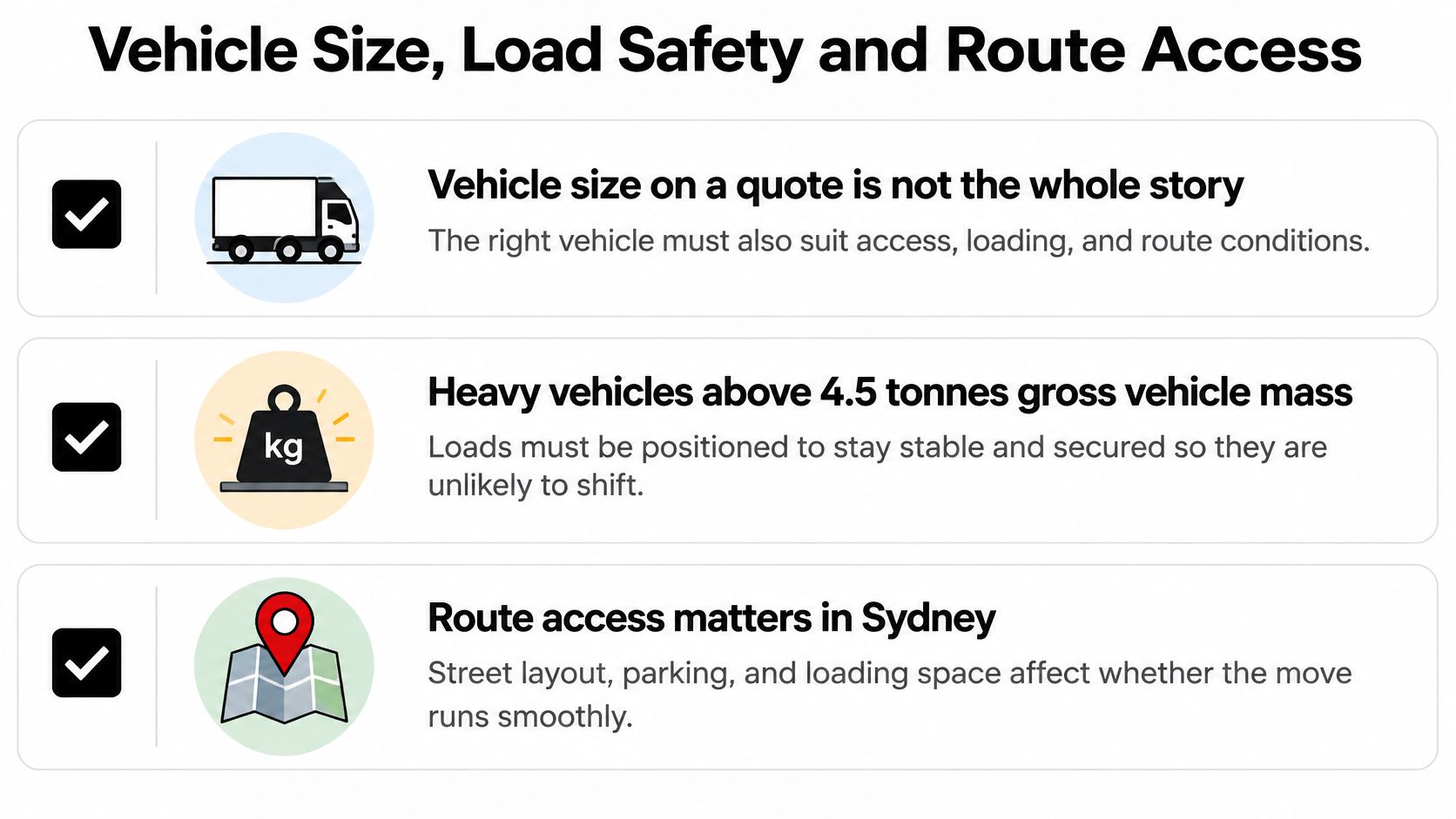
Vehicle size on a quote isn't the whole story. A truck might accommodate your furniture yet be unsuitable for the approach road, driveway or unloading area.
For vehicles above 4.5 tonnes GVM, the NSW heavy-vehicle provisions require stable load positioning and suitable restraint, with restraint benchmarks equivalent to 20% of load weight upward, 80% forward, 50% rearward and 50% sideways. Forward restraint matters particularly during braking, when the load tends to move towards the cab.
Use the checklist below to connect vehicle selection with loading and access.
Put these questions to the estimator
- Which restraint equipment will the crew use? Ask about rated straps, load bars, edge protection and blankets. Blankets protect surfaces; they don't replace a restraint system.
- How will fragile items be separated from heavy goods? A wrapped mirror still needs protection from a shifting appliance or dense carton.
- What are the vehicle's GVM and available payload? The allowance must account for fuel, equipment and other carried mass, not just the advertised cargo space.
- Would another vehicle be more suitable? A larger truck isn't automatically better if it can't reach the loading position.
For furniture removals Sydney jobs, loading order should reflect both protection and unloading needs. Keep heavy pieces stable, avoid loading pressure onto delicate surfaces and make essential destination items accessible without destabilising the remaining load.
Check the route all the way to the door
Send photographs of narrow streets, driveway gradients, gates and the proposed parking position. Include overhead obstructions, low bridges on the approach and any building height clearance.
The access plan should identify council parking restrictions, apartment loading zones, lift bookings and building booking windows. Don't assume that a truck can wait at the kerb while someone negotiates with the building manager.
Where direct access isn't practical, establish whether a smaller transfer vehicle is needed. That can solve a difficult approach, but it adds handling and coordination, so its cost and responsibility should be explicit.
A suitable provider should be able to explain a loading plan and an access plan for your addresses, rather than offering only a truck-size recommendation.
What a Sydney Move Really Costs in Cash Flow
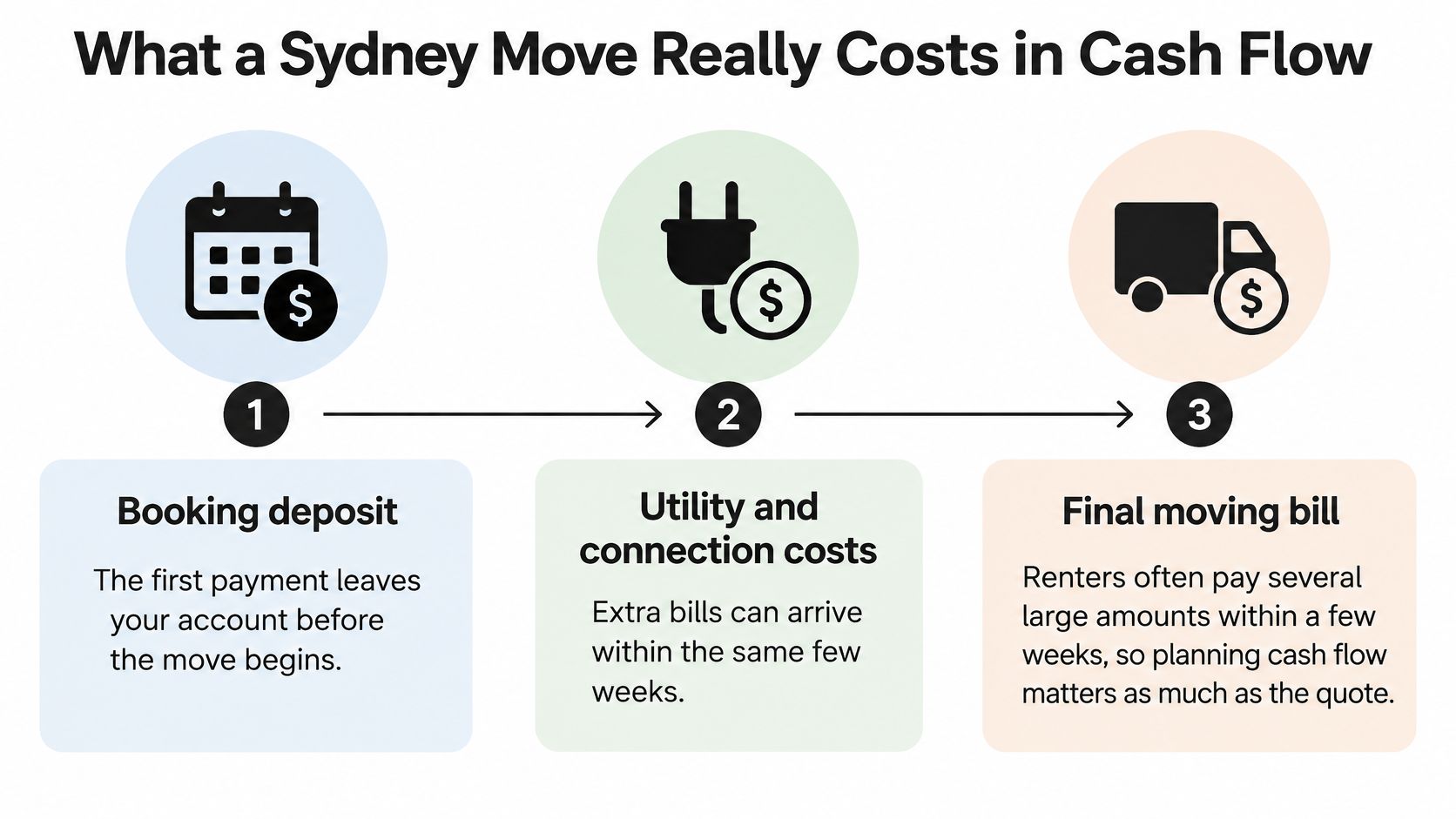
The moving bill is a cash-flow problem as well as a removalist quote. You may need to pay for the new property while your old bond remains unavailable, alongside cleaning, packing materials and transport.
The NSW Government's lease and moving guidance sets the rental bond cap at four weeks' rent and rent in advance at up to two weeks' rent; it also explains permitted charges and tenants' utility responsibilities. Don't accept extra application or lease-start charges without checking whether they're permitted.
When each moving cost falls due
| Cost item | When it is due | Refundable | Notes |
|---|---|---|---|
| Removalist invoice | On the date in the written quote | No, ordinarily a service payment | Include extra removalists in the total. |
| Rental bond | Before the lease starts | Yes, subject to valid claims | Statutory cap applies. |
| Rent in advance | Before the lease starts | No, credited to rent | Permitted advance limit applies. |
| Utility connections | Before move-in, where charged | No for connection fees; check deposits separately | Check agreement and supplier terms. |
| Professional cleaning | Before handover | No, ordinarily a service payment | Assess the required handover condition. |
| Packing materials | Before packing day | No for purchased materials | Check whether included or separately charged. |
A refundable bond still ties up money. Don't budget as though the old bond will arrive before the new one is due, and distinguish a genuine expense from money temporarily held elsewhere.
The timeline illustrates how moving payments can overlap.
Build a dated payment planner
Use these suggested planning checkpoints, not contractual deadlines:
- Six weeks out: Confirm the intended moving date and obtain an itemised quote.
- Two weeks out: Record bond and rent-in-advance payment dates, then arrange utility transfers.
- The week before: Book any necessary cleaning and confirm property access.
- Move day: Pay according to the written quote, checking approved additions against the invoice.
- After move-out: Complete the bond paperwork and track the refund rather than treating it as available cash.
The cheapest quote isn't the cheapest move if it leaves you short on bond day.
Our guide to the cost of removalists in Sydney can help you organise the transport component. For commercial tenants, Tandem Space, Inc.’s guide to find and lease office space provides context for coordinating premises decisions before committing to relocation dates.
Record overlapping rent, final utilities and connection charges separately. Your working figure should be the total cash needed before refunds arrive, not just the removal fee.
Protecting Your Bond and Belongings on Move Day
Weeks after moving, your landlord claims a wall dent. You remember the hallway being marked, but there's no clear photograph showing its condition before the furniture came out.
The NSW Government's moving-out guidance explains that bond claims can concern damage, cleaning, unpaid rent and other amounts owing, with property condition and key return relevant to handover. Your records should distinguish pre-existing marks, moving damage and the condition you left behind.
Photograph the property before loading starts, while the relevant surfaces are still visible.

Create a clear chain of evidence
- Photograph the old property before loading. Capture walls, floors, doorways and lifts with timestamps, using wide shots for location and close-ups for detail.
- Cross-check existing marks against the condition report. Keep the signed original, and date any supplementary record rather than altering the original retrospectively.
- Inventory valuable belongings. Record serial numbers, identifying features and photographs of their condition before packing.
- At both addresses, request a handover record showing crew names, time and any exceptions. Don't sign an unqualified statement that everything is undamaged before inspection.
- Document incidents promptly. Aim to record damage within 24 hours as a practical precaution, not a universal legal deadline. Notify the mover in writing immediately and follow the applicable claims terms.
- Keep the quote, invoice and insurance certificate together, with incident correspondence attached.
J&M Cleaning Team's checklist can help you document apartment condition before moving out. Include cleaned areas and empty cupboards, not just places you expect to dispute.
The following video provides additional moving-related context.
Keep tenancy and transport claims separate
A landlord's bond claim and a claim against a mover involve different parties and processes. Buying insurance won't establish when a wall was damaged; evidence still matters. Our removalist insurance guide provides context for checking cover alongside your records.
For apartments, retain lift and loading dock booking confirmations and photograph shared access areas. Before moving day, assemble an evidence folder containing:
- Property records: Condition report and access photographs.
- Inventory: Valuable-item descriptions and images.
- Handover forms: Ready for names, times and exceptions.
- Contract documents: Quote and agreed scope.
- Payment records: Deposit receipt and space for the final invoice.
- Insurance records: Certificate, relevant terms and claims contacts.
Request Quotes and Book with Confidence
Request written, itemised quotes from at least three removalists, using the identity, insurance and quote-format checks to decide who makes the shortlist. Send each business the same information so you're comparing the same work.
Include pick-up and delivery addresses, floor levels, stairs, lift access, parking restrictions and an inventory of large or fragile items. Add photographs of awkward access and identify anything needing dismantling, specialist packaging or placement in a particular room.
Follow a consistent booking process
- Shortlist suitable providers. Retain businesses that answer the registration, insurance and documentation questions clearly.
- Send an identical inventory and access description to each estimator. If the scope changes, update every provider.
- Compare line by line. Check labour, vehicle allocation, packing, travel, additional removalists and any stated exclusions.
- Confirm dates, access bookings, payment conditions and the damage-claims process in writing before paying a deposit.
Home Removals Sydney can be included in that comparison. We offer a free online quote, with a specialist getting in touch shortly after the form is completed; our pricing has no hidden costs, and we offer insurance options to protect belongings during a move. Confirm the applicable service scope, coverage and insurance terms in your written proposal.
Choose the quote that explains the complete job, rather than the lowest headline figure. A clear proposal gives you something practical to book against, budget around and refer to if the delivered service differs from the agreement.
Home Removals Sydney offers a free online quote, transparent pricing with no hidden costs and insurance options for your belongings. Visit Home Removals Sydney with your moving dates, addresses, access details and inventory ready, then compare the written proposal with at least two other quotes before booking.
