

The cartons are stacked in your Fairfield hallway, the fridge still needs emptying, and tomorrow's truck booking suddenly feels less settled than it did on the phone. Or you're moving an office to Parramatta and nobody's confirmed whether the loading dock will be available when the crew arrives. Either way, the question isn't just who can move your furniture. It's who has actually planned the job.
When comparing removalists in Western Sydney, choose the operator who asks about your inventory, access and deadlines before talking price. A cheap hourly rate won't fix an unsuitable truck, an unavailable lift or an interstate load containing items that shouldn't cross the border.
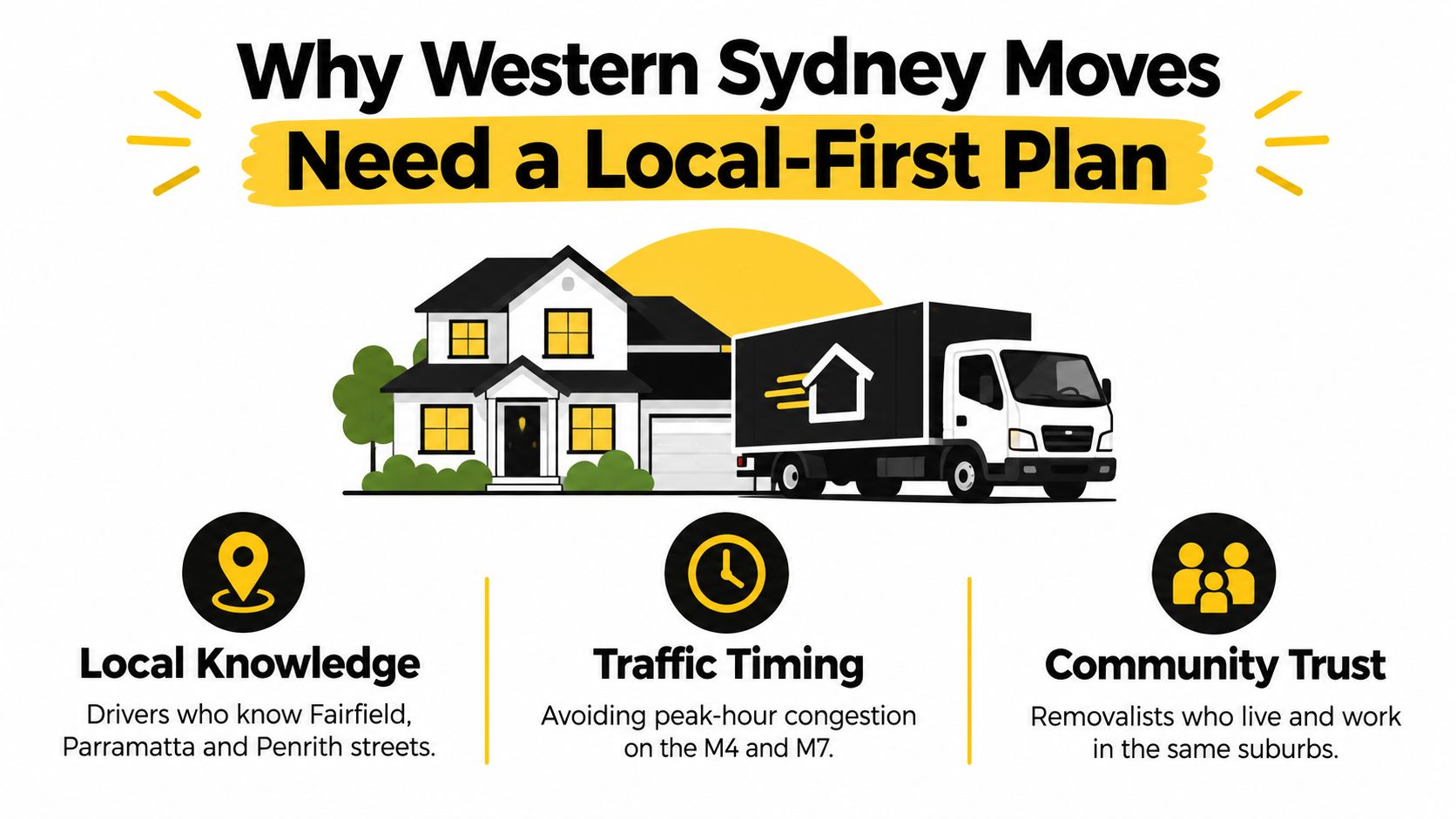
Why Western Sydney Moves Need a Local-First Plan
A family leaving Fairfield might need beds dismantled, appliances protected and cartons delivered straight into the right bedrooms. A small office heading to Parramatta might need workstations moved around a building's loading schedule. Both involve a truck, but they're different jobs. Booking them as though they're interchangeable is where trouble starts.
Western Sydney has about 2.8 million residents across 13 local government areas, represents roughly 33% of NSW's population, and includes 472,210 households containing children, according to the NSW Government's Western Sydney snapshot. That scale makes a suburb-by-suburb approach more useful than a vague promise to cover all of Sydney.
Start with the job, not the postcode
Tell the removalist what must happen at each address. Include the garage, outdoor furniture, filing cabinets and anything going into storage. An inventory based only on the main rooms leaves too much to guesswork.
Then settle the decisions that shape the booking: service type, vehicle and crew, and pricing model. Local knowledge matters when it helps the operator make those decisions properly, not just because the depot is nearby.
Three Core Service Types for Western Sydney Moves
| Service type | Best for | Typical crew and vehicle |
|---|---|---|
| Home removals | Houses, apartments, units and furniture-only moves | Furniture-handling crew with a van or removal truck matched to inventory and access |
| Office relocations | Workstations, files, equipment and staged business moves | Commercial relocation crew with suitable equipment and loading arrangements |
| Interstate removals | Household or business goods crossing state borders | Long-distance crew and vehicle with an agreed collection and delivery plan |
A sensible local-first plan connects the addresses, the goods and the customer's deadline.
Don't mistake proximity for competence. Ask how the operator would handle your particular building and destination. A clear answer about collection, loading and final placement tells you more than a broad service-area list.
Home, Office and Interstate Services Explained
Most customers don't need the biggest service package. They need the right one, with the boundaries written down.
The ABS housing mobility data recorded 1.14 million Australian households, or 12%, moving during the preceding year in 2019–20; among households that had moved during the preceding five years, 65% relocated within the same state or territory but outside their previous suburb or locality. That distinction matters: a move across Western Sydney isn't automatically a long-distance job, while crossing a state border deserves a different conversation.
Home removals and furniture-only bookings
Home removals Sydney services should be scoped around what you want the crew to do. Transport alone is different from packing cupboards, dismantling beds, reassembling furniture and unpacking at the destination. Ask whether those tasks are included, optional or unavailable.
For furniture removals Sydney customers should specify the finish, size and final position of important pieces. Slone Brothers Furniture's resource on a premium in-home furniture service is useful context when discussing careful delivery and placement. Don't assume that level of assistance comes with a standard transport booking.
If settlement dates don't align, arrange storage before collection. Specify which belongings you'll need to retrieve rather than packing essential documents or work equipment into an inaccessible load.
Office moves need an operational handover
An office manager should nominate who disconnects computers, labels equipment and approves the destination layout. Removalists can transport equipment without being responsible for reconnecting your network.
- Workstations: Match desks, chairs and components to labelled destination positions.
- Sensitive equipment: Agree on packaging and who handles disconnection.
- Business continuity: Ask about after-hours scheduling and staged deliveries.
- Files and archives: Keep departments and confidential material clearly separated.
Book an office relocation around when staff need to work, not just when the truck is free.
Interstate removals need an agreed delivery window, clarity about shared or exclusive vehicle use, and written arrangements for goods-in-transit cover. Confirm who manages any item-specific declarations or destination requirements. Choose a provider that can explain the whole journey rather than treating the border as somebody else's problem.
Matching the Fleet to Your Move Size
The biggest truck isn't automatically the most efficient choice. A vehicle that carries everything but can't reach the loading point may create more work than a smaller, properly planned alternative.
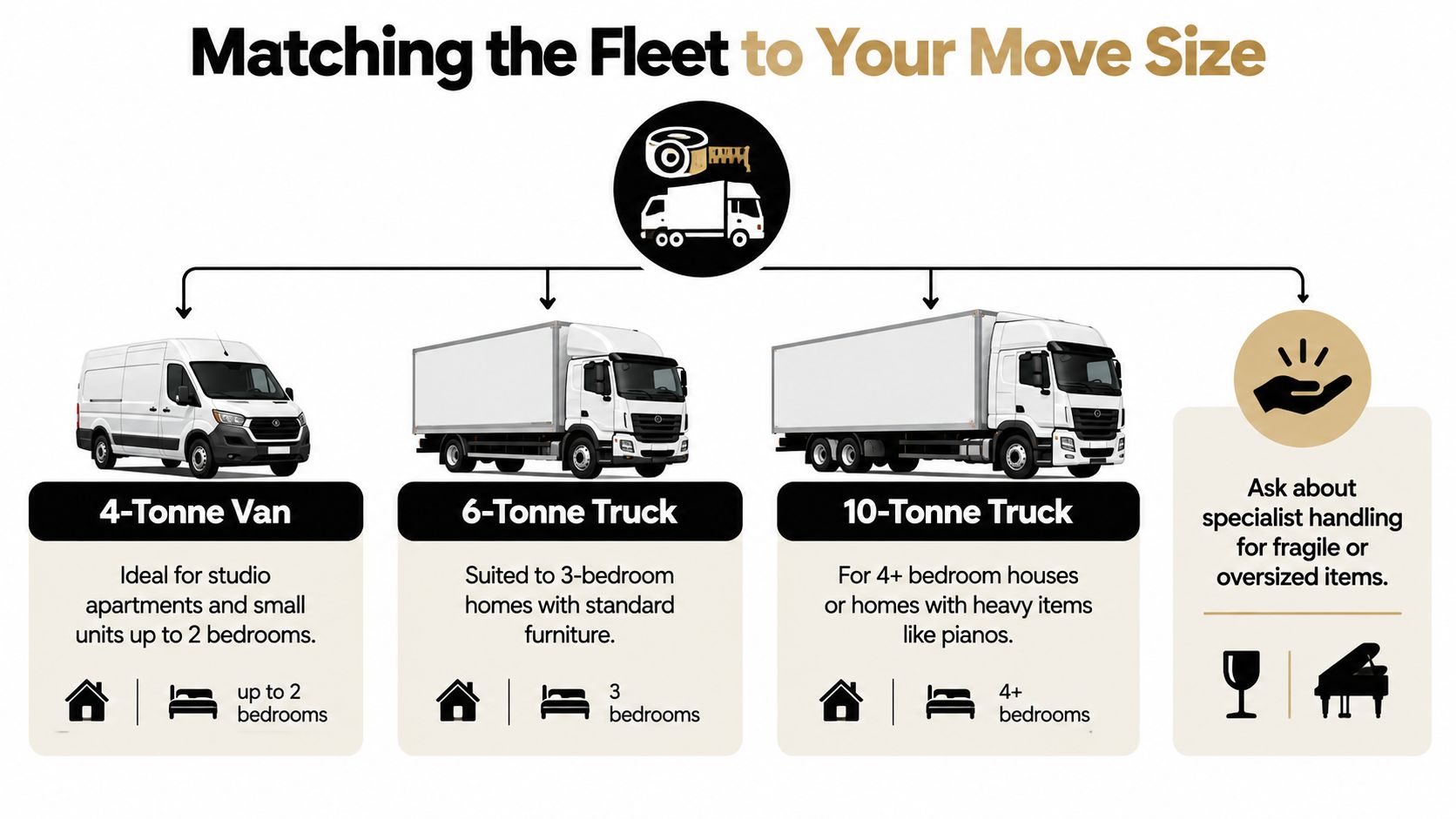
Use vehicle labels as a starting point, not a capacity guarantee. The moving truck size guide provides context for a fleet ranging from 4-tonne vans to 62-tonne trucks, but the operator still needs to confirm usable cargo space, payload and external dimensions. A tonne label alone doesn't tell you how many sofas, cartons or awkward objects will fit.
Compare the actual move profiles
For a studio apartment in Parramatta, the important question might be whether the vehicle can use the building's loading area. A compact load doesn't help if the longest piece of furniture won't fit through the lift or stairwell.
For a four-bedroom home in Baulkham Hills, count the whole property. Beds and sofas are only part of the inventory; garage shelving, garden equipment and outdoor settings can change the vehicle requirement.
A warehouse transfer in Wetherill Park needs a different assessment again. Give the operator pallet details, equipment weights, loading arrangements and the order in which stock must be available at the destination. Don't book it as an oversized house move.
This visual is a starting point for discussing vehicle options, not a substitute for an inventory assessment.
Size the crew around the handling
Ask the operator to explain the proposed crew, particularly if there are stairs, bulky furniture or restricted loading windows. Fewer people can mean a lower hourly headline but a slower job. More people aren't useful unless there's a workable plan for them.
- Pianos: Identify the type, route through the property and any steps before booking.
- Antiques and artwork: Supply photographs, dimensions and details of vulnerable finishes.
- Pallets and machinery: Confirm suitable loading equipment and compatible vehicle access.
- Oversized furniture: Measure the item and its narrowest exit point.
Practical rule: Choose the smallest suitable vehicle that can carry the agreed load safely and complete the planned delivery without avoidable repeat trips.
If someone recommends a vehicle solely from your bedroom count, ask for an inventory review. Bedrooms are shorthand, not a load assessment.
Pricing Models and What Really Drives the Quote
Compare the pricing method and inclusions, not just the headline rate. An hourly estimate, a fixed quote and a volume-based proposal answer different questions.
A useful quote discussion starts with the goods, both addresses and the work expected from the crew.

Understand what you're agreeing to
With hourly pricing, ask when charging starts and stops, how time is rounded, and whether depot travel is included. The online removalist quote page advertises pricing starting at $120/hr + GST; treat a starting rate as an invitation to establish the full job cost, not as a complete estimate.
A fixed-price quote gives clearer budget certainty when the inventory and access conditions are accurately recorded. Ask what changes would trigger an adjustment, including extra goods, unavailable access or a changed destination.
With volume-based pricing, ask how the load is measured and what happens if the actual inventory differs. Don't accept an unexplained volume figure as though it were a detailed scope of work.
| Moving scenario | What the quote needs to capture |
|---|---|
| Two-bedroom apartment in Liverpool | Lift availability, loading position and distance between apartment and truck |
| Three-bedroom townhouse in Castle Hill | Internal stairs, furniture dismantling and any restricted entry |
| Four-bedroom house in Blacktown | Complete inventory, including garage and outdoor goods, plus packing requirements |
These are assessment examples, not price bands. The property description alone can't establish a reliable total.
Separate the extras before comparing
Request an itemised list covering packing labour, materials, dismantling, reassembly, travel, after-hours work and storage. Ask whether waiting time or an additional trip changes the invoice. Give every bidder the same inventory and photographs so their proposals describe the same job.
Keep these questions beside you while reviewing the booking information.
Be equally direct about fully insured. Ask whose interests the policy covers, which activities are included, what exclusions apply and whether an excess is payable. Public liability, goods-in-transit protection and storage cover shouldn't be treated as interchangeable labels.
An unusually low quote deserves questions, not automatic rejection. If the operator can't explain its scope, assumptions and possible additions, you don't yet have a useful price comparison.
Planning Around Routes, Access and Quarantine Rules
A Western Sydney move needs a route plan as well as a packing plan. More than 80% of containers arriving from Port Botany are destined for freight and logistics warehousing in Western Sydney, according to Transport for NSW's Western Sydney freight information. Your household or office load may share roads and industrial access points with substantial freight activity.
For journeys using the M4, M7 or Cumberland Highway, ask the dispatcher to consider current conditions, loading appointments and the destination's receiving window. Don't accept a supposedly universal best departure time. A warehouse dock booking and an apartment lift reservation can matter more than just starting early.
Check access at both ends
NSW's heavy-vehicle restrictions and limits distinguish General Access Vehicles from vehicles exceeding general mass or dimension limits, which may need access through a notice or permit. Councils manage local-road access, while Transport for NSW manages state roads. Posted bridge, gross-load and no-truck restrictions still matter, and gross mass includes the vehicle and its load.
A large truck's capacity doesn't establish permission to use your street. Ask the operator to confirm route eligibility and any road-manager approval required before dispatch.
Keep this access checklist with your booking details:
- Street restrictions: Record no-truck signs, load limits and any uncertain approach roads.
- Parking position: Confirm legal kerb space or an approved loading area.
- Vehicle clearance: Check overhead obstacles, gates, driveway gradients and turning space.
- Building arrangements: Obtain lift bookings, loading-dock instructions and moving rules.
- Furniture pathway: Measure tight doorways, corners and stair landings.
- Destination readiness: Confirm keys, site contact and who can authorise unloading.
Photographs help, but send measurements where fit is uncertain. A picture of a driveway doesn't establish its clearance or slope.
Run a separate interstate quarantine check
Ordinary belongings can need attention when crossing quarantine boundaries. The Australian Interstate Quarantine traveller guidance provides a map search and traveller's guide, with advice available on 1800 084 881 during weekday business hours.
Check requirements for your origin, destination and items before sealing cartons. Don't assume something is permitted because you bought it in NSW or have owned it for years.
- Plants and soil: Identify pot plants, potting mix and soil attached to equipment.
- Food and produce: Check relevant fruit, vegetables and other potentially restricted goods.
- Firewood: Confirm whether it can travel and whether treatment or disposal is necessary.
- Outdoor equipment: Inspect gardening tools and other gear for attached soil or material.
- Instructions received: Record anything that must be declared, treated, excluded or otherwise managed.
Keep uncertain goods separate until you've confirmed the rules. That's far easier than searching through a loaded truck at a quarantine boundary.
The Hidden Cost Most Quotes Miss for Renters
The removalist invoice isn't always the hardest bill to pay. A renter can afford transport and still struggle to fund a new bond, rent in advance and overlapping tenancy costs before the old bond is returned.
A NSW bond is usually four weeks' rent; the supplied housing context also identifies 82,700 Western Sydney households, or 16.2%, in rental stress, homelessness or social/affordable housing, alongside regional rent increases of approximately 25–30% since late 2021. Eligible applicants may obtain interest-free Rentstart Bond Loan assistance covering up to 100% of a rental bond, with income, assets, rent affordability and tenancy circumstances affecting eligibility; use Legal Aid NSW's tenancy guidance to investigate the housing assistance relevant to your situation.
Budget by payment date
Separate moving expenses from tenancy expenses. Then write down when each payment is due and when you realistically expect funds to become available. Don't build the plan around an assumed immediate bond refund.
Cash-flow priority: A manageable payment timetable can be more valuable than the lowest advertised hourly rate.
Ask about deposits, accepted payment methods and staged payments where available. Availability must be confirmed, not assumed. Check assistance eligibility early, because an application isn't the same as approved funds ready for your move.
Spend on the work you can't safely do yourself
A tight budget calls for selective help. Pack ordinary belongings yourself if you can finish properly, and ask for targeted assistance with fragile goods or awkward furniture rather than automatically ordering full packing.
For sofa protection, The Sofa Cover Crafter's resource on plastic covers for moving day can help you consider materials. A cover doesn't replace appropriate padding or careful handling, so confirm what the crew supplies before buying duplicates.
- Keep essentials accessible: Avoid paying to retrieve necessities from storage.
- Finish agreed preparation: Have labelled cartons and cleared pathways ready.
- Confirm handover timing: Align key collection and property access with the booking.
- Evaluate the whole payment plan: Include deposits, final payment and separate tenancy costs.
My recommendation is straightforward: choose the quote you can understand and fund. A lower rate with unclear additions is a poor foundation for an already stretched moving budget.
Choosing the Right Removalist and Booking with Confidence
Shortlist operators who answer practical questions clearly and put commitments in writing. Reviews can help you choose whom to contact, but they don't replace a properly scoped booking.
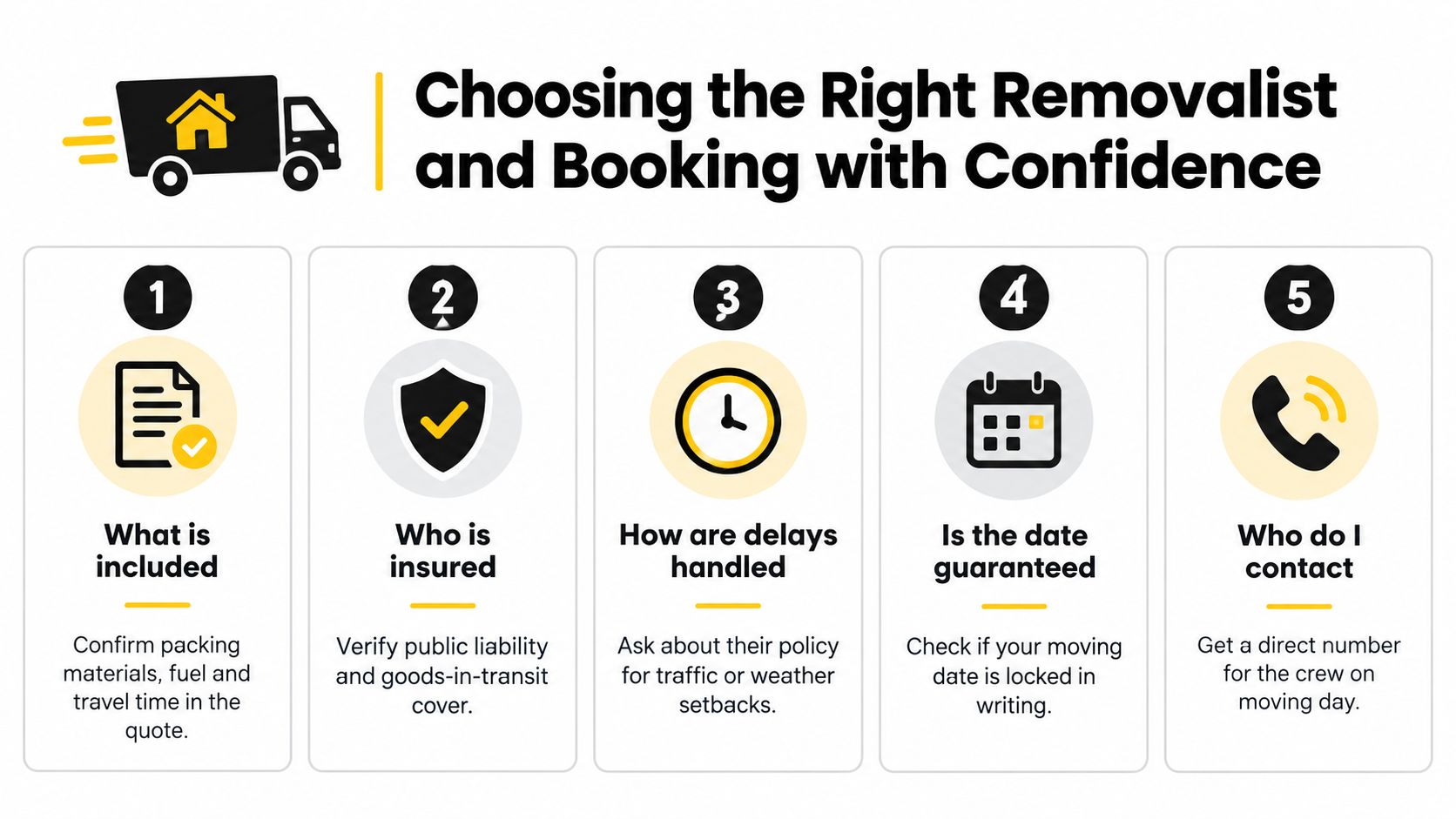
Ask before paying a deposit
- What's included? Confirm the tasks, equipment and materials covered.
- Who is insured? Request policy details relevant to your goods and the work.
- How are delays handled? Establish what happens if traffic, access or weather disrupts the plan.
- What happens to specialist items? Ask who handles them and how they'll be protected.
- How is the invoice calculated? Get the charging method and adjustment conditions in writing.
Also obtain written date confirmation and a direct moving-day contact.
Look for controlled handling
SafeWork NSW's hazardous manual tasks code identifies smaller loads, mechanical aids, maintained trolleys, planned workflow and reduced multiple handling as useful controls. Ask for a handling plan involving appropriate assistance, labelled heavy items and sensible staging. Worker strength isn't a substitute for preparation.
Use the AFRA-accredited removalists information when asking accreditation questions, then verify the operator's status. Maid in America's discussion of licensed bonded insured cleaning pros provides a useful reminder to examine service-provider credentials, although cleaning credentials aren't Australian removalist standards.
Home Removals Sydney is a family-owned Fairfield operator offering home, office, warehouse and interstate moves, with packing, furniture assembly, a large fleet and secure storage with 24/7 access. Request a custom quote through its 60-second form, with responses within 30 minutes during business hours, and include your inventory, access photos and specialist items so the team can plan from collection to final placement.
