

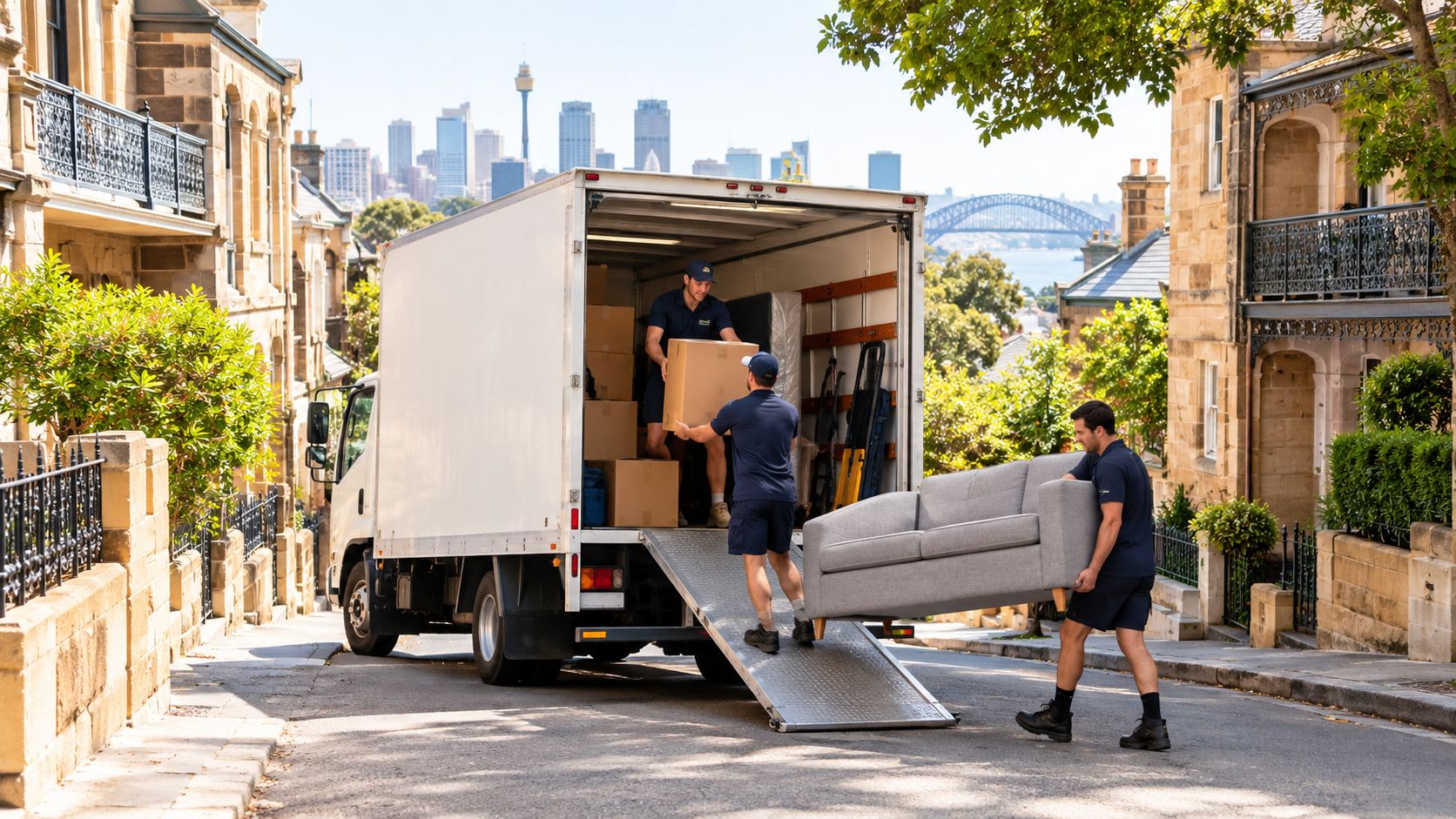
A moving day in Sydney can go wrong before the first sofa leaves the house. The truck arrives, the driver turns into a narrow terrace street, and the body is too tall for the awning, too long for the kerb, or much too large to stop without creating a traffic problem. The result is delay, extra carrying, and a quote that no longer resembles the price you expected.
Choosing a house moving lorry isn't mainly a question of how much furniture fits inside. It's a question of whether the vehicle can legally and physically reach both properties, whether the building will accept it, and whether the loading window gives the crew enough time to work. This guide covers truck sizes, payload, Sydney access, permits, load restraint and the cost details that customers should settle before booking.
Why the Right House Moving Lorry Matters in Sydney
A family moving from a terrace in the inner west once booked a large pantech because the household had several bedrooms and a substantial amount of furniture. On paper, the capacity looked sensible. On the street, the truck couldn't approach the front door cleanly because of a low awning and restricted kerb space. The crew had to stage furniture further away, carry it along the footpath and work around local traffic controls.
That wasn't a packing problem. It was a vehicle-access problem.
Sydney rewards the removalist who plans the approach before choosing the body. A smaller lorry can often sit closer to an apartment entrance, turn into an inner-west laneway more safely and work within a tighter loading window. A larger truck may reduce the chance of a second trip, but it can create longer carries, failed access and waiting time when the street or building can't accommodate it.
The four questions that matter
Before discussing cubic capacity, check:
- Can the lorry reach the kerb? Look for narrow streets, tight corners, overhead branches, low awnings and driveway structures.
- Can it stop legally? Resident parking permits generally aren't a solution for trucks. The City of Sydney excludes trucks, buses, tractors and trailers from residential permit eligibility, and Randwick applies further restrictions to larger vehicles. See the City of Sydney transport and parking guidance.
- Can the building receive the move? Strata buildings may impose loading-dock bookings, lift protection rules and fixed time windows.
- Can the crew load within the available period? CBD clearways, kerbside time controls and busy classified roads can make a technically suitable truck impractical at the wrong time.
The Australian Bureau of Statistics recorded that 14.3% of Australia's population changed address within Australia during the year before the 2021 Census. Over the five years before the Census, 30.7% moved elsewhere within their state or territory, while 3.8% moved interstate, representing 920,982 people. The ABS notes that these measures compare addresses at particular reference points, so they don't capture every move or multiple moves between those dates. For Sydney removalists, the operational lesson is clear: local and NSW relocations form the main market, while interstate work demands more careful vehicle selection and route planning. The ABS population movement analysis supports that distinction.
Practical rule: The biggest lorry that fits your furniture isn't automatically the right lorry. The right lorry is the largest vehicle that can reach the door legally and safely.
Common Lorry Sizes Used for Sydney Home Moves
Truck classes are useful only when matched to the property and the street. Room count gives a starting point, but bulky furniture, lift access, stairs and the distance from the kerb can change the decision completely.
Small vans and compact trucks
A 2 to 4-tonne van or compact truck is the large-delivery-van option. It suits a studio, a one-bedroom flat with limited furniture, a partial move or a small storage transfer. It's easy to position in dense streets and often makes sense when the customer has already sold or stored large items.
A 4 to 6-tonne truck handles a fuller one-bedroom apartment, a compact two-bedroom unit or a move involving several appliances and bulky pieces. This class is a practical choice for streets where a large pantech would leave too much distance between the truck and the entrance.
Some operators deliberately use a 4.5-tonne vehicle as a Sydney access sweet spot. That doesn't remove every parking or road restriction, but it can keep the vehicle within a more manageable operating envelope than a substantially heavier truck. Never assume the advertised class tells the whole story. Ask for the vehicle's loaded mass and dimensions.
Mid-sized furniture trucks
An 8 to 10-tonne pantech is the workhorse for many three-bedroom homes. It offers useful enclosed space for furniture and cartons while remaining more practical than a long interstate vehicle on suburban streets. For a three-bedroom house with a clear driveway, this is often the sensible first option.
A 12 to 15-tonne furniture truck suits a fuller four-bedroom home, a larger household with substantial storage, or a small office relocation. It becomes less attractive when the destination has a narrow lane, a low covered loading area or a strict building booking window.
Large rigids and interstate equipment
Larger rigid vehicles and 22-tonne-plus trucks are for full household relocations, warehouse work, palletised loads, unusually heavy furniture and interstate removals. A fleet may extend to 62-tonne trucks, but that doesn't make such a vehicle appropriate for an ordinary apartment move. Large equipment belongs on routes and sites designed for its size.
A tail-lift is worth requesting when the move includes heavy appliances, dense cartons, pallets or equipment that can be safely rolled onto a platform. It isn't a substitute for a loading plan. The operator still needs to confirm kerb height, turning room and whether the tail-lift can deploy without blocking traffic.
Sydney house moving lorry sizes at a glance
| Lorry Class | Payload (approx.) | Best For | Typical Sydney Move |
|---|---|---|---|
| 2 to 4-tonne van | Varies by vehicle and load | Studios, one-bedroom flats, partial moves | Inner-city unit with limited furniture |
| 4 to 6-tonne truck | Varies by body and GVM | One to two-bedroom apartments | Apartment move with appliances and bulky pieces |
| 8 to 10-tonne pantech | Varies by configuration | Three-bedroom homes | Suburban house with reasonable truck access |
| 12 to 15-tonne furniture truck | Varies by configuration | Four-bedroom homes and small offices | Larger home or office relocation |
| 22-tonne-plus rigid | Varies by configuration | Full relocations, warehouses and interstate work | Large household, pallet or warehouse move |
| 62-tonne truck | Specialist configuration | Exceptional heavy or consolidated loads | Specialised logistics, not routine apartment work |
Load Capacity and Dimension Limits You Must Know
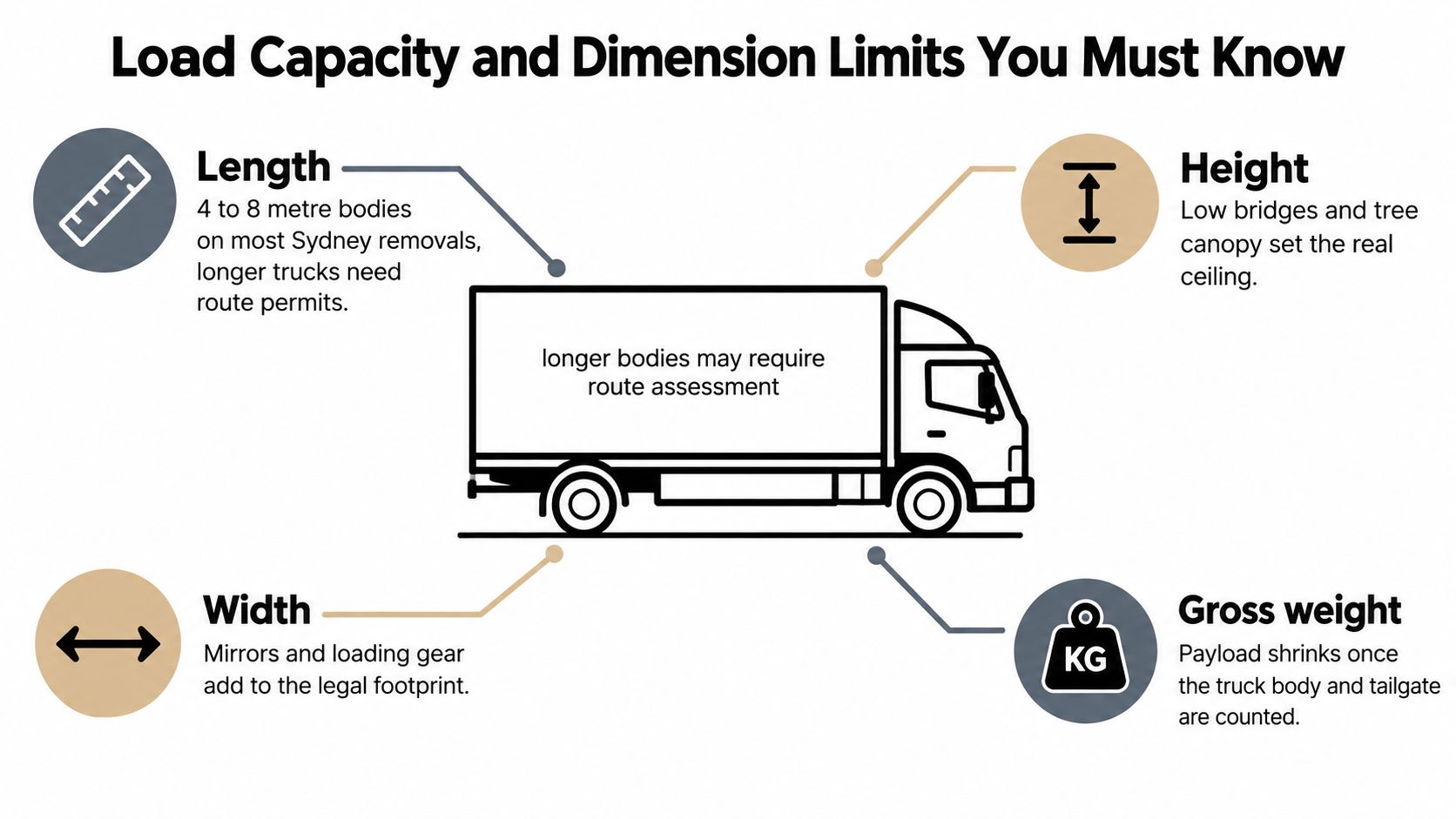
A truck's internal volume can be misleading. The legal limit applies to the vehicle and its load, not just the empty body. Furniture, blankets, cartons, ramps, tail-lifts and handling equipment all consume available mass or affect the vehicle's dimensions.
For a typical rigid truck operating in NSW, the general-access envelope cited by the state includes 12.5 metres overall length, 2.5 metres width, 4.3 metres height and up to 31 tonnes gross mass for the cited configuration. These are not targets for a household move. They're boundaries that route planners and operators must respect. NSW general-access heavy-vehicle guidance explains the relevant limits.
Length and width
Long bodies need more room to turn, reverse and stop without obstructing the road. A removal truck body commonly used for Sydney work may be within a 4 to 8 metre range, but longer vehicles need route assessment, particularly around terraces, laneways and CBD streets.
A body that approaches the general width limit can be difficult on a tight kerb. Mirrors, side protection, loading equipment and the driver's required clearance all affect the practical footprint. A vehicle exceeding the applicable width limit may become restricted access rather than a standard house moving lorry.
Height
Height is where many otherwise well-planned moves fail. Low awnings, basement entries, older shopfronts, tree canopies and covered loading bays can defeat a tall pantech even when the street itself looks generous. Newtown, Surry Hills and CBD access points deserve a physical check, not a guess from a map.
Transport for NSW states that heavy vehicles higher than 4.3 metres have restricted travel conditions and must use approved road networks. A vehicle between 4.3 and 4.6 metres must use roads approved for vehicles up to 4.6 metres, while a vehicle above 4.6 metres needs a specific National Heavy Vehicle Regulator permit. Transport for NSW heavy-vehicle safety information sets out those height implications.
Gross mass and payload
Gross vehicle mass, or GVM, includes the truck itself and everything loaded onto it. A vehicle can look half empty and still be too heavy if it carries dense books, safes, machinery, stone, commercial equipment or a large quantity of appliances.
Overloading affects braking, steering and stability, especially on Sydney's hills. It can also turn a general-access vehicle into a restricted-access vehicle requiring route authorisation. Treat legal payload as more important than the body's advertised capacity.
How to Match Lorry Size to Your Move
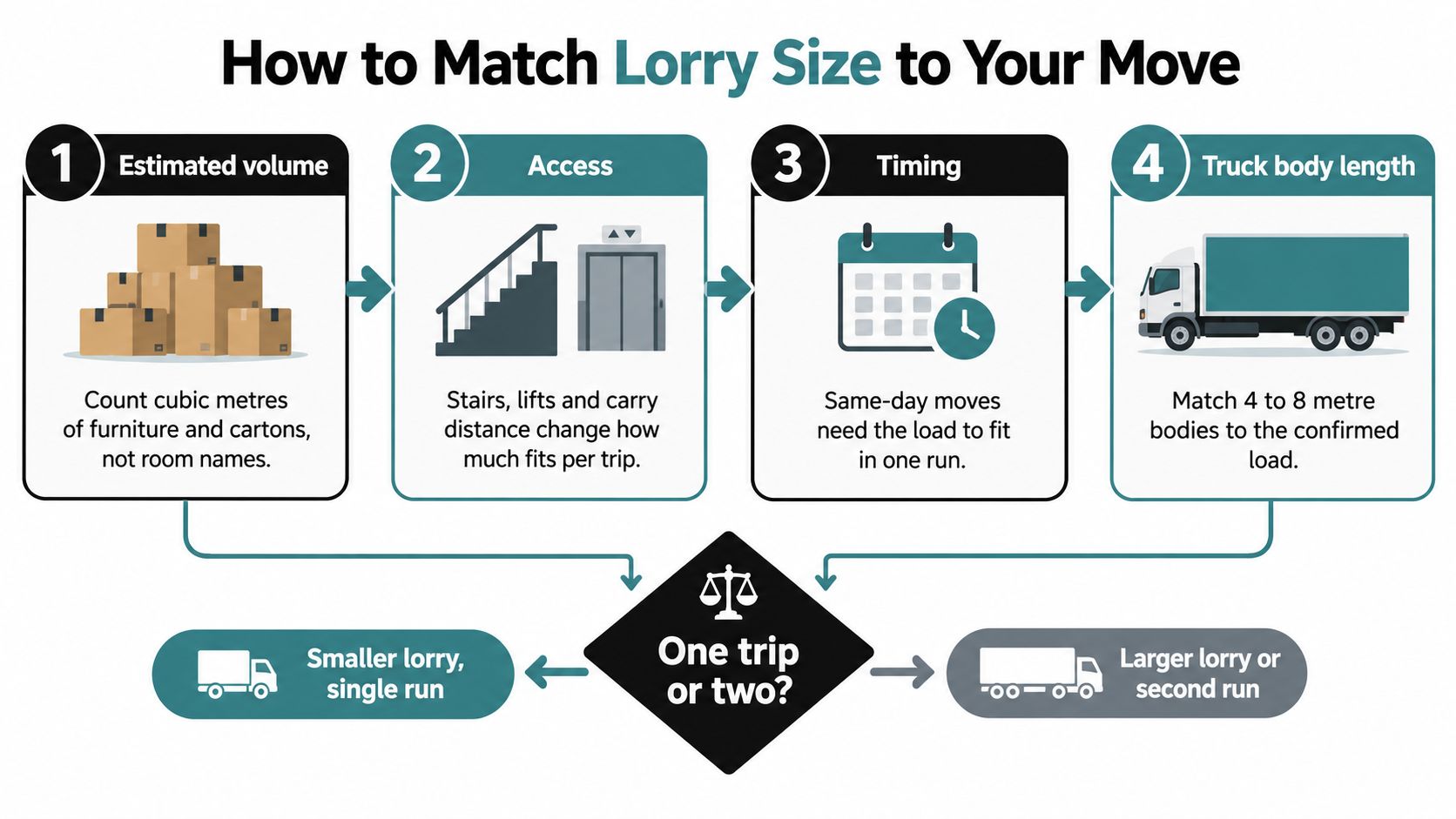
A reliable truck choice starts with four inputs, not a generic bedroom chart. Count the actual furniture, identify the heavy pieces, inspect both access points and decide whether everything must travel in one run.
Start with the load
List sofas, beds, wardrobes, dining settings, whitegoods, outdoor furniture and cartons. A three-bedroom home with minimal furniture can need less space than a heavily furnished two-bedroom property. A piano, safe, marble top or antique cabinet can change the crew, equipment and mass calculation even when it occupies little floor area.
Next, assess the weight. Books, tools, tiles and commercial stock load a truck differently from linen and lightweight cartons. If the operator only asks for the number of rooms, the quote isn't detailed enough.
Add the access risk
A Newtown terrace may contain the contents of a modest three-bedroom home, but a narrow street, stair turns and a long carry can make a smaller, more manoeuvrable truck the better choice. The same household moved from a Parramatta apartment with a wide driveway, a usable lift and straightforward kerb access might justify a larger body and a single loading run.
The Newtown job may need a 4 to 6-tonne truck, possibly with a shuttle arrangement. The Parramatta job may suit an 8 to 10-tonne pantech, provided the driveway, building and loaded height have been checked.
Decide whether one run matters
For a short local move, two runs can be cheaper and safer than forcing an oversized vehicle into a difficult street. For an interstate move, a second run usually isn't practical, so the operator must confirm capacity, mass and route before dispatch.
Use the moving truck size guide to prepare a more useful inventory for the quote. Include measurements for the largest pieces and photos of driveways, laneways, awnings and loading areas.
My sizing rule: A tight fit on a smaller lorry is usually better than a large lorry that can't park. If the bigger vehicle forces a long carry or a transfer, its apparent capacity advantage can disappear.
Sydney Parking, Permits and Access Rules
A resident parking permit isn't a truck-access plan. Sydney customers often focus on reserving a parking space, then discover that the permit they hold is intended for an eligible passenger vehicle and doesn't authorise a heavy removal lorry to occupy the kerb.
The City of Sydney says large transport vehicles may require National Heavy Vehicle Regulator approval, and its residential permit eligibility excludes trucks, buses, tractors and trailers. NSW draft permit-parking guidance also states that permit vehicles must not be trucks, buses, tractors or trailers. Randwick adds a specific restriction where resident permits can't be issued for vehicles 7.5 metres or longer or 4.5 tonnes and heavier. Check the Randwick resident parking permit conditions before relying on a permit assumption.
Build an access plan
Measure the usable kerb length, not just the frontage. Check whether a driveway, bus stop, cycle lane, clearway, fire access point or neighbouring construction activity reduces the space. For an apartment, confirm the loading dock height, lift booking, protection requirements and building manager's permitted window.
CBD loading needs particular care. Time controls and clearways can make an otherwise legal stop impossible during the intended period. Classified roads may also require notice or coordination with the relevant road authority. A removalist should confirm the road classification and proposed stopping arrangement rather than promising that the driver will “find somewhere”.
A smaller lorry may park on the destination street while a second vehicle stages nearby. That shuttle approach is often cleaner than sending a large body into a terrace lane or a street with a low awning. Driveway modifications or crane-truck arrangements can help in exceptional cases, but they require a site-specific assessment and appropriate approvals.
For route planning and Sydney removal logistics, review Sydney moving logistics advice.
Sydney moving lorry access and permit rules at a glance
| Lorry Class | Council Parking Permit | CBD Kerbside Booking | RMS Notice Required | Common Access Limit |
|---|---|---|---|---|
| Small van | May still need lawful stopping space | Check local controls | Depends on road and activity | Tight turns and limited kerb length |
| 4 to 6-tonne truck | Don't assume resident permit eligibility | Confirm with council or building | May apply on classified roads | Apartment docks, stairs and narrow streets |
| 8 to 10-tonne pantech | Usually requires a specific access plan | Confirm time window | May apply depending on route | Height, body length and CBD controls |
| 12-tonne-plus rigid | Permit assumptions are unsafe | Formal planning is sensible | Route and approval requirements may apply | Turning radius, loading zones and restrictions |
| Restricted-access vehicle | Standard resident permit isn't sufficient | Site and route approvals required | Approval or permit may be required | Approved network, dimensions and mass |
What Really Drives the Cost of Hiring a Lorry
The hourly rate is only one line in a moving quote. A cheap truck that stops far from the door can cost more than a smaller vehicle with a higher hourly rate if the crew spends the day carrying furniture, waiting for access or making an avoidable transfer.
A studio in Surry Hills with one flight of stairs may need less truck space than a four-bedroom home in the Hills Shire. Yet the studio can take longer because the crew must protect walls, negotiate stair turns and carry every item from a restricted kerb. The Hills Shire move may load quickly through a level driveway, even with a larger inventory.
Cost items to compare
- Minimum hours: A short job may still attract the provider's minimum charge. Ask whether the minimum is three or four hours.
- Stairs and long carries: Confirm whether stair flights, narrow stair turns and a carry from a distant legal stopping point are included.
- Shuttle vehicles: If the main lorry can't reach within a practical distance of the door, a smaller transfer vehicle can add labour, handling and waiting.
- Parking and approvals: Council bookings, building loading arrangements and applicable permits may be passed through as separate costs.
- Travel, fuel and tolls: Ask how travel time is calculated and whether fuel levies or tolls, including Sydney Harbour Bridge charges, sit outside the hourly rate.
- Protection and insurance: Blankets, wrapping, mattress bags, packing materials and insurance arrangements may be itemised separately.
The quote should also state after-hours, weekend and public-holiday charges. If the building only permits loading at a narrow time, ask what happens if the crew is delayed by a previous job or can't enter the street.
Use the Sydney removalist cost guide as a checklist, then request the actual terms for your property rather than relying on a headline rate.
Ask before you book: Which costs change if the truck can't park at the entrance, and who pays for the extra handling?
Smart Tips for Hiring a Sydney Removalist
A professional quote should tell you more than the truck's hourly rate. It should show that the operator understands insurance, access, load restraint, crew requirements and the limits of the vehicle being sent.
Check insurance and paperwork
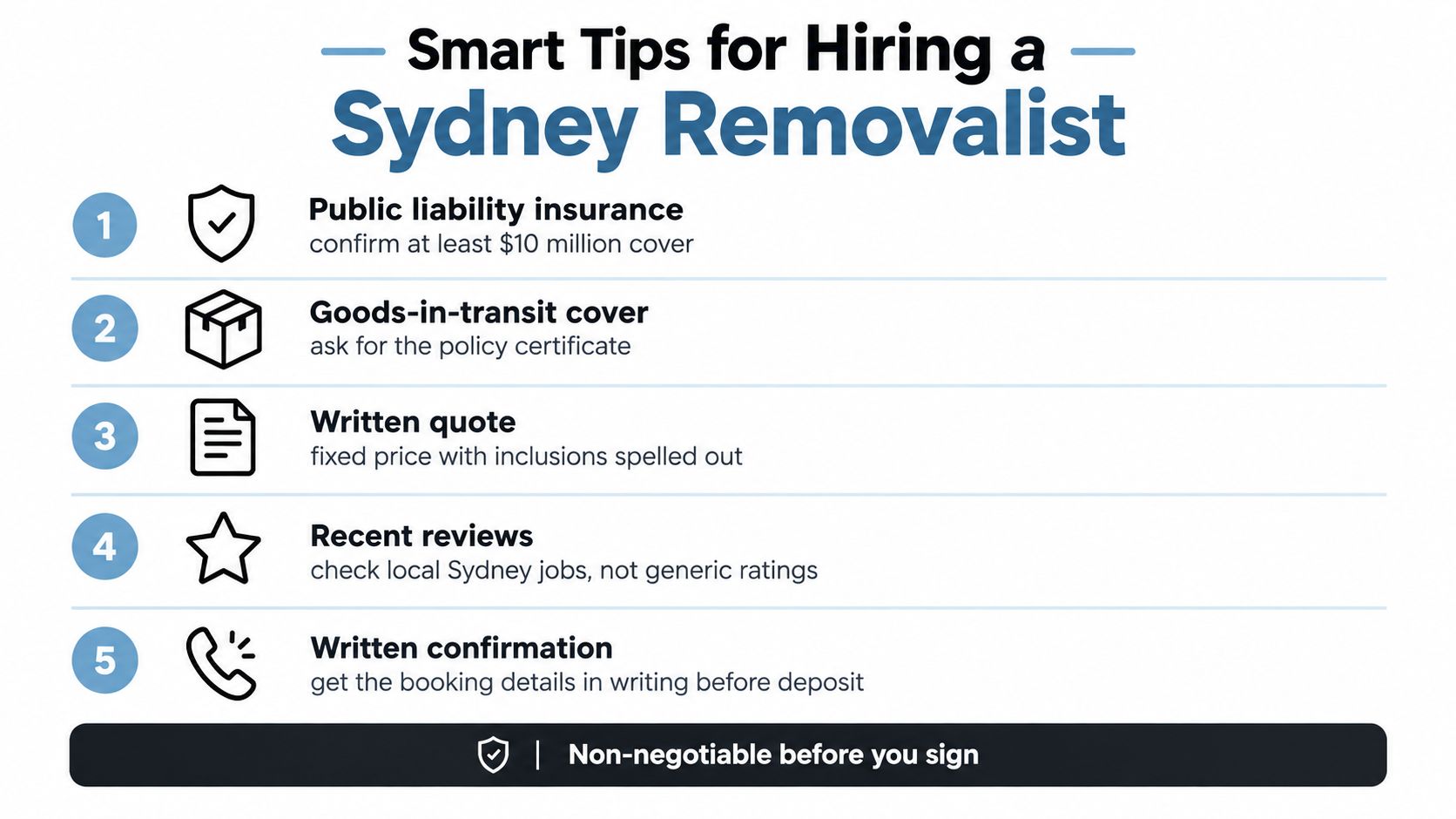
Ask for a certificate or policy detail, not a verbal promise. Confirm public liability insurance of at least $10 million and goods-in-transit cover, then ask for the insurer and policy number. Read the contract for exclusions, pre-existing damage, cancellation charges and limits on the operator's liability.
Request a written quote with the hourly rate, minimum hours, travel fees, fuel levy, packing materials, stair charges, shuttle fees and after-hours conditions. If the quote says “additional charges may apply” without explaining when, get clarification before paying a deposit.
Match the fleet to the job
Ask which vehicles the company operates in-house and which it subcontracts. A removalist proposing a 62-tonne pantech for a one-bedroom flat has probably ignored the access problem. The operator should recommend a vehicle that matches the load and the street, not merely the largest available body.
Check the basics of load handling:
- Restraint equipment: Rated webbing, ratchet straps and suitable anchor points should be available.
- Protection: Moving blankets, mattress bags, corner protection and wrapping should be standard where the inventory needs them.
- Lifting equipment: Request a tail-lift where heavy items or pallets make it useful, subject to safe access.
- Crew competence: Ask who will supervise loading and whether the team regularly handles pianos, antiques, artwork or safes.
For furniture that needs to arrive in good condition, restraint matters as much as stacking. The NHVR Load Restraint Guide treats restraint as a performance requirement under braking, cornering and evasive manoeuvres. Heavy pieces should sit low and near the centreline, gaps should be filled with suitable dunnage, and straps should protect rather than crush fragile surfaces.
Verify the operator
Validate the ABN and check AFRA membership where relevant. Read reviews for local Sydney jobs, and look for reviews dated within the last three months rather than relying only on a general star rating. Ask for the booking details in writing, including the vehicle class, arrival window, crew lead and cancellation terms.
If you're coordinating furniture colours for a staged property, a resource such as 2022's trending colour palette can help you plan finishes and presentation. That has nothing to do with truck selection, but it can be useful when deciding which furniture stays, moves to storage or needs extra surface protection.
Getting a Tailored Quote and Next Steps
A useful quote starts with information the removalist can act on. Send a complete inventory, not just “three bedrooms”. List sofas, wardrobes, beds, whitegoods, outdoor furniture and cartons, then flag anything heavy, fragile or awkward, including pianos, safes, marble tops, antiques and artwork.
Describe both properties clearly. Include the suburb, street, floors, lift availability, stair turns, driveway width, distance from the legal stopping point to the door, low awnings, basement entries and any weight-restricted driveway. A photo of the street approach and the building entrance can prevent a wrong vehicle from being dispatched.
Ask the operator to compare a 4-tonne van, 6-tonne truck and larger pantech against the actual access profile. Request two figures:
- A fixed price with inclusions and exclusions stated.
- An hourly estimate with the minimum charge, travel method and possible access costs identified.
For interstate removals, ask how the loaded height, gross mass, route and safety-station obligations will be managed. NSW requires heavy vehicles with a Gross Vehicle Mass greater than 8 tonnes to enter a Heavy Vehicle Safety Station, subject to listed exceptions. At Chinderah and Pine Creek, the threshold is 4.5 tonnes. Drivers may also need permits, work diaries, licences and load paperwork. Transport for NSW heavy-vehicle safety requirements explains why the paperwork matters even when the load is household furniture.
A removal truck becomes an oversize or overmass vehicle when it exceeds an applicable limit. Transport for NSW describes OSOM loads generally as exceeding 2.5 metres in width, 19 metres in length or 4.6 metres in height. General-access combinations must not exceed 42.5 tonnes gross mass, and vehicles outside the standard limits need an approved network, notice or permit. The NSW OSOM guidance is relevant to unusually large interstate, warehouse and consolidated-freight moves.
Confirm the truck registration, insurance details and crew lead's mobile number before move day. The decision rule is simple: choose the smallest vehicle that carries the confirmed load in the required number of runs, reaches both doors legally and leaves enough time for safe loading.
Home Removals Sydney offers residential, office and warehouse relocations with vehicle options, packing support and interstate moving assistance matched to your access conditions. Visit Home Removals Sydney to request a quote that accounts for truck size, parking, stairs, loading windows and the actual layout of both properties.
