

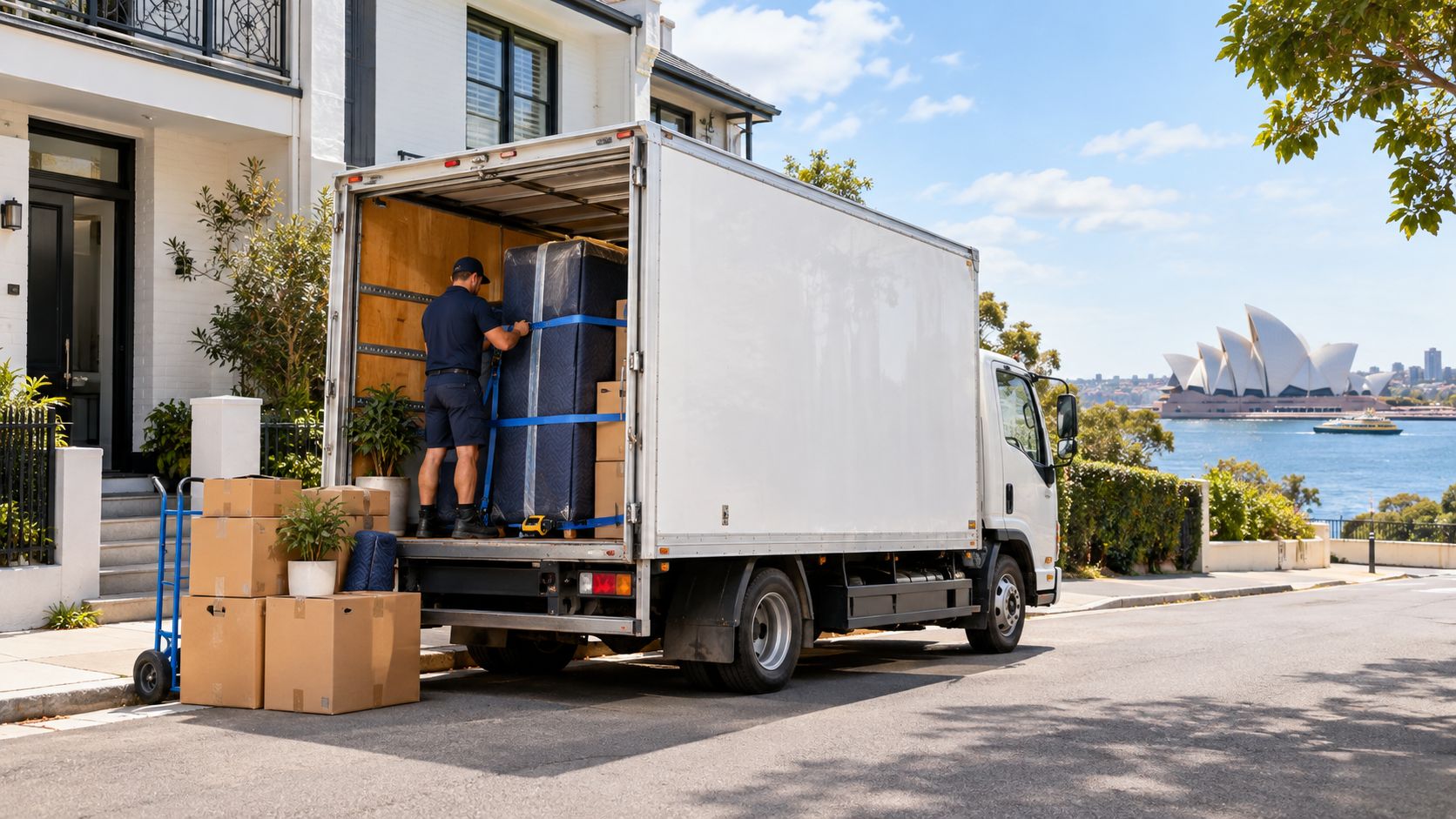
A 6 tonne truck in Sydney is usually the perfect choice for a 2–4 bedroom home move or a small office, offering a practical balance between manoeuvrability and cargo space. It remains a legal heavy vehicle, however, so the driver, load, axle weights and route all need careful attention.
You may be standing in a driveway surrounded by labelled boxes, dismantled beds and furniture that looked smaller inside the house. The truck choice made at this point can decide whether the move runs in one organised trip or turns into extra handling, parking problems and avoidable delays.
For Sydney homeowners, renters and businesses, the 6 tonne truck sits in a useful middle ground. It offers more room than a small van without the access challenges of a much larger vehicle. But “6 tonne” describes a vehicle's gross vehicle mass, not six tonnes of household goods. That distinction affects everything from the quote to the way the truck is loaded.
Understanding the 6 Tonne Truck for Your Sydney Move
On move day, the truck may fit the furniture but still fail the job at the kerb. A low branch, steep driveway or narrow street can force a change of vehicle, extra handling or a second trip. The right choice depends on the truck body, legal mass and access at both addresses, not just the “6 tonne” label.
A 6 tonne truck suits family relocations, furniture deliveries and compact commercial moves because it balances usable volume with urban access. Australian guidance commonly places this class around 27–30 cubic metres, with exact volume depending on body specification. Australian truck guidance on 6-tonne vehicles
Why Sydney access changes the decision
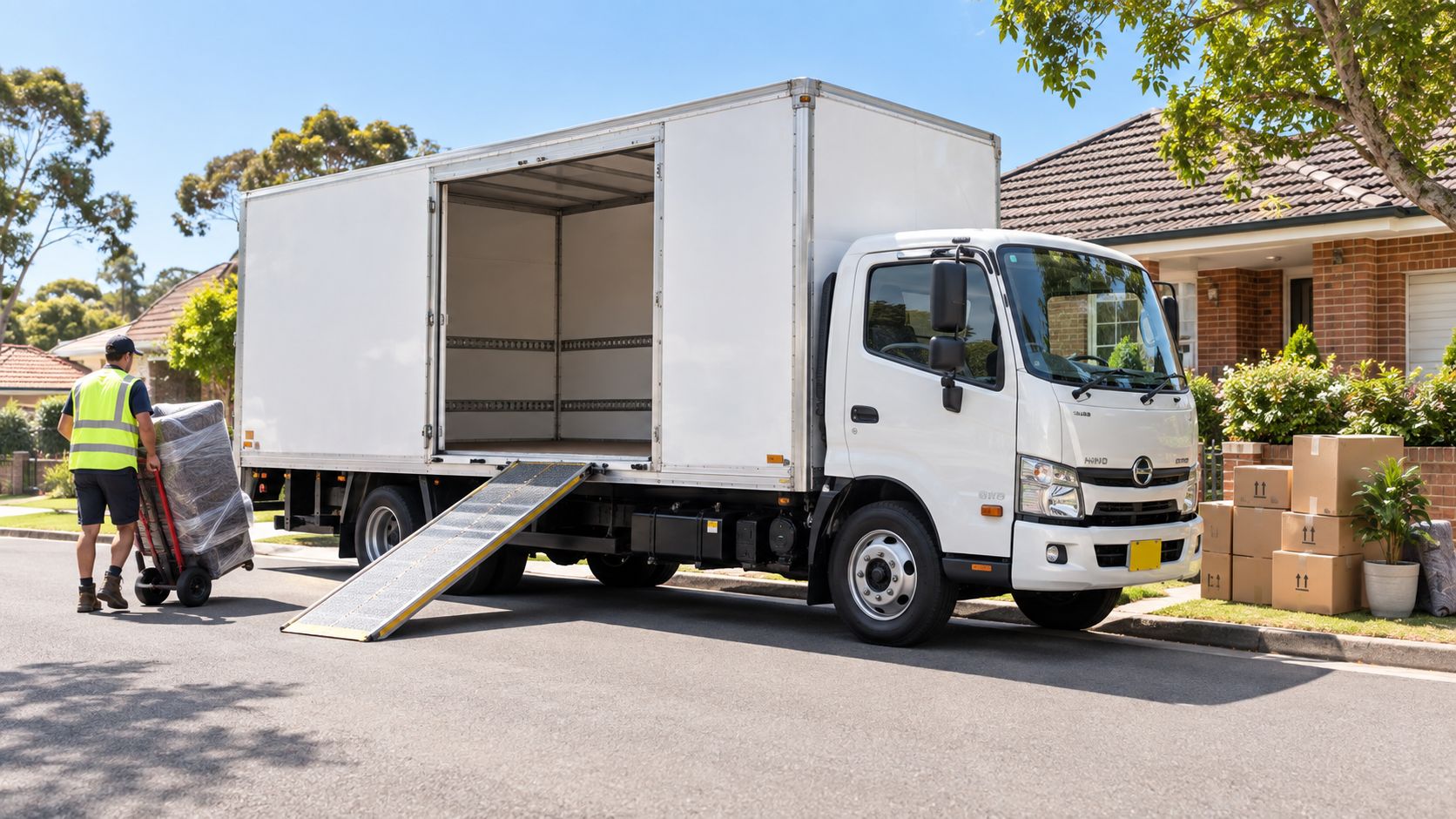
Sydney access can matter more than the advertised storage volume. A truck that works at a warehouse may struggle at a property with a steep driveway, tight cul-de-sac, low branches, school-zone congestion or limited kerb space. A smaller rigid vehicle may reach the door more reliably than a larger combination vehicle, while still handling a carefully planned household load.
Volume is only part of the booking decision. Bulky outdoor furniture, a workshop, dense books, commercial appliances and difficult access can require a larger vehicle, extra labour or staged transport. A lightly furnished apartment may need less truck space, but its lift booking and loading distance can still affect the plan.
What “6 tonne” actually means
The phrase refers to the truck's GVM, or gross vehicle mass. GVM includes the truck, fuel, driver, equipment and cargo. It does not mean the vehicle can carry 6,000 kilograms of belongings.
Legal payload also has to be shared across the axles. A load can remain below the vehicle's GVM yet place too much weight on one axle, particularly when dense items are packed at the rear or beside the tail lift. The compliance plate, actual tare and manufacturer limits should be checked before loading.
NSW operators also need to account for the 2026 heavy vehicle law changes when confirming licence, mass and route requirements. The applicable licence class depends on the truck's GVM, with Australian licensing and truck classification context available here.
Practical rule: Choose the vehicle from the inventory, access conditions, compliance plate and axle limits, not the headline tonnage alone.
For Home removals Sydney customers, a useful booking conversation covers rooms, stairs, lifts, oversized items, packed volume and both addresses. Those details let the removalist match the truck body, crew and route before move day.
Decoding GVM, Payload, and Actual Capacity
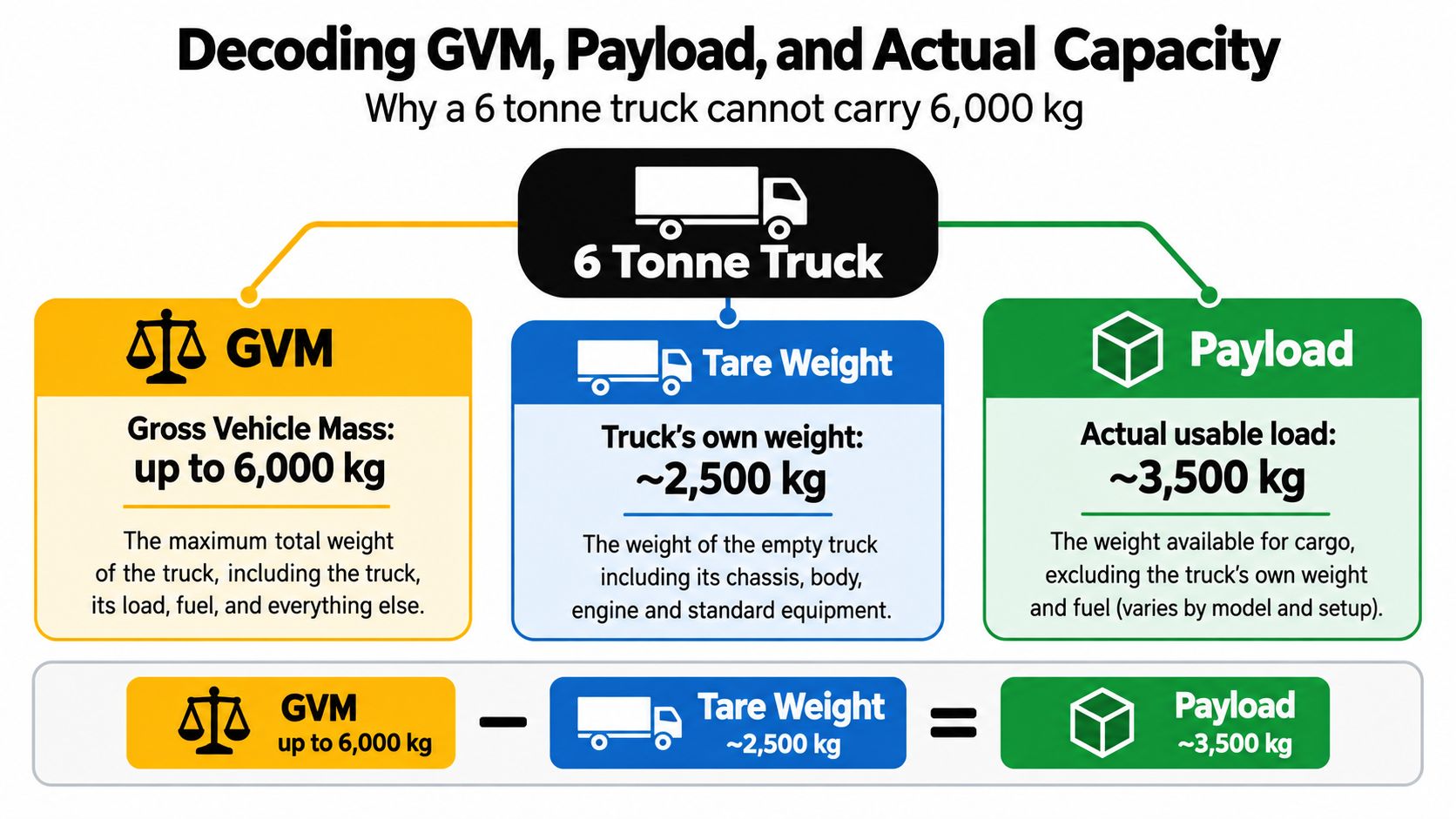
A truck advertised as “6 tonne” may carry far less than 6,000 kilograms of household goods. GVM is the maximum legal operating mass of the complete vehicle, including its tare weight, fuel, driver, body, tail lift, blankets, trolleys and other equipment.
The working calculation is simple:
GVM minus tare weight equals available payload.
That figure can vary sharply between trucks in the same advertised class. Payload variation in Australian 6-tonne trucks depends on the vehicle's wheelbase and specification, so the model name alone cannot confirm how much furniture it can legally carry.
Tare weight changes the answer
Two trucks can display the same “6 tonne” label yet offer very different usable payloads. A longer body, hydraulic tail lift, fixed fittings, extra fuel, protective equipment and larger cab all use part of the permitted mass before the first carton is loaded.
Check the compliance plate and the truck's actual tare before loading. The NHVR mass and loading guidance explains that loaded mass must not exceed the manufacturer's rating. A truck can have unused floor space and still be unable to accept more heavy goods legally.
Space and weight create different limits
Household goods are usually bulky but relatively light. Sofas, wardrobes and mattresses may fill the body before the truck reaches its mass limit. Books, tiles, tools, gym equipment and commercial stock create the reverse problem, using less space while consuming payload quickly.
Separate the inventory into three practical groups:
- Bulky goods: Sofas, beds, wardrobes and appliances determine how efficiently the cubic space is used.
- Dense goods: Books, packed files, tools and boxed stock can bring the truck close to its legal mass.
- Fragile or irregular goods: Glass, artwork, plants and unusually shaped furniture need protection and may reduce stacking efficiency.
A bedroom count alone can produce a costly mismatch. Tell the removalist about dense items, stone, metal and workshop equipment before booking furniture removals Sydney work. The load must also be distributed across the axles. A truck may remain below its GVM while an axle exceeds its permitted limit, especially when dense items sit toward the rear or beside the tail lift.
The useful booking question is: what is this specific truck's legal payload after its own equipment and crew are included, and how will the load sit across the axles?
Is a 6 Tonne Truck the Right Size for Your Move?
The right truck is the smallest vehicle that can complete the job safely and efficiently without compromising access or forcing unnecessary trips. A smaller vehicle may suit a studio or a single room, while a larger truck becomes more sensible for a heavily furnished home, a warehouse or a substantial office relocation.
A 6 tonne truck commonly suits a 2–4 bedroom move and can work well for a small office, particularly when the inventory is organised and the addresses have workable access. Australian removal guidance also places many vehicles in this market around 28–30 cubic metres or approximately 5–10 standard pallets, although actual usable capacity changes with furniture shape, access and legal mass limits. Practical truck-size guidance for Australian moves
Compare the practical options
| Truck Size | Ideal For | Typical Capacity |
|---|---|---|
| Smaller van or truck | Studio, one-bedroom move or selected furniture | Lower volume, easier access |
| 6 tonne truck | 2–4 bedroom home, light family move or small office | About 27–30 m³, depending on specification |
| Larger rigid truck | Large family home, dense inventory or larger office | More volume and payload, with greater access demands |
| Heavy vehicle combination | Major warehouse or substantial commercial relocation | High capacity, route and site access must be assessed |
The table is a planning guide, not a loading certificate. The same room count can represent very different volumes. A minimalist four-bedroom home may fit more comfortably than a crowded two-bedroom property with a garage, storage room and outdoor equipment.
When smaller works better
A smaller truck can be the right call where the property has tight access, limited parking or a short inventory. It may also suit a partial move, a storage transfer or a single large item. The trade-off is clear: if the inventory exceeds the body, multiple trips can add handling time and expose furniture to more loading and unloading.
For a more detailed household comparison, use this Sydney moving truck size guide when preparing your inventory.
When bigger isn't automatically better
A larger truck gives you more room, but it won't solve a narrow street or a low-clearance entrance. It can also make kerb positioning harder and may require more route planning. Vehicle purchasing decisions involve similar questions about intended use, configuration and operating conditions, so Unifyvehicle purchasing advice provides useful background when comparing vehicle capability with the work it needs to perform.
For Interstate removals, the calculation includes route practicality, loading density and the destination's access. For office relocations, assess desks, filing cabinets, server equipment and palletised stock separately rather than relying on staff numbers. The best booking decision balances volume, weight, access and licensing.
Mastering Load Planning and Truck Dimensions
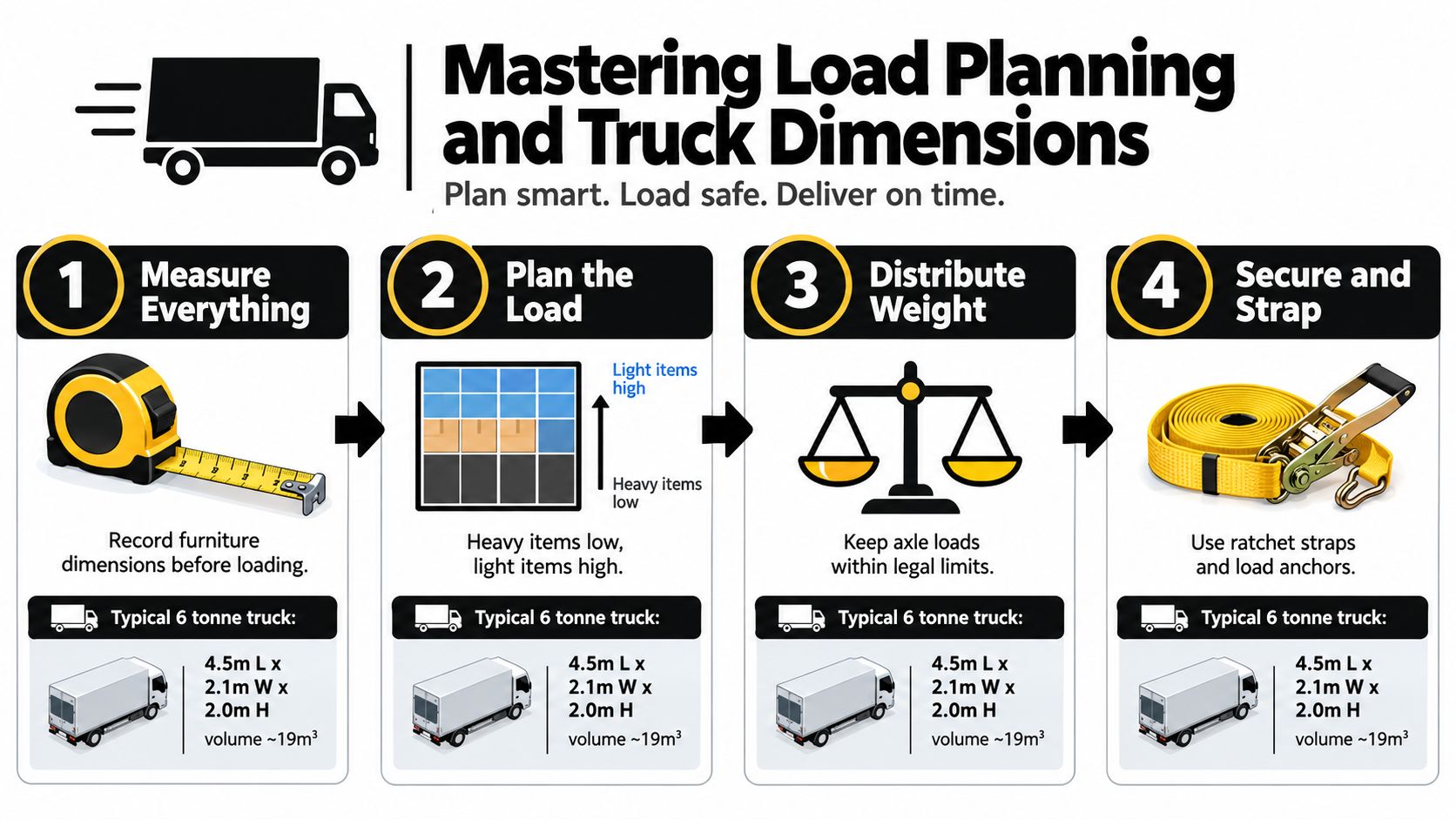
A 6 tonne truck commonly provides about 27–30 cubic metres of load space. Published Australian specifications also show tray lengths around 5.4–6.4 metres and widths around 2.4–2.5 metres, with some configurations carrying up to 8 standard pallets or about 5–6 tonnes of load capacity. The exact body and compliance plate matter, so confirm the truck assigned to the job. Australian 6-tonne truck specifications
Measure before the crew arrives
Start with the largest items. Record the length, width and height of wardrobes, lounges, refrigerators, dining tables and office equipment. Note pieces that can't be turned upright, items that need dismantling and anything that must remain accessible during the journey.
Measure access as well. A body that fits the inventory may not suit a driveway, loading dock or apartment lane. Check overhead clearance, turning space, kerb restrictions and the distance from the parking position to the front door.
Build from heavy to light
Load dense items low and keep them close to the vehicle's centreline and rear axle group. The Northern Territory mass-limit guidance illustrates why axle configuration matters, with a single steer axle limit of 6 tonnes and limits applying to single axles or single axle groups with single tyres.
A practical loading sequence looks like this:
- Place heavy furniture first. Keep weight low, stable and spread across the floor rather than concentrating it at the front.
- Use strong items as a base. Fridges, solid cabinets and wrapped appliances can support carefully protected lighter goods where appropriate.
- Fill voids selectively. Use boxes, cushions and soft goods to prevent movement, but don't bury fragile or essential items.
- Finish with access items. Put tools, bedding, cleaning supplies and first-night cartons where the crew can reach them without unloading half the truck.
Poor distribution can create an axle problem before the truck appears full. A half-full body carrying dense goods at the front may be less compliant than a fuller, evenly arranged load.
Use a cubic metre calculator for your move to organise a preliminary inventory, then let the removalist validate it against the actual vehicle and access conditions.
Before departure, inspect straps, curtains, doors and load anchors. The NHVR's general mass limits chart shows how permitted mass changes with axle configuration, including a single steer axle at 6 tonnes, a 2-axle rigid truck at 9 tonnes GML and a 3-axle rigid truck at 17 tonnes GML under general access arrangements. NHVR general mass limits
Navigating NSW Licence and Permit Requirements
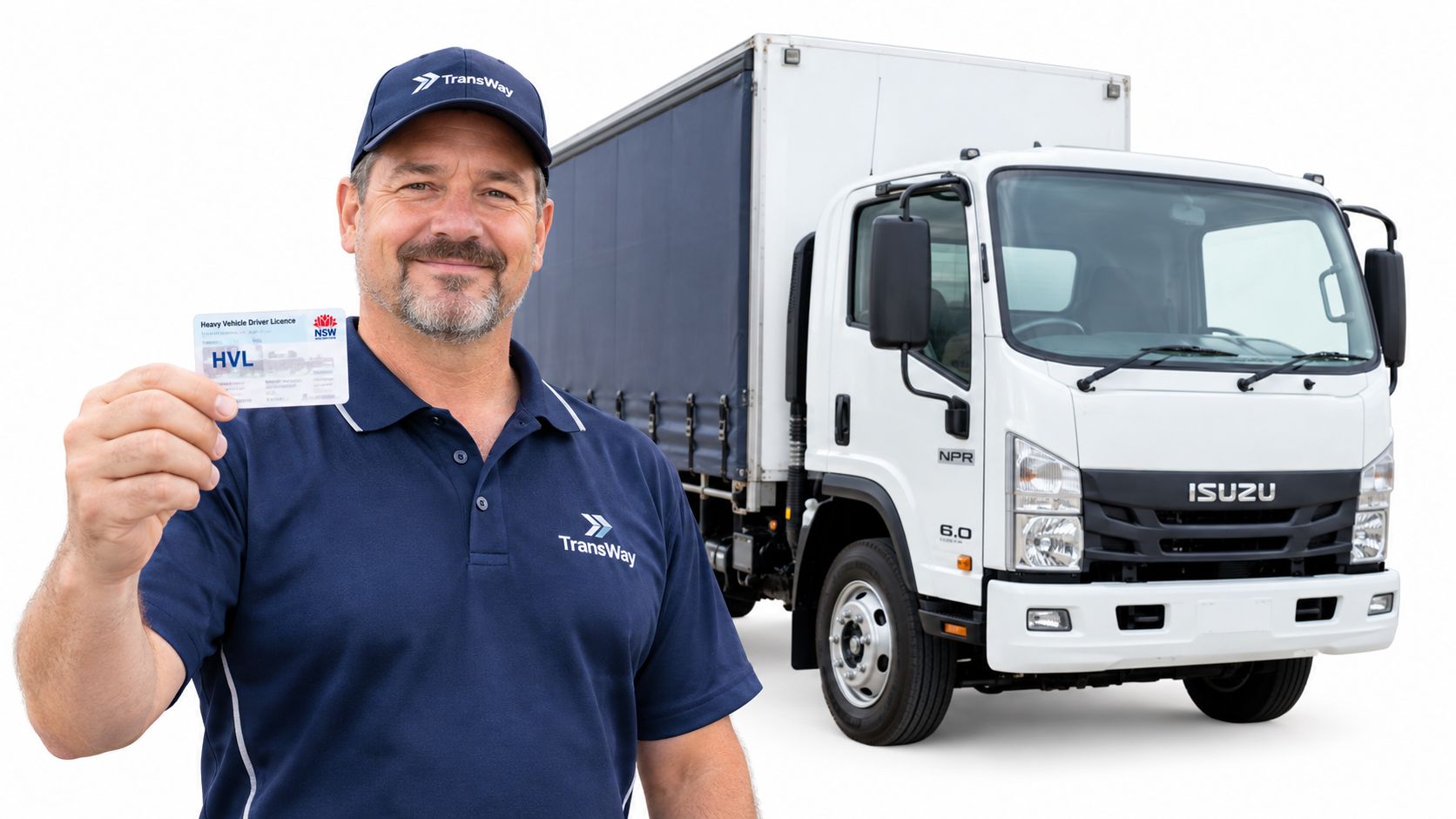
A 6 tonne truck isn't a large car with extra storage. In NSW, a vehicle with GVM over 4.5 tonnes is a heavy vehicle, even when it's only partly loaded. NSW heavy vehicle guidance explains the threshold that affects how the vehicle is operated.
The driver's licence must match the truck's specifications and the applicable class. A standard car licence isn't enough for a vehicle in this category. Depending on the vehicle and configuration, the operator may need an LR or MR licence, so customers hiring a truck should confirm the requirement with the hire company rather than assuming their existing licence covers it.
Height can change the route
Truck height deserves attention before moving day. In NSW, a heavy vehicle higher than 4.3 metres faces restricted travel conditions and must use approved road networks. A vehicle between 4.3 and 4.6 metres must use roads approved for vehicles up to 4.6 metres, while a vehicle above 4.6 metres needs a specific NHVR permit. NSW heavy vehicle road-safety guidance
Ask for the truck's actual overall height, not just the internal body height. Check the route for bridges, shopping-centre entries, loading docks and tree cover. A route that works for a car may not work for a high-body truck.
The 2026 change customers should understand
From 1 August 2026, amended Heavy Vehicle National Law provisions introduce new work-and-rest record requirements and explicit unfit-to-drive duties for heavy vehicles over 4.5 tonnes in participating states and territories. NSW is within the reformed HVNL scope. Information on Australia's amended heavy vehicle laws
For a customer, the practical response is straightforward. Use a properly licensed operator, provide accurate job details and allow a realistic schedule. Don't pressure a driver to continue when fatigue, access delays or loading complexity make the original plan unsafe.
NSW also sets a maximum speed limit of 100 km/h for vehicles exceeding 4.5 tonnes GVM, as stated in the heavy vehicle driver handbook. NSW heavy vehicle driver handbook Compliance isn't paperwork after the move is booked. It shapes the route, timing and responsibility on the road.
Cost Expectations and Booking Your Move
A 6 tonne truck quote should account for the work required, not only the vehicle's hourly rate. Removalists price the inventory, crew size, travel, loading conditions, stairs, lifts, parking, dismantling, packing, assembly and protection for fragile goods. Access details can affect the labour estimate as much as the number of rooms.
Hourly pricing can suit a clear local move with straightforward access. A fixed quote may give better cost control when the route, building access or inventory is complicated. Ask whether travel time is charged separately, which services are included, and how extra work must be approved.
What changes the final price
Distance affects the schedule. Sydney traffic, toll choices, parking delays and kerbside restrictions can extend a suburban move. Interstate work requires route planning and secure load management, with the truck's legal payload still applying throughout the journey.
Volume affects truck choice and labour. A lightly furnished home may load efficiently, while a crowded property may require more crew, another vehicle or staged transport. Marketing descriptions such as “six tonne” do not guarantee six tonnes of usable furniture. The quote should allow for GVM, axle limits and the weight of dense items.
Services affect handling time. Packing, unpacking, dismantling beds, rebuilding furniture, wrapping artwork and placing items room by room add labour. They can still reduce your preparation time and lower the risk of damage caused by rushed packing.
Access affects productivity. Stairs, lifts, long carries and restricted loading zones can make a small move take longer than a larger move with direct truck access. Low clearances or unsuitable parking may also require different equipment or a smaller vehicle.
For a clearer explanation of pricing factors, read this cost of removalists in Sydney guide. Request a quote with the inventory, useful photographs, both addresses, preferred dates and access restrictions. Mention pianos, antiques, artwork, safes, gym equipment and commercial machinery before the quote is prepared.
Home Removals Sydney lists home, office and warehouse relocation services, including packing, furniture assembly, storage and interstate support. Its published starting rate is $120 per hour plus GST, while the final price depends on the job. Home Removals Sydney can assess whether a 6 tonne truck suits the payload, height and access conditions, or recommend another vehicle.
For the most accurate fixed quote, send the inventory with photos, both addresses with parking notes, and a list of dense items like pianos or gym equipment so the crew and truck can be matched before arrival.
Home Removals Sydney can organise Sydney home removals, furniture removals, office relocations, warehouse moves and interstate transport with suitable trucks, trained crews, packing support and storage options. Request a custom quote and confirm whether a 6 tonne truck fits the move.
