


You're probably reading this with your phone in one hand and a lease email in the other. Maybe your agent wants the keys back in 48 hours. Maybe your settlement date moved and now your furniture removals Sydney booking needs to happen this week, not next month. That's exactly when people waste time calling ten random operators and still don't get a truck locked in.
Urgent moves in Sydney aren't won by panic. They're won by speed, clean information, and knowing which obstacles kill a booking before the crew even leaves the depot. If you need last minute removalists, your job is simple: make it easy for a removalist to say yes.
Why Last Minute Removalists in Sydney Are Harder to Book
A rushed move in Sydney usually starts with a normal problem that turns into a same-day problem. A renter in Surry Hills gets a tight vacate timeline. A buyer in Parramatta suddenly has to settle faster than expected. An office relocations job gets pushed forward because access changed. The job itself might be ordinary. The timing isn't.
The first thing to understand is that urgent demand isn't niche. The Australian Bureau of Statistics reported that 1.14 million households, or 12% of all Australian households, moved at least once in 2019 to 2020, and more than 40% had moved within the previous five years (ABS housing mobility data). In plain terms, Australians move often, and a fair chunk of those moves get compressed by life events that don't wait for a neat four-week booking window.
A softer market doesn't mean easy booking
This catches people out. They assume slower demand means trucks are sitting idle. That's not how it works. Recent Australian reporting said removalist demand fell to a 20-year low in 2024/25, while search interest also dropped, which points to a softer market overall, not a dead one (housing-crisis moving demand report).
What I see in practice is this: active operators protect their margins by tightening schedules, clustering jobs, and avoiding messy access bookings that blow out the day. That means urgent jobs now compete for fewer flexible gaps. If three crews are already committed to booked routes, your Saturday call doesn't matter unless your move is easy to price and easy to execute.
Practical rule: The fastest booking usually goes to the customer who can confirm access, inventory, and timing in one call.
Sydney adds its own pressure points. University-area turnovers, end-of-financial-year office relocations, and weekend lease transitions all compress demand into the same windows. If your move involves overseas shipping, storage, or cross-border paperwork, sort out the customs compliance for relocations side early as well. Short notice jobs fall apart when the logistics are treated as an afterthought.
What actually helps
Don't call the first Google result and hope. Call operators who already handle home removals Sydney, interstate removals, or office jobs with short-notice scheduling. Ask one thing first: “If I send photos and access details in five minutes, can you confirm a crew today?” That question gets you to a real yes or no quickly.
What to Have Ready Before You Call
If you want a fast quote, act like someone worth scheduling. A removalist can't price a move properly from “a few things from a two-bedder” and “parking should be okay”. Vague customers get slow responses because they look risky.
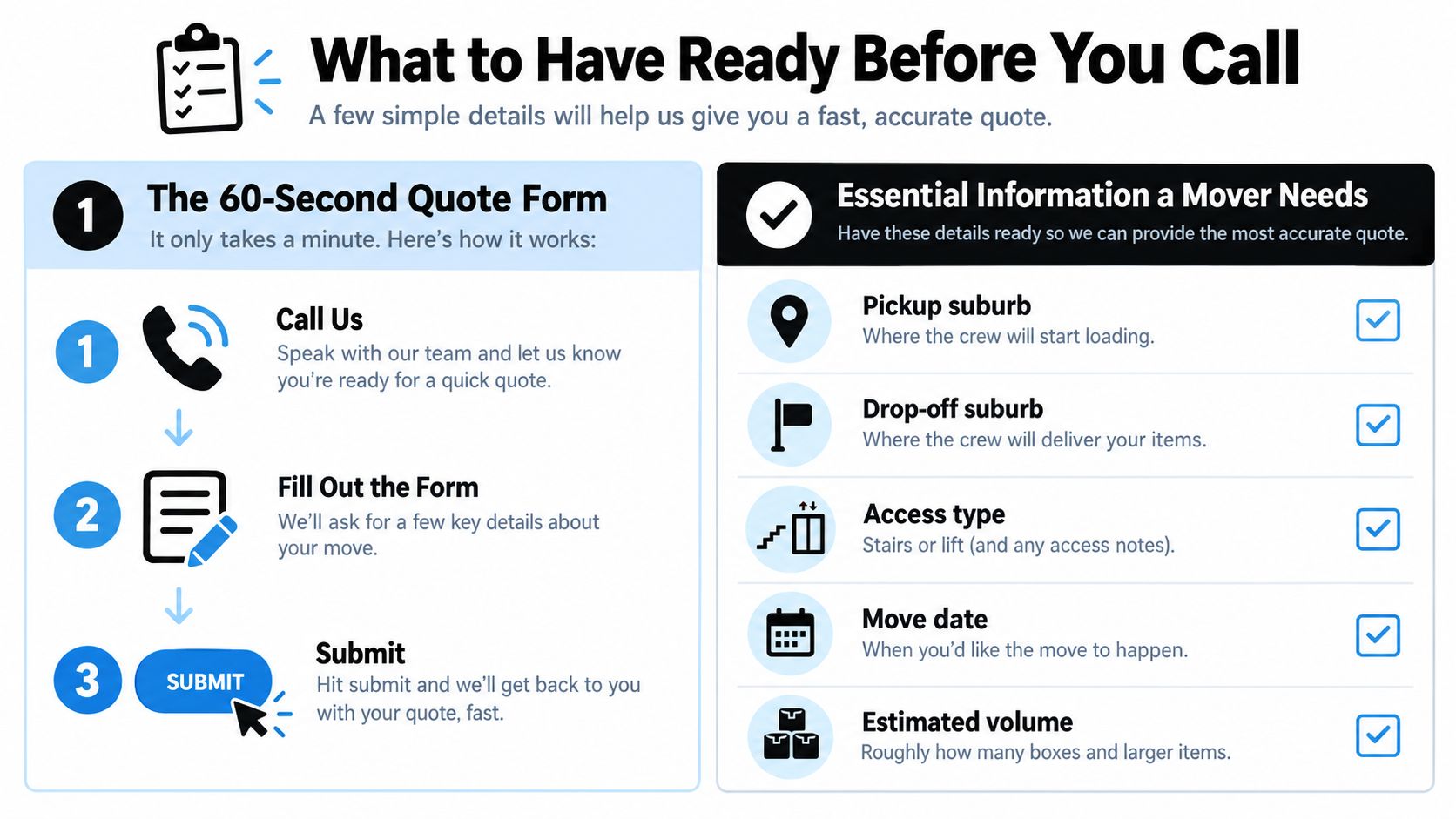
Have the basics ready before you pick up the phone.
The must-have details
- Pickup suburb: Give the exact suburb, not just “inner west”.
- Drop-off suburb: Same rule. Removalists Sydney jobs live or die on route planning.
- Access type: Ground floor, lift, stairs, split-level terrace, basement loading dock, or rear lane.
- Parking reality: Not “there's street parking around”. State the truck distance from the front door.
- Move date and time window: Morning, midday, after settlement, after key collection.
- Approximate volume: Bedrooms are fine if you're accurate. Cubic metres are better if you know them.
- Special items: Piano, safe, marble table, fridge upstairs, artwork, gym gear, pool table.
What speeds up confirmation
A recent video walkthrough is gold. Two minutes on your phone, room by room, with a pause on the bulky items. That often does more than a written inventory because the allocator can judge truck size, crew size, and likely loading time immediately.
Photos matter most for the heavy pieces. Think fridge, modular lounge, solid timber dining table, stone top furniture, oversized bed frames, and anything awkward in stairwells.
If you need a same-day slot, don't make the removalist guess. Guesswork pushes your job to the bottom of the call list.
The details people forget
Two issues derail urgent bookings more than customers realise:
- Strata lift bookings
- Street access approval
If you're in an apartment, confirm whether the building manager has approved the move. If you're loading from a tight street, confirm where the truck can legally stop. Most operators won't hold a crew for a next-day move if access sounds shaky.
Keep your bond deadline, settlement date, or handover timing visible when you call. A real urgency fee should connect to a real timing constraint, not just panic.
What an Urgent Move Really Costs in Sydney
Urgency changes price, but not in a random way. The final bill usually moves for four reasons: crew availability, timing pressure, access complexity, and waiting time. Distance and load size still matter, but short notice work adds a premium because the operator has to reshuffle labour, truck allocation, or both.
Australian cost guides mostly focus on standard pricing. One guide places a two-person truck setup at about $111 to $200 per hour, while broader estimates run from roughly $300 to $3,500 locally and $2,000 to $6,000 interstate. That same guide notes competitor pricing pages often suggest same-day or next-day jobs can attract 20% to 50% premiums over standard rates, and it also found 78.2% of respondents said price was their top moving priority while 27.3% moved to reduce cost of living (Airtasker removalist cost guide).
Sydney urgent move cost premiums by scenario
| Scenario | Notice window | Typical premium range | Notes |
|---|---|---|---|
| Standard booking | Several days or more | Standard rate | Best chance of route planning and normal crew allocation |
| Short-notice booking | 2 to 3 days | Lower end of urgent premium | Easier if access is simple and load size is modest |
| Next-day move | About 24 hours | Mid urgent premium | Commonly affected by truck availability and crew reshuffle |
| Same-day move | Same day | Higher urgent premium | Highest risk of premium pricing, especially on weekends |
What actually pushes the bill up
The big cost trigger isn't just urgency. It's disruption. If your move forces a crew to run after hours, wait for keys, double-handle furniture because the truck can't park close, or sit outside a building for lift access, you're paying for lost productive time.
Read a full Sydney removalist cost breakdown if you want the standard pricing framework. For urgent work, I'd focus on these questions instead:
- Can the mover start immediately, or are they fitting you between jobs?
- Is the move on a weekend or at month-end?
- Will the crew lose time waiting for keys, settlement, concierge approval, or lift access?
- Does the property need a smaller truck, shuttle run, or long carry?
Good premium versus bad premium
A legitimate urgency premium is tied to operational friction. A bad quote uses vague language like “emergency fee” with no explanation. Ask the operator to separate the base rate from the short-notice loading and to confirm any waiting-time policy in writing.
A fair urgent quote is still transparent. If the numbers get fuzzy when you ask for written terms, keep moving.
Expedited Packing Checklist for 24 to 72 Hour Moves
Packing for an urgent move isn't about neatness. It's about truck efficiency and breakage prevention. The crew should be able to walk in, wrap what needs wrapping, and start loading without stepping around half-packed boxes and loose kitchenware.
Australian moving checklists generally recommend booking removalists 4 to 6 weeks ahead, with tighter competition at month-end, on weekends, and around public holidays (Australian moving checklist guidance). If you're already inside a 24 to 72 hour window, you need to compress the work in the right order.
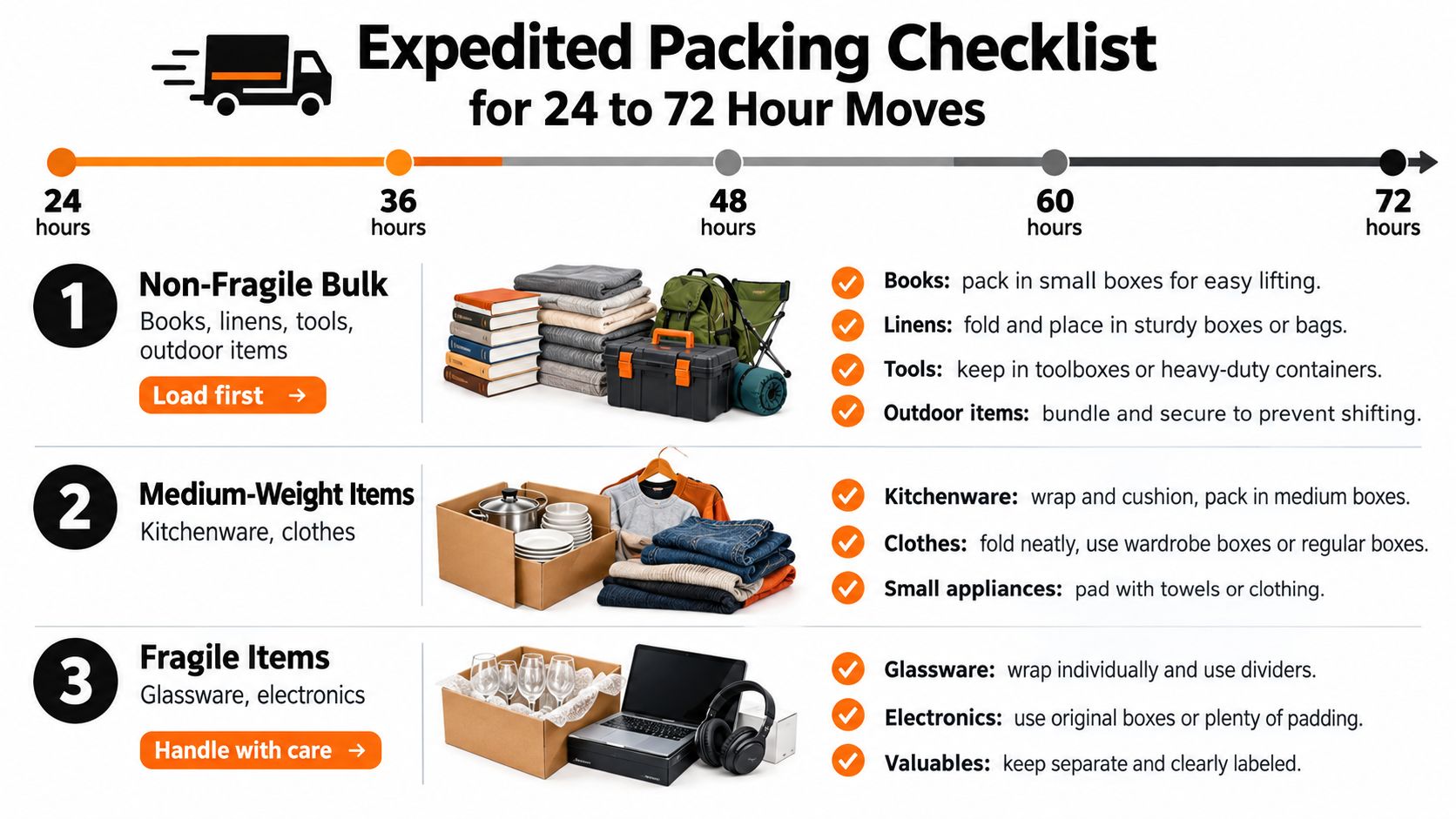
Pack in the order the truck wants
Start with the boring, dense, non-fragile stuff.
- Books and files: Small boxes only. Heavy items in big cartons waste time and split bottoms.
- Linen and clothing: Bags, suitcases, or labelled cartons. Fast to stack, fast to load.
- Garage and tools: Group by type. Tape sharp items securely.
- Outdoor gear: Empty soil, water, and fuel where needed before the crew arrives.
Then move to the medium-priority contents. Kitchenware, shoes, toys, pantry goods, bathroom items. Keep categories together so unpacking doesn't turn into a scavenger hunt.
Leave the fiddly parts for later
Fragile items and electronics should be packed last, ideally with a short buffer before truck arrival. That reduces the chance that packed boxes get opened again because someone still needs a charger, kettle, or medication.
Use one personal-load zone for essentials:
- Documents and ID
- Medication
- Chargers and laptops
- One change of clothes
- Basic toiletries
- Kettle, mugs, and simple snacks
If you need more structure, this guide to packing tips for moving house in Sydney is worth saving before you start.
What to delegate to the movers
Don't waste your best energy fighting bed frames and washing machine hoses if the booked crew handles that kind of work. In urgent home removals Sydney jobs, the smartest move is usually to prepare the contents and let the removalists deal with the bulky disassembly and protective wrapping.
There's also a safety issue. Australian product-safety analysis reports at least 28 deaths linked to toppling furniture since 2000 and estimates at least 900 injuries per year requiring medical treatment. A related consultation paper says children under 7 account for 75% of reported fatalities and children under 4 account for over 50% of emergency department presentations from furniture tip-overs (furniture toppling impact analysis). Rushed disassembly is where people make bad decisions. Secure, controlled handling matters.
Access and Parking Rules That Can Derail an Urgent Move
Bad access is the silent killer of urgent bookings. Not price. Not distance. Access. A cheap quote means nothing if the truck can't stop legally, the lift isn't booked, or the building manager sends the crew away.
Strata timing is rarely flexible
For apartment moves in NSW strata buildings, one Sydney removalist guide says minimum notice is 14 days and recommends booking the lift slot at least 2 weeks in advance (Sydney strata moving guide). If you're moving into or out of a strata block with only a day or two to spare, check this before you ring any mover.
That's why urgent apartment jobs often fail while house moves still get through. The truck may be available, but the building isn't.
Street permits aren't optional in many areas
A Sydney parking guide says most councils expect a permit or booking if a removal truck stops on public streets for more than a few minutes, with lead times of about 10 business days and permit costs commonly between $30 and $100. It also cites the City of Sydney tradesperson permit at around $80 and its visitor permit at around $30 (Sydney removalist truck parking permit guide).
Another Sydney guide notes that a tradesperson parking permit for a truck under 4.5 tonnes can be used in the City of Sydney area, but that Inner West Council has no quick one-day removalist permit, so the truck has to comply with ordinary street rules and timing limits (Inner West parking guidance for removal trucks).
Sydney Access Requirements by Area
| Area | Lift Booking Lead Time | Parking Permit Cost | Common Access Issue |
|---|---|---|---|
| City of Sydney apartments | Often advance booking required | Commonly around the lower to mid permit range | Loading zones, concierge rules, tight booking windows |
| Inner West terraces and units | Building-dependent | Quick one-day permit option may not exist | Narrow streets, standard street-rule compliance |
| Eastern Suburbs units | Often building-managed | Council and street conditions vary | Timed parking, steep access, stairs |
| North Shore apartments | Often building-managed | Council and street conditions vary | Basement clearance, dock booking, lift control |
The right truck on the wrong street still loses the job.
Red Flags, Insurance, and NSW Consumer Rights
Urgency makes people sloppy. That's when dodgy operators get paid.
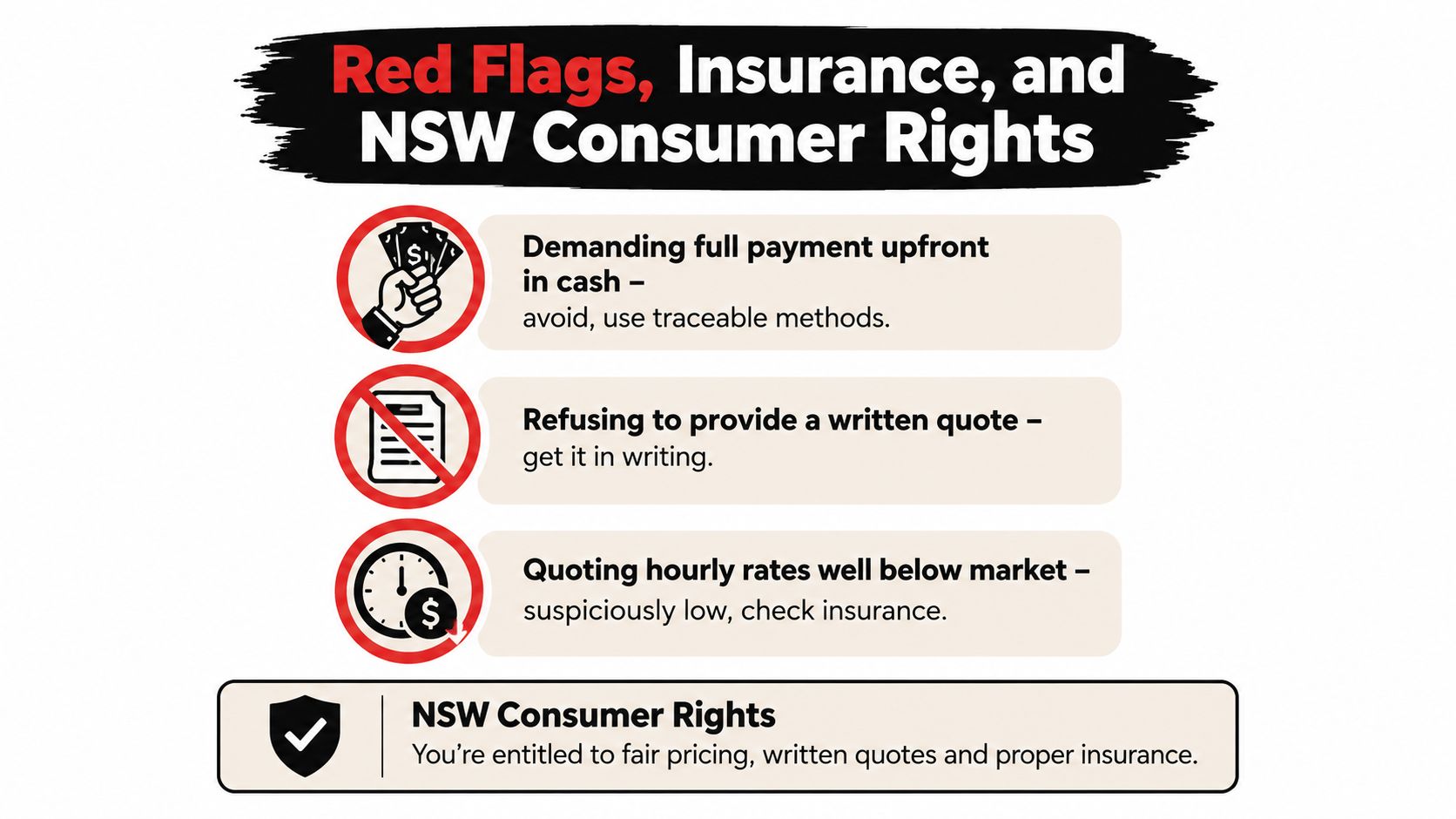
The first red flag is a mover who refuses to put the quote in writing. The second is pressure to pay in cash before the truck arrives. The third is a quote so thin on detail that you can't tell whether fuel, stairs, waiting time, or heavy-item handling are included.
What a proper quote should include
NSW Fair Trading advises consumers to choose a removalist carefully and provides official guidance on checking terms, pricing, and dispute pathways for this type of service (NSW Fair Trading removalist advice). That's the baseline. If the operator won't clearly state the hourly rate, minimum hours, cancellation terms, and any short-notice loading, don't book them.
A written quote protects both sides. It tells you what's included, and it tells the mover what they're committing to.
Red flags worth treating seriously
- Cash pressure: Traceable payment methods are safer when a move is rushed.
- No written confirmation: Verbal promises vanish the moment access gets messy.
- Vague insurance answers: If they dance around liability, move on.
- Too-good-to-be-true urgency pricing: Panic discounts often become expensive add-ons later.
For actual booking options, one provider that states it can accommodate short-notice jobs when possible is same day removals in Sydney. That's useful because urgent work needs upfront clarity about what can be done, not vague reassurance.
Take photos of furniture before loading starts. It's the simplest record you can create in two minutes.
Contingency Planning and Booking Your Urgent Move
Even a well-booked urgent move can wobble. Traffic blows out. A previous job overruns. Building access changes. The customers who handle this best don't just book a truck. They book a fallback plan.
If the mover is delayed
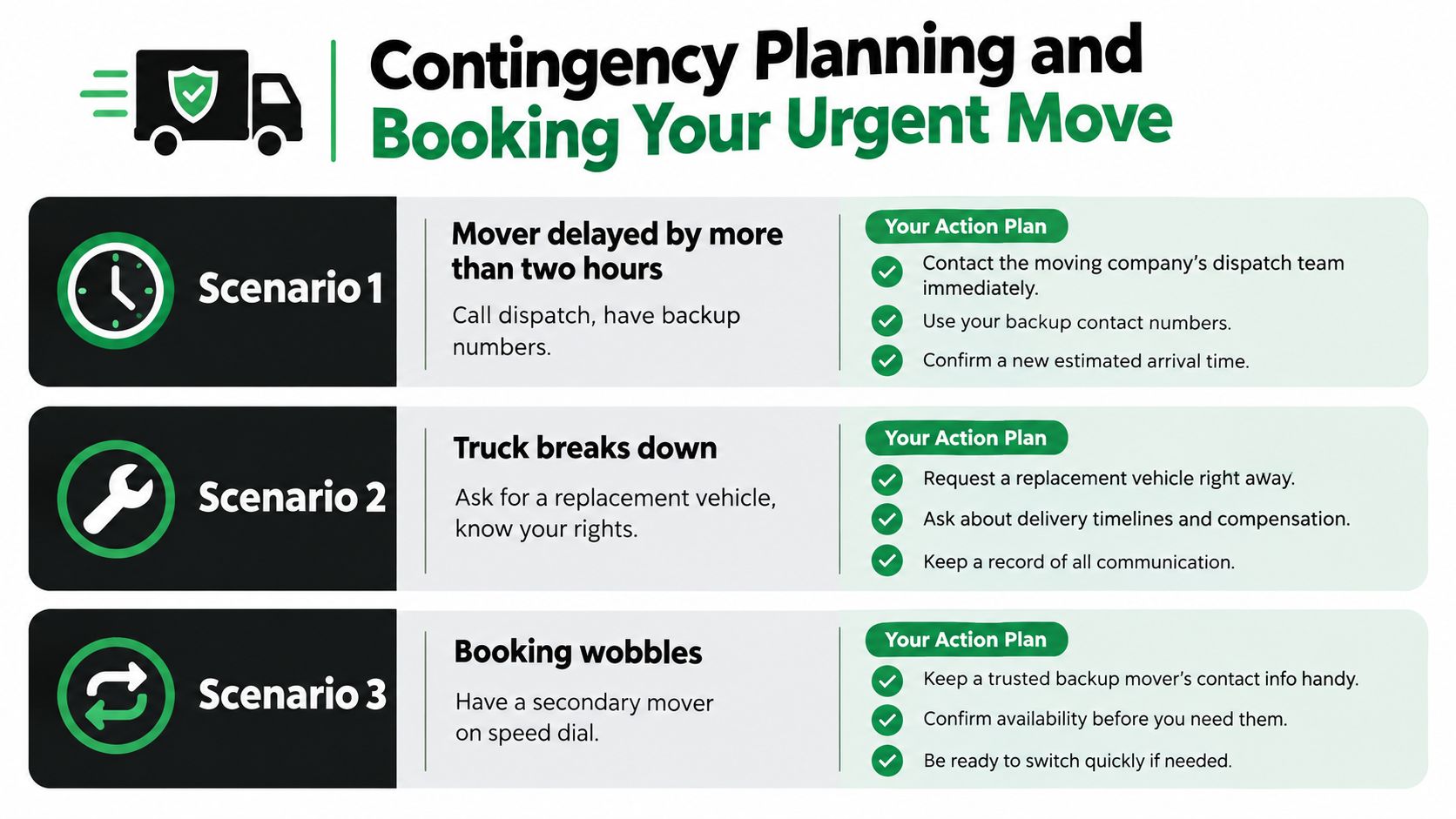
Call the booking office first, then the crew leader. Ask for an updated ETA and whether the truck is still completing another run. If the delay affects a key handover, lift slot, or settlement timing, say that immediately. Specific consequences get faster action than general frustration.
Save these four contacts before move day:
- Booking office
- Crew leader mobile
- Building manager or strata contact
- Backup removalist
If the truck breaks down or the booking wobbles
Ask one question straight away: what is the replacement plan? You want to know whether another vehicle is being dispatched, whether the crew is transferring to a different truck, and who is updating the building or receiving address.
If access fails because permits or lift bookings weren't sorted, stop arguing about blame and solve the physical problem first. That may mean changing truck position, using a smaller vehicle, moving to a different loading window, or shifting the drop-off sequence.
The booking rule that matters most
Request a written quote that confirms:
- Crew size
- Vehicle type
- Hourly minimum
- Any urgent premium
- Waiting-time terms
- Contingency process if timing changes
Then sign digitally and pay the deposit required to lock the slot. Urgency favours operators who document the job properly. It doesn't favour whoever shouts loudest on the phone.
If you're comparing options, keep one checklist in mind. Fast response matters. Clear written terms matter more.
Home Removals Sydney handles local Sydney moves, interstate removals, packing support, and short-notice bookings when capacity allows, so you can lock in a crew without guessing what's included. If you need a written quote that spells out crew size, timing, access requirements, and urgent-move pricing clearly, visit Home Removals Sydney and request a quote.
