

Moving day in Sydney often feels organised right up to the moment something goes wrong. The lift booking runs late in Parramatta, the truck is packed for an interstate leg, and when the dining table comes off at the other end there's a deep scratch along the edge. The first question is simple. Who pays?
That's where many first-time movers get caught. A removalist can be careful, experienced and properly insured as a business, and you can still find that your goods themselves aren't automatically covered in the way you assumed. People hear “fully insured” and picture a blanket promise over the truck, the crew, the furniture, the loading dock and the storage unit. Real policies don't work like that.
Insurance for removalists is more like a relay race. One type of cover responds to damage to someone else's property during the move. Another can apply to the goods being transported. Storage may sit under a separate extension again. If you don't know where one stage stops and the next starts, it's easy to think you're protected when there's a gap.
Introduction Why Insurance Matters on Moving Day in Sydney
A Sydney move has plenty of moving parts before the truck even leaves the kerb. There may be narrow apartment stairs, a booked loading bay, wet weather, a long carry from the garage, or a late settlement that pushes your goods into overnight storage. None of that means the move is unsafe. It does mean there are more points where customers can misunderstand what “covered” really means.
I've seen the same confusion many times with home removals Sydney customers and office relocations. The truck arrives, the team is in uniform, the paperwork looks professional, and everyone assumes the insurance side must already be sorted. Often it isn't. What's sorted is the removalist's business protection. That is not always the same thing as protection for the sofa, artwork, monitors or boxed kitchenware being moved.
A good way to think about it is this. A builder can have insurance for the business and still require separate cover for the client's site risks. Moving works in a similar way. The removalist's insurance may protect the company against certain liabilities. It may not automatically replace your belongings if they're damaged.
Practical rule: If you haven't seen written wording for cover on your goods, assume nothing yet.
If you want broader context on how moving policies are commonly discussed, this overview of moving insurance coverage is a useful starting point. Then you can come back to the NSW details that matter most for local moves, furniture removals Sydney jobs, interstate removals and business relocations.
Before you book, it helps to get three things clear in plain language:
- What policy exists: Is it public liability, transit cover, storage cover, or a mix?
- When it applies: Does it respond during loading, only in transit, or also during unloading?
- Who is protected: The removalist's business, your goods, or both under different documents?
Once you understand those three points, the rest of the insurance conversation becomes much easier to follow.
How Removalist Insurance Works in Australia
You book a truck, the crew turns up on time, and the move feels under control. Then a wardrobe panel is gouged during loading, a TV is damaged in transit, or boxes sit in storage longer than planned. The first question is usually, “Whose insurance covers that?” In Australia, the answer depends on which stage the goods were in and which policy applies.
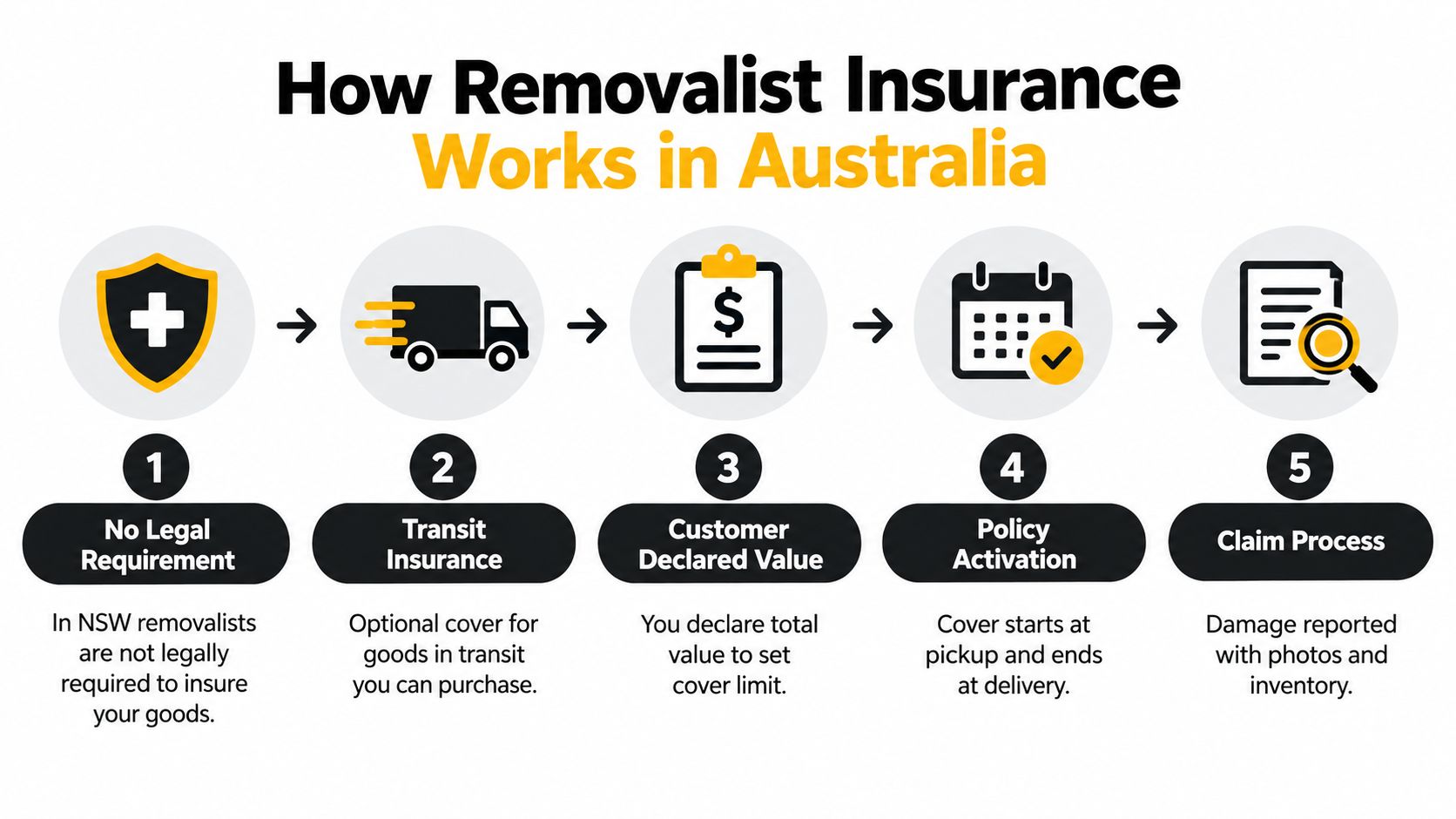
In NSW, a removalist is not legally required to hold insurance that covers a customer's belongings during a move according to the NSW Government's guide on choosing a removalist. That is why confusion is so common. Customers often hear that a company is “insured” and reasonably assume their furniture is included. Sometimes it is. Sometimes the company only has cover for its own business risks.
Why goods cover is usually separate
The easiest way to understand the system is to split it into two buckets.
The first bucket is the removalist's own insurance. That can include things like vehicle insurance and protection for liabilities the business may face while doing the job.
The second bucket is cover for your goods while they are being handled, carried, delivered, or stored. That cover is often arranged as a separate transit or storage product rather than something that automatically comes with the booking.
There is a regulatory reason for that separation. Treasury's paper on the AFRA arrangement explains that goods-in-transit cover in the removals industry developed within a regulated framework, with AFRA and ASIC working on an add-on product and licensing rules applying from the early 2000s, including from March 2004 for businesses offering insurance under that system in Treasury's AFRA paper. In plain English, this is not an informal promise written on the back of a quote. It is a distinct insurance arrangement with its own rules, wording, limits, and claims process.
Why “we're careful” and “you're covered” are different statements
Careful handling reduces risk. It does not define what an insurer will pay for.
That point catches first-time movers out. A removalist can do a professional job, use blankets, straps, and trained staff, and still have a policy structure that does not automatically replace a damaged item unless the relevant goods cover was arranged. Consumer protections may still matter if there was poor service or negligence, but that is a different path from having a policy that responds to accidental loss or damage during an insured stage of the move.
A useful comparison is a building site. The builder may carry insurance for the business and the worksite, while the owner may still need separate protection for specific property risks. A move works in much the same way. One set of cover protects the operator. Another may protect the items being moved.
Where customers get tripped up
The part many Sydney guides skip is the hand-off between stages.
Cover is often described as if the whole move is one continuous event. On the ground, it is really a chain of stages: loading at the pickup address, transit in the truck, unloading at the destination, and sometimes storage before final delivery. Policies can start and stop at different points across that chain.
That means a customer needs to ask a more precise question than “Are you insured?” A better question is: What cover applies to my goods at each stage of the move, and when does it begin and end in writing?
What a customer should take from this
If you are booking removalists Sydney services, furniture removals Sydney work, or an interstate move, treat goods cover as something to confirm line by line.
Use this checklist:
- Ask whether cover for your goods exists at all
- Ask who arranges it, the removalist or you
- Check whether it applies during loading, transit, unloading, and any storage period
- Confirm the policy wording, not just the verbal summary
- Get the start point, end point, and any exclusions in writing
That small check before moving day often makes the difference between a clear claim path and a long argument after the truck has gone.
Public Liability Versus Transit and Storage Cover Explained
A common Sydney moving-day problem goes like this. The truck is booked, the mover says they are insured, and everyone assumes that means the business, the truck, and the customer's furniture are all covered from the first box lifted to the last box set down. That is where confusion starts.
A removalist can be properly insured as a business while your own goods still have limited cover, or no cover, for a particular stage of the job.
The clearest way to separate the cover types
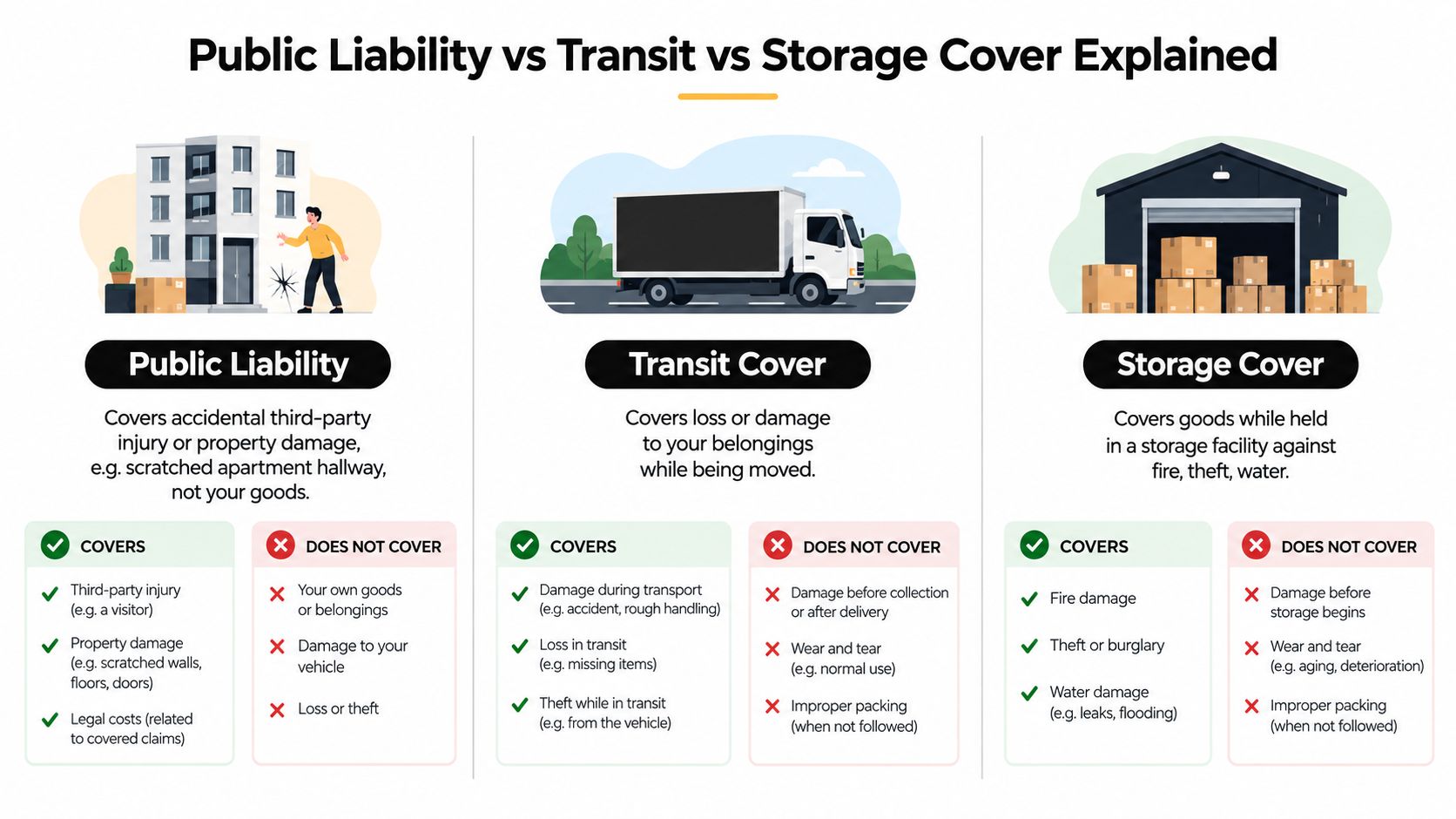
Public liability protects the removalist's business against claims for injury or damage caused to other people or other property during the work. Transit cover relates to the customer's goods while they are being moved during the policy's insured transit period. Storage cover applies if the goods go into storage and that part has been included.
The practical point is simple. These covers do different jobs, and they do not automatically replace one another.
If a removalist scrapes the apartment lobby wall with a fridge trolley, that usually sits in the public liability category. If your TV is damaged while the truck is on the road, that usually falls under transit cover. If your lounge is later affected by water while held in a storage unit, that is usually a storage claim.
Here is the distinction in a format customers can check quickly.
| What Each Type of Removalist Cover Actually Protects | |||
|---|---|---|---|
| Cover Type | What It Protects | When It Applies | Typical Gap to Watch |
| Public liability | Accidental third-party injury or property damage caused during moving work | Commonly during on-site handling such as loading or unloading | It usually does not mean your goods are insured |
| Transit cover | Your belongings during the defined transit period | Usually during the insured move, subject to the policy wording | Damage before pickup, after delivery, or outside the transit window may sit outside cover |
| Storage cover | Goods held in storage, if included | During the storage period listed in the policy | Short-term holding or overnight stops may need to be listed specifically |
For customers comparing documents, the easiest mental model is this: public liability follows the removalist's responsibility to others, while transit and storage cover follow the customer's goods through named stages. If the stage is not included, that is where claims often stall.
For customers who want a deeper look at storage-specific wording, this guide to Container Self Store contents cover helps explain why storage isn't always automatically bundled into moving protection.
Why customers mix these up
On the phone, “insured” sounds like one big umbrella. In policy wording, it is usually more like a set of separate switches.
One switch may be on for the removalist's liability to third parties. Another may be on for goods while in transit. A third may be on only if storage has been added. That is why a mover can answer “yes, we're insured” and still need to confirm separately whether your goods are covered during loading, on the truck, after unloading, or while stored.
If you are reading policy summaries, this page on goods in transit insurance for Sydney moves is useful for seeing how goods cover is commonly described in practice.
This short video also gives a helpful visual overview before you compare documents.
Where claims commonly go wrong
Claims often become difficult because the damage happened in a stage the customer assumed was included.
- Loading was treated differently from transit: A policy may define the transit period narrowly, so damage while carrying items out of the unit or house may need careful checking.
- Unloading marked the end of cover: Once goods are off the truck and placed at the destination, some cover stops unless the wording says otherwise.
- Storage was assumed to be automatic: Even a short storage period can need its own listed cover.
- Packing method changed the risk: Some policies limit claims for owner-packed cartons because the mover did not control how those boxes were packed.
- Pre-existing weakness became part of the dispute: An older table joint, cracked veneer, or fragile flat-pack item can affect how the insurer assesses cause.
A mover's business insurance and a customer's goods cover are related, but they are not the same thing. The safe approach is to match each stage of the move to the exact cover that applies.
Understanding Policy Limits Declared Value and What It Costs
Price usually sounds simple until you look at how moving cover is measured.
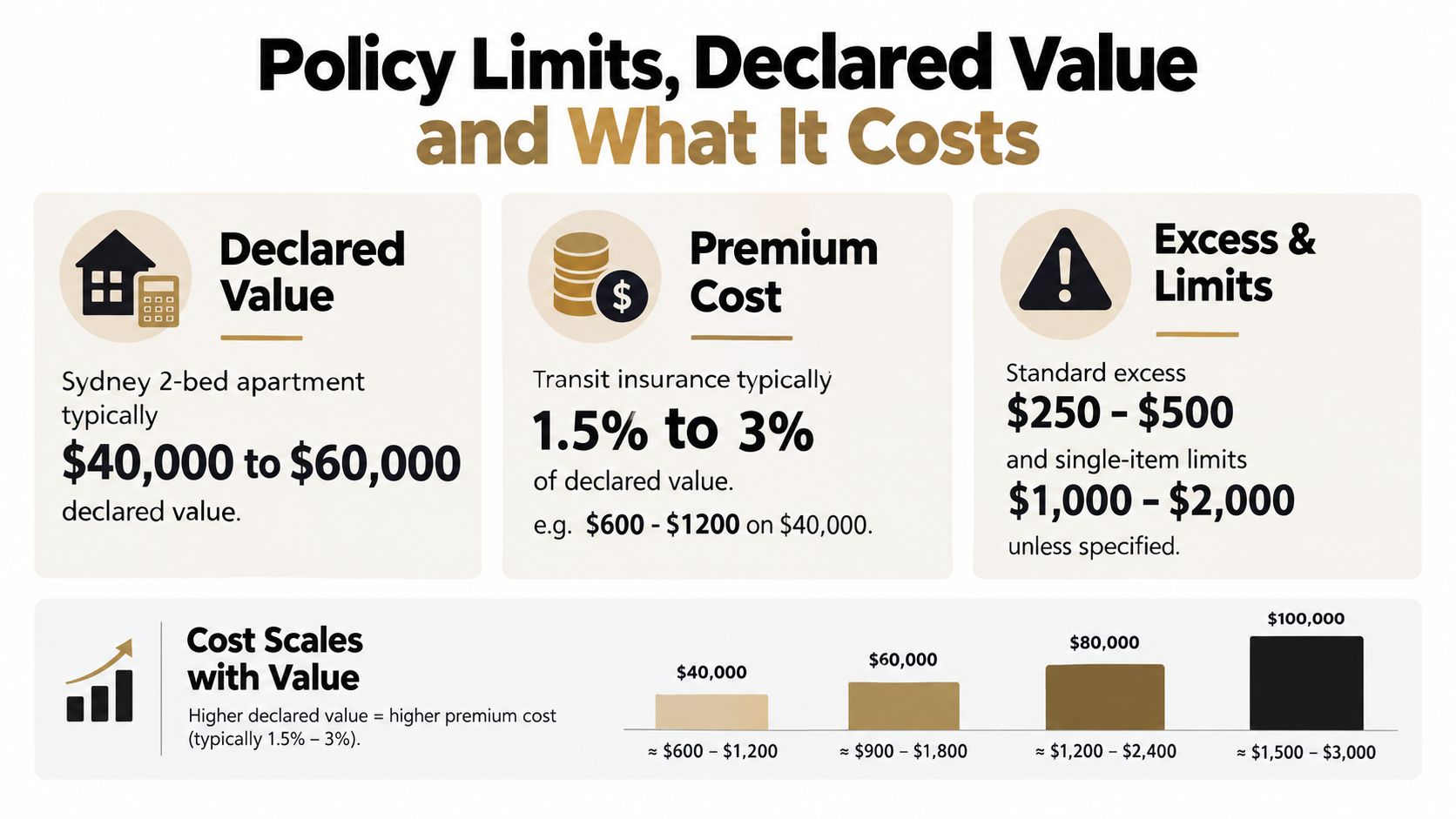
With removalist transit and storage cover in Australia, the premium is often based on the declared value of the goods you want insured, rather than a single flat charge for the whole job. One published example shows 2.5%, or $25 per $1,000, with a minimum premium of $450 for removal and transit full cover. Another option is listed at 1.75%, or $17.50 per $1,000, on Transcorp Removals and Storage's insurance page.
What declared value means
Declared value is the amount you nominate as the value of the goods covered under the policy wording. A simple way to read it is this: it is the number the insurer uses as the starting point when judging whether the cover fits the load.
It should be based on the contents of the move, not a quick estimate made to keep the quote down. That matters more when the shipment includes higher-value items such as electronics, antiques, artwork, business equipment, or stock going into storage.
Using the same published pricing example, a declared value of $20,000 would point to a premium of about $500 at 2.5%, or about $350 at 1.75%, before any minimum premium rules apply on that same Transcorp page.
Why the number matters so much
Declared value works a bit like setting the ceiling before the storm arrives. If you set it too low, the policy does not stretch upward later because the loss turned out to be larger than expected.
That is where first-time movers get caught. They look at the truck space, not the replacement value. A two-bedroom flat may not look expensive when it is packed into cartons and furniture pads, but televisions, mattresses, whitegoods, laptops, wardrobes, and dining settings add up quickly.
If the load is worth far more than the figure on the form, the gap sits with you.
A practical way to avoid that is to value the move room by room:
- Living areas: Sofa, dining table, chairs, television, artwork, rugs
- Bedrooms: Beds, mattresses, wardrobes, bedside tables, clothing
- Kitchen and laundry: Appliances, small electrical items, boxed crockery
- Study or office: Monitors, laptops, printers, ergonomic chairs, files
- Specialty items: Pianos, antiques, collections, framed mirrors
Limits, sub-limits, and stage-based costs
This is also the point where it helps to separate two different things. The removalist's own business insurance protects the business against certain liabilities. Your goods cover is about the items being moved, stored, loaded, or unloaded under the terms of that policy.
Those are related, but they are not interchangeable.
Some policies also apply limits to categories or individual items, even if the total declared value looks high enough. A policy might insure the load up to the overall amount declared, but place a lower cap on jewellery, artwork, antiques, or a single high-value item unless it is listed separately. That is why a customer can be properly insured in one sense and still underinsured for one part of the load.
For storage, the price can also change because the risk period is longer and the trigger for cover may be different from a same-day move. Cover for a truck journey from Bondi to Parramatta is one stage. Cover while goods sit in a warehouse for a week is another stage. Good policy reading means checking where each stage begins and ends, not assuming one premium covers the lot in the same way.
Common exclusions to read closely
As noted earlier, cover needs to match the move being booked and the way the goods are handled. The terms worth checking in writing are usually the ones that cause disputes later:
- Owner-packed boxes
- Pre-existing damage
- Antiques and fragile items
- Electronics
- Temporary storage
- Single high-value items
AFRA's consumer guidance on transit insurance and moving cover is useful here because it reinforces a practical point customers often miss. Policy wording decides the claim, not the sales phrase on the quote.
Budgeting tip: A low premium only helps if the declared value and exclusions still match the move you are doing.
For office relocations and interstate jobs, the same principle applies with even more care. A modest-looking office can hold a high insured value once monitors, fit-out items, archived files, and specialist equipment are listed properly.
What Sydney Customers Should Ask and How to Verify Cover
By the time you're comparing quotes, the phrase “fully insured” should set off a simple follow-up question. Insured for what, exactly? Without documents, that phrase doesn't tell you much.
The documents worth asking for
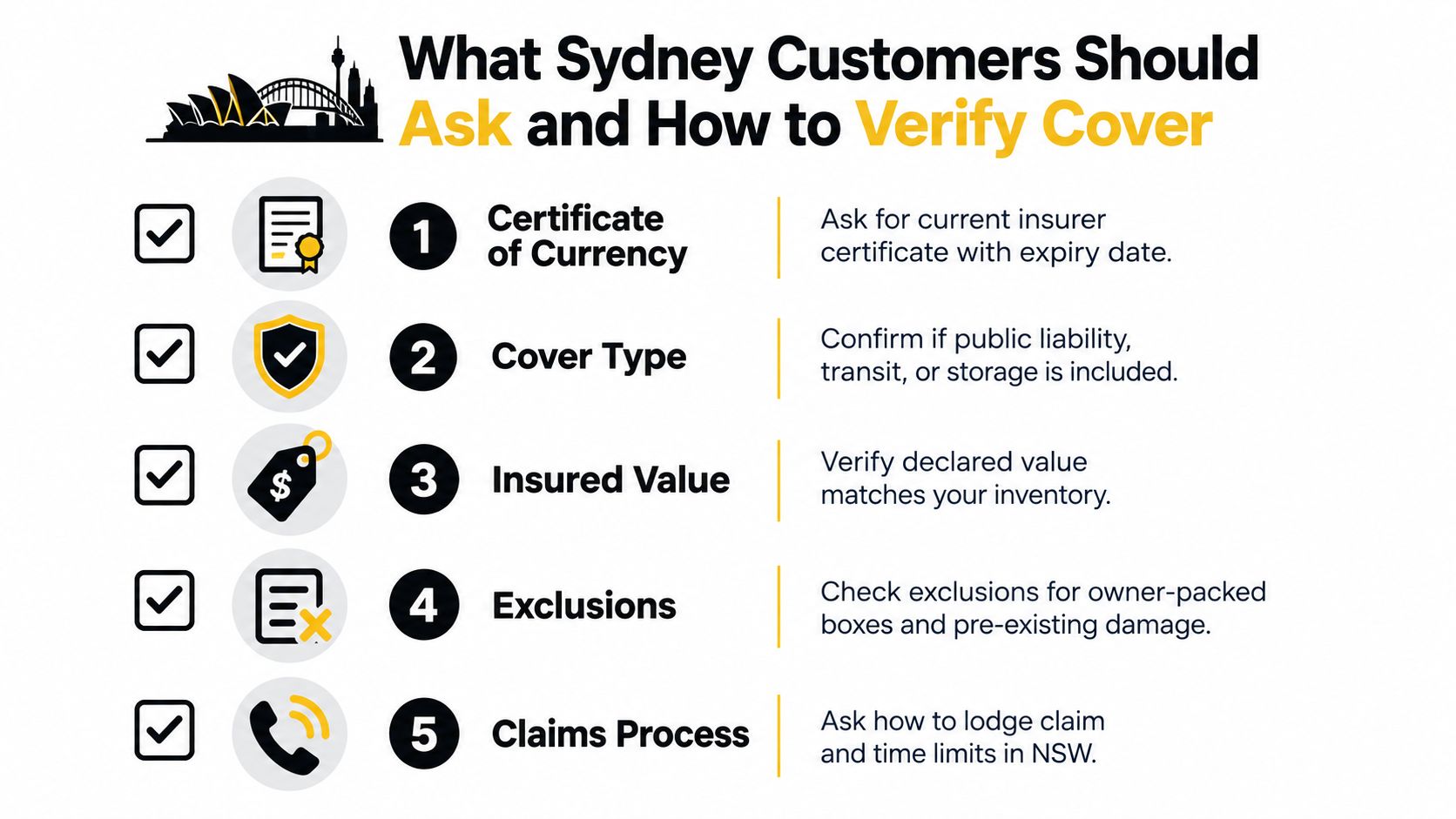
Queensland consumer guidance, which is useful nationally on this point, highlights the importance of asking for the exact claim terms and a Certificate of Currency in its advice on using a removalist. That matters for Sydney customers because verbal assurances don't help much once a claim becomes a paperwork exercise.
Ask for these before booking:
- Certificate of Currency: Check that it's current and matches the business name you're dealing with.
- Policy type in writing: Confirm whether the quote includes public liability, transit, storage, or only one of those.
- Declared value confirmation: Make sure the insured amount reflects your inventory, not a generic placeholder.
- Exclusions list: Owner-packed cartons, fragile items, pre-existing damage and storage should be addressed clearly.
- Claims process: Ask how quickly damage must be reported and what evidence is needed.
AFRA and paperwork still matter
AFRA accreditation is useful because AFRA-accredited removalists should have public liability insurance and can provide transit insurance for goods, while other Australian guidance notes removalists are not legally required to hold insurance covering a customer's belongings during a move in this Australian removals guidance. That's why accreditation is helpful, but it still doesn't remove the need to read the actual cover arrangement.
If you're screening firms, it also helps to review the basics on AFRA accredited removalists so you know what that label should and should not mean.
Don't stop at “yes, we're insured”. Ask, “Can you send the current certificate and show whether my goods are covered during loading, transport, unloading and any storage?”
How vague wording usually looks
You don't need legal training to spot weak answers. Be cautious if you hear things like:
- “Everything's covered” with no document attached
- “We've never had a problem” instead of a policy explanation
- “The truck is insured” as if that answers the goods question
- “Storage should be fine” without a listed extension
A good removalist won't be annoyed by these questions. They'll answer them cleanly, because clear cover reduces disputes for both sides.
How Cover Changes During Loading Transit Storage and Delivery
At 7:30 on moving morning, the policy question is not just “am I insured?” It is “which cover applies at this exact stage?”
That catches first-time movers out. A Sydney move runs like a relay race. The goods move from your flat, to the lift, to the truck, to the road, sometimes to a warehouse, then back onto another truck, and finally into the new place. Cover can change at each hand-off, even when the booking feels like one continuous job.
Take one common example. Your fridge is taken out of a terrace in the Inner West, loaded onto the truck, held overnight, then delivered the next day to a regional NSW address. If the fridge is dented while being wheeled through the hallway, that can raise a different insurance question from a transit accident on the motorway. If it sits in storage between addresses, that is often a separate insurance stage again.
AFRA's guidance for customers and removalists makes the same practical point in plain terms. The paperwork needs to show what applies during packing, loading, transit, storage and delivery, rather than relying on a broad verbal assurance on AFRA's insurance information and moving guidance.
The part many customers mix up
The removalist's own business insurance and the customer's goods cover are related, but they are not the same thing.
If a mover damages a wall in the apartment building, that usually sits in the removalist's business insurance world. If your dining table is scratched in the truck, that sits in the goods cover world, assuming that stage is insured. If the truck is insured, that protects the vehicle itself. It does not automatically mean your belongings are insured from door to door.
A simple way to read the stages is this:
- Loading: Goods are being carried out, lifted, wrapped and placed onto the truck. Damage can happen to the item, the home, or common property. Different policies can respond to different parts of that event.
- Transit: Goods are on the truck and moving between addresses. This is the stage people usually mean when they say “transit cover”.
- Storage or overnight holding: Goods are no longer just in transit. They may be in a depot, container or warehouse. Transit wording sometimes stops here unless storage is listed.
- Unloading and placement: Goods come off the truck and are carried into the destination. Some cover ends at arrival. Some continues until set-down inside the home. You need the wording, not a guess.
That stage-by-stage map matters most when the move is split over more than one day.
If your move includes temporary holding, warehouse storage or a delayed settlement, check whether the policy follows the goods without a gap. This guide to storage with insurance for household moves is useful for the storage leg because that is where many assumptions fall apart.
Where gaps usually appear
The common gap is not dramatic wording. It is one missing stage.
For example, a policy may respond while goods are in the truck but say little about the period after unloading starts. Another may include short-term storage only if it is booked in advance. Owner-packed cartons can create another break point, especially if the item inside is fragile and the insurer wants proof of packing quality.
Home contents insurance can sometimes help around the edges, but it usually does not replace move-specific cover. Insurers often set narrow triggers such as fire, theft, collision or another named event, and those triggers may not respond to the everyday moving problems people see, such as a scraped fridge door, a cracked table leg or pressure damage inside a carton.
So the practical question is this. At what minute does one type of cover stop, and at what minute does the next one start?
If the answer is vague, keep asking until the timeline is clear in writing.
Choosing the Right Cover and Booking Your Sydney Move With Confidence
The right cover depends on the shape of the move, not just the size of the truck. A local apartment move with basic furniture has a different risk profile from office relocations with screens and workstations, or interstate removals with overnight holding, or warehouse moves involving pallets and staged delivery.
Match the cover to the move
A sensible way to choose is to work backwards from what would hurt most if something went wrong.
For a local home move, the focus is often transit protection for furniture, electronics and boxed contents, plus clarity around owner-packed cartons. For a business relocation, the attention shifts to declared value accuracy, timing windows and whether unloading happens over more than one day. For storage-linked moves, the key issue is continuity between pickup and final delivery.
If you want a broader industry perspective on how moving businesses structure their insurance thinking, this moving company insurance guide is useful background reading.
Three things to confirm in writing
Before you lock in a booking, make sure you have these three points nailed down:
The actual cover type
Is your quote referring to public liability, goods in transit, storage, or some combination?The insured period
Does it apply only in the truck, or across loading, transit, unloading and any overnight or warehouse stop?The declared value and exclusions
Do the figures and limitations match what you're moving, including fragile or high-value items?
One practical option in the Sydney market is Home Removals Sydney, which states that its moves are fully insured and offers home, office, warehouse and interstate services with storage support. That still doesn't remove the need to confirm the exact wording that applies to your job, but it does show why customers should compare both service scope and insurance detail side by side.
The best booking decisions usually come from calm paperwork, not last-minute reassurance on moving day. When the cover is clear, the move feels calmer because everyone understands where the responsibility sits.
If you're planning a local Sydney move, interstate relocation, office shift or storage-based move, Home Removals Sydney can help you line up the moving service and the insurance questions before the truck arrives. Visit Home Removals Sydney to request a quote, check what cover applies to your move, and get clear answers in writing before moving day.
