


A growing Sydney team is preparing to leave its current office. The lease end date is fixed, several employees work on a hybrid schedule, clients still expect uninterrupted service, and the new building has a narrow handover window for the loading dock. The move may look like a matter of booking trucks, but the work is coordinating people, technology, building management, furniture and communications in the right order.
Office removals in Sydney run smoothly when the business makes decisions early and assigns ownership clearly. They become expensive when staff pack without labels, IT is left until the final night, or the removalist arrives before the lift and loading zone have been booked. The same principles apply whether you're a small professional practice, a growing SME, a larger corporate office, or a business moving between Sydney and another state.
This guide focuses on the decisions and practical controls that protect working time. It covers whether moving is the right choice, how to build an eight-week execution plan, how to keep systems and mail operating, and how to manage Sydney access restrictions. It also addresses furniture removals, specialised equipment, insurance and quote comparisons, so homeowners, renters and businesses can assess the wider support available from Sydney moving services. By the time you request a quote, you'll know what information a professional removalist needs and which risks should already be under control.
Introduction to Office Removals in Sydney
The most reliable office moves begin before anyone touches a desk. A relocation manager needs a clear picture of the business, not just a list of furniture. That means understanding which teams must be operational first, which equipment needs specialist handling, how clients will reach the business during the changeover, and what the outgoing lease requires at handover.
Sydney adds practical complications. A CBD office might depend on a loading dock booking, a goods lift, building security approval and a restricted delivery window. A suburban office may have easier vehicle access but still require coordination with the landlord, neighbours or strata management. An interstate move introduces another layer, particularly when furniture, records, warehouse stock or specialist equipment travel beyond Sydney.
The move is an operating project
Treating the relocation as a facilities task usually creates gaps. Leadership needs to approve the budget and business priorities. Facilities or administration needs to manage buildings, furniture and access. IT must plan the shutdown and recommissioning sequence. HR and communications should prepare employees, clients and suppliers for the address change. The removalist needs accurate inventories, floor plans and access information rather than a rough estimate of boxes.
The Sydney market also gives businesses a reason to examine the move strategically. The Sydney CBD recorded 39,300 square metres of year-to-date net absorption through Q2 2026, vacancy fell to 13.9% from 14.6% at the end of 2025, and no new supply was delivered in either Q1 or Q2 2026, according to Sydney office market reporting on current tenant movement. Those figures don't mean every business should relocate, but they do show that space is being reallocated while tenants consolidate, upgrade and refit offices.
Practical rule: Decide what must remain operational, what can be staged, and what can be discarded before you ask a removalist to price the move.
What a good result looks like
A successful office relocation has more than a truck arriving on time. Staff know where to go, the new floor has been checked, workstations are placed according to a destination plan, sensitive equipment is protected, and the business can communicate with customers throughout the transition. The outgoing premises is cleared in line with lease obligations, while the incoming premises is ready to receive furniture and systems.
Home Removals Sydney operates across home, office and warehouse relocations, with packing, furniture assembly, storage and interstate transport available as part of a broader moving plan. Whether you use that provider or another commercial removalist, insist on a written scope that reflects both buildings, access arrangements and the level of support required. The steps below turn that scope into an organised move rather than a rushed moving day.
Should You Move or Rethink Your Sydney Office Space
An expensive lease, unused desks or a changing workforce does not automatically justify an office move. Start by identifying the actual problem. The business may need a different address, less floor area, a better-quality building, or revised terms with the existing landlord. That decision should come before comparing Removalists Sydney.
Sydney's office market is favouring better-quality stock. JLL reported 105,500 square metres of net absorption in prime-grade stock over the 12 months to June 2026, while secondary assets contracted by 9,500 square metres, as detailed in JLL's Sydney office market analysis. CBRE also recorded 141 leasing enquiries totalling 125,230 square metres in Q1 2026, with no new CBD office space due in 2026, according to the same market summary. For businesses planning office removals Sydney-wide, the decision is increasingly about quality, transport access and amenity, not finding more desks.
Compare the four realistic choices
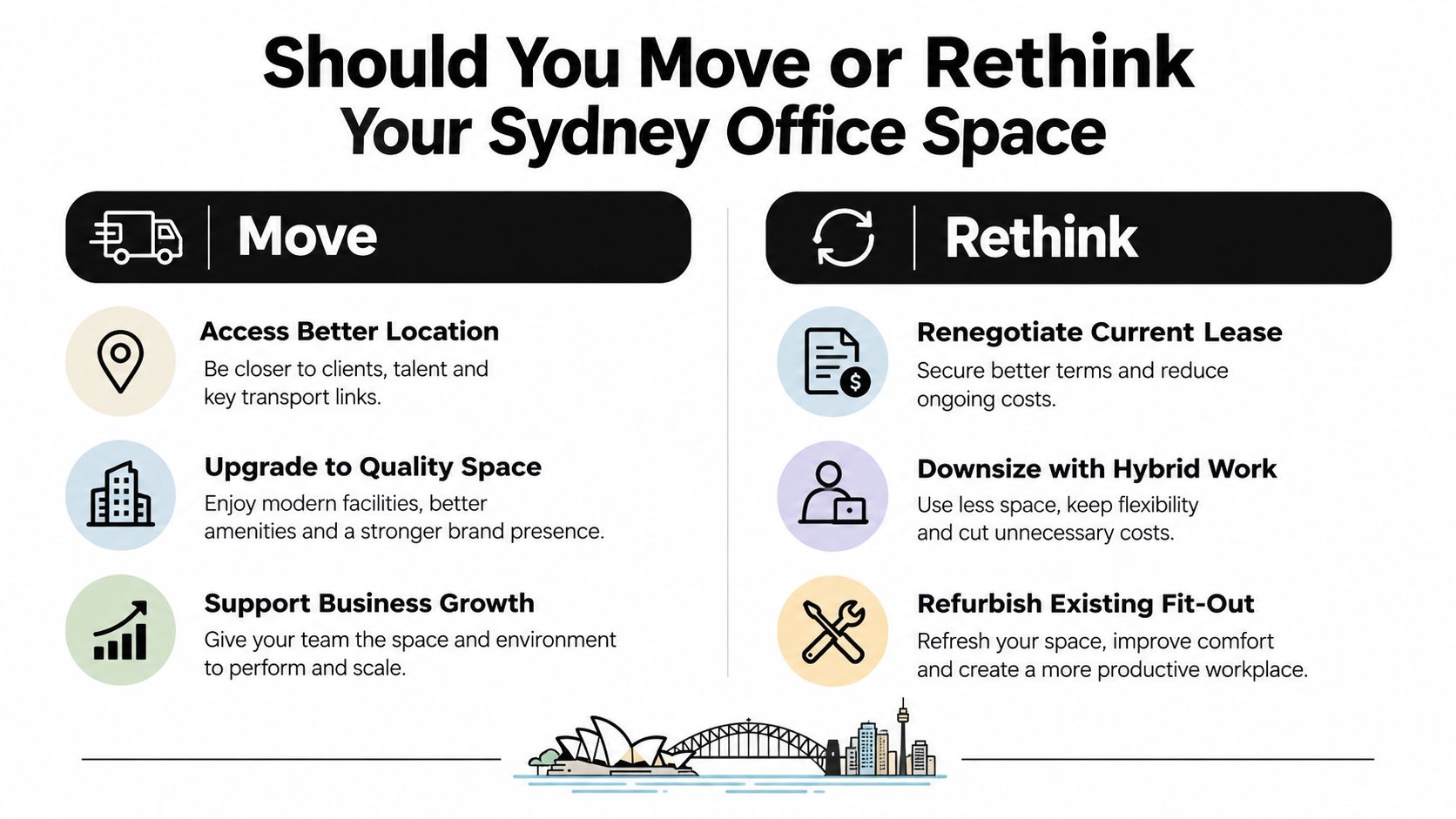
Move to a better location when transport connections, client access or staff commuting are weakening attendance and retention. Tenant movement is concentrated among businesses pursuing flight-to-quality relocations and precincts with strong transport links. Average net effective rents across Sydney Metro softened as incentives increased, according to Cushman & Wakefield's Sydney Metro office report. A well-connected precinct may improve access to staff and clients, but premium premises can create a larger ongoing commitment.
Upgrade the premises if the current workplace is affecting recruitment, client confidence or daily output. Better building services and facilities may address those problems, but assess the fit-out, lease terms and moving costs together. A polished reception area will not correct a floor plan that no longer suits the way teams work.
Downsize or consolidate when hybrid work has left significant space unused. Count the rooms and settings required for meetings, storage, confidential work and peak attendance. Reducing the footprint can lower overheads. Compressing too far can create booking conflicts and restrict collaboration.
Renegotiate or refurbish when the address still serves the business. Discuss term flexibility, incentives, maintenance, end-of-trip facilities, access and the cost of improving the existing fit-out with the landlord. Avoiding a relocation still may require staged decanting, temporary work areas and furniture handling.
Questions that should decide the timing
Ask staff which transport links and precinct features affect attendance, then test that feedback against lease costs and operating needs. Confirm whether the proposed premises will be ready on the required date, which access charges apply, and who pays for reinstatement or make-good work. Leadership must also decide whether the business can tolerate a staged transition or needs one controlled changeover.
Sydney CBD vacancy fell to 13.9% in Q2 2026, the lowest since Q1 2023, and the market recorded five consecutive quarters of positive absorption, as reported by JLL. That supports deliberate timing. Waiting can preserve flexibility, while an attractive office near reliable transport may become harder to secure. Moving can improve the workplace, but only when the new space addresses a defined business problem and the budget covers the full change, including fit-out, access and removal costs.
Your Office Relocation Timeline and Stakeholder Plan
An eight-week execution plan works when the lease and destination premises are already sufficiently defined. It doesn't replace earlier property, legal or fit-out decisions, but it gives the team a practical control period for turning an approved move into a coordinated changeover.
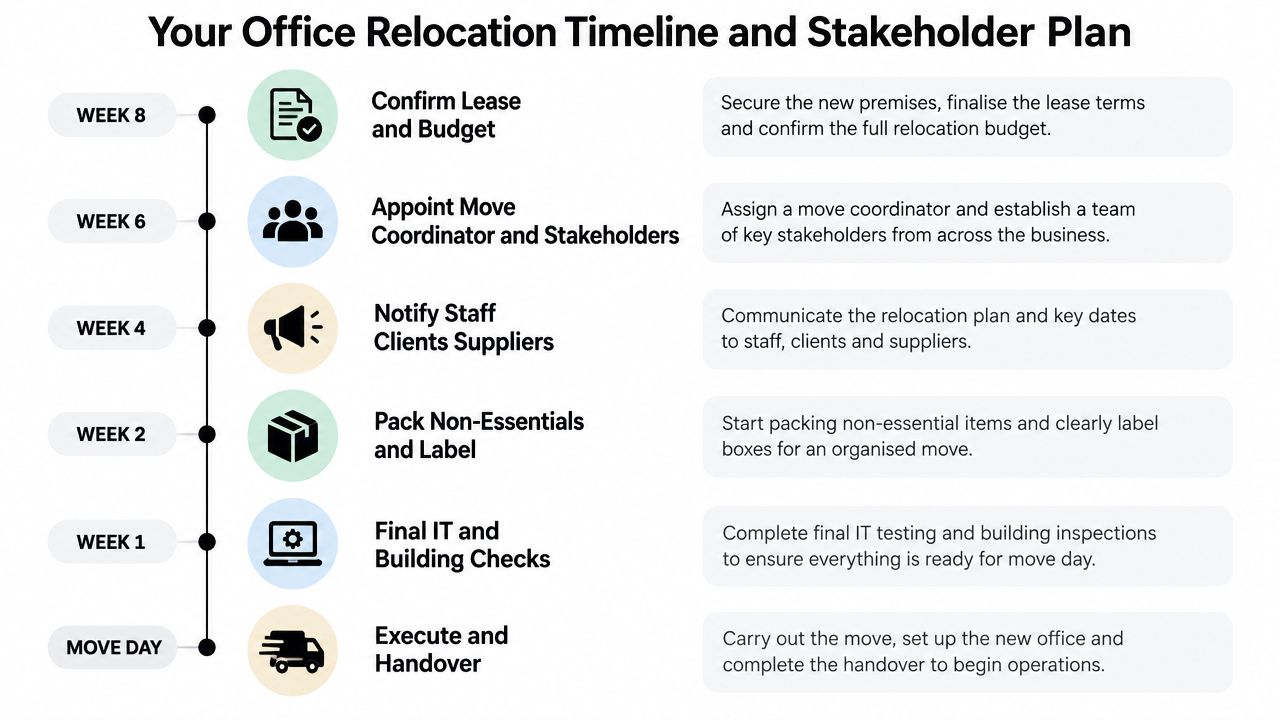
Week eight and week six
At week eight, confirm the lease, budget, move scope and handover conditions. Review the outgoing premises for make-good work, identify furniture to retain or dispose of, and create a destination floor plan. The project owner should also arrange a site inspection with the removalist, because an estimate based only on a phone description may miss stairs, dock restrictions, long carries or dismantling requirements.
At week six, appoint a move coordinator and name the owners for leadership, facilities, IT, HR, finance and communications. Give the coordinator authority to maintain one decision log and one master schedule. Use a shared workspace such as Microsoft Teams, SharePoint or a project board, but keep the final inventory and access instructions in a controlled document that every contractor can read.
The office relocation checklist should include dependencies rather than only tasks. For example, IT equipment can't be packed until the shutdown sequence is approved, and the removalist can't unload efficiently until each item has a destination label.
Week four and week two
At week four, notify staff, clients, suppliers and service providers. The message should state the old and new address, the effective date, contact arrangements during the move, and any temporary change to deliveries or appointments. HR should explain desk allocation, access cards, parking and the first working day in the new office. Client-facing teams need a short approved message they can use consistently.
At week two, pack non-essential items and label everything by destination room or workstation. Archive records separately from active files, protect confidential material, and record serial numbers for valuable equipment. Dispose of unwanted furniture and obsolete electronics through suitable channels instead of leaving clearance until the final handover.
Week one and move day
At week one, facilities should complete the final IT, furniture, cleaning and building checks. Confirm lift bookings, loading dock access, security contacts, parking arrangements and the destination floor plan. IT should verify that the new internet service, cabling, power, phones and access controls are ready for testing.
On move day, the coordinator should run a short arrival briefing, control the inventory, and release teams in the agreed sequence. Place desks and large furniture first, then equipment and labelled cartons. Keep a small essentials kit available with chargers, stationery, access information, cleaning supplies and basic tools.
Move-day discipline: One person should approve changes. If every department redirects movers independently, the truck may be unloaded quickly while the office becomes difficult to use.
After placement, facilities should complete an outgoing inspection and document the condition of both premises. IT should test priority systems before staff are asked to work, and the coordinator should record missing, damaged or delayed items immediately.
IT Systems Comms and Mail Continuity Checklist
A business can tolerate a desk arriving later than planned more easily than it can tolerate unavailable email, phones, internet or shared files. IT needs its own run sheet, with named owners and a clear difference between systems that must be live immediately and services that can be restored later.
Prepare, disconnect and protect
Start with an equipment register covering servers, network hardware, workstations, monitors, phones, printers, access-control devices and backup equipment. Confirm whether servers will be physically transported or whether the move is an opportunity to rely on cloud services. In either case, complete and verify a secure backup before shutdown, then record who can authorise the final disconnect.
Label cables at both ends and photograph complex connections before dismantling. Use anti-static protection for suitable equipment, keep hard drives and sensitive devices under controlled custody, and separate fragile technology from general cartons. Removalists can move equipment safely, but the IT provider should control system shutdown, data protection and reconnection.
For practical ideas on business continuity for SMBs, review the recovery arrangements that sit behind the physical relocation. A move is a useful point to confirm who can access critical services if the new office isn't ready on schedule.
Recommission in dependency order
The new site should be tested before staff arrive. Check power, structured cabling, Wi-Fi coverage, internet connectivity, phones, printers, meeting-room equipment and access controls. Reconnect core network services first, then servers or cloud access, followed by workstations, phones and peripheral devices. Ask representatives from finance, sales, operations and customer service to test the applications they use every day.
Mail redirection belongs in the pre-move schedule. Australia Post reports that around 1.14 million Australians move house each year, and about 84% use mail redirection, as noted by Gangroup's Australia Post relocation guidance. Although that benchmark relates to household moves, the operational lesson applies to offices. Arrange redirection, update stationery and website details, and notify regular senders before the old tenancy closes.
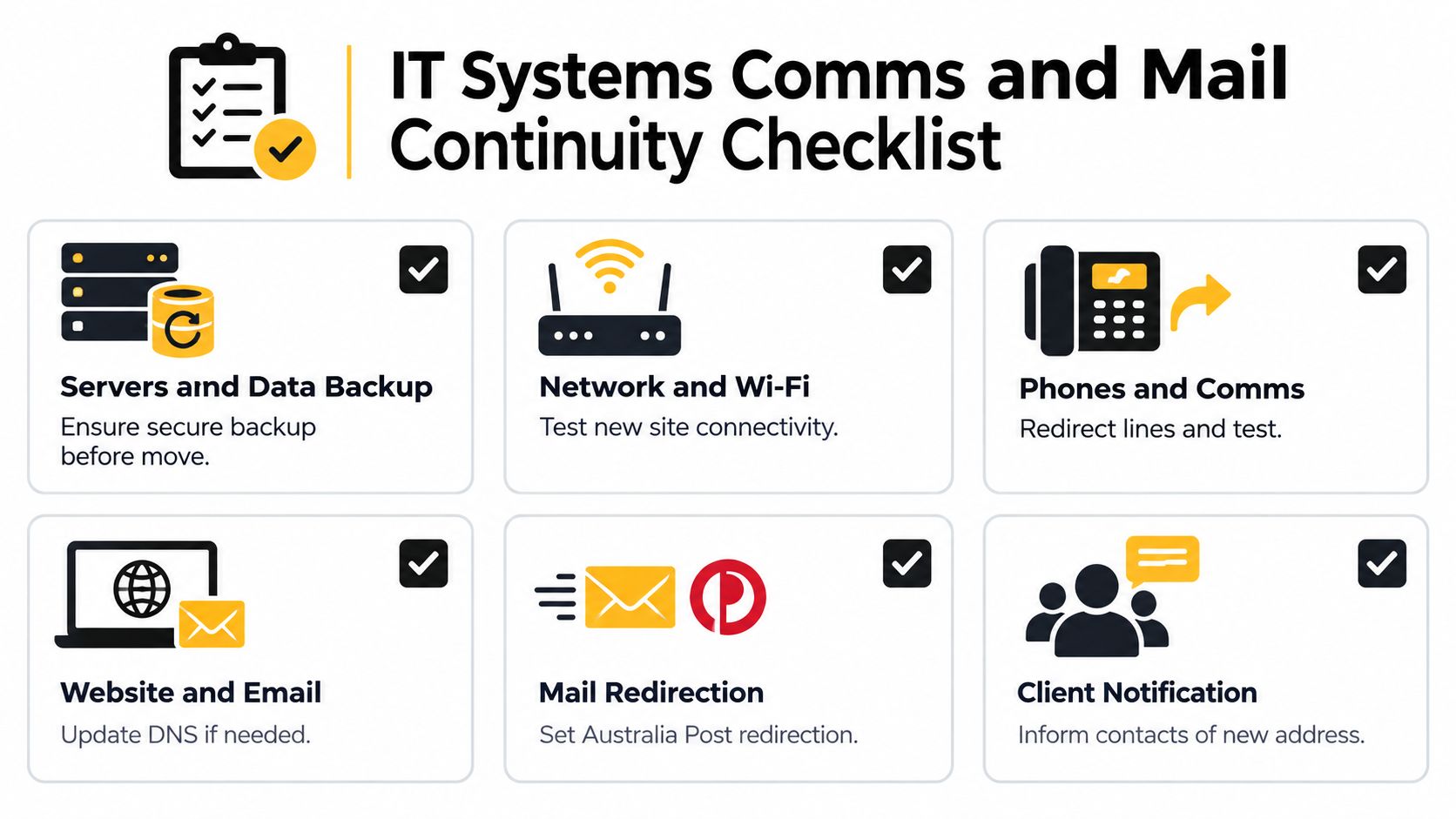
Use the following delegation list:
- Servers and backups: Confirm the backup, shutdown authority and secure transport or cloud migration plan.
- Network and Wi-Fi: Test the connection and wireless coverage in the destination office before occupancy.
- Phones and communications: Redirect lines, verify handsets and provide a temporary contact method.
- Website and email: Update business details and coordinate any required service changes with the IT provider.
- Mail redirection: Arrange Australia Post redirection and update suppliers, banks and government contacts.
- Client notification: Give customers the new address, effective date and temporary contact instructions.
The commercial office relocation service can be coordinated around these technical dependencies, particularly where furniture, equipment and staged placement need to happen in a defined order.
The physical move is only one part of continuity planning. This short video can help teams think through the relationship between preparation, systems and operational recovery.
Sydney Permits Parking and Specialised Equipment Handling
Access failures cause more disruption than slow carrying. A truck can be ready, staff can be waiting and the lift can still be unavailable because the building manager didn't receive the required booking, certificate or vehicle details. Confirm requirements with both buildings before the move is priced as final.
Council-controlled streets often need permits. Loading zones commonly allow only short stays of around 15 to 30 minutes, while clearways prohibit stopping during peak hours, according to Sydney moving access guidance. Treat those restrictions as scheduling constraints, not minor details. A vehicle that can't remain at the kerb may require repeated repositioning, a smaller transfer vehicle, or a building loading dock.
Secure the building route
Ask the outgoing and incoming building managers to confirm:
- Goods lift access: Book the lift, confirm its dimensions and check protective padding requirements.
- Loading dock rules: Provide vehicle details, arrival windows and the name of the move coordinator.
- Security approval: Arrange contractor access, swipe cards, inductions and after-hours entry.
- Parking and permits: Confirm whether council approval or a temporary parking arrangement is needed.
- Floor protection: Check who supplies lift blankets, corridor protection and protective coverings.
- Handover timing: Match the removal schedule to lease access and key collection.
CBD buildings may have tight turning areas, restricted dock heights or a long route from street level to the office. A pre-move inspection lets the removalist choose an appropriate vehicle and equipment plan. If the building can't accommodate a large truck, schedule transfer runs rather than discovering the problem at arrival.
Protect specialist items
Pianos, artwork, antiques, server racks and warehouse pallets need different handling from ordinary desks. Use purpose-suitable wrapping, corner protection, ramps, pallet equipment and restraints. Record condition before handling, identify fragile items clearly and agree where each item will be placed at the destination.
Server racks require particular care because weight distribution, doors, rails and connected hardware can make them difficult to move safely. Artwork and antiques should travel separately from loose office cartons, while pallets need a route that can accommodate pallet jacks or suitable lifting equipment. Furniture removals may involve dismantling and reassembly, so label fixings and photograph complex assemblies before work begins.
If access changes on the day, don't improvise without recording the decision. Call the building contact, revise the route, protect the item and update the coordinator. That simple control prevents a rushed workaround from damaging a lift, wall, piece of equipment or finished floor.
Pricing Insurance and Booking Your Office Move With Confidence
A useful office relocation quote explains what will happen, not just what the truck costs. Ask whether pricing is based on time, a fixed scope or a combination, and check which assumptions affect the final amount. Labour, fleet size, extra removalists, packing materials, dismantling, reassembly, storage, travel, difficult access and specialised handling can all change the work involved.
Compare quotes against the same inventory and access information. A low figure may exclude packing, lift delays, long carries or furniture assembly, while a higher figure may include a more complete service. Request a site assessment where possible and provide floor plans, photographs, equipment details, destination addresses and building rules. For interstate removals, confirm the transport scope, delivery conditions and storage arrangements before booking.
Insurance needs a separate check
In NSW, removalists aren't legally required to provide insurance for your property during a move. NSW Government guidance also says that most removalist companies insure their vehicle rather than the contents being transported, as explained in NSW advice on choosing a removalist. Ask for the policy details in writing and arrange your own appropriate cover where necessary.
Don't assume a business policy covers transit, handling, temporary storage or items packed by staff. Confirm exclusions for fragile equipment, artwork, records and pre-existing damage. Take condition photographs, keep an inventory, and understand the claim notification process before the crew arrives. Further planning guidance is available in this insurance information for removals.
Make the booking decision practical
A dependable quote should identify the move coordinator, arrival process, crew scope, vehicle requirements, access assumptions, packing responsibilities and cancellation terms. It should also show how the provider will handle delays, staged moves, storage and last-minute changes.
Home Removals Sydney offers Sydney and interstate office, furniture and warehouse relocations, with packing, assembly, storage and quoting available for different move sizes. Once the scope is accurate, flexible scheduling and clear communication become more valuable than a headline rate.
Request a quote from Home Removals Sydney with your inventory, floor plans, access details and preferred move window. Their team can coordinate office removals, furniture handling, packing, storage and interstate transport so you can plan the changeover around staff, systems and client service.
