


The most popular advice about this route is also the most misleading. People look at the map, see a short motorway run, and assume Removalists Sydney to Wollongong should cost about the same as a long local move. A car trip hides the work involved. It doesn't show you a loaded truck descending Mount Ousley, a lift booked for the wrong hour, a driveway that's too steep for a rigid truck, or keys that aren't released until late afternoon. Price the move on loaded travel time, crew hours and access at both ends, not on distance alone, and you'll get a quote that holds up on the day.
Sydney to Wollongong Removal Costs and Travel Times
Eighty five kilometres by car isn't the same job in a loaded truck. The Princes Motorway run takes about 75 to 100 minutes by car, but a loaded removal truck needs 1.5 to 2.5 hours from inner or southern Sydney. Add 45 to 90 minutes if you're loading on the northern beaches, in the Hills District or in the north west, because the crew still has to cross Sydney before it reaches the motorway. Two households with the same number of bedrooms can pay different amounts for the same destination.
The table below gives indicative 2026 market bands for a one way household or small office move. Use them as budgeting ranges. Your actual price depends on inventory, weight, stairs, packing and the day you travel.
Indicative Sydney to Wollongong removal costs in 2026
| Move size | Typical crew and truck | Loaded travel | Indicative cost |
|---|---|---|---|
| Studio or 1 bedroom | 2 removalists, 4 to 6 tonne van | 1.5 to 2 hours | $650 to $1,100 |
| 2 bedroom home | 2 removalists, 6 tonne truck | 1.5 to 2.5 hours | $900 to $1,500 |
| 3 bedroom home | 2 to 3 removalists, 8 to 12 tonne truck | 1.5 to 2.5 hours | $1,300 to $2,200 |
| 4 to 5 bedroom home | 3 removalists, about 14 tonne truck | 2 to 3 hours | $1,800 to $3,200 |
| Small office or warehouse | Crew matched to weight and cubic metres | 1.5 to 3 hours | From about $1,500 |
Small offices and warehouse loads are quoted by cubic metres and weight because ten desks, filing cabinets and pallets don't behave like ten bedrooms of furniture. A room count tells a removalist almost nothing about a safe. For a tighter number, start with a guide to the cost of removalists in Sydney, then send an itemised list.
What pushes a job into a higher band
Access and heavy items move prices more than a few extra cartons do.
- Stairs or no lift: Two flights at pickup and two at delivery can add a full labour hour or more.
- Long carries: If the truck can't park near the door, every item travels further on a trolley.
- Piano, safe or large stone table: These need extra hands, specialised equipment and slower handling.
- Full packing service: You're paying for labour and materials, but you're also reducing breakage risk.
- Friday or month end travel: Peak days book out first, and traffic is heavier.
- Northern Sydney pickup: Crossing the city before the motorway can add one to two labour hours to the same Wollongong delivery.
Ask how travel is charged before you compare quotes. Removalists on this corridor typically bill for the loaded leg, and some also add a return leg or call out fee. Packing materials, an extra mover and a second delivery attempt are usually extras. A low hourly rate that excludes the motorway leg leaves out part of the cost.
Quote rule: A room count gets you a ballpark. An inventory that names heavy items, stairs and parking gets you a price you can rely on.
Why this corridor keeps getting busier
Wollongong City Council's submission to the Future Transport review reports that the Illawarra to Shoalhaven region is expected to exceed 550,000 residents by 2041, approximately 30% growth from 2021 to 2041, with Shellharbour alone projected to grow by 39%. The same submission describes Wollongong as the regional capital serving a workforce of more than 700,000 people within a one hour commute, and it forecasts Illawarra commuters travelling to Greater Sydney to rise from 26,000 in 2016 to 46,000 by 2041.
Those figures show up in booking diaries. Families move south for space, workers keep a Sydney job on hybrid days, and businesses follow customers into growing coastal suburbs. Home Removals Sydney customers share the road with office relocations and other furniture removals Sydney jobs, all competing for the same Friday crews, the same lift bookings and the same clear run down the motorway. Book early in peak months, and build your budget around a truck timetable rather than a car trip.
Matching the Truck to the Load and the Street
Cubic capacity is only half the choice. A truck can hold every box you own and still be the wrong truck for your street. Under the NSW Government heavy vehicle restrictions guide, a vehicle with a GVM above 4.5 tonnes is classified as a heavy vehicle, and Restricted Access Vehicles exceeding standard mass or dimension limits may require an approved route, notice or permit.
That threshold sits lower than most movers expect. Even a modest furniture truck crosses it, so nearly every Sydney to Wollongong run involves a heavy vehicle on paper. The practical question is how far above it you go. A bigger truck can cut trips, but it can also fail at a narrow street, a low awning, overhanging branches, a short driveway or a posted bridge limit.
The size ranges below are indicative rather than official limits. Treat them as a starting point for the conversation with your removalist, and confirm the current NSW mass and dimension rules before booking.
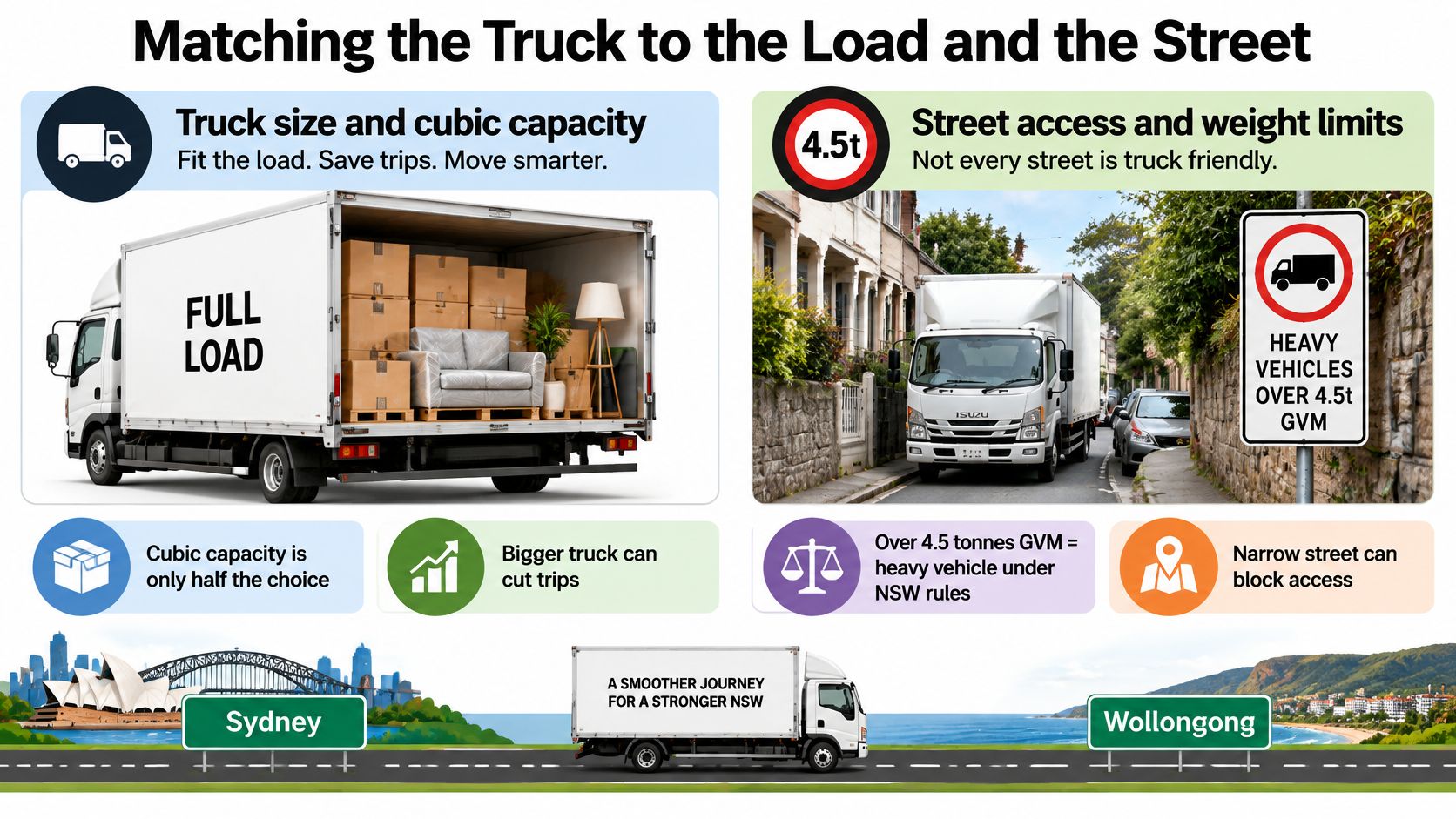
Indicative vehicle size ranges for this route
| Vehicle | Typical gross mass | Typical drive axle limit | Sensible use on this route |
|---|---|---|---|
| Rigid, single drive axle, dual tyres | Up to about 18 tonnes | Up to about 10.5 tonnes | Apartments and 1 to 3 bedroom homes on local streets |
| Rigid, tandem drive | Up to about 26 tonnes | Up to about 18.5 tonnes | Larger homes and office relocations |
| Rigid, tri axle | Up to about 27 tonnes | Up to about 21 tonnes | Dense warehouse or pallet loads |
| Any vehicle over 4.5 tonnes GVM | Classed as a heavy vehicle | Bridge and route limits still apply | Check height, length and council roads before booking |
Those figures describe the truck, not your furniture. Payload works like a budget: the truck's own tare weight, body, blankets, trolleys, ramps and tools spend part of it before your first box goes on. A truck that's legal at the depot can still sit over the limit on one axle if dense items end up in the wrong place. A detailed guide to what size moving truck you need helps match volume to load, but it doesn't replace checking both addresses.
Fleet range matters here too. Home Removals Sydney runs trucks from 4-tonne to 62-tonne, so a crew can size the vehicle to the street rather than sending the largest truck by default.
Check the street before you book the truck
Record the truck's height, length, width and turning needs, and whether a trailer is attached. Then check driveway slope and width, overhead branches, kerbside stopping space and any posted gross load limit at pickup and delivery. Councils manage access to local roads under their control, so a route that's fine on the motorway can still be restricted for the last two streets.
The same routine applies inside the house. The measuring habits behind resources that prepare for furniture delivery in Columbus translate directly to a Wollongong move: measure doorways, clear the path and confirm where the truck will stand before anyone lifts anything.
One truck that fits the street and reaches the door costs less than a larger truck that needs an unplanned shuttle on the day.
When Settlement Slips or the Street Will Not Fit
A cheaper Wollongong home doesn't guarantee an easier move. Tight supply can mean tighter settlement timing, less parking and very little room to improvise when keys run late. Recent Illawarra reporting in Region Illawarra on 2025 property results shows dwelling values rose 8.2% during 2025, listings were 16% lower than a year earlier, and estimated sales were almost 10% higher. The same source identifies rail access as a recurring feature of the strongest performing suburbs.
That pattern matters for access. Rail connected suburbs often mean apartments and townhouses with lifts, stairs, timed loading zones and narrow streets, not wide driveways with all day parking.
This checklist shows how those market conditions turn into moving day decisions.
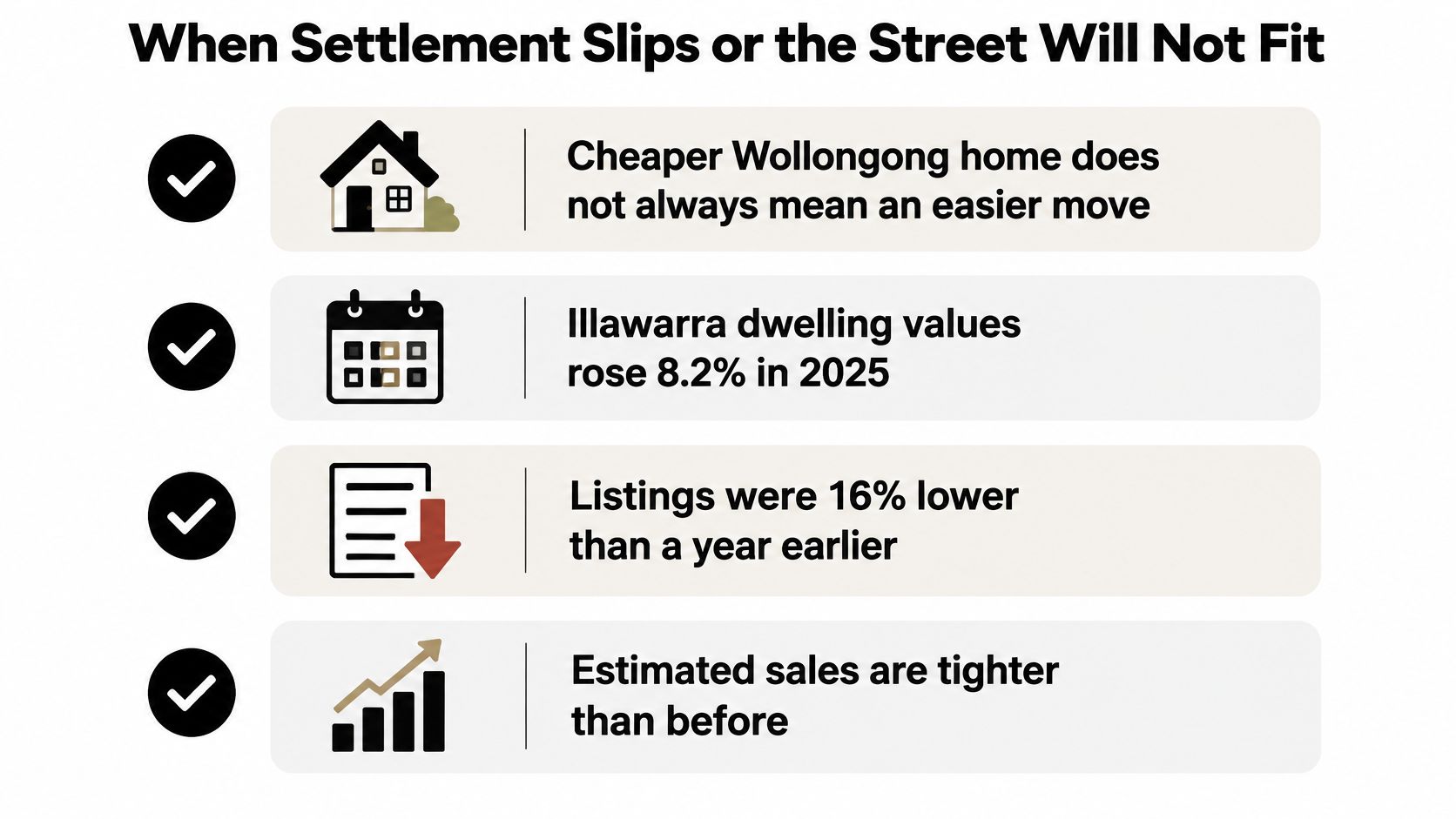
Three situations that change the plan
A family settling on Friday with a Sydney lease ending Saturday should book two to four weeks ahead in peak months and keep a one night buffer if they can. If settlement is delayed after the truck is loaded, short term storage is usually cheaper than paying a crew to wait in the street or paying for a second full delivery attempt the next day.
A Wollongong CBD or rail side apartment needs the lift booked, the loading zone confirmed and the carry distance measured from truck to door. If the legal truck can't stop outside, plan a smaller shuttle vehicle in advance. Discovering that problem with a full truck idling nearby is expensive.
An office move should avoid Monday morning receiving hours and confirm dock height before loading in Sydney. Desks that fit the truck still cause delays if the dock, lift or corridor turn won't take them.
Store the load when the destination cannot take it on the booked day. Do not pay for a second attempted delivery unless access is already confirmed.
Choosing storage without guessing
Compare three routes. A short term storage unit near the destination suits a settlement gap of several days. A storage bay offered by your removalist suits a short hold because the goods are handled fewer times. Keeping the load on the truck for a second attempt only suits a brief delay, and only if the company agrees in writing.
Ask for weekly rates, access hours, whether stored goods are insured, and whether the unit is climate controlled for timber, electronics and artwork. Label every carton with its storage location, keep the inventory with your quote, and photograph driveways, low branches and stair turns. Send those photos before loading starts, along with the storage address and collection time if storage is your backup.
This short video is a useful prompt for checking access and timing questions before you lock in a date.
Book storage when the settlement date or street access isn't confirmed. If both are confirmed, a direct same day delivery is simpler and your goods are handled once.
Clear Unwanted Goods and Check the Cover
Two jobs need finishing before your booking is tight. First, get unwanted furniture out of the load and off the kerb legally. Second, confirm insurance in writing. Skip either one and you create delays that look like removalist problems but aren't.
Book the collection, do not dump it
The City of Sydney moving waste and recycling guide states that bulky waste collections run weekly but must be booked in advance, and placing unwanted items in public areas without a booking is illegal dumping. Book several days before moving day so a mattress or broken bookcase isn't blocking the carry path when the crew arrives.
Recycling rules change at the council boundary. The City of Sydney system doesn't automatically apply in Wollongong, Shellharbour or Kiama, so check the destination council for collection days, bin sizes and what it accepts. Renovation rubble and loose packaging shouldn't go into an open furniture load either. Waste needs to be contained so it can't spill during transport, and higher risk waste is a disposal job, not a removalist extra.
Sorting is simpler than it sounds. The same three-way split that households use when they find furniture disposal options in Virginia works just as well here. Separate what can be reused, what council will collect and what needs a licensed service, then keep all of it out of the truck.
One sentence worth remembering: every item that never gets loaded is one less thing you pay to move 85 kilometres.
Ask what the cover actually covers
A careful crew isn't the same as cover for fire, collision or accidental damage. Treat insurance like the booking itself and get the terms settled before you pay a deposit, not after something breaks. Ask these questions first.
- Transit cover: Is it included or optional, and what excess applies?
- High value items: Are pianos, antiques and artwork limited or excluded unless declared?
- Owner packed cartons: Are they covered for breakage, or only if the carton itself is damaged?
- Storage period: Does cover continue if goods go into storage between pickup and delivery?
Home and contents policies often pause or restrict cover once goods are in a truck or in storage, so ask your insurer rather than assuming you're protected. Our guide to insurance for removalists explains the options we offer to protect belongings during a move, and we'll confirm the details in writing with your quote.
Photograph valuable pieces from several angles, note existing marks, and keep that record with your inventory. The aim is simple. The truck should carry only goods that are allowed, listed and covered, with nothing left on the kerb to cause a fine or a blocked driveway.
How to Pack and Load for the Motorway
Treat the load as a balance problem rather than a job of filling empty space. Blankets, ramps, trolleys and tools already use payload before the first lounge goes in. What remains has to stay within the legal mass limit and sit so no axle is overloaded, even when the truck brakes, corners or descends Mount Ousley.
This loading sequence shows why weight placement matters as much as wrapping.
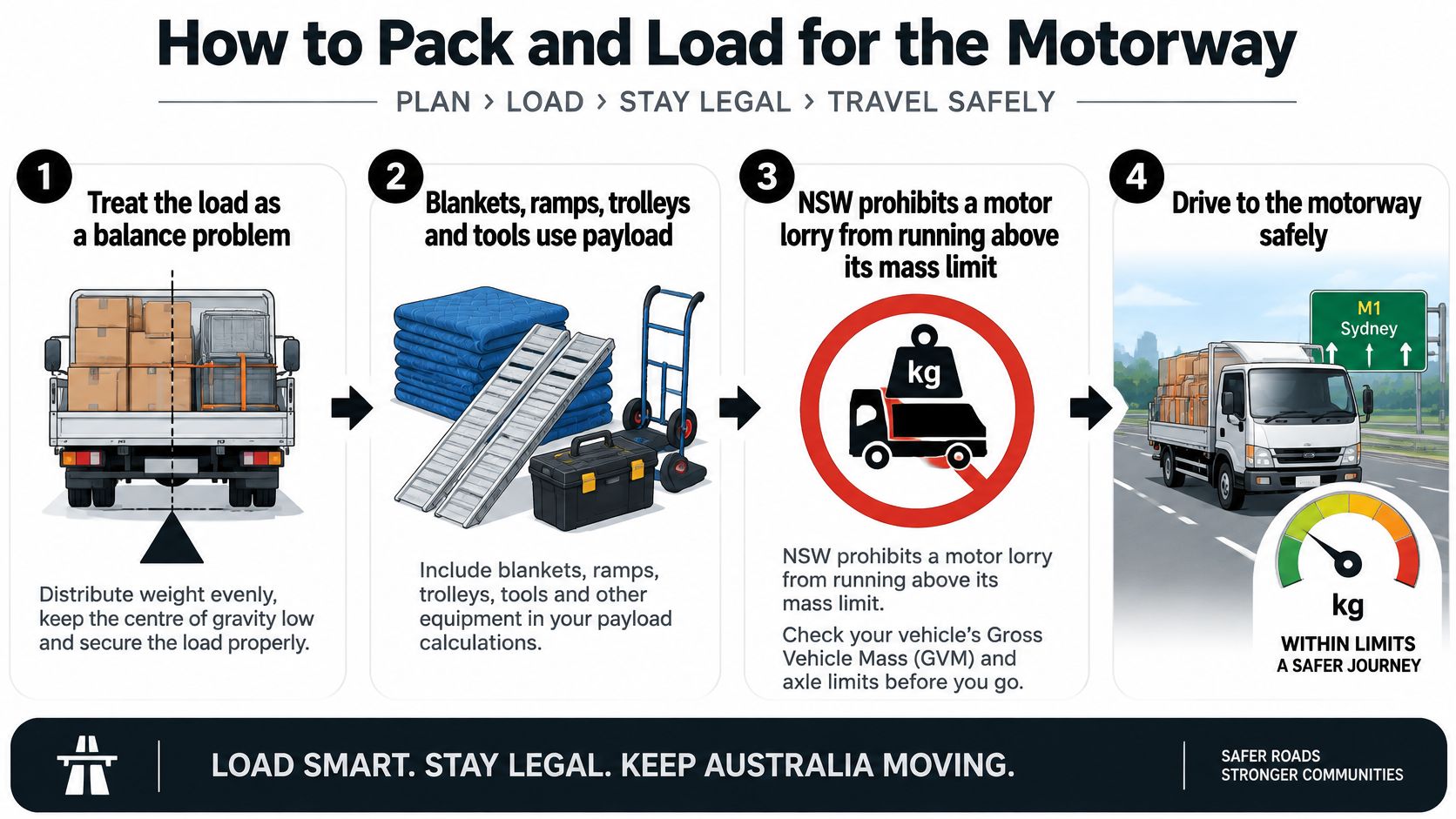
Seven steps in order
- List heavy pieces with a rough weight. Include books, appliances, filing cabinets, safes, pianos and packed kitchenware, not just a room count. Weight decides the truck.
- Set aside what will not travel. Keep a do not load pile by the door so rubbish and disposal items don't consume payload.
- Pack books in small cartons. A large carton of books is hard to lift and easy to overload. Keep appliances upright and fit transit bolts where the maker requires them.
- Wrap timber, antiques and artwork in blankets. Keep finished surfaces off bare metal and away from sharp edges.
- Load dense items low and near the centre. Heavy pieces go against the floor and close to the middle of the load, while lighter cartons and cushions fill the upper gaps where they won't crush or shift.
- Strap furniture against sliding and tipping. Braking and gradients create forces that a static stack on your floor never reveals.
- Check safety gear for larger vehicles. If the planned vehicle exceeds 12 tonnes, confirm the required warning triangles are on board before departure.
The low and central placement in step five is standard loading practice, and it matters because a truck handles weight the way a seesaw handles people. Put all the weight at one end and the whole thing tips. The legal side sits on top of that. The NSW Road Transport (Vehicle Registration) Regulation prohibits operating a motor lorry above its mass limit, states that vehicles over 4.5 tonnes must not exceed 100 km/h, and requires three portable warning triangles if the planned vehicle exceeds 12 tonnes.
A written inventory grouped by approximate mass shows whether one larger truck or two smaller trips is safer. Two trips can beat one overloaded axle even when the volume looks fine, which is common with pallets and office equipment. Concentrated weight is the trap. A half empty truck can still be illegal if filing cabinets and safes sit over one axle group.
On moving morning, label every carton by room, clear hallways and stairs, and keep medications, documents and chargers in your own car. Furniture removals Sydney crews work fastest when they aren't sorting your decisions at the truck ramp, and on a motorway run that discipline is what keeps a same day delivery on schedule.
Request a Sydney to Wollongong Moving Quote
The cheapest quote on a Sydney to Wollongong move is usually the one that left something out. A written scope protects you, so send both addresses, your preferred date, stairs and lift details at each end, and a room by room inventory. List pianos, safes, artwork and pallets separately, and attach photos of driveways, low branches and tight stair turns. Those photos stop a truck being booked that cannot reach your door.
Ask for travel time, labour, packing materials, extra removalists and storage to appear as separate lines. An additional removalist costs $40/hr + GST on request, and pricing carries no hidden costs, so a crew change should show on the quote rather than on the final invoice. A general checklist on what to do before moving day helps you prepare the property, but the quote itself still needs the specific access and inventory details for both ends of this route.
We're a family owned removalist based in Fairfield, serving Sydney and beyond, and we offer interstate removals from Sydney to anywhere in Australia, so send us your Wollongong details and we'll confirm the scope for your run. Our fleet includes trucks from 4 tonne to 62 tonne, covering anything from a small apartment to a warehouse load, and we offer a free online quote with a specialist getting in touch shortly after the form is filled in.
Compare our written scope with at least one other quote against the same inventory. Check both list the same crew size, truck, travel leg, packing and insurance, then book only after access, storage backup and cover line up with your settlement date. Get those three things confirmed and the run stays a same day move.
Ready to move from Sydney to Wollongong with a written scope covering crew, truck, travel time, packing and insurance options? Send us your inventory and access photos for a free online quote, and a specialist will be in touch shortly after you submit the form. Visit Home Removals Sydney to request your quote and book once your settlement date, parking and cover are confirmed.
