

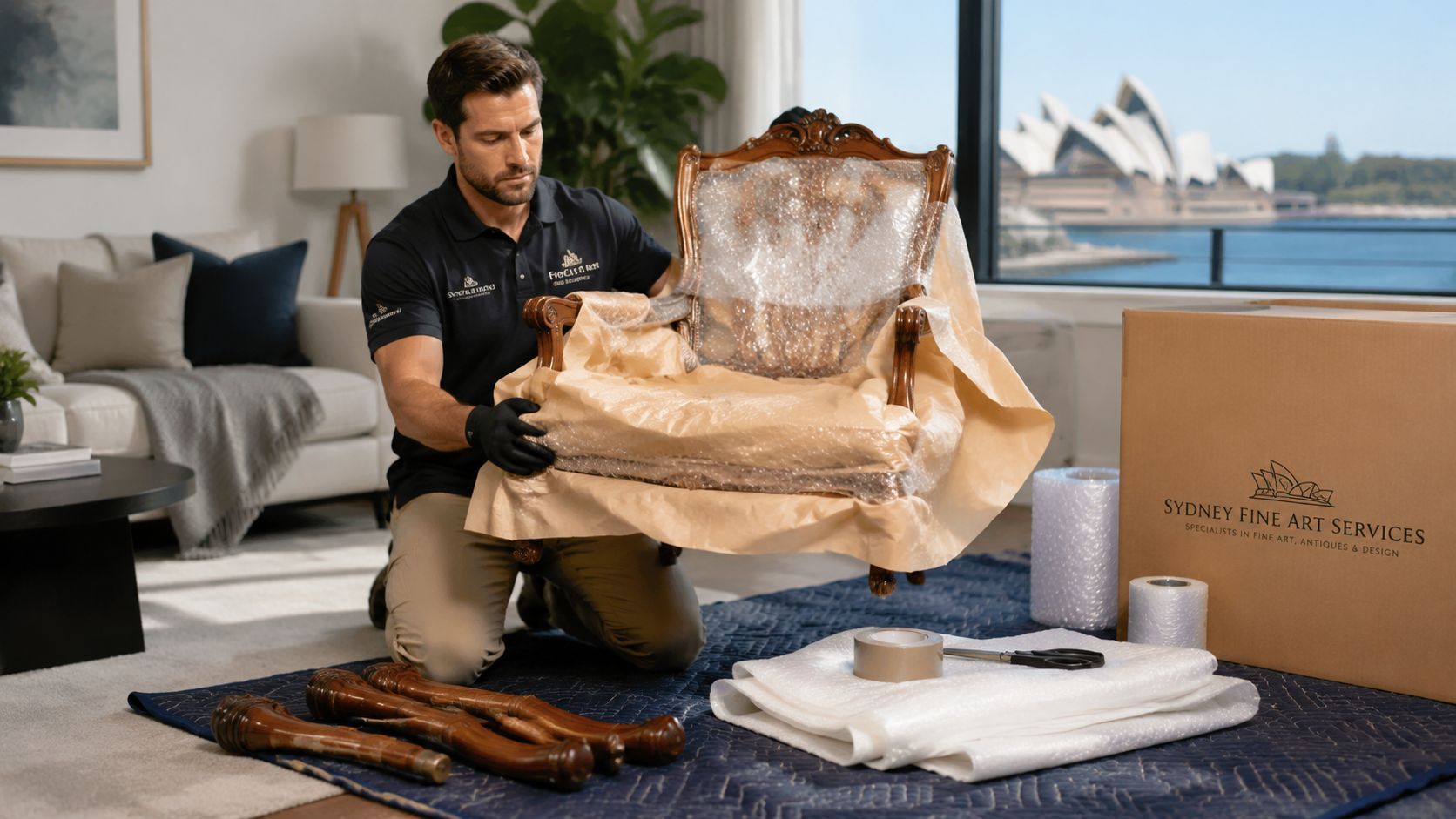
You've found the perfect spot for an antique sideboard, but getting it there is another matter. The hallway turns sharply, the doorway looks narrow, and the timber has already survived more years than most modern furniture. A rushed lift, a strap across a fragile veneer, or a sudden change from a humid truck to a heated room can cause damage that's difficult, and sometimes impossible, to reverse.
Knowing how to move antique furniture safely means treating the relocation as a conservation move rather than an ordinary household transfer. The right approach combines condition records, controlled handling, suitable packing, careful loading, environmental awareness, and insurance documentation. That applies whether you're arranging Removalists Sydney services for a local move, planning interstate removals, or coordinating furniture removals Sydney customers need for a valuable home collection.
Understanding the Unique Risks of Moving Antique Furniture
Antique furniture has often been repaired, refinished, altered, or exposed to decades of changing conditions. Its timber may have moved over time, while joints, veneers, upholstery, locks, and decorative projections can be more vulnerable than they appear. Standard household handling tends to prioritise speed and volume. A conservation-style move prioritises support, stability, and evidence of condition.
Australian collecting-sector guidance says furniture should never be slid. Handlers should carry it one piece at a time, avoid lifting from projecting parts, lift chairs by the seat rails, and lift tables by the legs. Drawers and doors should be tied in place with cotton tape, rather than allowed to swing during handling. These practices support the structure and reduce vibration and stress on joints and veneers, as outlined in the Australian Institute for the Conservation of Cultural Materials handling guidance.

Why ordinary moving methods can fail
A modern flat-pack cabinet may tolerate brief contact with a trolley or a firm strap. An antique cabinet may not. Dragging places force through feet and joints, while lifting from a tabletop or crest rail can transfer the load to areas never designed to carry it. Vibration can loosen an already delicate connection, rub through a finish, or make an existing veneer split worse.
Environmental change creates a separate risk. Conservation-focused Sydney guidance recommends temperate collection conditions around 15–25°C and 45–55% relative humidity. Those ranges are provided in Sydney antique furniture moving guidance, and they illustrate why a move needs more than blankets and a truck. Hot weather, interstate travel, temporary storage, and direct sunlight can all expose timber and finishes to conditions they're not ready to handle.
For fragile pieces, the safest plan includes a route inspection, structural assessment, and a clear decision about whether the item needs a dolly, soft restraint, custom support, or a crate. The fragile removals and storage service approach is closer to managed handling than routine room-to-room shifting.
Preparing and Documenting Your Antiques Before the Move
Documentation starts before packing materials enter the room. Create one inventory record for every piece, using a clear identifier such as “Dining table A” or “Hall cabinet B”. Record the maker if known, materials, identifying marks, approximate value, provenance information, and any previous repairs or alterations.
Photograph every side, including the underside where practical. Take close images of scratches, lifting veneer, stains, cracks, loose joints, missing fittings, and upholstery wear. Good photographs should show both the whole item and the existing defect clearly, so nobody has to guess whether a mark appeared before or after transport.

Build a practical pre-move record
Use a simple inventory sheet, then keep a digital copy with the photographs. A useful record includes:
- Identity: Note the item description, maker, materials, visible labels, and distinctive features.
- Condition: Describe existing damage in plain language, including where it appears and whether it feels loose or stable.
- Value: Record an approximate value and retain any appraisal, purchase record, restoration invoice, or estate documentation.
- Handling needs: Mark glass, detachable sections, fragile ornament, unstable joints, and surfaces that must not receive adhesive.
- Destination: Note the intended room and final position, so the team doesn't repeatedly reposition the piece after delivery.
The practical reason for this effort is accountability. Australian collection-care guidance recommends inspecting weak points, clearing the route, preparing the destination, and using both hands with fitted gloves where appropriate. If an object breaks, loose fragments should be secured in a labelled bag with the handler's name and date. That creates an auditable point in the damage-control process, as explained in museum object handling guidance from Museums and Galleries of NSW.
Empty, separate, and inspect
Empty every drawer, cupboard, and compartment. Small objects left inside can strike the interior or become trapped behind a drawer during vibration. Remove detachable legs, doors, shelves, glass panels, and other loose components where the construction allows it, then label each part and pack it with its matching item.
Before the crew arrives, walk the planned route from the current position to the vehicle and from the vehicle to the new room. Check stair turns, lift access, door clearances, balcony approaches, uneven surfaces, and overhead obstructions. A practical antique furniture moving checklist also stresses photographing all sides, recording defects, removing detachable parts, and avoiding adhesive directly on finished surfaces.
Don't clean aggressively or apply polish immediately before transport. A product that looks harmless on a modern finish may react poorly with an aged surface, and cleaning can obscure the condition you need to record. If the item is especially valuable or irreplaceable, arrange a pre-move survey and discuss the record with the removalist before the booking is confirmed.
Safe Packing and Disassembly Techniques for Valuable Pieces
Packing protects an antique from contact, friction, dust, and impact, but the material must be applied in the right order. Start with a clean, dry work area and keep tools, buckles, zips, and hard edges away from exposed finishes. Use acid-free paper against sensitive surfaces where suitable, then add soft blankets or other cushioning that won't rub decorative details.

Lift from the structure, not the decoration
A chair should be lifted by its seat rails, not by the back, arms, or decorative crest. A table should be lifted by its legs, with the load shared and controlled, rather than by the tabletop or apron. Never drag either piece across timber, tile, carpet, or concrete. Australian museum handling guidance sets out these methods because projecting parts and finished surfaces aren't reliable lifting points.
Tie drawers and doors closed with cotton tape. Don't use adhesive tape on timber, veneer, lacquer, painted decoration, or upholstery. Tape can pull finish away, leave residue, or create a repair problem that didn't exist before the move.
Wrap in layers and remove what you can
Remove detachable legs, shelves, doors, glass panels, and handles only when you can identify how they're fitted and can keep every fastener with the correct piece. Photograph connections before removal, place fittings in a labelled bag, and avoid forcing seized screws or historic hardware. If a component doesn't release cleanly, a specialist should assess it rather than turning disassembly into a restoration job.
Wrap edges, feet, corners, carved projections, and glass separately. Bubble wrap can provide cushioning, but it shouldn't sit directly against a delicate finish where heat, pressure, or trapped moisture could create trouble. Use a soft inner layer first, then protective padding outside it, and make sure the wrapping doesn't compress fragile ornament.
The fragile packing advice from Get n Go Removals Melbourne is useful for understanding separation, cushioning, and secure packaging. For Sydney households, the same principle applies, but antique pieces need an item-specific plan rather than a generic box-and-tape routine.
A furniture dolly can reduce physical strain, but it only helps when the item is balanced, padded, and secured. SafeWork NSW's Code of Practice for hazardous manual tasks highlights mechanical aids, suitable working heights, and correct lifting methods for heavy or awkward loads. Read the guide to packing fragile items before deciding whether your available equipment and labour are adequate.
DIY Moving vs Hiring Professional Removalists in Sydney
DIY can look attractive when the antique is a single chair, a small cabinet, or a family table. The calculation changes once the piece needs a narrow stair turn, a long carry, protective wrapping, a tail lift, or temporary storage. The upfront saving may disappear if you need to hire a suitable trolley, buy blankets and restraints, arrange extra labour, or repair a damaged finish.
A private vehicle also gives you less control over positioning and restraint. A piece may fit physically but still be exposed to rubbing, abrupt movement, heat, or unstable stacking. Physical strain matters too. Heavy or awkward furniture can injure a helper, particularly when the route includes stairs, uneven paving, or tight corners.

Where professional support earns its place
Professional furniture removals Sydney teams can assess access, use suitable mechanical aids, bring protective materials, and assign enough people to control the load. For a high-value piece, ask how the company handles condition reporting, packing, restraint, storage, and claims before you accept a quote.
A specific quote is more useful than a vague hourly estimate. Give the removalist photographs, dimensions, approximate weight, floor information, stair details, lift restrictions, parking conditions, and the intended destination. Ask whether the quote includes packing, disassembly, reassembly, custom crating, storage, and insurance arrangements.
| Decision point | DIY move | Professional move |
|---|---|---|
| Handling | Relies on personal experience and available helpers | Uses planned lifting, equipment, and coordinated communication |
| Protection | Requires you to source and apply materials | Can include blankets, soft straps, packing, and custom support |
| Risk control | You manage route, loading, transport, and evidence | The provider can document and manage the move process |
| Physical demand | Falls on household members or friends | Assigned staff share the work and use mechanical aids |
| Complex access | May require improvised solutions | Can be assessed before the moving day |
Choosing the right service
A standard home removals Sydney booking may suit ordinary household furniture, but antiques deserve direct discussion with the estimator. The same applies to office relocations involving display cabinets, boardroom furniture, or artwork, and to interstate removals where travel time and environmental changes add complexity.
Home Removals Sydney is one option for customers seeking local or interstate relocation support, with services that include specialist handling for antiques, packing, furniture assembly, and storage. Compare providers on their process, not just the first price. The cheapest quote is poor value if it excludes the protection and documentation your item requires.
Loading, Transport, and Climate Control Considerations
Loading is where a well-packed antique can still be put at risk. Heavy pieces should sit low in the truck, while lighter fragile items belong higher and towards the centre. Avoid stacking directly on delicate furniture, and don't allow a cabinet, table, or chair to become a brace for another load.
Use soft strap systems that hold wrapped items without cutting into edges or crushing upholstery. A custom crate may be appropriate for an especially fragile or valuable piece, particularly when the route includes interstate removals, multiple handling points, or storage between collection and delivery.
Keep the journey stable
The driver's route and the truck's internal arrangement both matter. Secure every item against shifting, leave clearance around vulnerable projections, and check that restraints don't press on veneer, glass, carved details, or loose joints. Climate awareness should form part of the transport plan, especially during hot Sydney weather or a long trip between states.
Stable conditions are preferable to sudden swings. A truck that becomes hot in direct sun, followed by placement against a heater or in a strongly cooled room, can expose timber and finishes to unnecessary stress. Climate-controlled storage in Sydney can help when the new property, renovation schedule, or delivery timing isn't ready for immediate placement.
The same restraint principle applies beyond furniture. The HD Asian Art shipping guide provides useful context on securing large, valuable objects for transport. Antique furniture needs its own assessment, but the broader lesson is sound: support the object, control movement, and plan for the full journey rather than only the first lift.
Allow the piece to settle
After delivery, don't rush to reassemble or position the furniture beside a heater, air-conditioning outlet, or sunny window. Let the wrapped item acclimatise in its destination environment before removing protective layers, tightening fittings, or placing weight inside it. The appropriate waiting approach depends on the material, condition, packaging, and difference between the transport and destination environments, so ask the removalist or conservator for item-specific advice.
Insurance, Storage, and Final Setup Advice
Insurance should be arranged before the first item leaves the house. Tell the removalist about valuable antiques during the quoting process, provide the inventory and photographs, and ask what the policy covers during packing, loading, transit, unloading, and unpacking. Don't assume a standard household move automatically provides the level of protection required for a rare or irreplaceable piece.
Australian removals-insurance terms distinguish transit cover from broader protection associated with packing and unpacking, and valuable categories may require specific declaration. The Two Men and a Truck insurance terms show why customers need to read exclusions, declaration requirements, valuation conditions, and claim procedures rather than treating insurance as a generic add-on.
Make the paperwork claim-ready
Keep the following together in a move folder:
- Condition evidence: Store dated photographs and written descriptions of every existing mark, crack, loose joint, and repair.
- Value evidence: Include appraisals, purchase records, restoration documents, and provenance material where available.
- Provider documents: Retain the quote, booking confirmation, inventory, terms, and any special handling notes.
- Incident records: If damage occurs, photograph it before moving the item again and report it promptly through the agreed claims process.
- Loose parts record: Keep labelled bags of fittings and fragments with the relevant inventory entry.
A specialist pre-move survey is particularly sensible for valuable or irreplaceable antiques. Kent Removals' guidance on high-value antique moves supports the use of specialist assessment, custom crating, climate control, specialized insurance, and pre-move photography. Those measures cost time and planning, but they address risks that ordinary packing alone can't solve.
Treat storage as part of the move
Storage isn't a neutral waiting room. An unsuitable facility can expose timber, veneer, upholstery, and finishes to temperature and humidity fluctuations, dust, pests, accidental contact, or poor access control. Choose a secure facility with conditions appropriate for the furniture, and confirm how items will be wrapped, raised, spaced, checked, and accessed.
At the new property, inspect each piece against the pre-move record before reassembly. Keep furniture away from direct sun and heat sources, place it where it won't be repeatedly shifted, and use the original photographs to restore detachable components correctly. If you're also coordinating office relocations, warehouse moves, or a broader household transfer, keep antique handling as a separate workstream with its own inventory and sign-off.
Home Removals Sydney can organise careful local and interstate moves for antique furniture, including packing, specialist handling, furniture assembly, and storage planning. Visit Home Removals Sydney to provide your item details and request a tailored quote before moving day.
