

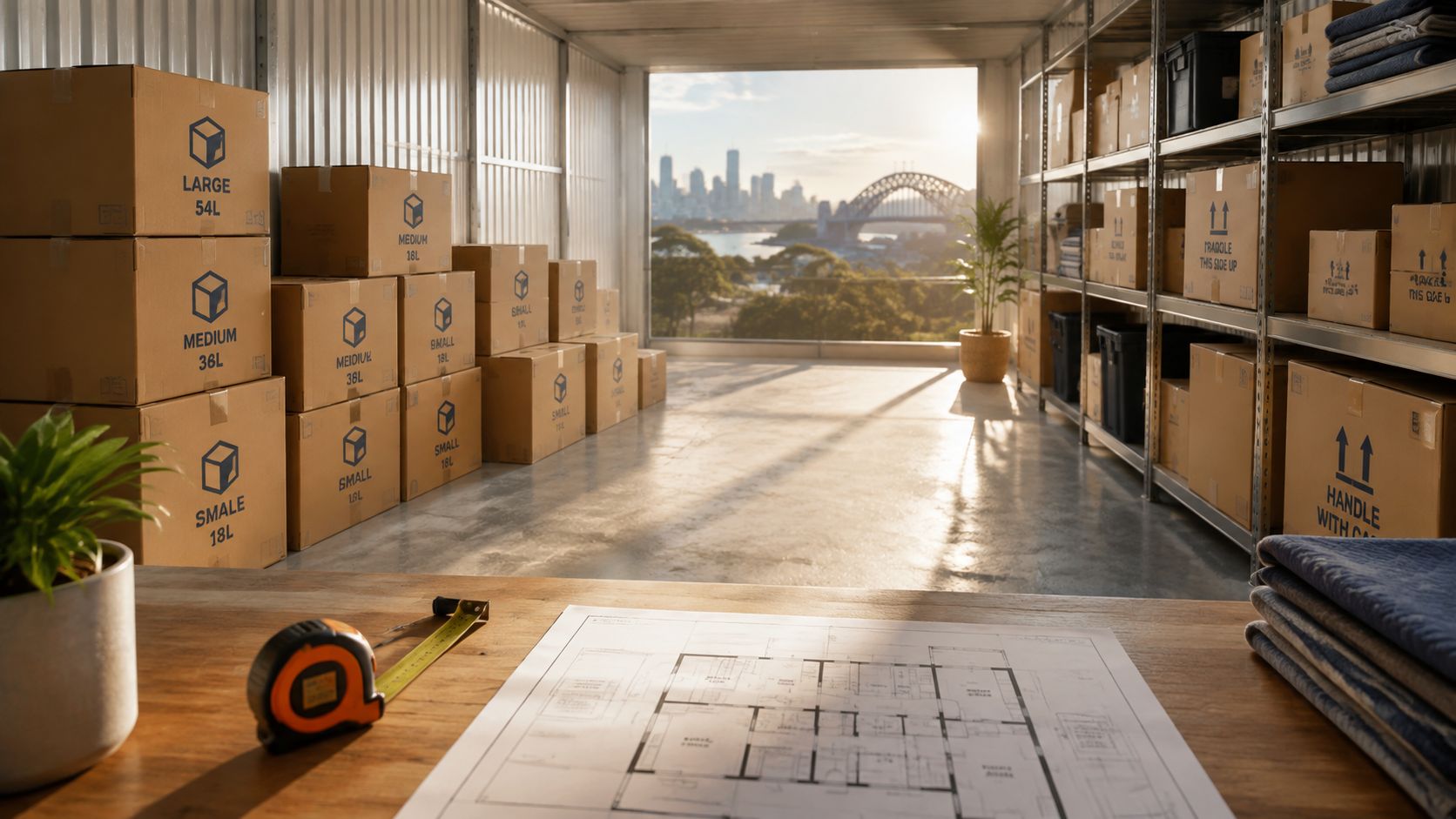
You're standing beside a loaded removal truck in Sydney, watching the last boxes disappear into a storage unit. The indoor furniture fits, but the garage shelving, balcony chairs, pot plants, bikes, winter bedding and laundry appliances are still on the truck. The unit looked large when you booked it. It isn't large enough now.
That mistake is common because people measure rooms, not possessions. If you're asking, “How much storage do I need?”, start with cubic metres, then check the floor area, access, lease term and type of goods. A sensible estimate can prevent a second truck trip, an emergency unit upgrade and damage caused by forcing furniture into every remaining gap.
Why Most People Underestimate Their Storage Needs
A renter in Parramatta recently arrives at a facility with what they believe is a straightforward load from a two-bedroom unit. The lounge, bedrooms and kitchen contents fit into the booked space, but the calculation never included the balcony furniture, shared storage cage, winter gear and laundry overflow. The team can stack higher, but doing so blocks access and leaves awkward pieces leaning against boxed goods.
The choices on moving day are unpleasant. Leave items behind, pay for a larger unit at short notice, or send the truck back while storage rent and removalist time continue. The problem began before the truck arrived. The booking was based on visible living areas rather than the full inventory.
The spaces calculators miss
Many online tools focus on bedrooms and main furniture. Sydney homes often contain extra volume in:
- Garages: Shelving, tools, bikes, camping equipment, tyres and workbenches.
- Balconies: Outdoor seating, barbecues, pots and weather-resistant cupboards.
- Sheds and cages: Seasonal decorations, sporting equipment and cartons that aren't used every week.
- Laundries: Washing machines, dryers, cleaning supplies and storage cupboards.
Apartment living makes this worse. A compact unit can look easy to move, while the household's possessions spread across a basement cage, balcony and communal areas. A family home creates the opposite trap, with garages and sheds often treated as an afterthought.
Practical rule: If you haven't opened every cupboard, cage, shed and garage before booking, you haven't finished measuring.
Under-sizing also creates practical risks. Overpacked units can restrict ventilation and access, make fragile goods harder to retrieve, and increase the chance that furniture or cartons are damaged during loading and unloading. Check the facility's storage and insurance conditions before you stack goods tightly. A useful independent explanation of the planning process is this guide on how to avoid overpaying for storage.
Accurate sizing is the most important storage decision because every later choice depends on it. Your unit, truck capacity, packing plan, moving date and budget all become harder to manage when the original volume is wrong.
How to Inventory Your Belongings Before Choosing a Unit
A reliable inventory starts with a complete walk-through, not a guess based on bedroom count. Photograph each room from several angles, then record item groups and approximate dimensions. The photographs help you spot objects hidden behind furniture, while measurements give your removalist something more useful than “about the size of a two-bedroom home”.
Start inside, then work outwards
Move through the property in a fixed order:
- Living areas: Record sofas, armchairs, entertainment units, televisions, coffee tables, bookcases, rugs, lamps and packed cartons.
- Bedrooms: Include bed frames, mattresses, bedside tables, wardrobes, drawers, desks, mirrors, clothing tubs and bedding.
- Kitchen: List the fridge, freezer, dishwasher, microwave, coffee machine, cookware, pantry goods, dining table and chairs.
- Laundry: Measure washing machines, dryers, ironing boards, shelving and cleaning supplies.
- Garage: Count tools, bikes, shelving units, lawn equipment, workbenches, boxes and sports gear.
- Balcony, shed and storage cage: Add outdoor furniture, barbecues, potted plants, camping equipment, decorations and anything stored outside the main home.
Use the same description for each group. “Three dismantled bookcases” is more helpful than “bookshelf stuff”. Include awkward items separately because dining tables, exercise equipment, children's outdoor toys and large appliances don't stack like cartons.

Calculate volume instead of relying on intuition
For centimetre measurements, use:
Length × width × height ÷ 1,000,000 = cubic metres
For example, an item measuring 180 cm by 90 cm by 80 cm occupies 1.296 m³ before allowing for wrapping and the space around it. You don't need laboratory precision. Consistent estimates across the whole inventory are enough to expose whether your planned unit is realistic.
A useful visual check is to imagine each room filled with standard cartons stacked to a sensible height. Then do the same for the garage, balcony and cage. Add a 10–15% buffer for packing materials, irregular shapes and goods that won't stack neatly. Those extra cubic metres are often what separate a clean load from a last-minute unit upgrade.
The finished inventory should include item description, quantity, dimensions, estimated volume, dismantling status and access notes. Use the Home Removals Sydney cubic metre calculator to total the list, then send the result to your removalist before booking storage.
Australian Storage Benchmarks by Bedroom Count
Bedroom count is a useful starting point, but it isn't a final answer. Australian guidance commonly places a two-bedroom home around 10–15 m² of storage, while a three-bedroom home often needs 10–20 m² or more, depending on garage, shed and outdoor contents, as outlined in the Australian storage space guidelines.
Cubic volume gives a better picture than floor area alone. A fully furnished two- to three-bedroom home is commonly estimated at roughly 28–37 m³, while a standard three-bedroom family home is often placed around 35–40 m³ in the same Australian guidance. Other Australian move-size references place three-bedroom contents between 25–40 m³ and, for a fuller household estimate, 35–50 m³. The range changes with furniture density, garage contents and the number of packed cartons.
A practical benchmark table
| Bedroom Count | Floor Area (m²) | Cubic Volume (m³) | Approx. Box Count | Common Unit Size |
|---|---|---|---|---|
| Studio or one-bedroom apartment | 3–5 m² | Roughly 9–20 m³ | About 30–50 boxes plus furniture | Small unit, carefully stacked |
| Two-bedroom unit or home | 6–10 m² | Roughly 18–30 m³ | About 50–80 boxes plus furniture | Medium unit |
| Three-bedroom house | 10–15 m² or more | Roughly 28–40 m³ | 100+ boxes may apply | Large unit |
| Three-bedroom home with substantial outdoor contents | 11–20 m² or more | Can move beyond the standard band | 100+ boxes, plus bulky goods | Larger unit or staged loading |
The box guidance comes from Australian storage sizing references that map 2–5 m² to one room or 30–40 boxes, 5–10 m² to a one-bedroom apartment or 50–80 boxes, and 10–20 m² to contents from a two- to three-bedroom home with 100+ boxes. Treat these as planning bands, not promises.
A two-bedroom apartment and a two-bedroom house can need very different units. The house may include a garage, more outdoor gear and larger furniture, while the apartment may have lift restrictions and a storage cage. Australian household patterns also make these categories useful. The Australian Bureau of Statistics recorded about 10.4 million households in the 2021 Census, with an average household size of around 2.5 people, so storage advice naturally starts with common dwelling types rather than a bespoke formula for every property. See the broader Australian moving storage guide for that household context.
Real Storage Examples for Sydney Households
The easiest way to size storage is to compare your inventory with a household that resembles yours. The examples below are planning profiles, not fixed guarantees. A minimalist studio may need less, while a full apartment with bulky furniture, cartons and outdoor goods can quickly move into the next category.
| Household Type | Unit Size (m) | Approx. Boxes | Key Items Stored |
|---|---|---|---|
| Studio apartment | About 2 × 2 m | Around 30–40 | Bed, sofa, small dining setting, television, compact appliances and cartons |
| One-bedroom unit | About 3 × 3 m | Around 50–80 | Bed and mattress, sofa, dining table, appliances, shelves, clothing and packed goods |
| Two-bedroom townhouse | About 3 × 4 m or larger | 80–100+ | Two bedrooms, lounge, kitchen, dining furniture, laundry items, garage tools and outdoor goods |
| Three-plus bedroom family home | About 6 × 6 m or staged equivalent | 100+ | Multiple bedroom suites, large lounge, dining setting, appliances, garage contents, toys and seasonal equipment |
A studio in a high-rise near the CBD may contain a bed, sofa, television, narrow dining setting, refrigerator, washing machine, desk and cartons. The lift and corridor can affect the move, but the storage volume remains relatively compact if there's no bulky cage or balcony inventory.
A one-bedroom unit is where people often book too tightly. The indoor contents may fit a 3 × 3 m unit when dismantled and stacked properly, but a balcony barbecue, outdoor chairs, plants, boxes of documents and an exercise machine can consume the remaining working space. Inner West apartments regularly create this surprise because balconies function as informal storerooms.
House contents behave differently
A two-bedroom townhouse in the Hills District may have moderate indoor furniture but a garage full of shelving, tools, bikes and children's equipment. Those items aren't necessarily large individually, yet their combined volume can change the booking from a medium unit to a larger one.
A three-plus bedroom Northern Beaches household may add surfboards, camping equipment, outdoor seating, beach gear, garden items and seasonal bedding. A 3 × 3 m unit provides 9 m² of floor area, so it suits a carefully consolidated smaller move, not a typical full family household. A 6 × 6 m unit provides 36 m² of floor area and gives considerably more room for larger inventories, sensible stacking and access lanes, but its suitability still depends on ceiling height and the actual contents.
Dining tables, treadmills, gym benches, children's ride-on toys and large wardrobes consume disproportionate space. Measure them separately. The Australian furniture volume calculator provides another reference for comparing furniture-heavy moves before you request a storage quote.
Proven Ways to Reduce Your Storage Volume
The cheapest cubic metre is the one you remove before the truck arrives. Use three passes, declutter first, disassemble second and compress what remains.
First pass, remove what shouldn't be stored
Walk through the home with four destinations in mind:
- Sell: List usable furniture on Gumtree or Facebook Marketplace and price it to move quickly.
- Donate: Contact Vinnies or Salvos for suitable bulk donations, subject to their collection rules.
- Discard: Remove broken, unsafe or incomplete goods rather than paying to store them.
- Keep: Reserve storage for items you'll use, need or cannot reasonably replace.
Sydney garage sales work better when timed around local council clean-up schedules, because households are already sorting bulky goods. Don't store items that cost less to replace than they cost to transport, insure and house for the duration of the lease.
Second pass, dismantle and consolidate
Remove table legs, bed rails, shelving frames and wardrobe doors where safe. Keep screws and fittings in labelled bags taped to the relevant item. A dismantled king bed frame can free up nearly one cubic metre, according to the practical move-size guidance in this Australian inventory guide.
Nest saucepans, stack containers and place smaller boxes inside larger ones. Remove drawers from dressers during loading if the manufacturer and removalist allow it, but label them so the furniture remains complete.
Third pass, compress soft goods
Vacuum-seal bedding, coats and soft furnishings, then pack them into uniform cartons. The same Australian guidance notes that vacuum-sealing winter doonas can cut linen volume by 70%. Keep sealed bags away from sharp edges and don't use compression as an excuse to overload cartons.
Digitise documents and photographs where appropriate, while retaining originals that matter legally or personally. Never place gas bottles, fuel, paint, chemicals, explosives, perishable food or other prohibited goods into storage. Facilities set their own acceptance rules, so confirm the list before loading.

A smaller unit can work after these steps, but don't force a reduction that leaves no access or protection around fragile goods.
Duration, Cost, Insurance and Access Considerations
Unit size is only one part of the decision. A small amount of storage for a short gap should be planned differently from a household stored through a long renovation, interstate relocation or office transition.
Match the lease to the move
Ask whether the facility charges weekly or monthly, whether the first and final periods are prorated, and whether there are administration, lock, transport or exit fees. Over-sizing for a two-week gap can leave you paying for unused capacity, while under-sizing during a six-month renovation can force repeated handling and re-stacking.
For warehouse relocations, Australian guidance recommends a six-month planning horizon, with a site audit at the start and layout finalisation around week 12. That approach suits palletised inventory, equipment and office relocations where late capacity checks can create rework. The Self Storage Association of Australasia 2025 industry snapshot reports average occupancy of 85% by area, so popular facilities may have limited spare capacity when your preferred moving date arrives.
Pay for the service you'll actually use
Premium storage commonly reflects features such as climate control, ground-floor or drive-up access, extended entry hours and location convenience. Climate-sensitive goods, artwork, documents and certain electronics may justify a more controlled environment, while household furniture stored during an interstate move may not need every premium feature.
Insurance needs to match replacement value and the facility's liability limits. Ask whether your home or business policy covers goods in storage, whether the facility requires a separate policy, and which exclusions apply. Don't assume that a storage contract automatically covers every item.
Use a simple decision test:
- Duration: Choose flexible terms when the end date is uncertain.
- Access: Select drive-up or extended-hours access if you'll retrieve goods regularly.
- Value: Check insurance against the cost of replacing the contents.
- Handling: Confirm loading areas, trolley availability, lift access and restrictions on vehicle size.
For a Sydney-specific breakdown of rent, access and service variables, review how storage costs work in Sydney. The right arrangement is the one that fits the volume without making every retrieval, claim or invoice harder than it needs to be.
Get a Tailored Storage Quote in Sydney
Accurate sizing starts with measuring twice and checking the garage, shed, balcony, laundry and storage cage. Declutter before packing, dismantle what can be safely dismantled, then match the unit to your expected duration, insurance requirements and access frequency.
Home Removals Sydney provides secure storage facilities with 24/7 access and climate-controlled options, alongside a quoting process designed to confirm cubic-metre requirements before packing begins. Their team can assess a move remotely or arrange a free on-site or virtual assessment, then combine removal, packing and storage where that suits the job.
Flexible month-to-month terms, transparent pricing and no hidden fees make it easier to plan when settlement, renovation or an interstate move changes timing. You can review the available Sydney storage solutions and locations before choosing a facility.
Don't wait until the truck is loaded to discover the unit is too small. Prepare your inventory, send it for review and request a quote that accounts for the complete household, not just the rooms you can see.
Home Removals Sydney can measure your goods, recommend a practical storage size and coordinate secure storage with your local Sydney move, office relocation or interstate removal. Visit Home Removals Sydney to request an online quote and stop guessing about your cubic-metre requirements before moving day.
