

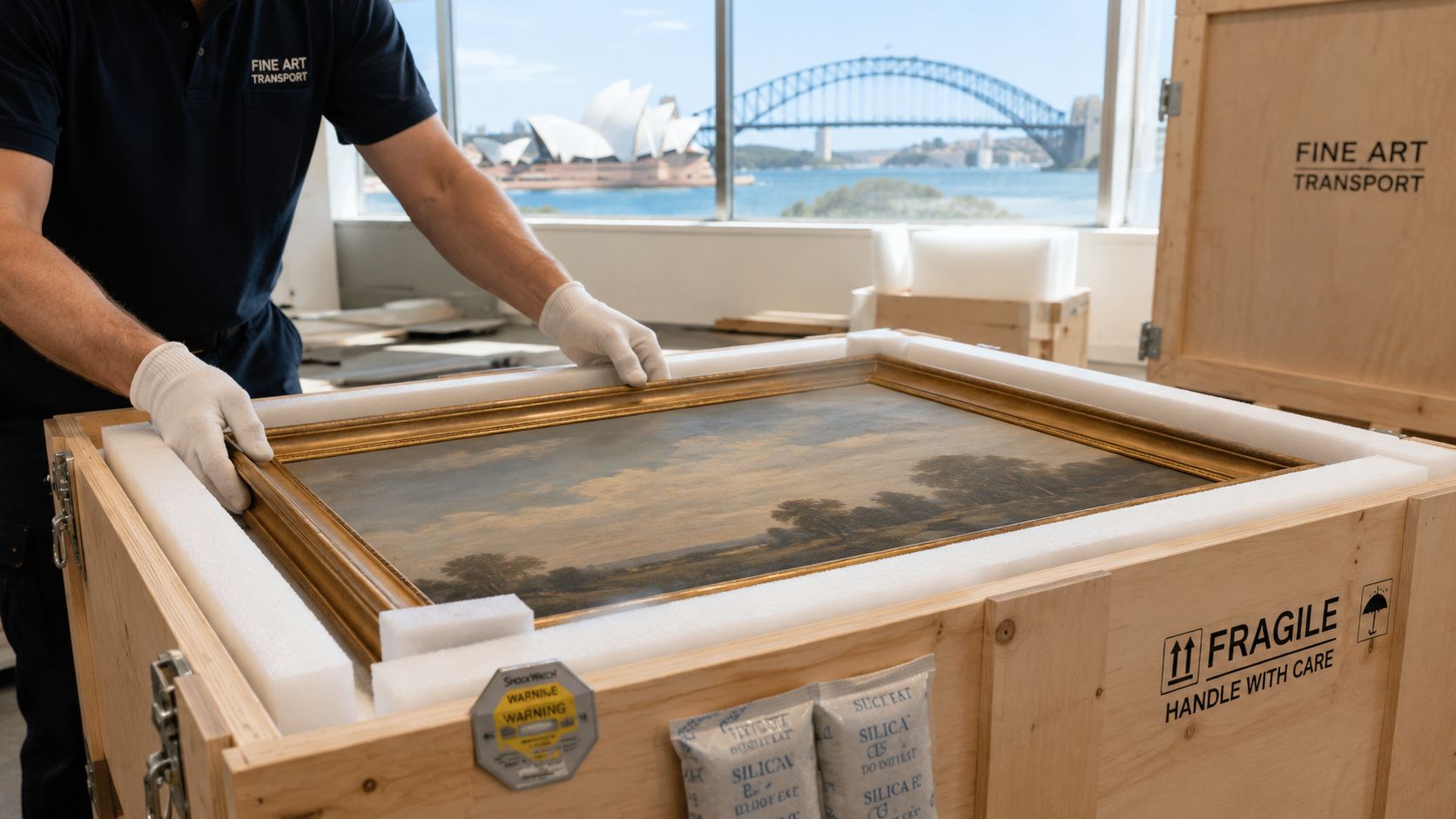
You've found the right home for a painting, sculpture or framed print, but the move itself is where the risk starts. A Sydney artwork transport job isn't a matter of adding bubble wrap to a standard removal. The vehicle, loading order, crate design, climate conditions, insurance and handoff records all shape the result.
That matters whether you're arranging home removals Sydney, moving furniture between suburbs, planning an office relocation, or sending a collection interstate. Australia has a substantial specialised fine-art logistics market, with one industry group describing the country as the fourth largest in the world, serving over 11,500 regular clients and handling more than 150,000 artworks and objects each year (Australian Design Centre overview of IAS Fine Art Logistics Group). Artwork transport deserves the same planning discipline as any other specialist freight.
When a Painting Gets Damaged on the Way Home
A Paddington client once had a mid-size oil painting damaged on a local move to Mosman. The owner had wrapped it in one moving blanket, placed it upright in the back of a standard van and assumed the short distance made the job straightforward. At delivery, one corner had been punctured and the stretcher bar had cracked.
The blanket wasn't the only problem. It softened surface contact, but it didn't provide rigid face protection or stop the frame from taking a concentrated impact. The artwork also travelled without shock monitoring, so nobody could establish whether the damage came from loading, braking, a pothole or a later handoff.
The booking decision mattered more than the blanket
The move had already been designed incorrectly before the truck arrived. The team had no agreed condition report, no protective crate or box matched to the painting, and no plan for the change between an air-conditioned living room and a 34-degree December afternoon. That environmental transition matters because conservation guidance treats stable temperature and relative humidity as transport concerns, not just gallery concerns (National Gallery of Australia preventative conservation guidance).
The damage wasn't caused by one dramatic mistake. It came from several ordinary decisions that left the artwork exposed:
- No rigid face protection: A moving blanket couldn't prevent a sharp object or another frame from pressing into the painting.
- No internal restraint: The artwork could move inside the vehicle when the van braked or turned.
- No environmental plan: The work moved from a controlled indoor room into a hot vehicle environment without a buffer.
- No documented handoff: The customer had little evidence showing the condition at collection or who handled the piece at each stage.
Practical rule: The outcome is often locked in at booking, not when the wrapping slips.
This guide takes a logistics view of artwork transport. You'll see how Sydney removalists should assess vehicle selection, packaging hierarchy, climate management, insurance design, loading and NSW documentation. Before the truck arrives, ask the removalist which of those decisions they've made for your specific piece, rather than accepting “we'll wrap it carefully” as a complete answer.
What Artwork Transport Actually Involves
Professional artwork transport follows the familiar removal sequence, but every step needs more control. A normal move involves survey, quote, packing, loading, transit, delivery and unpacking. Fine art adds object assessment, condition recording, specialised protection and a documented chain of custody at each handoff.
A double mattress can often survive plastic wrapping because its soft structure spreads pressure. A painting can't. The frame, glazing, stretcher, canvas and surface finish react differently to pressure, vibration and temperature. A load plan that works for furniture removals Sydney may be unsuitable for a framed artwork sharing the same truck.
The working categories
Most Sydney jobs fit into four practical groups:
- Unframed canvases: The stretcher and canvas need face protection, corner protection and restraint against movement.
- Framed works under glazing: Glass or Perspex, frame joints and the artwork surface each need separate protection.
- Three-dimensional sculpture: The crew must protect the base, mount points, projecting elements and any fragile mixed-media components.
- High-value or oversized pieces: These may require a custom crate, specialist vehicle and more detailed condition and insurance records.
The Australian Institute for the Conservation of Cultural Material recommends full support, protection from vibration and impact, and protection from environmental extremes. Its handling guidance also recommends protective foam such as Cellair for framed three-dimensional works, while small to medium unmounted paper items should sit between acid-free boards with acid-free paper or tissue interleaving (AICCM handling, storage, transport and display guidance).

What a genuine artwork service adds
A general mover may offer bubble wrap and a “fragile” label. A proper service should also be able to discuss:
- Condition reporting: Photos and written notes record existing marks, frame damage and surface condition.
- Object labelling: Barcode or item labels reduce confusion during storage and multiple deliveries.
- Climate-aware routing: The team considers storage duration, vehicle conditions and exposure during handoffs.
- Art-grade vehicles: Padded interiors, secure rails and suitable suspension reduce movement and impact.
- Written handoffs: Collection, storage, delivery and installation responsibilities are recorded.
Confirm that scope before you book. If the quote only mentions labour, blankets and a standard van, you're buying a general removal with fragile handling, not a complete artwork transport service.
Packaging and Crating That Protects Every Surface
Packaging should match the object, not the mover's usual supply kit. The University of Melbourne identifies vibration, movement, breakages and surface scratches as key transport hazards, and recommends soft wrapping, a crate or box modified to the object's size, and internal supports that stop the artwork moving (University of Melbourne packing guidance).
For an unframed stretched canvas, use a clean face cover such as Tyvek or Glassine, protect the corners and add a rigid cardboard slip over the stretcher. That rigid layer helps prevent pressure from crushing the stretcher bar. Don't let plastic, tape or rough cardboard touch the painted surface.
Framed works need a different system. A Sydney crew should discuss whether the glazing is glass or Perspex, use archival foam spacers where appropriate to stop the frame pressing against the glazing, and place the work in a snug mirror box. The box should restrain the frame without forcing pressure onto corners or glazing.
Sculpture needs an assessment of its material and shape. Marble can chip at edges, bronze can scratch or bend at projecting points, ceramic can fracture, and mixed-media work may combine rigid and delicate components. Mount points and base bolts need protection, while a foam-lined travel crate should isolate the sculpture from direct vibration rather than allowing it to sit loose on a blanket.
For a high-value or oversized work, a custom ISPM-15 timber crate with a foam-lined interior is the sensible option. A silica-gel system can provide humidity buffering, and a shock indicator attached inside the lid can help document handling conditions. The Western Australian Museum also recommends photographing and documenting extremely valuable objects before packing, with temperature, humidity, shock and vibration loggers used where appropriate (Western Australian Museum collections care manual).
| Artwork Type | Primary Packaging | Key Materials | Main Risk Addressed |
|---|---|---|---|
| Unframed stretched canvas | Soft wrap plus rigid outer protection | Tyvek or Glassine, corner protectors, cardboard slips | Surface contact and stretcher crush |
| Framed work under glazing | Snug mirror box | Glass or Perspex protection, archival foam spacers, box supports | Glazing breakage, frame contact and movement |
| Three-dimensional sculpture | Braced travel crate | Foam lining, mount-point protection, base bolt covers | Vibration, projecting-part damage and tipping |
| High-value or oversized work | Custom timber crate | ISPM-15 timber, foam interior, silica gel, shock indicator | Impact, humidity shifts and uncontrolled handling |
The price should follow the risk. A $200 piece rarely justifies a $900 crate, while a $20,000 work usually warrants a much more controlled solution. Ask the removalist to name the packing method, materials and internal restraint they'll use, and compare that answer with the object's value and construction. For broader fragile-item planning, the fragile removals and storage service provides useful context on how delicate items can be separated from ordinary household loading.
Climate, Vibration, and Shock Risks on Sydney Roads
Four threats deserve separate attention: sudden shock, continuous vibration, temperature swings and humidity changes. A pothole or hard brake creates a short impact. Road surfaces create repeated low-level movement. A parked truck can become environmentally unstable, while moving a work between air-conditioned rooms and humid outdoor conditions can stress sensitive materials.
For a short Sydney run, loading and the final kerbside delivery often create the greatest immediate exposure. Crews lift, rotate and carry the piece through doorways, driveways and lifts. A work can travel safely along a main road and still be damaged in the last metre if it strikes a wall, tips on a trolley or waits uncovered beside the vehicle.
Short move versus interstate run
Interstate removals add time, more road surfaces, possible storage and extra handoffs. That increases the importance of a suitable vehicle, secure internal restraint and documented environmental conditions. The Western Australian Museum recommends vibration and shock data loggers for particularly valuable objects moved by commercial carriers, and identifies air-ride truck transport as an option where a more cushioned conveyance is needed (Western Australian Museum preventive conservation guidance).
Australian art-logistics guidance cites controlled conditions around 21°C and 50% relative humidity as a benchmark that can significantly slow deterioration, while another Australian service specifies monitored storage around 20–21°C and 55–60% relative humidity (Grace fine-art transportation guidance). Those figures aren't a universal setting for every material, but they show why “it's only in the truck for a few hours” isn't a complete climate plan.
| Risk Type | Main Cause on the Road | Typical Sydney Impact | Highest on Metro or Interstate |
|---|---|---|---|
| Shock | Braking, potholes, drops and collisions | Frame damage, cracked stretchers or broken components | Both, with loading often decisive |
| Vibration | Road surfaces and vehicle movement | Loosened joints, abrasion and cumulative stress | Interstate |
| Temperature | Parked vehicles and uncontrolled compartments | Expansion, contraction and surface stress | Both |
| Humidity | Indoor and outdoor environmental changes | Movement in canvas, wood and paper materials | Interstate or storage-linked moves |
If the work needs temporary storage, ask about monitored conditions rather than just asking whether the facility is secure. A climate-controlled storage facility should be assessed as part of the complete transport route, not treated as an unrelated add-on.
Vehicles, Loading Order, and Air-Ride Options
A specialist art vehicle is organised around restraint and cushioning. Padded walls reduce contact risk, tie-down rails give the crew controlled anchor points, and a dedicated climate-controlled compartment can separate sensitive pieces from ordinary household loads. A standard removal truck may carry art safely, but only when the team can create that same protection inside the vehicle.
Air-ride suspension uses inflated bellows instead of conventional steel springs. The system absorbs more road shock before it reaches the crate or frame. It won't fix poor packing, but it reduces the force passed through a properly restrained load.
Loading order controls movement
The heaviest household items belong towards the front and lower in the load, provided the vehicle's load limits and balance remain suitable. Framed works should travel upright, separated from other frames and secured so they can't slide. Sculptures need bracing around the base and projecting elements. Nothing should be stacked on top of a canvas.
A crew should also plan the delivery order. Artwork loaded last can often be unloaded first, reducing the time it spends buried behind furniture. That approach is especially useful during office relocations, gallery deliveries and Sydney apartment moves where lift access is limited.

For businesses coordinating several deliveries, route planning and delivery sequencing deserve the same attention as packing. A practical overview of 2026 furniture delivery solutions can help teams think through scheduling, vehicle allocation and handoff visibility, even when the individual consignment needs specialist art handling.
Ask these questions before booking:
- Suspension: Do you use an air-ride vehicle for valuable or vibration-sensitive work?
- Interior: What padding, rails and separation systems are installed inside the vehicle?
- Crate fit: What does the crate interior look like, and how is the piece restrained?
- Loading plan: Will the artwork be protected from stacked furniture and loose equipment?
- Delivery sequence: Will the crew unload and place the artwork before ordinary items?
- Monitoring: Can you provide shock, vibration or climate logging when the value justifies it?
A confident removalist should answer with a method, not a vague promise that the driver will “take care”.
Insurance Decisions That Change the Real Risk
Insurance decides what happens financially after damage. A removalist's standard carrier liability may be limited or calculated by weight, which can leave a valuable painting badly underinsured even when the crew handled it properly.
A separate fine-art transit policy is designed around the declared value and the transport event. NAVA's Australia-wide transit and exhibition factsheet says cover can apply while artworks are in transit, storage and exhibition, with transport possible by road, rail, air, sea or registered post (NAVA transit and exhibition insurance factsheet).
Transit-only is not the same as transit plus storage
Sydney moves often include a delay between pickup and final placement. You may be waiting for settlement, renovating a room or coordinating an office fit-out. A transit-only policy may not respond during that storage period, even though the artwork remains in the mover's custody.
NAVA's guidance lists rates commonly set at 1.5% to 2.5% of insured value, with a minimum payable of A$66.00 (NAVA transit and exhibition insurance factsheet). Treat that as a policy-design reference, not an automatic quote. Eligibility, valuation caps, member conditions, storage arrangements and registration requirements can change the actual cover.
Insurance check: Ask whether the policy follows the artwork from pickup through storage, exhibition and return, or stops when the truck reaches the first destination.
Before signing, confirm:
- Declared value: The amount matches the insured sum, not a casual replacement guess.
- Transit event: The work is registered for the specific movement and route.
- Storage status: Temporary storage is included if the piece won't go straight into its final room.
- Damage process: You know who issues the condition report and damage certificate.
- Vehicle acceptance: The policy accepts the transport method and destination.
- Existing cover: Your household contents policy doesn't exclude fine art, glazing or commercial transit.
For a household move, compare the policy wording with the mover's goods in transit insurance information. Don't assume a single-piece rider on home contents insurance covers professional handling, temporary storage or an agreed-value claim.
Interstate Rules and Documentation for NSW Moves
A Sydney-to-Sydney move and a Sydney-to-Melbourne consignment may use the same road corridor, but the paperwork expectations differ once the artwork joins an interstate freight chain. The customer should control the record before loading, because claims become difficult when the condition, value and custody trail don't match.
Start with a condition report. Photograph the front, back, frame corners, glazing, stretcher and any existing marks. Add the date and time, then have the customer and removalist acknowledge the record before the work leaves the property.
Build the paperwork around the insurance
The declared value should match the insured sum. If the value comes from a gallery, auction house or professional valuer, keep the supporting certificate with the move documents. A consignment note should identify fragile artworks separately from the general household load, especially when the same vehicle carries furniture, boxes and office equipment.
For NSW homeowners, renters and small galleries, the useful preparation list is simple:
- Condition report: Written notes and timestamped photographs.
- Valuation record: Supporting evidence for the declared value.
- Insurance schedule: Transit-only or transit-plus-storage wording.
- Consignment note: Separate descriptions for each artwork.
- Delivery instructions: Room placement, lift access and any unpacking requirements.
- Handoff record: Signatures or electronic confirmation at collection, storage and delivery.
| Move Type | Required Documents | Trigger Threshold |
|---|---|---|
| Sydney local removal | Condition report, photographs, consignment details and insurance confirmation | Every artwork should be documented |
| NSW to Victoria or Queensland | Condition report, declared-value records, consignment note and interstate insurance details | Interstate transport |
| NSW to ACT delivery | Condition report, consignment note, insurance confirmation and site access instructions | Interstate delivery with destination-specific access |
| Commercial gallery or business consignment | Itemised inventory, valuation support, custody records and policy schedule | Multiple artworks or commercial handling |
There isn't a separate NSW fine-art permit simply because a painting crosses the state border. But documentation still matters, and commercial or higher-value freight may require additional declarations depending on the goods, route and carrier arrangements. Don't rely on a verbal valuation or an unsigned report. A missing signature, unsupported value or vague item description can undermine a claim even when the physical packing looked reasonable.
The practical test is clear: the paperwork trail should match the insurance trail. Prepare both before the removalist arrives.
Putting It Together and Booking the Right Removalist
Return to the Paddington painting. A better result would have started with a survey that recorded the oil's condition, identified the cracked-stretcher risk, selected rigid face protection, matched the vehicle to the route and confirmed whether climate-managed storage was needed. The crew would then load the work upright, separate it from household furniture, record each handoff and place it directly in the Mosman room.
That standard separates an artwork-fluent crew from a generalist mover offering bubble wrap. A capable team can explain not only how it will pack the piece, but also who owns each decision after collection.
Questions that expose competence
Ask for direct answers to these points:
- Experience: Have you handled paintings, sculpture, antiques or glazed works similar to mine?
- Condition records: Will you photograph every item before loading and at delivery?
- Packaging stock: Do you carry the right crate, foam, spacers and rigid protection, or will you improvise?
- Vehicle setup: Do you have padded interiors, secure rails and air-ride options?
- Loading order: Will the artwork be separated, protected from stacking and unloaded first?
- Insurance structure: Is cover based on declared value, and does it include storage?
- Final placement: Will the crew carry the piece into its final room, rather than leaving it at the front door?
- References: Can you provide relevant references from galleries, auction houses or businesses?
A quote should itemise packing, crating, transport, storage and insurance separately. A single bundled number hides the decisions that control risk and makes it difficult to compare one provider with another. That approach also applies to office relocations and interstate removals, where a low headline price can conceal unsuitable loading or storage arrangements.

Home Removals Sydney is one option for Sydney and interstate customers who need removal services alongside careful handling of large and delicate items, including artwork. The team can discuss packing, transport, furniture removals and storage as separate parts of the move, so request a custom quote through Home Removals Sydney and ask for the artwork-specific vehicle, packaging and insurance plan in writing.
