

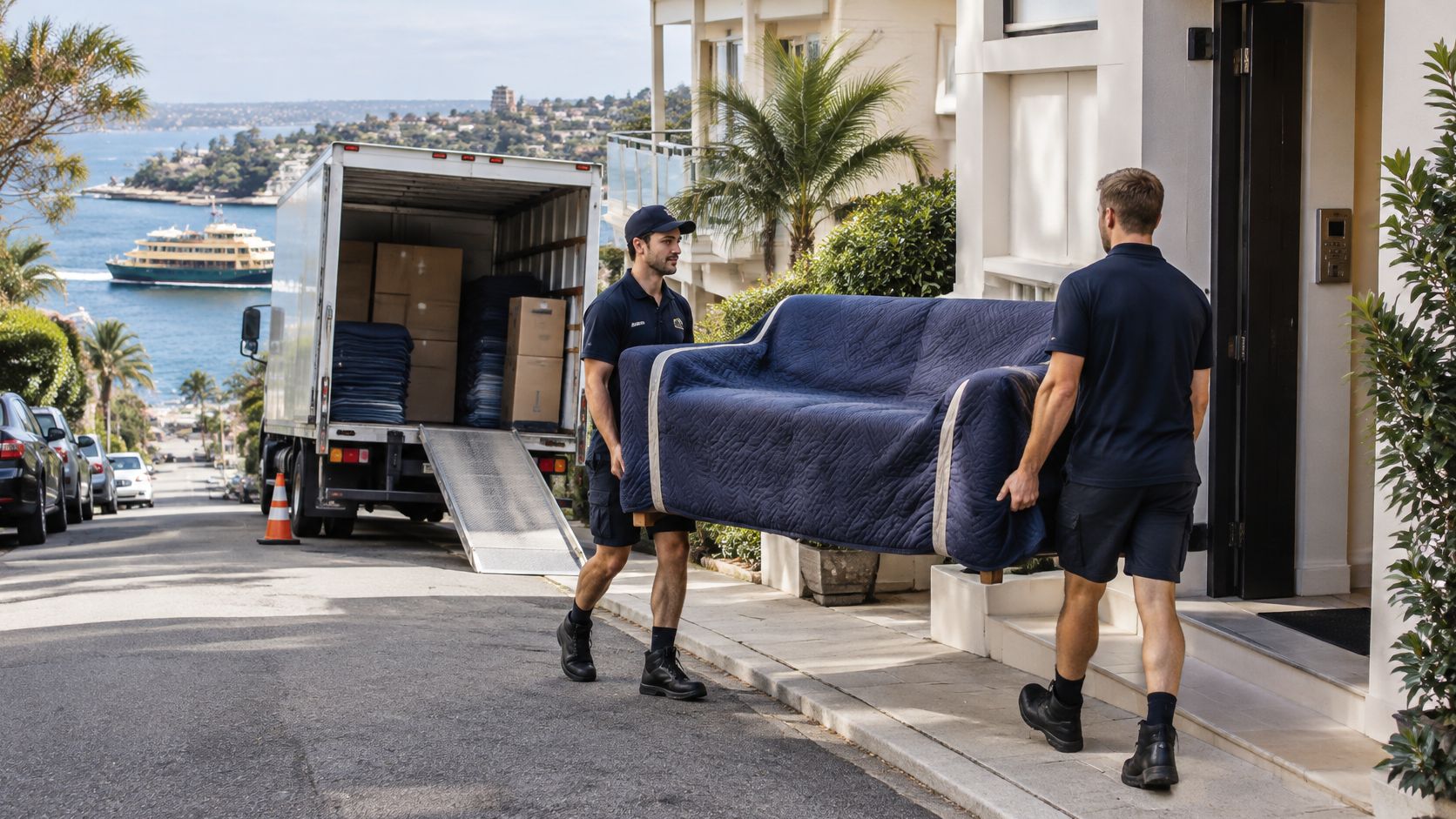
The lease ends on Friday. The strata manager has a lift booking sheet, the sign outside the front door carries a time limit, and a neighbour's ute is sitting in the only legal spot within dragging distance of the lobby. Your removalists are due at eight.
Most Manly moves don't fall apart over furniture. They fall apart on access, paperwork and timing. The hourly rate in your quote is the least informative number in it. What decides whether the day runs to schedule is how close a truck can legally park, whether the building will release a lift, what the council requires on your street, and how much of the load has to come down a staircase at shoulder height.
This is a working guide to those parts: the crews and trucks that suit each home size, the geography that adds hours, the loading rules and vehicle limits that apply on NSW roads, the permits and bookings to arrange first, and the evidence to collect so the bond comes back in one piece.
Manly Removal Costs and Time Estimates
A two-bedroom move with a clear lift booking can take less time than a smaller load carried down stairs. Home size helps set expectations, but access at both addresses and the distance the crew must carry items determine how quickly loading proceeds.
Typical crew, truck and loading time by home size
| Home size | Typical crew | Typical truck | Typical loading time |
|---|---|---|---|
| Studio or 1-bedroom apartment | 2 removalists | 4-tonne truck | 2-3 hours |
| 2-bedroom apartment or house | 2 removalists | 4-6 tonne truck | 3-4 hours |
| 3-bedroom house | 2-3 removalists | 8-10 tonne truck | 4-6 hours |
| 4-5 bedroom house | 2 removalists | 14T truck | 6-8 hours |
These are planning estimates, not guaranteed job durations. The published configuration for a 4-5 bedroom home is 2 removalists, a 14T truck and a 60-65m capacity, priced at $130/hr + GST. A written quote should account for the actual load and access at both addresses.
What moves the total
The hourly rate is only one part of the cost. Crew size, travel time and delays at either property all affect the final hours. An extra removalist costs $40/hr + GST and is available on request. More crew can shorten the time spent loading, but it also raises the hourly charge.
Ask whether travel time is included and how the minimum charge works. A low hourly rate can cost more overall if the estimate leaves out travel or undercounts the time needed to carry items from the property to the truck.
Lift access and carrying distance deserve specific attention in the quote. A lift that is unavailable during the booked window can hold up loading, while a long carry from the legal parking spot adds repeated trips. Packing costs should also be itemised so you can compare the service with packing the belongings yourself.
For a broader benchmark, this guide to removalist costs in Sydney explains how crew size and job requirements affect pricing.
Ask before you compare: Does the quote include travel? What is the minimum charge? How are extra hours handled? Clear answers make it easier to compare the total expected cost, not just the hourly rate.
Why Manly Moves Take Longer Than Sydney Averages
Manly is a peninsula, and that single fact shapes the day more than the size of your flat. Everything that arrives by road comes down the same handful of corridors, and the truck doesn't get to take the scenic option.
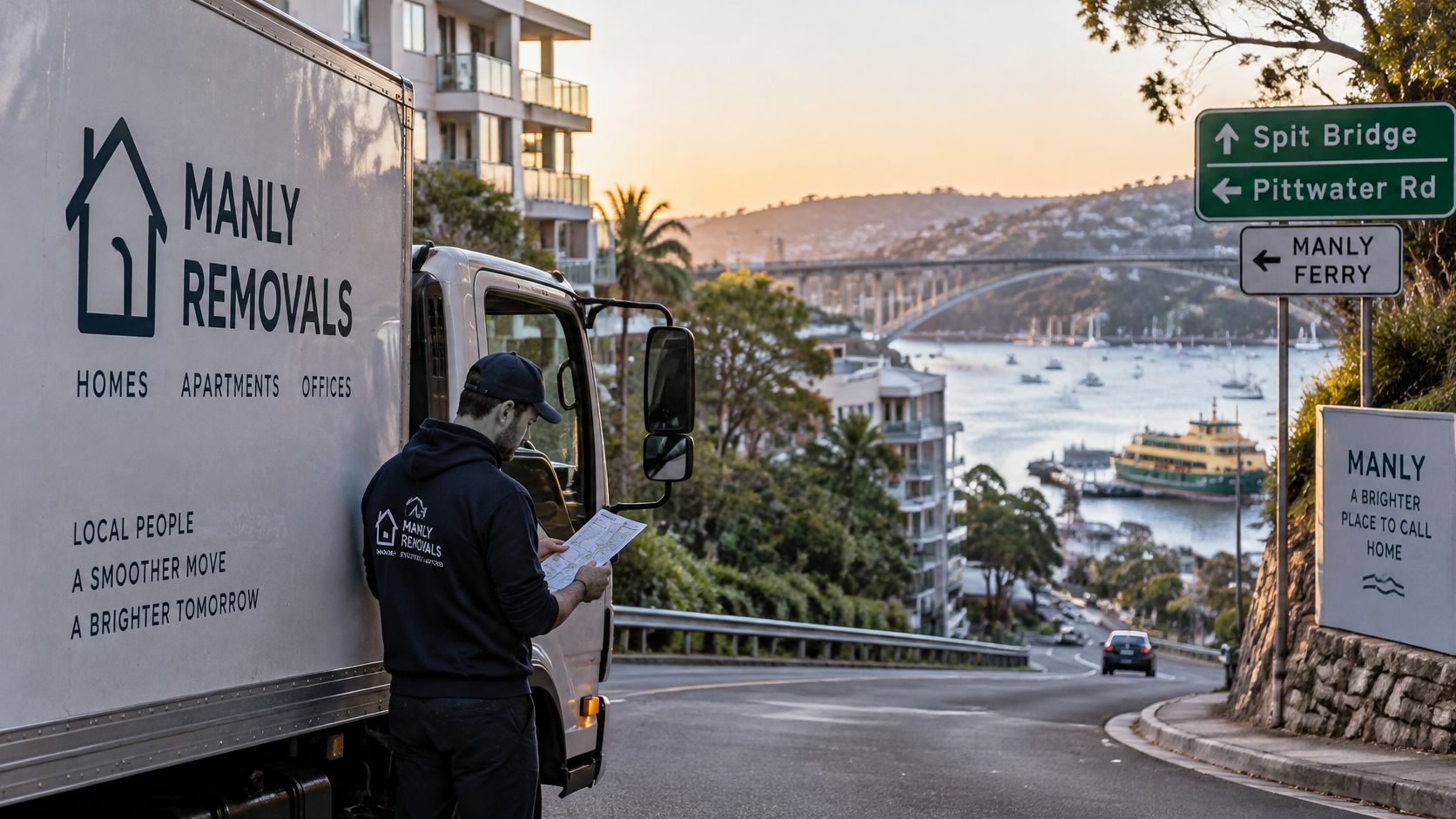
Where the hours go
Traffic funnels through the Spit Bridge and the Pittwater Road corridor, and both slow to a crawl at the morning and afternoon peaks. A crew that leaves the depot at 7.30 for an eight o'clock start can lose twenty minutes to a bridge lift and still be on time for the booking. A crew that leaves at 7.50 won't be.
The Manly ferry from Circular Quay is the quickest way for a person to cross the harbour. It won't take a fridge. Anything that has to reach the peninsula from the north side of the harbour goes by road, and the same applies in the other direction, so the water is a shortcut for people and never for goods. If a job involves moving items across the harbour in stages, that's a second handling cycle, and it's billed as one.
Warm weekends and school holidays add a different problem. The wharf, The Corso and the beachfront fill with visitors, and a two-hour loading window that would be comfortable on a Tuesday can stretch through the whole morning in January.
The Corso and the wharf forecourt are pedestrian territory. A truck that plans to hold position there has planned badly.
What the streets themselves add
Steep hills behind the beachfront mean some driveways can't be entered by a loaded truck at all, and the hand carry happens on a slope. Older blocks of units often have no lift, so a third-floor flat is a stair job with tight landings where a wardrobe has to be turned twice. Around the town centre, lanes are narrow, several streets run one way, and a truck that misses the approach has to circle back through traffic to try again.
Three actions offset most of this:
- Book a weekday morning start where your lease allows it, before the beach traffic builds.
- Confirm the route and truck access on the day, not the week before, because roadworks and bridge works appear without notice.
- Add at least an hour of buffer to any estimate that involves a lift booking or a carry of more than a short driveway.
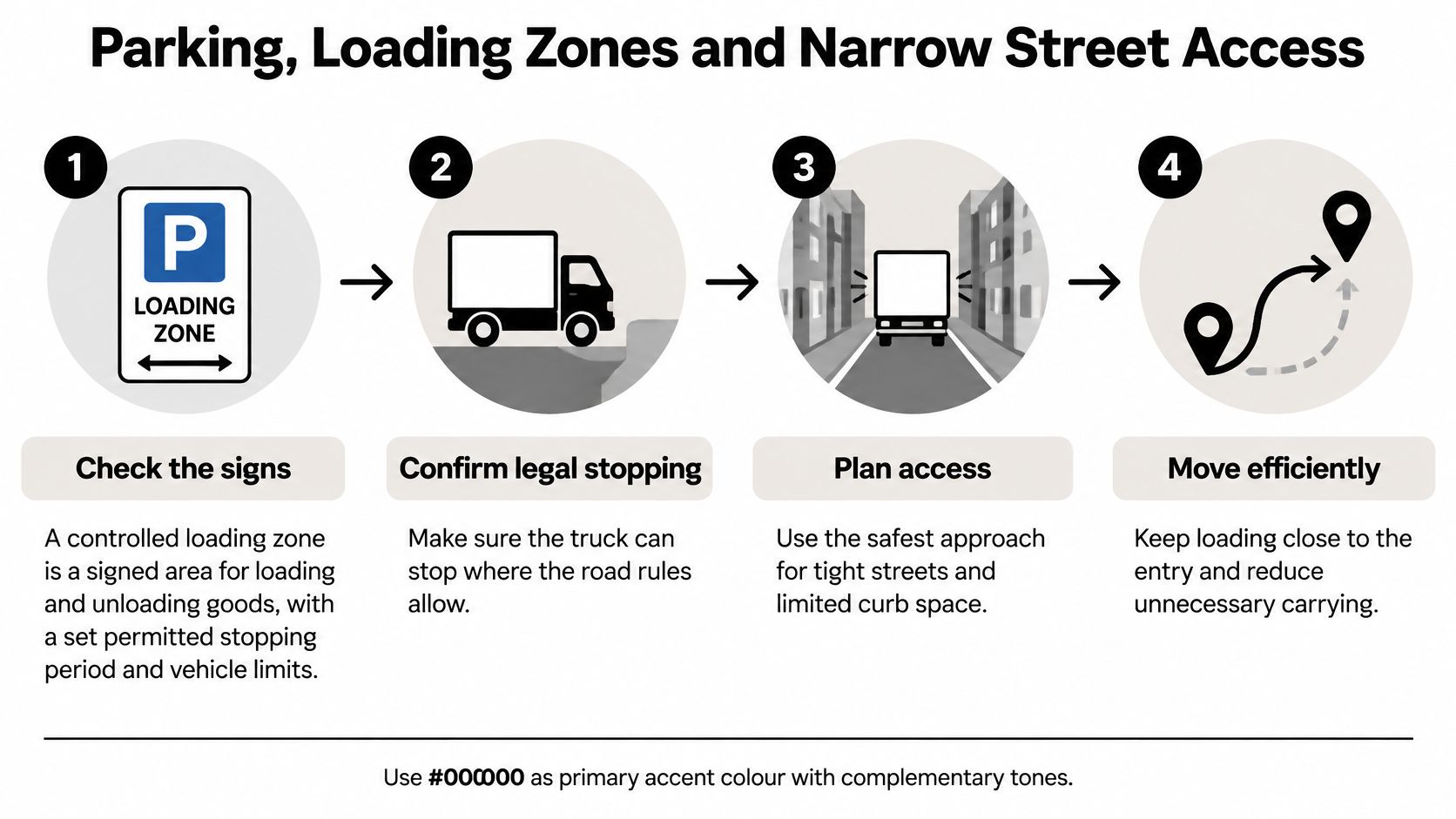
Parking, Loading Zones and Narrow Street Access
Two pieces of street furniture decide your move more than anything else on the road. A controlled loading zone is a signed area set aside for collecting and delivering goods, and it operates under the Road Transport (General) Regulation 2021, as set out in Transport for NSW's draft pay parking and controlled loading zone guidelines. The sign tells you how long a vehicle may stop and which vehicles are eligible.
A no stopping line, a bus zone or a clearway is the opposite. No stopping at any time, hazard lights or not. Loading zones are also restricted to vehicles designed to carry goods, so the family wagon with the seats down isn't a workaround.
Loading options for a Manly move
| Loading option | Where it usually works | Main risk | Confirm before move day |
|---|---|---|---|
| Controlled loading zone | Signed kerbside areas on busier streets | Permitted stopping period and vehicle eligibility | Signage, time limit and vehicle type |
| Kerbside space near the entrance | Quieter residential streets | Truck may not fit or may block traffic | Width, turning room and no-stopping lines |
| Building loading bay | Apartment blocks with a strata bay | Bookings, height clearance and lift access | Booking rules and bay dimensions |
| Private driveway or frontage | Houses with wide access | Owner consent and property damage | Written permission and ground condition |
| Council-approved temporary arrangement | Large trucks or long occupation of the kerb | Lead time and approval conditions | Application status well before move day |
The sequence that keeps the kerb clear
- Inspect the site before the move, ideally at the same time of day as the booking, so you see the school run and the delivery vans.
- Measure what limits you. Width of the approach, turning constraints, lift and stair positions, and the distance from kerb to entrance.
- Choose the smallest vehicle that safely carries the load. A smaller truck that can sit outside the door usually beats a large one parked two streets away.
- Confirm the signage and any council approval for the space you intend to use.
- Book a loading window outside peak traffic and tell the building manager when the truck will arrive.
When the truck can't sit close to the entrance, walking distance and handling cycles rise. The same load takes longer, occupies the kerb for longer, and raises the chance of a traffic incident or a scuffed wall in the stairwell. That's the cost of a bad park, and it shows up as labour hours.
At the site visit, photograph the signs, the kerb, any overhead obstructions such as tree limbs and balconies, and the turn into the street. Measure the entrance door, the lift door and the narrowest point on the carry.
Heavy vehicle limits that change the route
NSW treats a vehicle as heavy when its Gross Vehicle Mass exceeds 4.5 tonnes, or when the combined weight of vehicle and trailer exceeds 4.5 tonnes including the load, with usual limits of 4.3 metres in height, 2.5 metres in width and 19 metres in length, according to Legal Aid NSW's heavy vehicle guidance.
Bridge-load-limit and gross-load-limit signs are absolute, and a heavy vehicle generally can't pass a NO TRUCKS sign unless the sign allows its mass or length or the destination lies beyond it with no alternative route, as the NSW Government's heavy vehicle restrictions page explains. Oversize or overmass loads, including large indivisible items, may need an access permit, and high-risk movements can require a Traffic Management Plan under Transport for NSW's oversize and overmass rules.
Council Permits and Strata Approvals to Arrange
Move-day logistics in Manly involve more paperwork than most removalist checklists admit. Find your situation in the table, then deal with it before the crew is booked, not after.
Permits and approvals by situation
| Situation | Permit or approval | Action before move day |
|---|---|---|
| Resident moving in or out | Resident parking permit | Update the address or deactivate the old permit |
| Visitor, tradesperson or carer parking | Multi-use permit, up to 40 free 24-hour sessions a year | Check eligibility and scheme-area rules |
| Truck needs a space in a timed or permit zone | Council temporary parking or traffic arrangement | Apply early and confirm conditions with council |
| Apartment with a strata loading bay | Building manager booking | Book the bay, lift and any dock access in writing |
| Heavy truck or oversize load | Access check on route and dimensions | Confirm vehicle size with the removalist and check route restrictions |
Northern Beaches Council runs the Manly parking permit scheme with defined renewal periods, and its multi-use permit can provide up to 40 free 24-hour parking sessions a year for visitors, tradespeople and carers, subject to eligibility and scheme-area rules, as listed on the council's Manly parking permit page. The same page notes that people moving into or out of the area may need to apply manually or deactivate a permit, which is why address-change timing trips people up.
A resident permit is tied to a property. It gets you a legal place to leave a car, not a truck-sized loading bay. Those are different approvals, and a temporary traffic arrangement or a loading zone question goes to council separately.
The cheapest hourly rate is not the lowest total cost. Waiting for access, repositioning a truck or carrying furniture from a distant legal space all bill at the same rate as productive loading.
When the space falls through
Booked bays get taken. Lifts break down. A resident returns early and claims the spot the building manager promised. Build a fallback into the plan: a smaller vehicle that can legally use a nearby zone, a revised start time that puts the truck on the street after the morning school run, and the building manager's mobile number in the crew's job sheet. A written note from the building manager confirming an alternative loading point is worth more at the kerb than a verbal agreement.
Have these with you on the day:
- Booking confirmation for the lift, the bay and any dock access
- Permit details, including the permit number and the scheme area
- The strata or building manager's contact, saved and reachable
- The quote, with the crew size and arrival time on it
- Access codes for gates, garages and loading docks
Packing and Handling Fragile Items Safely
Most damage and most back injuries start with the same object: something heavy, awkward, and carried by two people who are already four hours into their day.
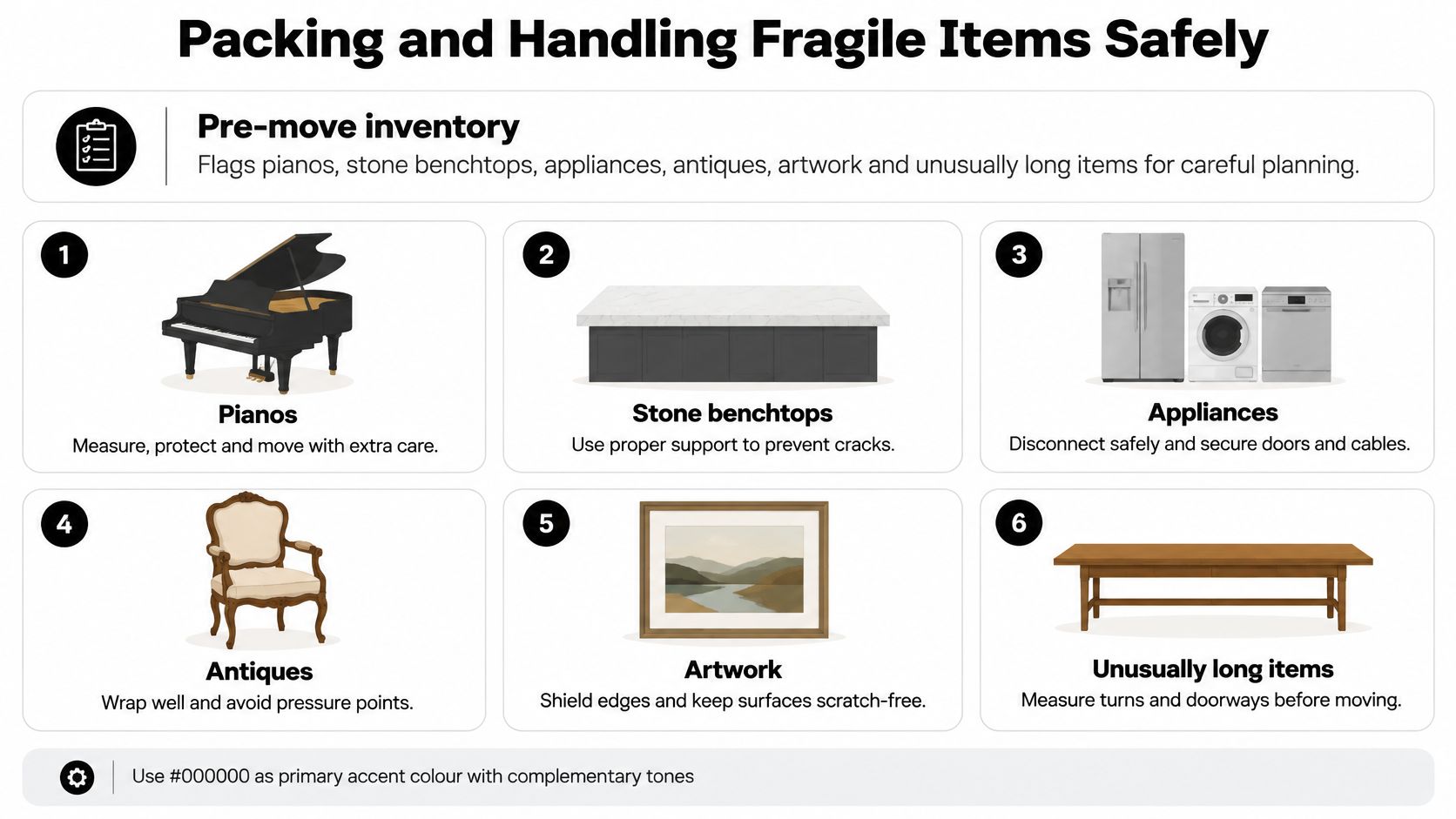
The work starts with an inventory, not with a roll of tape. Flag pianos, stone benchtops, appliances, antiques, artwork and anything unusually long for a specific method, because those items don't travel on a standard two-person carry down a tight Manly staircase.
SafeWork NSW lists the risk factors on a manual task as high or sudden force, repetitive or sustained force, awkward or sustained posture, vibration, and the size, weight and number of objects handled. Its risk management guidance for hazardous manual tasks recommends changing the work area or the load, using mechanical aids and adapting equipment. It also states plainly that training in lifting techniques alone is not an effective control for musculoskeletal injury, which is the part many people get wrong.
A handling sequence that protects backs and furniture
- Disassemble oversized furniture where it's structurally safe: beds, wardrobes, table legs. Fewer awkward shapes means fewer awkward carries.
- Reduce carton weights and keep the heavy boxes low in the stack. A box you can lift with one hand is a box that won't drop on a landing.
- Use maintained trolleys or hand trucks for long corridors, ramps and repeated trips. SafeWork NSW specifically points to correctly designed, well-maintained trolleys for pushing and pulling rather than carrying.
- Secure loads with straps, moving blankets and edge protection, so nothing shifts on the first corner out of the street.
- Limit stair carries to the fewest possible, and clear the stairwell before the first item goes down.
Packing is where the time trade-off sits. Wardrobe boxes protect hanging clothes, glassware travels better double-boxed, artwork wants glassine and cardboard corners, and every carton should be labelled by room and fragility. Professional packing costs more hours at the start and saves breakage, rescheduling and replacement on the tight landings and turns that older Manly blocks are full of. Our guide to packing fragile items for a move covers the materials and wrapping order in more detail.
Carry these yourself rather than putting them on the truck:
- Passports, ID and legal documents
- Medication, including anything refrigerated
- Jewellery and small valuables
- Phone chargers and the kettle, so the first night isn't spent unpacking
Protecting Your Bond During a Manly Rental Move
On moving day, a scrape to a doorway or a mark in a common hallway can be mistaken for pre-existing damage unless you have a clear record. Protect your bond by documenting the property before furniture leaves and again once it is empty.
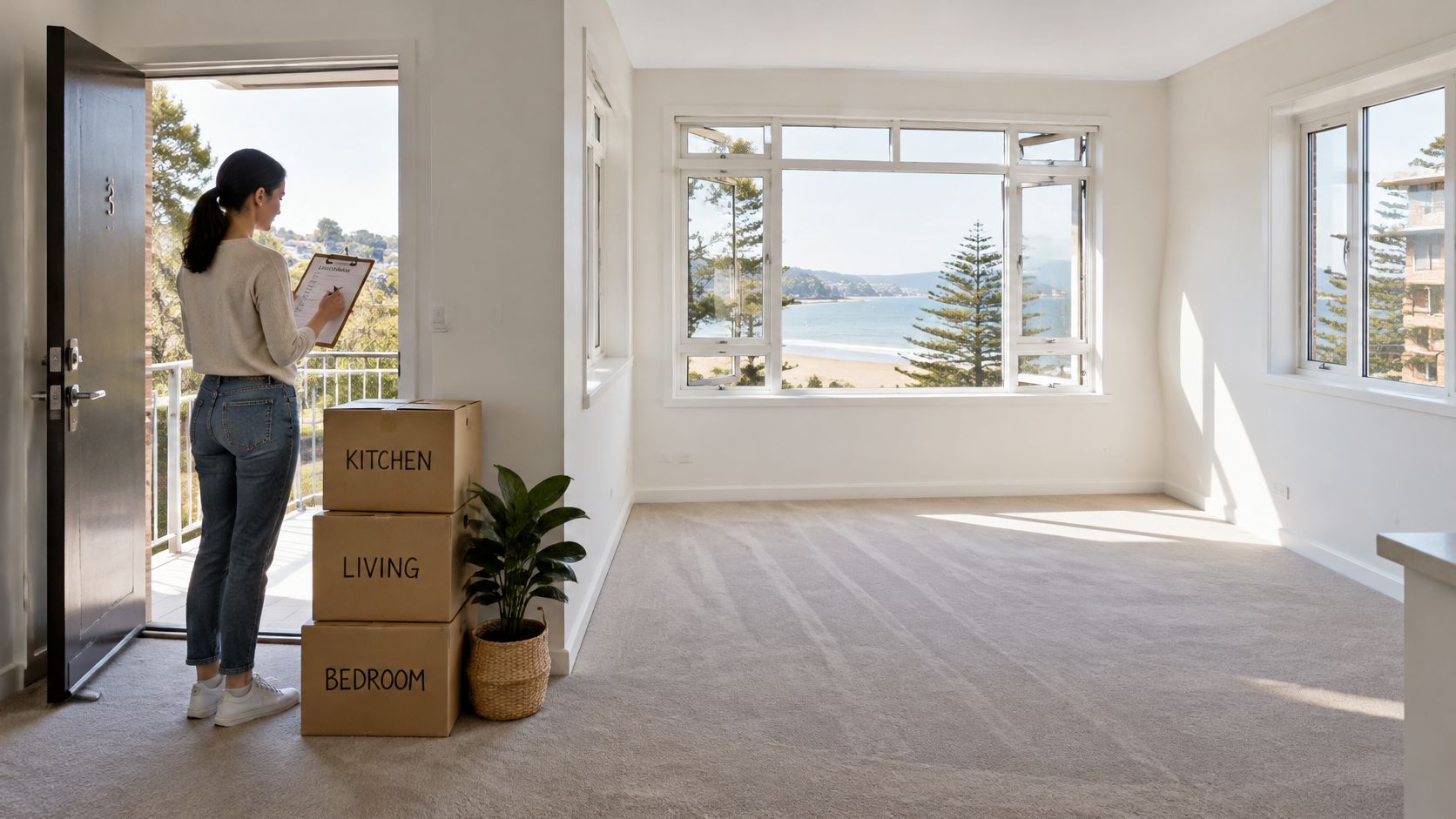
NSW tenants must leave the property clean and empty, and repair damage beyond fair wear and tear. The NSW Government's guide to moving out of a rental home explains how condition reports and timestamped photographs can help resolve disputes. Compare the property with the incoming report, which records its condition room by room.
What to capture before the truck leaves
- Photograph each room before loading. Include floors, walls, doorframes, kitchen and bathroom fittings, balconies, and any marks already present.
- Record shared areas before the move. Photograph the lift, stairwell and entrance so there is a baseline if a scuff occurs during furniture handling.
- Photograph the empty property after the last item leaves and before cleaning or the final inspection.
- Compare with the move-in report and keep a record of repairs completed during the tenancy.
Keep move-related damage separate from existing defects. If a doorframe or shared hallway is marked during loading, photograph it and tell the agent promptly. Clear records help distinguish a new mark from wear already documented.
Schedule cleaning after the last box leaves and before the final inspection. For general guidance on end-of-lease cleaning, check what needs attention once the property is empty. A removalist can handle packing and furniture, but the tenant remains responsible for cleaning, documentation and meeting tenancy obligations. Check whether you can transfer an existing bond to a new tenancy through Smart Rental Bonds before arranging payment.
The removalist protects your furniture. Your records help protect your bond.
Keep room and shared-area photos, the final condition photos, the condition report, and any record of damage during the move together.
Connecting Utilities and Internet for a Manly Rental Move
Renters in NSW arrange their own telephone and internet connections, and the landlord isn't required to supply them, as the NSW Government's guidance on telephone and internet in rental properties sets out. That makes it a move-in task with a long lead time, not something to sort once the boxes are open.
If a line isn't already connected, the tenant needs the landlord's written permission before arranging installation. Connection itself can take time, so contact a provider as early as possible once the lease is signed.
The order that works:
- Check the existing connection with the landlord or agent, and ask which provider the previous tenant used.
- Contact a provider as soon as the lease is signed, not after the move.
- Request written approval from the landlord for any installation work.
- Book the install for a window after the furniture delivery, so nobody is stepping over a technician.
- Keep the approval and booking confirmation with the rest of your move documents.
Furniture often arrives days before the internet does. Plan a mobile data backup or a temporary workspace for the first week, particularly if anyone in the household works from home.
Request Your Free Manly Removal Quote
A good quote is built from details you supply, not from a suburb name. Have these ready before you ask for one: the move date and any flexibility around it, the access at both addresses including stairs and lift bookings, the parking or strata rules for each building, the largest vehicle your street can take, and a list of fragile or oversized items.
Fill in our online quote form and include the awkward parts. Stairs, lift access, permit zones, lease-end dates and settlement times all change the crew size and the hours, and the more accurate the input, the closer the estimate lands to the invoice.
Ask for the quote to itemise the hourly rate, crew size, estimated hours, travel time and any extra removalist you've requested. Confirm which services are optional, including packing, reassembly and insurance, so you can compare two quotes line by line instead of guessing what's inside a flat figure. If your street needs a council arrangement or your building needs a bay booking, say so at the quoting stage and we'll build the loading plan around the Manly address, then confirm it with you before the truck rolls.
Home Removals Sydney is a family owned and operated business handling home, office and interstate moves across Sydney, with packing, furniture reassembly and secure storage available alongside the truck. Our pricing has no hidden costs, and we offer insurance options to protect your belongings in transit. Request a free online quote and a specialist gets in touch shortly after to confirm the crew, the access plan and the dates for your Manly move. Visit Home Removals Sydney to get started.
