


A lease expiry lands on your desk, the new floor plan is still being debated, and your team is expected to keep client work moving without interruption. That's reality for many Sydney businesses arranging office relocations. The truck is only one part of the job. Building access, IT cutover, furniture configuration, staff communication, records control and the decision to move at all can determine whether the relocation feels controlled or chaotic.
Sydney's commercial property market makes that decision more important. The national CBD vacancy rate reached 14.8% in January 2026, up from 14.3% in July 2025, while Sydney CBD stood at 13.8% and Melbourne CBD at 19.0%, according to Property Council data cited in CBRE's 2026 CBD market commentary. Businesses are consolidating, upgrading and reshaping their workplaces, but a relocation still needs a commercial reason, not just an attractive new tenancy.
Planning an Office Move in Sydney
A 45-person marketing agency in Surry Hills has seven weeks before its lease ends. Client campaigns are active, the creative team relies on shared screens, and the business cannot close for a fortnight while desks and servers are moved. Its shortlist includes smaller hybrid-fit spaces in Surry Hills, Pyrmont and Alexandria, where landlords may offer fit-out incentives or more flexible lease structures.
Start by deciding how the workplace should operate, not where the truck will park. Post-pandemic offices often need fewer assigned desks, more collaboration zones, denser cabling, hot-desking hardware and shared monitors. Recreating the old layout in a new tenancy can leave you paying for space and equipment that staff rarely use.
Sydney's office market gives tenants room to assess alternatives. Businesses are consolidating, upgrading and reshaping their workplaces, so the relocation brief should connect property strategy with daily operations. A move needs a commercial reason, such as a better workplace model, lower occupancy burden or a tenancy that supports the way teams now work.
Lock down the decisions that control the move
Before requesting a removalist quote, confirm:
- Floorplate and workplace plan: Establish the number of workstations, collaboration areas, meeting rooms and storage zones.
- Building access: Check service-lift dimensions, loading-dock rules, booking windows, protective-flooring requirements and access-card procedures.
- Lease and handback dates: Align the removal with make-good works, cleaning, inspections and key return.
- Council and kerbside access: Identify loading restrictions, temporary parking requirements and any road or building approvals.
- Technology scope: List servers, network cabinets, printers, screens, meeting-room equipment, handsets and cabling.
- Target cutover: Choose the date when staff can work from the new premises, then build backwards from it.
Use a documented office move management plan that assigns owners to property, IT, facilities, communications and the moving contractor. Treat the relocation as a sequenced project, not a weekend event. By the time movers price the work, give them the headcount, asset inventory, floor plans, access rules and target date.
The brief should also state what happens to surplus furniture, archived records and equipment that will not move. Those decisions affect storage, disposal, packing volume and the final labour requirement.
Practical rule: If the mover discovers the lift restrictions on moving day, the planning process has already failed.
What Office Movers and Packers Actually Do
A commercial moving team should give a business more than labour and a truck. The right scope combines asset control, packing, furniture handling, IT coordination, storage and site logistics. Ask for each element separately on the quote so you can compare vendors without guessing what “full service” includes.
The service categories that matter
Labelling and asset tagging create the chain between the old office, the truck and the new workstation. A department, floor or workstation code can be printed on a box label, furniture tag or inventory record. Barcoded or colour-coded systems work well when the receiving team has a floor plan and a person responsible for checking placement.
IT handling needs its own method statement. Workstations, servers, printers and audiovisual equipment should be disconnected, protected with suitable anti-static materials where required, labelled and reinstalled in the correct sequence. Ask whether the assigned technicians understand cabling and equipment identification. General removal labour can carry a monitor, but that doesn't mean they should disconnect a server rack or rebuild a meeting-room system.
Furniture disassembly and reassembly is often unavoidable in Sydney buildings. Modular workstations, height-adjustable desks and boardroom tables may not fit through a service lift or tight corridor in one piece. The quote should state who will dismantle, protect, transport, reassemble and check each item.
Secure storage helps when the new fit-out isn't ready or the business wants to archive excess furniture and files. Confirm whether storage is short-term or ongoing, how items are inventoried, who can access them and whether staged deliveries are included.
| Service Category | What It Covers | Best For |
|---|---|---|
| Packing and labelling | Crates, cartons, wrapping, asset tags and destination codes | Teams that need controlled packing and fast unpacking |
| Furniture services | Disassembly, protection, transport and reassembly | Modular workstations, boardroom tables and large desks |
| IT relocation | Disconnect, protective wrapping, transport, reconnection and testing | Offices with servers, screens, printers and meeting-room technology |
| Storage and staging | Secure holding, inventory control and scheduled delivery | Fit-out delays, archives and surplus furniture |
| Project supervision | Site coordination, sequencing, access management and sign-off | Multi-floor or after-hours relocations |
| Specialist add-ons | Crate hire, shredding and warehousing | Offices with confidential records or staged move requirements |
A standard removalist crew may be suitable for a small furniture-only job. A dedicated office moving team is more appropriate when the relocation involves supervision, protective padding, building coordination, after-hours work or technology. For a useful comparison of commercial service expectations, review this guide to Beyond Surplus Atlanta office movers, then ask a Sydney vendor to translate the same scope into local building conditions.
Office Move Timelines and Cutover Planning
For a 30-to-60-person Sydney office, plan around an eight-to-ten-week runway. Larger CBD tenancies, multi-floor moves and strata-managed buildings need more preparation because access approvals and lift bookings can take time. The exact duration depends on the fit-out, inventory and building rules, but rushing the early decisions creates problems that no crew can repair on moving night.
Weeks eight to ten, planning and lease control
Confirm the lease end, new-site access, make-good obligations and the target cutover. Appoint one internal move coordinator and book the mover's site survey. Notify building management at both premises, check service-lift requirements and identify the loading area.
Weeks six to eight, inventory and IT audit
Catalogue furniture, boxes, screens, printers, servers, cabling and specialist equipment. Finalise the floor plan and decide what will be disposed of, stored, donated or moved. Your IT lead should document the shutdown and reconnection order, including backups and supplier contacts.
Weeks four to six, packing preparation
Order crates, labels and protective materials. Pack non-essential files, display items and surplus equipment first. Issue staff instructions that explain what stays on each desk, what employees must pack themselves and how confidential material will be handled.
Weeks two to four, logistics and approvals
Confirm the moving crew, insurance certificates, lift windows, loading access and parking arrangements. Sydney CBD work commonly runs after hours, from Friday evening through Sunday, to reduce lift congestion and disruption to neighbouring tenants. Check strata by-laws governing weekend noise and building access.
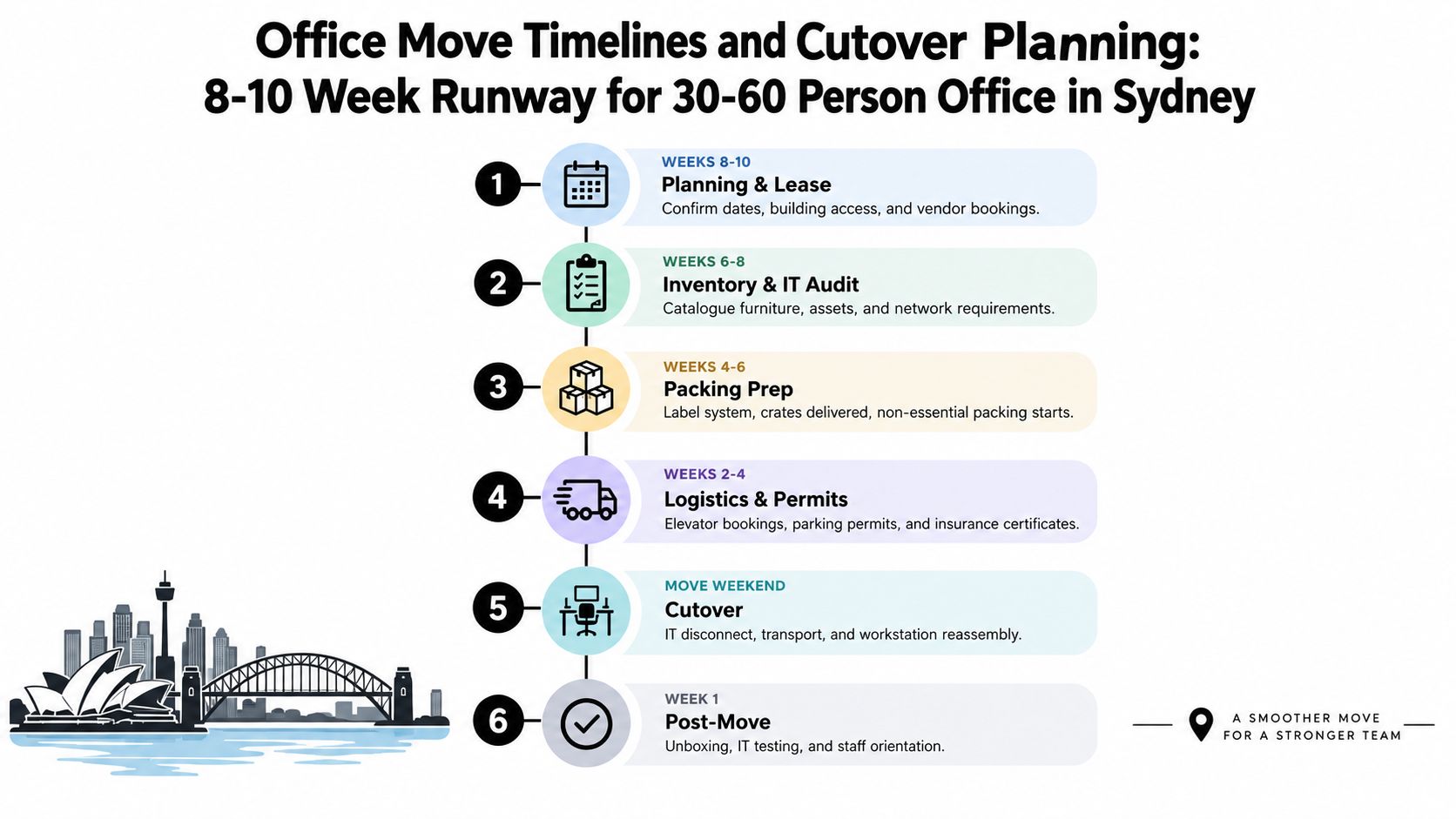
Cutover weekend and the first working day
A staged move is safer for complex offices. IT can disconnect on Friday, furniture and archives can move on Saturday, and the team can provide final go-live support on Monday. Leave contingency for lift downtime, missed deliveries and reconnection issues. The Sydney office downtime guide is useful when assigning responsibilities for the cutover.
Office Moving Costs in Sydney
Sydney office moving quotes usually use one of four structures. Small furniture-only jobs may be priced hourly. A full-floor relocation is more likely to receive a fixed project quote. Hybrid workplaces can be priced per desk or workstation, while after-hours, weekend, high-rise access and difficult loading conditions may attract separate charges.
The quote changes when the mover has to work around a booked lift, carry equipment between levels, dismantle furniture, handle IT crates or wait for access. Parking permits, insurance documentation, storage, document shredding and server transport can also sit outside a basic transport allowance. Don't accept a low headline price until you know what happens when the scope changes.
Compare the scope, not just the total
The following table is a comparison framework, not a fixed Sydney price list. A reputable provider should replace broad categories with an itemised quote after inspecting the site.
| Office Size | Standard Hours, Mon-Fri | After-Hours/Weekend | Typical Add-Ons |
|---|---|---|---|
| Small studio | Hourly crew and vehicle pricing | Access and timing surcharge may apply | Cartons, packing, furniture assembly |
| Small team | Fixed or hourly scope after a site survey | Weekend cutover pricing | Crates, IT disconnect, short-term storage |
| Medium office | Fixed project quote or per-workstation pricing | After-hours crew, lift and access requirements | Cabling, server handling, shredding |
| Larger team | Detailed fixed quote with staged labour | Multi-shift or weekend programme | Warehousing, phased delivery, project supervision |
Ask every mover to price the same inventory and identify whether labour includes packing, unpacking, furniture reassembly, rubbish removal and final placement. A quote that excludes server handling may look cheaper but won't be comparable with one that includes IT technicians.
For a more detailed internal benchmark, use this guide to office relocation costs in Sydney. Then ask each shortlisted supplier to identify assumptions, exclusions, waiting time, storage terms and variation rates in writing.
Choosing the Right Office Moving Vendor
The vendor you choose should be able to manage a building, a schedule and an asset register, not just lift furniture. Start with evidence. Request current public liability and transit insurance certificates, workers compensation cover and AFTA membership or equivalent professional accreditation.
Test the capability before signing
Ask direct questions about server racks, anti-static wrapping, workstation cabling and chain-of-custody tagging. If the mover plans to subcontract IT work, ask who the subcontractor is, what tasks they'll perform and who remains accountable for the result.
A site survey should record access points, lift dimensions, stairs, loading zones, furniture quantities, packing volume, IT equipment and the destination layout. Read it line by line. Vague descriptions such as “office contents” leave too much room for a variation on the day.
Check references with the vendor's last three commercial clients. Ask whether the crew arrived when promised, whether the final invoice matched the quote, how the mover handled damaged items and whether staff could work normally after the cutover. Those answers tell you more than a polished sales presentation.
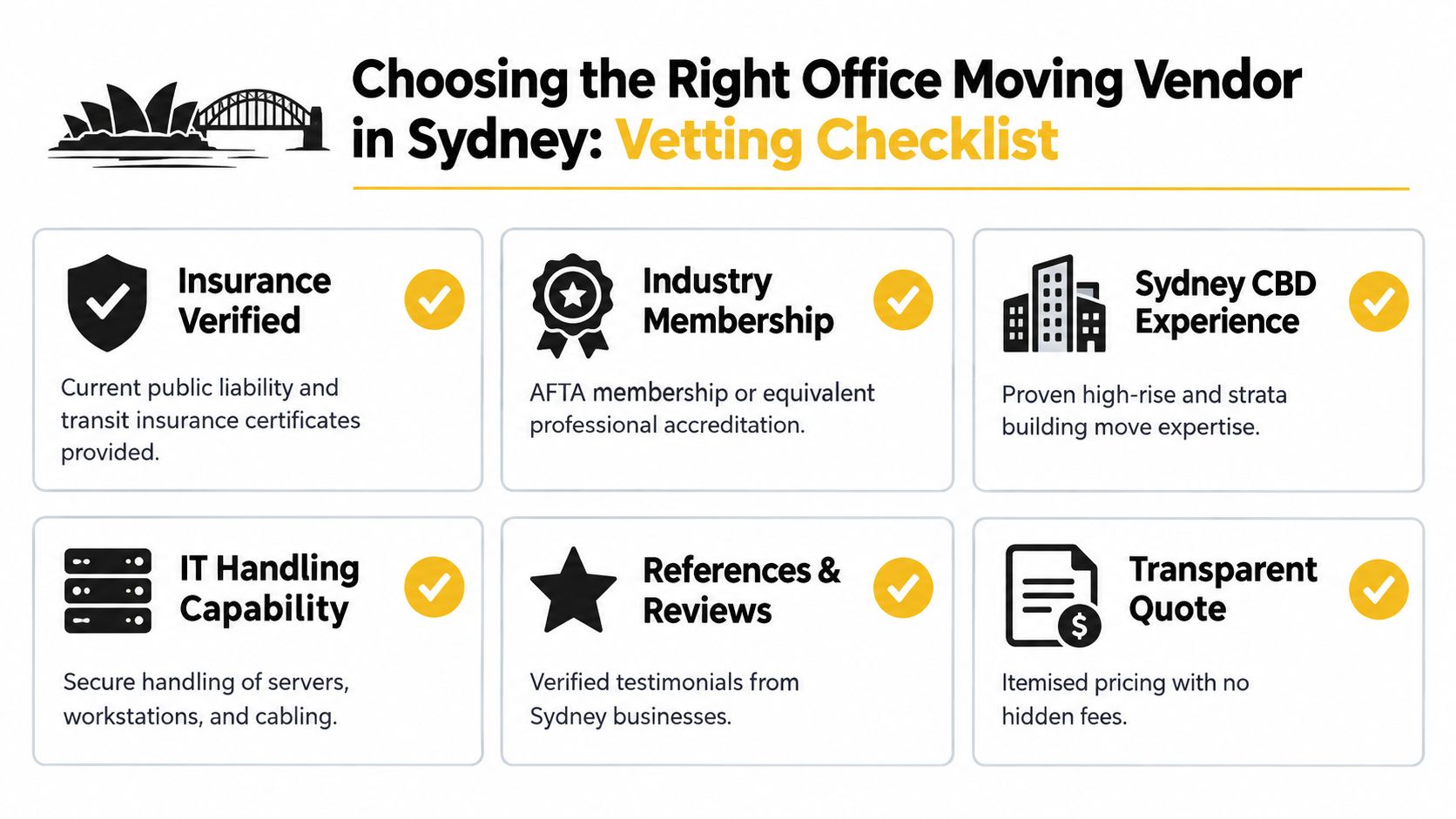
Red flags: Cash-only deposits, vague inventories, missing insurance certificates and unnamed subcontractors handling IT should remove a vendor from your shortlist.
Compare three quotes using identical criteria:
- Scope: Packing, furniture, IT, storage, disposal and reassembly.
- Access: Lift bookings, loading arrangements, floor protection and after-hours work.
- Protection: Insurance, tagging, wrapping and responsibility for damage.
- Supervision: Named project manager and on-site decision-maker.
- Commercial terms: Fixed inclusions, exclusions, variation rates and payment schedule.
If the project includes modular or temporary workspace, clarify how the move interacts with construction and installation. Information on deployment timelines for modular offices can help property and facilities teams ask better questions about handover sequencing.
Sydney Office Move Checklist
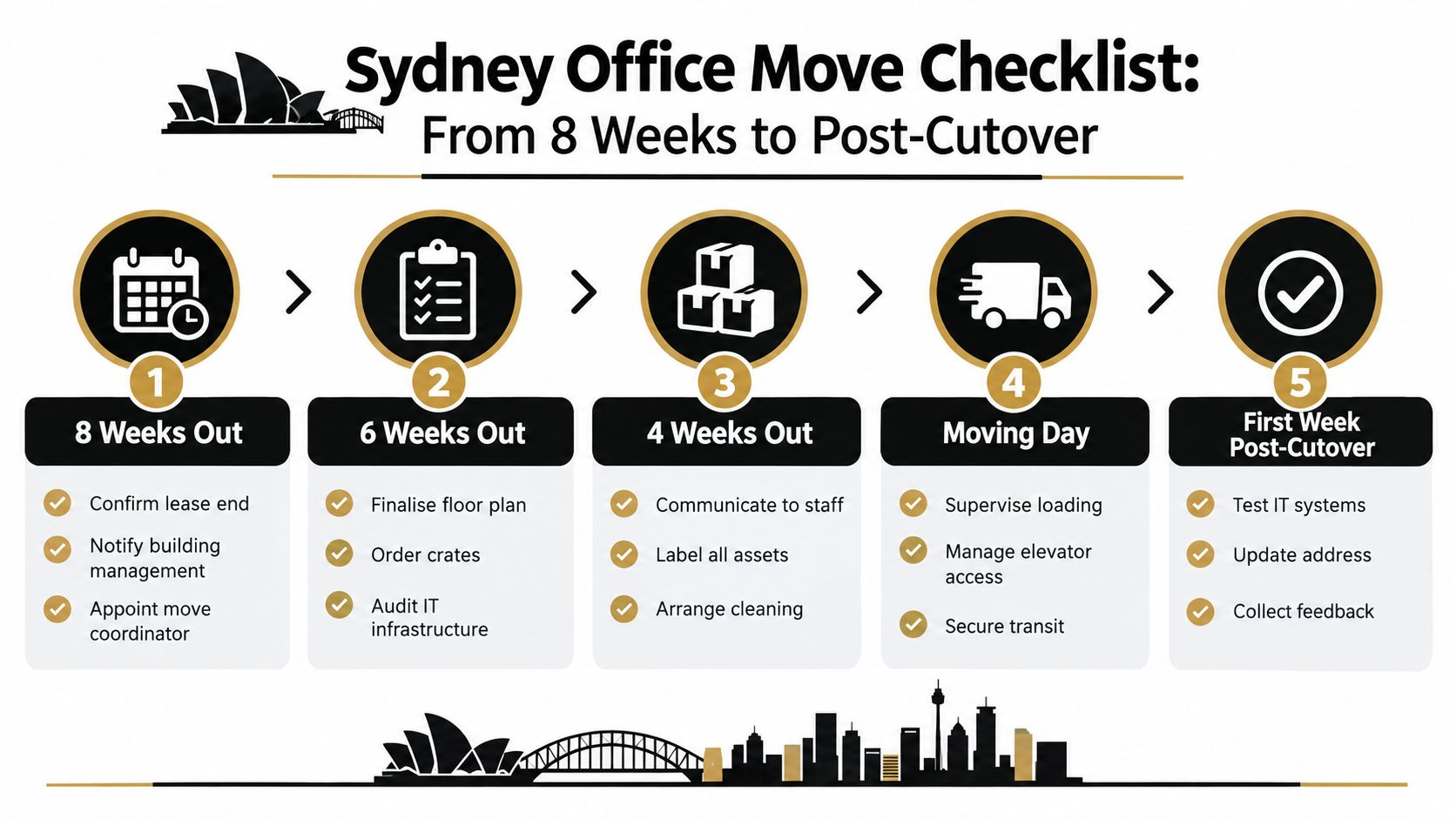
A reliable checklist assigns an owner to each task and attaches a deadline to every approval. The move coordinator should keep one live document covering the lease, building management, IT, staff, records, WHS and the removalist scope.
Eight weeks out
- Confirm the lease: Check the lease end, make-good works, access dates, key return and inspection requirements.
- Appoint responsibility: Name the internal coordinator and decision-makers for facilities, IT, finance and communications.
- Notify buildings: Contact both building managers about access, loading docks, lift bookings, certificates and protective requirements.
- Approve the floor plan: Mark workstations, meeting rooms, storage, emergency exits and shared equipment.
- Book the survey: Have the mover inspect both sites before pricing becomes final.
Six weeks out
- Audit technology: List servers, network cabinets, monitors, printers, handsets, audiovisual equipment and cabling.
- Protect data: Schedule server backups and confirm the IT shutdown and reconnection sequence.
- Order materials: Arrange crates, cartons, labels, bubble wrap and protective coverings.
- Review records: Create an inventory showing affected files, formats, locations, controls and applicable disposal authority.
- Plan storage: Include records held by commercial storage providers in the inventory, as required by NSW Government guidance on relocating records.
NSW Government guidance also says paper records moved during an administrative change should be packed securely in labelled boxes, with arrangements made with the receiving public office. A retention and disposal authority identifies how long records must be kept and when they may be destroyed or retained as State archives, so don't shred files because they're inconvenient to move. Use the NSW Government recordkeeping guidance for administrative change when public records are involved.
Four weeks out
- Brief staff: Explain packing responsibilities, crate labels, desk clean-out rules and the new address.
- Coordinate suppliers: Confirm internet, telecommunications, security, cleaning and access-control cutover windows.
- Complete WHS checks: Walk through the new site, identify trip hazards, confirm emergency egress and check first-aid arrangements.
- Arrange disposal: Book confidential shredding and remove unwanted furniture before the movers arrive.
- Confirm access approvals: Obtain strata sign-off, weekend permissions and loading arrangements.
Moving day and the first week
- Supervise loading: Match the inventory against the truck, protect lifts and confirm the final sweep.
- Control placement: Use destination labels and floor plans so staff don't become unpaid furniture movers.
- Test systems: Check network access, phones, printers, meeting-room screens, access cards and shared drives.
- Update details: Change the registered address, website, invoices, suppliers, insurance records and emergency contacts.
- Collect feedback: Record unresolved defects and assign each issue to a named person.
For the technology component, a dedicated business relocation technology plan gives IT and facilities teams a useful structure for sequencing systems rather than treating reconnection as an afterthought.
Sydney parking needs its own check. The City of Sydney lists a residential visitor parking permit application as taking about five days and costing $30, although an office move may require a different approval, so confirm the applicable arrangement with the council and building manager through the City of Sydney transport and parking information.
Move or Renew and Next Steps
Don't assume relocation is automatically the smart choice. In 2025, brokers reported that many occupiers favoured renewals because incentives could reduce disruption and costs, while Sydney, Brisbane and Canberra recorded relocation transaction volumes near two-decade lows. At the same time, Australian office absorption reached 135,279 square metres in H2 2025, the highest H2 total since 2022, according to CBRE's Australian office market commentary.
The workplace brief has also changed. In 2025, 53% of Australian employees were in unassigned seating, compared with 30% in 2019, and average desk density was 0.7 desks per employee, according to the 2025 Australian Office Occupier Survey. The same source reported that 72% of Australian organisations planned to increase investment in space design and fit-outs over the next five years, while another market report found that relocating tenants were more likely to expand than downsize, with 52% expanding and 14% downsizing. The practical lesson is clear. The risk may sit in choosing the wrong workplace configuration, not in moving the furniture.
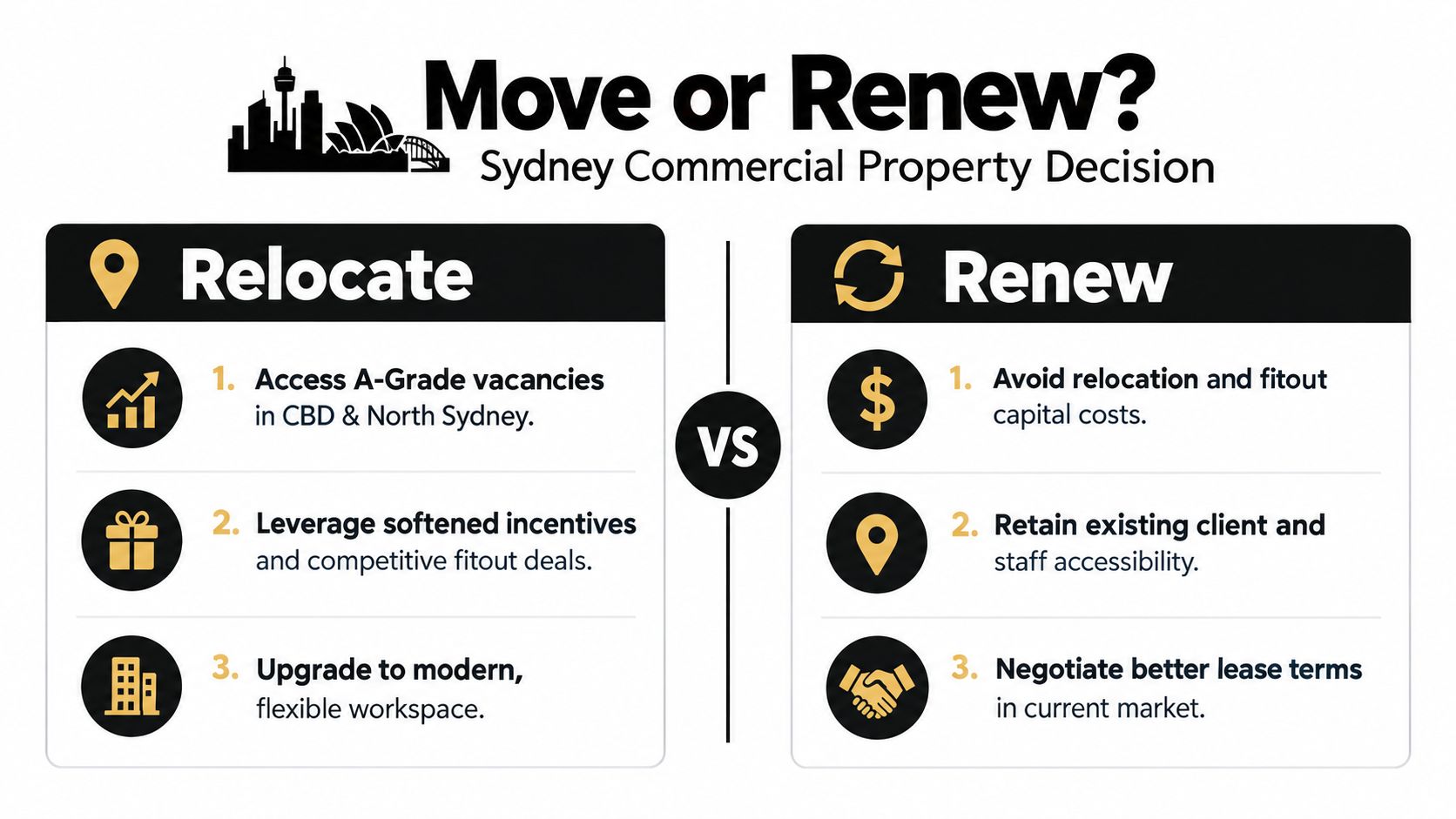
Use a simple decision score
Give each option a score for:
- Lease cost delta
- Fit-out value
- Talent catchment
- Commute and transport access
- Growth flexibility
Assign a weight based on your business priorities, score move and renew, then compare the result with the practical cost of disruption. A new workplace should improve attendance, recruitment, client access or space efficiency in a way you can explain. If it doesn't, negotiate the renewal harder.
Take three steps next. Commission a written relocation brief. Request three fixed-price quotes that include IT and weekend cutover scopes. Book one pre-move survey at the new premises before selecting a supplier.
Home Removals Sydney can coordinate office and warehouse relocations, packing, furniture assembly, storage and interstate removals for businesses planning a controlled transition. Visit Home Removals Sydney to request a quote and discuss your Sydney office move with a moving team before the schedule becomes urgent.
