

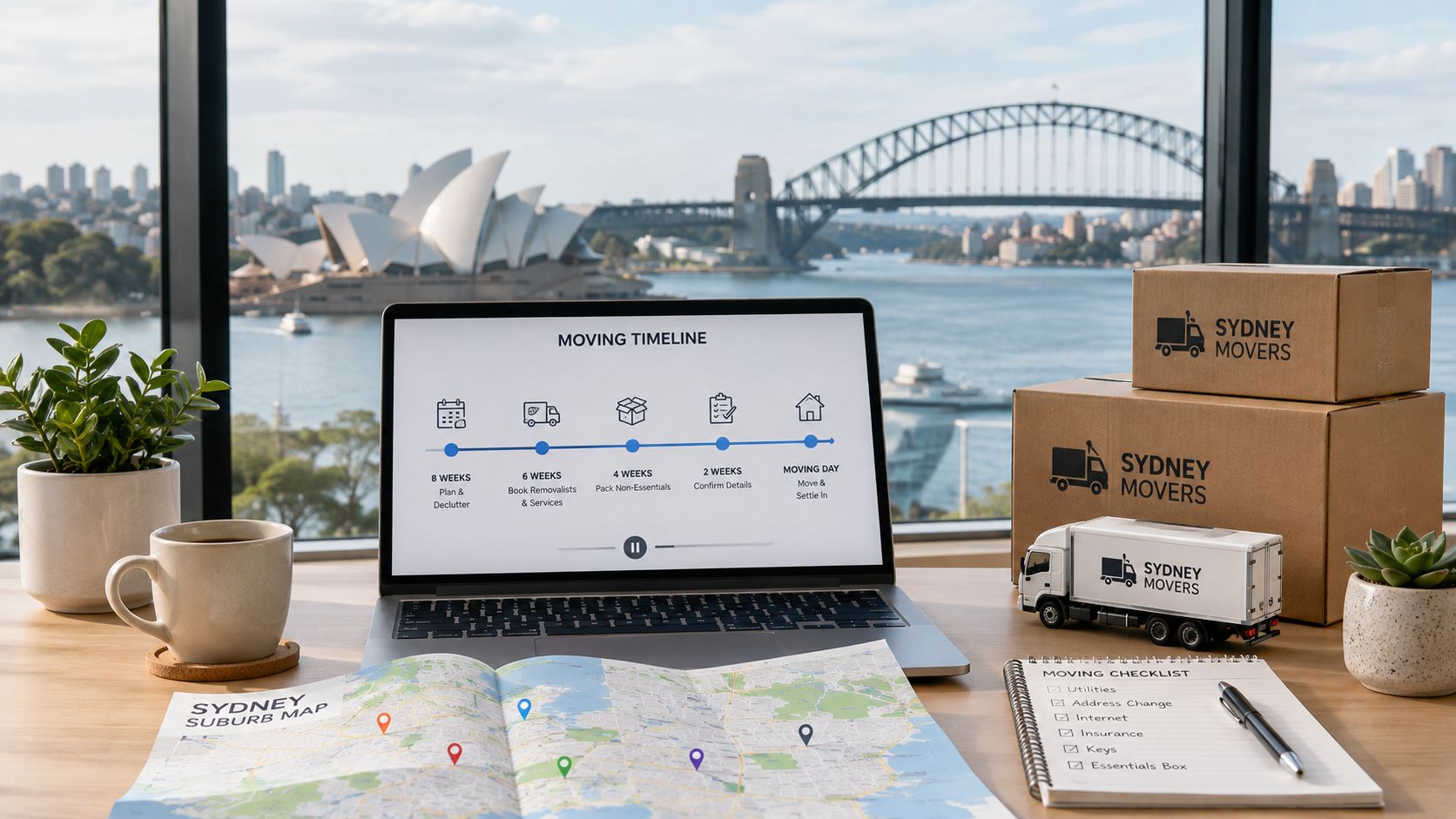
Most smooth Sydney moves are planned 8 to 12 weeks out, with the removalist booked at least 4 weeks ahead during peak season. That lead time gives you room to secure the right date, manage lease handovers, and deal with Sydney's rental and building-access rules before moving day.
You may be standing in a half-packed lounge room, comparing a rental in Parramatta with a house in the Hills District, while your current lease end date, a child's school term, or an office handover is already closing in. Relocation to Sydney isn't a one-way move into the CBD. Greater Sydney gained 75,200 people in the 2024–25 financial year, a 1.4% increase, yet net internal migration was -33,300, meaning more people moved from Sydney to other parts of Australia than moved in domestically, according to this Sydney migration analysis.
That churn creates two practical realities. You may be moving into Sydney, out to another NSW corridor, or from one Sydney subregion to another, and the easiest move depends less on the postcode than on timing, access, rental supply, and the volume of furniture you're carrying.
Planning a Sydney Relocation From the First Call to Move-In
A family in Parramatta recently begins with a familiar problem. They want a mid-month Saturday move, their lease end date is fixed, and their child's school term starts soon after the relocation. They haven't settled on the next suburb, but they're already asking removalists for availability.
That's the wrong order. Lock the move date before you lock the suburb, especially if you're targeting a Saturday, the end of a month, or a school holiday period. An eight to twelve-week runway gives you time to compare properties without leaving the removalist booking until the last minute.

Build the move around fixed dates
Use the calendar backwards from the day keys change hands:
- Eight to twelve weeks out: Choose a preferred moving date, request removalist quotes, review lease notice requirements, and identify whether you'll need storage.
- Six to eight weeks out: Shortlist suburbs, inspect homes, begin school enquiries, and confirm whether your current and new properties overlap.
- Four to six weeks out: Book the removalist, confirm packing support, notify the school, and check strata or building requirements.
- Two to four weeks out: Confirm utilities, update addresses, arrange cleaning and repairs, and decide what will be sold, donated, recycled, or discarded.
- Final week: Finish packing, photograph the old property, confirm keys and lift access, and prepare an essentials box.
The Parramatta household's biggest risks aren't dramatic. They're the small clashes that make a move expensive, such as an end-of-month handover, a school holiday booking spike, or a strata building that only allows Saturday access through a pre-booked service lift.
Practical rule: Treat the removalist date, lease handover, lift booking, and key collection as one connected schedule.
If you're still comparing dates, use the Home Removals Sydney move-in quote process to test availability early. A quote is more useful when it includes the actual property addresses, floor levels, parking conditions, lift details, and estimated furniture volume.
Budgeting the Real Cost of a Sydney Move
A Sydney moving budget should be built as a list of cost lines, not a single hopeful figure. The final quote can change with access, packing volume, travel distance, parking, stairs, lift availability, storage, and whether the crew has to dismantle and reassemble furniture.
I won't give you invented hourly ranges or pretend every move fits a standard price. A one-bedroom unit in the Inner West and a four-bedroom house in the Hills District need different estimates because the work is different. A compact unit may involve less furniture but more lift coordination, restricted loading, and longer carry distances. A house may hold much more, but a driveway can let the crew load directly from the front door.
Use a line-item estimate
| Cost line | 1-2 bed unit | 3-4 bed house |
|---|---|---|
| Removalist labour and vehicle | Confirm by inventory and access | Confirm by inventory, access, and travel |
| Fuel or travel charges | Ask whether included | Ask whether included |
| Stairs or lift access | Check building policy | Check stairs, driveway, and internal access |
| Packing materials | Boxes, tape, wrap, labels | Larger quantity and specialist protection |
| Packing labour | Useful for fragile or time-sensitive items | Useful for kitchens, garages, and full-home packing |
| Short-term storage | Consider if lease dates overlap | Consider during settlement, renovation, or downsizing |
| Bond cleaning | Match the lease handover standard | Allow for larger floor area and outdoor areas |
| Pet transport | Arrange separately where required | Arrange separately where required |
| Utility connection costs | Check each provider | Check each provider |
| Rubbish removal | Allow for unwanted furniture | Allow for bulky items and garden or garage clear-outs |
For a practical method to separate labour, transport, packing, storage, and access charges, review these moving cost estimation tips from Endless Storage. Use the framework, then replace its assumptions with your own inventory and building rules.
Watch the quiet budget blowouts
The charges that surprise customers usually come from decisions made late:
- After-hours access: A building may charge or restrict evening lift bookings.
- Parking permits: A truck might not be able to stop where the crew needs it.
- Unplanned storage: A delayed key handover can extend storage beyond the original booking.
- Discarded furniture: Items that won't fit the new home may require removal, recycling, or donation logistics.
- Packing changes: A home that was described as “mostly packed” can become a full packing job on arrival.
Build a contingency for changes, especially if settlement, lease dates, or temporary accommodation are involved. The cost of moving in Sydney also depends on the details you provide, so include photos, stairs, lifts, parking, and oversized items before accepting a quote.
Choosing the Right Sydney Suburb for Your Household
Sydney suburb selection should start with daily friction, not postcode prestige. Ask how you'll commute, where the children can attend school, whether the rental is realistically available, and whether a moving truck can reach the property without blocking a narrow street.
The wider relocation pattern supports that approach. In the 2024–25 financial year, nearly 44% of Sydney departures remained within NSW, with major destinations including the Central Coast, Wollongong, Newcastle, the Southern Highlands, and the Mid North Coast, as detailed in this regional migration and housing analysis. Sydney and regional NSW function as connected relocation markets.
Shortlist by practical constraints
Start with three subregions, then narrow them:
- Inner East and Inner West: Strong access to city employment and established transport, but expect tighter streets, limited parking, and more apartment or terrace access issues.
- North Shore and Northern Beaches: Lifestyle and school considerations can dominate the decision, while steep streets, narrow access, and distance can affect moving logistics.
- Hills District: More family-sized housing and driveways in some areas, but the commute and school catchment need careful checking.
- Western and South-West Sydney: These corridors may offer more rental choice and different access conditions, but inspect the exact street, parking arrangement, and public transport connection.
- Sutherland Shire: A reasonable option for households prioritising space and lifestyle, provided the commute works on ordinary weekdays.
Rental supply isn't uniform across Sydney. The available evidence for 2026 places vacancy around 1.3% to 1.7%, compared with 3% to 3.5% often associated with a balanced market, while another update reports 11,957 available rentals in June 2026 and 12,782 in July 2026, according to this Sydney rental market overview. A separate NSW update reports vacancy around 1.8% in Western Sydney, 2.1% in South-West Sydney, and closer to 0.9% to 1.2% in tighter inner and lifestyle areas, so supply should influence your shortlist.
Before you request a final removalist quote, shortlist three suburbs and inspect the rentals in person. Read the full Sydney neighbourhood guide for newcomers alongside your own commute and school checks.
Apartment Townhouse or House How Property Type Shapes Your Move
Property type often changes a removalist quote more than suburb. A two-bedroom high-rise apartment around Zetland or Chatswood may contain less furniture than a three-bedroom house, yet take longer because the crew must use a service lift, follow a booking window, and move through shared corridors.
A terrace in Newtown or Marrickville creates a different problem. The truck may need to stop away from the front door, furniture may pass through tight entries, and stairs can turn a straightforward load into a slow carry. A freestanding house in the Hills District or Northern Beaches usually offers better drive-up access, although long driveways, steep blocks, narrow gates, and large furniture can still affect the work.
Sydney apartment and strata moves commonly require a pre-booked goods lift or service lift, and some buildings ask for at least 48 business hours' notice, as shown in these strata moving instructions. Some buildings also require a refundable $1,000 damage bond and 72 hours' written notice, according to this removal booking form.
Compare the access before comparing prices
| Property type | Common access issues | Typical cost impact | Key preparation steps |
|---|---|---|---|
| Apartment | Lift bookings, loading docks, corridors, stairs, strata rules | Labour can rise when access is slow or restricted | Reserve the lift, confirm dock rules, measure bulky furniture |
| Townhouse | Stairs, shared driveways, narrow entries, limited visitor parking | Extra carrying and staging can add time | Photograph access, clear shared paths, check visitor rules |
| House | Driveway slope, gates, long carries, garages, outdoor furniture | Volume often matters more than building access | Measure gates, clear the driveway, separate items for disposal |
To reduce cost safely, disassemble beds and tables where appropriate, label every room, reserve the lift yourself, and remove small personal items before the crew arrives. Don't ask movers to rush a heavy item down stairs or through a narrow entry. Careful access planning saves more than unsafe shortcuts.
Choosing Removalists Storage and Insurance in Sydney
A professional-looking quote can still hide the conditions that matter. Read every line and ask what the price includes, how travel is charged, whether packing materials are separate, and what happens if the crew waits for a lift, parking space, or key handover.
Check the removalist's business details, public liability cover, transit insurance wording, claims process, and any relevant industry membership such as AFTA. Insurance isn't interchangeable. Transit cover may apply while goods are being transported, while damage during packing, storage, loading, or unloading can depend on the policy wording.
Decide whether storage solves a real problem
Short-term storage makes sense when your old lease ends before the new keys are available, a renovation delays occupancy, or an interstate move needs staged delivery. Facilities around Alexandria, Silverwater, and the Hills can be useful depending on your route and access needs.
Storage becomes wasteful when you use it as a substitute for making decisions. Sort furniture before the move, measure the new rooms, and separate items that are definitely coming with you. If the delay is uncertain, ask for flexible terms rather than committing to a long storage period.
Ask this before signing: Who is responsible if goods are damaged while they're being packed, stored, or handled between the truck and the storage unit?
Pack for the unload, not just the departure
A weekday Sydney move works better when every box helps the crew place it correctly. Use a room code, a short contents description, and a priority mark such as “first night” or “open later”. Keep documents, medication, chargers, valuables, and children's essentials with you rather than inside the truck.
For office relocations, label by destination desk, department, or workstation. For warehouse moves, identify pallets and equipment by the receiving area before loading begins. For furniture removals Sydney customers often forget to photograph complex assemblies, so take reference photos before dismantling beds, shelving, entertainment units, or office workstations.
Home Removals Sydney is one local option that provides residential, office, warehouse, packing, unpacking, furniture assembly, interstate removals, and storage services. Compare it with other providers on the same basis, using a written inventory and access details rather than choosing on an hourly figure alone.
Utilities Registrations and NSW Tenancy Essentials
Keys don't complete a relocation to Sydney. They start the handover and administration phase, where missing paperwork can create disputes, service delays, or unnecessary stress.
Renters should compare the new property against the condition report immediately and record any marks, damage, missing fittings, or cleanliness concerns. NSW guidance requires tenants moving out to return the property in a condition similar to its move-in condition, remove belongings, complete repairs beyond fair wear and tear, and arrange the final inspection and bond return with the landlord or agent, as set out in the NSW moving-out guidance.
Create a handover folder
Keep the following together, digitally and in print:
- Condition evidence: Save the signed condition report and dated photos.
- Bond records: Keep bond lodgement details, agent correspondence, and final inspection notes.
- Meter information: Record electricity, gas, and water readings where applicable.
- Keys and access: Confirm every key, swipe card, garage remote, and mailbox key.
- Inspection documents: Check the latest smoke alarm inspection record alongside the lease paperwork.
NSW rental homes must have at least one smoke alarm in a hallway outside a bedroom, or another suitable location, on each storey, according to the NSW smoke alarm requirements. Tenant paperwork should also include the most recent inspection record confirming testing and compliance, as explained in this NSW tenancy rights guide.
Connect services before the boxes arrive
Arrange electricity and gas with your chosen provider, organise water matters with Sydney Water, and schedule nbn activation as early as the property allows. Ask whether the provider is connecting a new service or transferring an existing account, because the process and timing can differ between addresses.
Also update your address with Services Australia, the ATO, your bank, insurer, employer, subscription services, and the NSW driver licence authority. Register pets with the relevant local council and confirm any strata rules before bringing them into an apartment or townhouse.
Connection charges can be easy to miss, particularly in homes with solar equipment. This connection fee explanation for solar homes is useful when checking what an energy provider may charge during setup.
Your Final Week and Move-Day Checklist for Sydney
The final week needs a run sheet, not a pile of reminders. Sydney access rules, traffic, key handovers, and building bookings can all fail at the same time if nobody owns the sequence.
Use a seven-day countdown
- Day seven: Confirm the removalist arrival time, inventory, packing completion, addresses, parking arrangements, and any oversized items.
- Day five: Reconfirm the strata lift, loading zone, building contact, and move-in or move-out window.
- Day three: Defrost and clean the fridge, finish non-essential packing, and separate rubbish, donations, and items travelling with you.
- Day one: Take final meter readings, clean the property, pack the go-bag, and place keys, remotes, documents, and phones in one accessible location.
- Move day: Complete the walkthrough, supervise loading, protect floors and entries, check every room, and hand over the old keys as agreed.

Call the foreman the day before. Confirm the truck arrival point, lift booking, access code, parking instructions, and the person authorised to make decisions. If you're moving through a CBD building, follow the loading-dock rules. Sydney loading docks commonly require prior notice, restrict parking at the dock itself, and limit unloading to specified windows, according to this Sydney loading-dock guidance.
Weekday traffic around the Harbour can punish a loose schedule, while weekend loading-bay rules may prevent the truck from stopping where you expect. Keep the first-night box with bedding, towels, medication, chargers, basic cookware, children's items, pet supplies, and a change of clothes.
The move should follow a simple order: final walkthrough first, loading supervision next, travel and access coordination after that, then room-by-room unloading. Once the furniture is placed, check damage, confirm utilities, collect every key, and leave the essentials box open before tackling the rest.
Home Removals Sydney handles local home removals, furniture removals, office relocations, warehouse moves, interstate removals, packing, unpacking, assembly, and secure storage across Sydney and Australia. Request a quote through Home Removals Sydney, and provide your move date, addresses, inventory, stairs, lifts, parking details, and storage requirements so the team can plan the job properly.
