

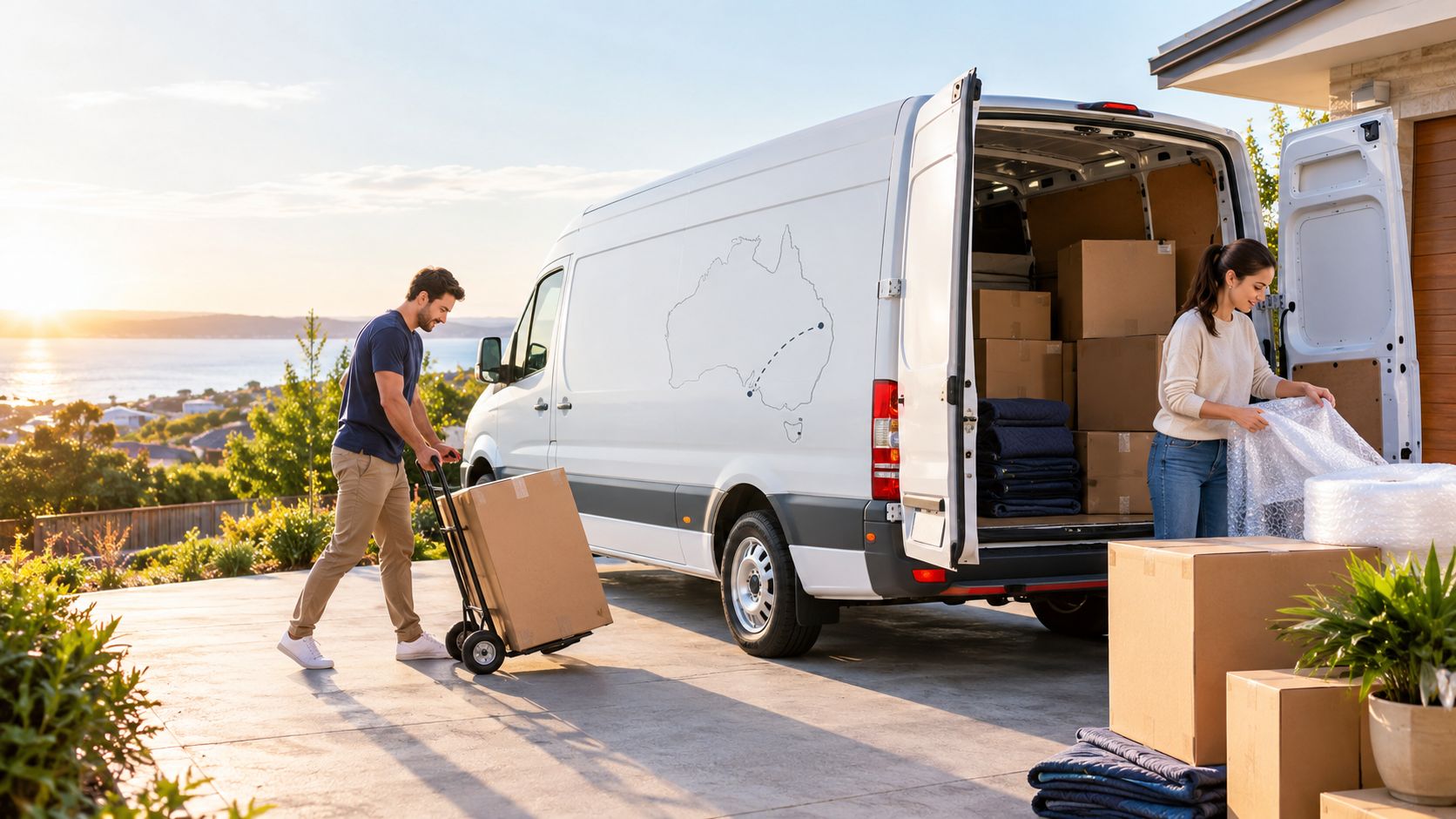
You've found a Sydney removalist quote that looks manageable, then noticed the extras, the narrow pickup window and the amount of furniture still hiding in the spare room. That's where interstate budgets usually start to move. The cheapest way to move interstate in Australia isn't choosing the lowest headline price. It's matching your volume, route, timing and level of help so you don't save money in one place and lose it through labour, storage, damage or rushed decisions.
For most flexible household moves from Sydney, backloading is the strongest starting point. Industry guidance places it at roughly $60–$75 per cubic metre, and it can be up to 50% cheaper than hiring a dedicated truck (Australian interstate moving cost guidance). The catch is that your dates and delivery window need to fit a truck that's already travelling your way.
Why Interstate Moves Cost More Than People Expect
A Sydney family may accept a $1,400 backload quote to Melbourne, then see the invoice exceed $3,200 after additional charges. Fuel levies, stairs, transit protection and a Friday uplift can change the total. Those figures illustrate how quote structures work, not a universal price.
The quieter costs are often more damaging to a budget. Depot handling, regional fuel adjustments, GST on insurance waivers, tolls, parking and access delays can all appear outside the headline figure. A crew carrying furniture through a narrow apartment building, waiting for a lift or parking streets away spends more labour time on the same cubic metres.

The quote is an equation
Four variables usually shape the final price:
- Volume: More furniture takes more truck space and needs more handling.
- Distance: Longer routes generally carry higher rates per cubic metre, with published benchmarks ranging from about $150–$190 per cubic metre for trips under 1,000 kilometres to about $230–$290 per cubic metre for trips over 3,000 kilometres (2026 Australian removalist cost data).
- Access: Stairs, long carries, lifts and restricted parking add crew time.
- Timing: A fixed Friday or weekend booking removes the flexibility that helps shared transport stay affordable.
Volume reduction, route choice and timing work together. A smaller load on a flexible route can cost less than a larger load with an urgent delivery requirement, even if both travel on the same corridor.
For broader planning, national guides place interstate moves between $1,350 and $9,260, while another guide places many moves between $2,500 and $8,000 (national interstate moving cost guide). Treat those ranges as boundaries, not promises. A quote becomes useful only after the mover has the inventory, both addresses and access details. Before comparing prices, review the hidden costs of moving so labour, parking and delay risks are included in the decision.
Comparing the Four Main Service Models
Sydney customers usually choose among four service models. Each reduces one cost while shifting another burden to the customer.
| Service Model | Indicative Cost (2-BR, Sydney–Melbourne) | Scheduling Control | Transit Time | Customer Effort | Damage / Delay Risk |
|---|---|---|---|---|---|
| Dedicated removalist truck | Usually the highest-cost option, because the truck is reserved for one move | High | Usually more direct | Low to moderate | Lower handling risk, but the price is less forgiving |
| Shared backload | Often the lowest-cost full-service model, around $60–$75 per cubic metre (backloading cost guidance) | Low to moderate | Flexible window required | Low during loading and unloading | Requires accurate inventory and acceptance of route timing |
| General freight carrier | Suitable for a small number of cartons or pallets | Moderate | Depends on depot network | Moderate to high | Fragile, bulky or awkward household goods may be rejected |
| DIY truck or trailer hire | Vehicle, fuel, tolls and accommodation determine the total | High | Under your control | Very high | Driving, loading and securing goods sit with you |
Dedicated transport suits certainty
A dedicated truck fits fixed settlement dates, larger households and goods that need a direct trip. It also suits office relocations, specialist furniture and delivery appointments. The trade-off is straightforward: you pay for the reserved capacity, whether the truck is full or not.
Backloads suit flexible households
Backloading shares available truck space with other consignments. Dedicated express service is often 40–60% more expensive than backloaded transport. That difference reflects the broader pickup and delivery window required for consolidation, rather than reduced handling standards.
Backloading becomes cheaper when you reduce volume and allow route flexibility at the same time. A smaller consignment on a regular corridor gives the dispatcher more ways to fill unused space. A fixed date, urgent delivery or unusual destination can remove that advantage quickly.
Freight and DIY have narrower use cases
Freight works well for boxed, stackable cartons or pallets. It is less suitable for sofas, wardrobes, large screens and fragile collections that require household removalist handling. Depot collection and delivery may also leave you responsible for extra lifting.
DIY truck or trailer hire gives maximum schedule control, but the quoted vehicle rate is only the starting point. You must provide a capable driver, loading equipment, secure parking and enough time for the route. Fuel, tolls, accommodation, loading fatigue and lost work can turn an apparently cheap hire into the dearer option. If damage occurs because goods were poorly secured, the financial risk also sits with you.
For smaller moves, compare the full labour requirement rather than the transport price alone. Once packing, loading, driving, unloading and recovery time are priced accurately, shared professional transport can be the cheaper choice, even when DIY appears cheaper on the first quote.
How Backloading Actually Works End to End
Backloading starts with space, not with a date. The dispatcher looks at trucks already travelling between Sydney and destinations such as Melbourne, Brisbane, the Gold Coast, Canberra and Adelaide, then checks whether your goods fit the available route and loading sequence.
Start by measuring each item or room in cubic metres. A rough calculation uses width multiplied by depth multiplied by height, but bulky furniture needs practical judgement because irregular shapes create unusable gaps. Photograph sofas, beds, dining settings, appliances and oversized cartons, then send the images with your inventory.

Give the dispatcher usable information
A good booking conversation answers these questions:
- What is the measured volume? Don't describe a home only as “small” or “average”.
- What is the route? A busy Sydney to Melbourne or Sydney to Brisbane corridor usually offers more matching opportunities than an unusual destination.
- What flexibility can you provide? Several possible pickup days allow the dispatcher to consolidate freight.
- Is the service depot-to-depot or door-to-door? These are different services with different handling responsibilities.
- What does transit cover include? Check the value basis, exclusions and whether protection is calculated by kilogram or item.
A route matters more than a preferred date. A truck may be available on your chosen day but have no suitable space for your goods, while another truck may have room a few days later. Sydney to Perth can be harder to match than the heavily travelled eastern corridors, which is why route availability affects the price.
Use strong cartons, protect corners and pack goods so handlers can stack them safely. Customers who provide an accurate inventory, keep the driveway clear and make the property accessible in the morning are easier to schedule. If you're considering containerised transport, review how moving with shipping containers changes loading, access and delivery arrangements.
Cutting Costs Through Decluttering, Packing and Timing
Volume is the cost lever you control most directly. Before requesting a quote, walk through each room with four decisions: sell, donate, bin or take. Large low-value furniture deserves particular scrutiny because it consumes truck space and may cost more to move than to replace at the destination.
Pack tightly rather than casually. Put pots inside pans, use suitcases for books, disassemble flat-pack furniture and double-bag soft items such as doonas and clothing. Label every carton with its destination room and a short contents description. That makes loading faster and reduces the chance that a box gets treated as an unknown fragile item.
Published home-size guides estimate 10–15 cubic metres for a one-bedroom apartment, 15–25 cubic metres for a two-bedroom home, and 25–35 cubic metres for a three-bedroom home (2026 interstate moving cost planning guide). Actual volume depends on furniture density and what you remove before booking.
Use volume as a decision tool
| Home Type | Pre-Declutter Volume (m³) | Post-Declutter Volume (m³) | Estimated Truck Space Saved |
|---|---|---|---|
| One-bedroom apartment | Measure your full inventory | Aim for a visibly smaller, tightly packed load | The difference between the two measurements |
| Two-bedroom home | Measure furniture, cartons and appliances | Remove low-value and duplicate items first | The difference between the two measurements |
| Three-bedroom home | Include garage, shed and storage areas | Separate items worth replacing from items worth transporting | The difference between the two measurements |
The table is deliberately based on your own inventory rather than invented averages. A virtual walkthrough or itemised list gives a removalist something concrete to price.
Time the route, not just the calendar
Month-end, school holidays, public holiday weekends and Friday departures are popular because leases and work schedules often line up. They're also the windows with less operational flexibility. Mid-week and mid-month departures can open more backload choices, especially when your destination is already on a regular route.
Don't treat a discount claim as automatic. Ask the carrier to price two realistic windows, then compare what changes in the written quote. The practical savings come from combining a smaller load with a route and departure period that the truck operator can use efficiently. For a room-by-room sorting method, use this decluttering guide before moving house.
Hybrid Approaches That Blend DIY and Professional Help
The hybrid move is often the sensible middle ground. You pack and organise the household, then pay professionals for the parts where equipment, speed and lifting technique matter most.
A typical plan works like this:
- Prepare at home: Box, label and photograph everything before the crew arrives. Disassemble beds, tables and flat-pack furniture where you can do so safely.
- Load professionally: A removalist crew loads the truck, protects furniture and uses the available space properly.
- Share the long haul: Your goods travel on a backload rather than occupying a dedicated truck.
- Unload with support: A crew at the destination places furniture where you need it, while you handle unpacking and final assembly.
This approach reduces the customer's physical effort without paying for a full packing service. It also avoids the common DIY mistake of loading heavy furniture first, creating unstable gaps and making the final cartons difficult to reach.

Confirm the details before paying a deposit
Ask for a written quote that identifies the estimated cubic metres, access charges, loading responsibilities and delivery conditions. Confirm whether transit and loading cover apply, and ask who pays fuel levies, tolls and waiting time if access is blocked.
For a move dispatched from NSW, AFRA accreditation is a useful risk check. The NSW Government states that an AFRA-accredited removalist must have public liability insurance and can provide transit insurance for goods being moved (NSW removalist guidance).
A 30-minute walkthrough before moving day prevents avoidable charges. Check that every box is labelled, furniture is dismantled, lifts and parking are arranged at both properties, and the inventory matches what the crew will see. Unmarked cartons, forgotten furniture in a garage and a missing parking permit can turn a controlled load into a slow one.
When Hiring a Professional Is the Cheaper Option
DIY looks attractive when you compare a truck hire with a removalist's headline quote. The comparison changes once you add the one-way vehicle, fuel, tolls, equipment, accommodation, time away from work, loading effort and the chance of damaging a valuable item.
A Sydney to Brisbane move illustrates the point. A household may hire a truck, pay for fuel and equipment, take time off work and still face a storage stop or a damaged dining table. A professional backload quote can look higher at first, but it may include loading, transport and delivery without transferring those tasks to the customer.
One published cost comparison gives a DIY scenario of $2,200, including $950 truck hire, $300 fuel, $800 for two days of lost wages and $150 for equipment, compared with a $1,950 professional backload quote (interstate moving cost guide). Treat that as an illustration of the calculation, not a guaranteed Sydney to Brisbane price.
Price the hours you'd otherwise give away. If you're lifting, driving, waiting and repairing damage, those hours belong in the move's real cost.
Professional help becomes especially rational when you have heavy or specialist items, a long route without a convenient backload corridor, a firm settlement deadline or no second driver who can tow, shuttle or share the driving. Home and furniture removals are not just transport. They're a risk-management decision.
A Simple Decision Framework and Your Next Step
Make the decision with three questions.
What is the measured volume?
After decluttering, a load under 8 cubic metres points towards backloading. A load between 8 and 20 cubic metres can suit a hybrid plan or a larger backload. Above 20 cubic metres, compare a full-service removalist with shared transport rather than assuming a small DIY truck will be cheaper.
These thresholds are planning prompts, not fixed industry rules. The item list, access and destination can change the recommendation.
How much timing freedom do you have?
A pickup window of five to seven days can make shared-truck matching easier. A fixed date narrows the dispatcher's choices and may push you towards dedicated transport. If the delivery must happen at a particular hour, convenience and certainty may matter more than the lowest freight rate.
What is your real hourly value?
DIY may suit someone whose available time has little direct cost and who has the equipment, driving confidence and physical capacity. Professional labour becomes more cost-effective when vehicle hire, fuel, injury risk and missed work carry meaningful value. Add those items before deciding that a truck hire quote is cheap.

Request a quote with your Sydney pickup suburb, destination, measured or estimated volume, access details and preferred pickup window. That gives a removalist enough information to provide a useful price band instead of a vague number that changes on moving day.
Home Removals Sydney can arrange interstate removals, self-pack or professional packing, furniture handling, storage and customised loading support for Sydney households and businesses. Visit Home Removals Sydney with your pickup suburb, destination and moving window to request a quote built around the cheapest safe option for your load.
