

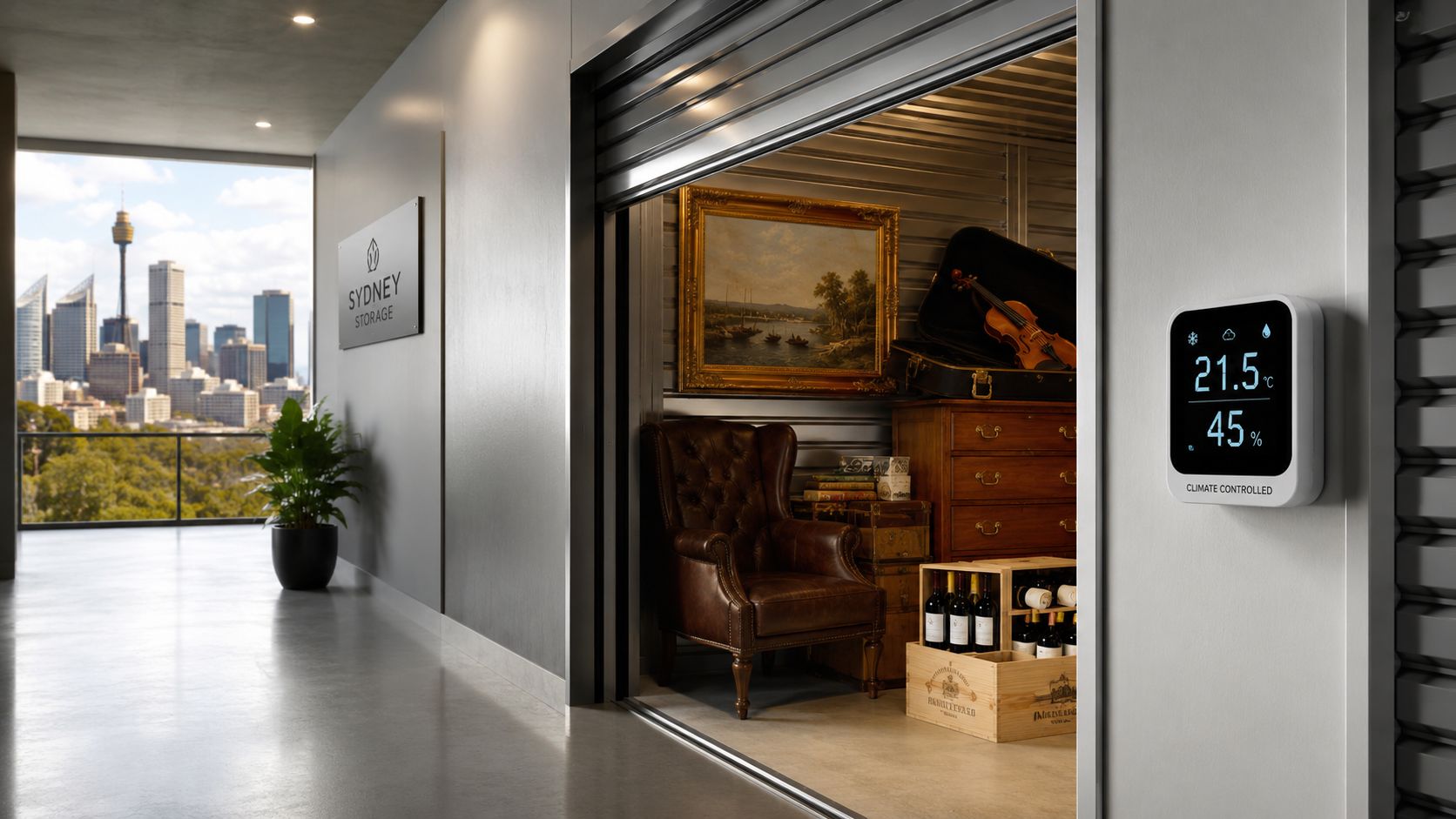
You're probably deciding what to do with a couch, a timber buffet, a few boxes of paperwork, and the rest of the house while you move, renovate, or wait for settlement. In Sydney, that decision gets harder because summer heat, coastal humidity, and a long storage timeline can turn a neat stack of belongings into swollen drawers, musty fabric, or electronics that don't quite work the way they should. Climate controlled storage is the option that keeps those problems from starting in the first place.
What Climate Controlled Storage Actually Means
A Sydney family comes back to collect their timber buffet after a few months in storage, and the first thing they notice is that the drawers don't sit flush anymore. The leather on the lounge has gone dull and tight, and one box smells a bit musty the moment it's opened. That's the moment people realise storage isn't just about keeping items dry, it's about keeping the environment steady.
Climate controlled storage means the unit is designed to manage both temperature and humidity, not just one or the other. In mainstream storage guidance, that usually means a range of about 55°F to 85°F and 30% to 55% relative humidity to reduce mould, warping, and moisture damage see the storage guidance on climate-controlled units. A more engineering-focused benchmark puts practical performance at about 13–29°C with 30–50% relative humidity, using HVAC, insulation, and dehumidification together to limit corrosion, mould, and wood movement practical climate control benchmark.

What to look for in the wording
The tricky part is that facilities don't always use the same language. Some say air-conditioned, some say insulated, and some say temperature-controlled without explaining how humidity is handled. A fan or a cooler room is not the same thing as a properly managed storage environment.
Practical rule: if a provider can't tell you the humidity target in writing, you're probably not looking at full climate control.
A proper system is a building-level setup. It usually includes a regulated HVAC system, a sealed envelope that keeps outside air from rushing in, and dehumidification that stops moisture from building up when Sydney weather changes quickly. That matters because the damage doesn't always show up on day one. It often appears when you open the unit weeks later and realise the space behaved more like a garage than a controlled storage room.
Why Temperature and Humidity Control Matter for Your Belongings
A wine cellar works because the temperature doesn't swing wildly every time the weather turns hot or damp. The same idea applies to storage, only the stakes are more ordinary, a family table, a box of documents, a guitar, or a desktop computer that has to survive until the next move. In Sydney, that matters even more because coastal air carries moisture, and moisture is what turns small fluctuations into long-term damage.
What moisture actually does
Wood reacts first. Timber can swell, then shrink, and that movement is what leads to sticking drawers, split joints, and warped panels. Leather and fabric are next, because damp air lets them absorb odours and lose their finish, while paper goods can curl or cling together when humidity climbs.
Electronics are vulnerable for a different reason. Moisture can contribute to corrosion and internal problems, while heat can stress components even if the item looks fine from the outside. For people storing business records, artwork, or instruments, the issue isn't dramatic failure, it's slow deterioration that's hard to reverse once it starts.
The engineering side, in plain English
A good unit needs four things working together, stable temperature, controlled humidity, filtered air circulation, and sealed construction. A unit that only cools the room but leaves moisture unmanaged can still let condensation form on metal, leather, and timber. That's why written humidity specifications matter just as much as a thermometer reading.
If you want to compare HVAC and moisture control more closely, browse HVAC dehumidifier options is a useful technical starting point. It's the same principle storage facilities rely on, even if the equipment and scale are different.
A simple way to think about it, temperature control keeps the room comfortable, humidity control keeps the belongings stable.
Sydney homeowners often ask whether their items really need both. The answer depends less on how tough the item looks and more on what's inside it, wood, glue, paper, fabric, seals, and electronic parts all react differently when the air changes.
Items That Genuinely Need Climate Controlled Storage
The easiest way to sort your belongings is to ask one question, would I be comfortable leaving this in a hot roof space or a damp garage for a few weeks? If the answer is no, it probably belongs in climate controlled storage. That's especially true for longer stays, because once you move past a short hold, your items are exposed to seasonal swings rather than just a few stable days.

High priority items
Antiques and heirloom furniture need protection because timber movement and finish damage are hard to undo. Electronics and appliances are also sensitive, since heat and moisture can affect internal components. Add fine art, collectibles, musical instruments, leather lounges, and important documents or photos to that same group, because all of them can suffer from warping, mildew, sticking, or corrosion if the air is too damp or too hot.
If you're storing stock for a move, pay attention to packaging as well as the item type. A box of catalogues, branded merchandise, or archived files can look harmless, but paper and coated surfaces still react badly to humidity over time.
Lower priority items
Plastic outdoor furniture, boxed kitchenware, tools, and most clothing in sealed plastic bins can usually handle a standard unit. Those items are less likely to be ruined by a few temperature swings, and they don't rely on a finish, glue line, or electronic circuit to keep their shape. They're the kinds of things people often keep in a shed or garage without much concern.
Rule of thumb: if the item is sentimental, expensive to replace, or sensitive to moisture, climate control is usually worth a closer look.
The practical cut-off is storage time. Once belongings are sitting for longer than 30 days, the odds of seeing a real seasonal effect increase, so the case for climate control gets stronger, especially in Sydney's coastal conditions. Short stays can be fine in a standard unit if the items are durable, but longer storage deserves a more careful decision.
Climate Controlled vs Standard Storage in Sydney
A standard storage unit is a good fit for sturdy, low-risk items. A climate controlled unit is the better choice when the contents are sensitive, the storage period is long, or the replacement value is high enough that a bit of extra monthly cost makes sense. The useful question isn't which one is “better” in the abstract, it's which one matches your belongings and your timeline.
| Factor | Climate Controlled | Standard |
|---|---|---|
| Temperature stability | Actively managed to stay within a set band | More exposed to outside swings |
| Humidity control | Designed to limit moisture build-up | Usually little or no humidity management |
| Air quality | Often better circulation and filtration | Basic circulation only, if any |
| Best use case | Wood, leather, paper, artwork, electronics, longer storage | Durable goods, short-term storage, low-risk items |
| Cost | Higher, because of HVAC and building design | Lower and simpler |
| Risk profile | Better for sensitive inventory | Better for sturdy goods that can tolerate change |
Where the middle ground sits
Some Sydney facilities sit between the two. They may use a central system for the building rather than independent controls in every single unit, so the environment is managed but not always identical from one room to another. That's why it pays to ask exactly how the system works, not just whether the building has climate control somewhere in the brochure.
Sydney's market also has a practical split by customer type. If you're moving a sofa, a few boxes, and a dining table for a fortnight, standard storage can be perfectly sensible. If you're storing furniture during a renovation, or keeping office records and stock through a longer interstate move, climate control gives you more protection against avoidable damage.
The cost premium is real, so the choice should be deliberate. If the items are replaceable and the storage period is brief, standard storage is usually enough. If the contents are hard to replace or vulnerable to moisture, the premium starts to look like insurance rather than a luxury.
What Climate Controlled Storage Costs in Australia
Climate controlled units usually cost about 20% to 50% more than standard storage, and the most commonly reported premium sits around 25% to 40% more industry pricing overview. That difference isn't random. It reflects the cost of HVAC operation, better insulation, and the kind of building construction that keeps the internal environment steadier in the first place.
What drives the premium in Sydney
Sydney facilities often carry higher operating costs because climate systems have to work through warm, humid periods, especially in coastal suburbs where moisture loads are higher. Better-located sites also tend to charge more, and modern buildings with tighter insulation and monitoring usually sit at the higher end of the market. You're not only paying for conditioned air, you're paying for the building design that holds that environment steady.
A useful benchmark from self-storage pricing data shows climate-controlled units often sit above standard units even where the storage format is otherwise similar Self Storage Association data spotlight. That lines up with the usual experience in Sydney, where the location and the quality of the building change the quote as much as the unit size does.
How to judge whether it pays off
A simple way to think about it is to compare the monthly premium with the replacement value of what you're storing. If the contents include timber furniture, electronics, artwork, or family archives, even a modest upgrade can make sense because the cost of damage can be far greater than the storage difference. If the unit is holding durable household items you'd happily keep in a garage, the extra spend may not return much value.
For Sydney planning and budgeting, how much storage costs in Sydney is a practical companion read when you're comparing unit types and durations. It's also smart to remember that inner-city and waterfront facilities can price differently from western Sydney warehouses, so quotes should be checked suburb by suburb rather than treated as one flat market rate.
Packing and Preparing Items for Climate Controlled Storage
Climate control works best when the packing supports it. If you wrap a leather lounge in plastic and seal in moisture, you've made the unit work harder than it should, and you've also increased the risk of sweating inside the wrap. The goal is to let the storage environment stabilise your items, not trap heat and moisture around them.
Packing choices that help
Use acid-free tissue paper for photographs and artwork, because ordinary paper can leave marks over time. Choose breathable cotton covers for leather and timber instead of cling wrap, so air can move without letting dust settle. Leave small gaps between items, because crowded furniture blocks circulation and creates pockets where humidity can linger.
Boxes should stay off the concrete floor where possible. Pallets or shelving give air a path underneath the load and help reduce contact with any residual moisture in the slab. It also makes it easier to inspect the unit without shifting half the contents around.
Label for sensitivity, not just room type
A good label should tell the storage team what needs the most careful placement. Mark boxes containing documents, artwork, electronics, or instruments so they can sit in the most suitable part of the unit, away from heat sources and away from the door line if the facility gets frequent access traffic. That small step saves time later and lowers handling risk.
For framed art and delicate pieces, the packing approach matters as much as the box itself. How to pack artwork for moving is a helpful reference if you're dealing with canvases, prints, or framed pieces that shouldn't be tossed into a standard carton.
Practical rule: climate control can't fix poor packing. If an item needs airflow, don't suffocate it in plastic.
Professional removal teams usually handle this by grouping sensitive items together, choosing the right packing materials, and arranging the load so fragile pieces aren't crushed by heavier furniture. That's especially useful for homeowners juggling renovations, interstate moves, or office relocations, where the storage unit becomes part of the moving process rather than a separate task.
What Climate Control Does Not Protect Against in Sydney
Climate control manages the conditions inside the unit, but it doesn't solve every risk outside it. Sydney storage customers still need to ask about flood exposure, smoke intrusion, security, and what happens if power cuts out for a while. The best unit in the world won't help much if the site itself is poorly chosen.

The protection it does give
Stable temperature and humidity are the main benefits. That lowers the chance of mould, mildew, and the slow material damage that affects wood, paper, textiles, and electronics. Those benefits are real, but they sit in one layer of protection, not the whole risk picture.
The risks it doesn't remove
Flooding is still a site issue, which means you should ask whether the building sits above likely water entry points and how the ground level is designed. Smoke can still be a problem during bushfire season if the ventilation path allows outside air in, so the building design matters. Power interruptions also matter because a climate system can only regulate the room while it's running, and a prolonged outage changes the environment inside the facility.
For a deeper look at building resilience, forensic waterproofing inspection NSW is a useful reference because it shows how site condition and waterproofing affect what happens when water gets where it shouldn't. That's the same kind of thinking worth applying before you trust any storage site with furniture, paperwork, or stock.
If you're comparing facilities, ask direct questions. Is the unit above flood level? Is the building raised or slab-sealed? Does the HVAC have backup power? Is there off-site monitoring and alarm coverage? Those questions are boring, but they're the ones that matter when weather or infrastructure goes off script.
Choosing the Right Sydney Storage Partner for Your Move
A good storage provider should be able to answer a practical checklist without hesitation. Ask what temperature and humidity range is maintained, how those conditions are monitored, whether the facility has 24/7 access, what security is included, and whether the site is designed with flood resilience in mind. If the answers sound vague, that's usually a sign to keep looking.
What to ask before you book
- Temperature and humidity: Find out the actual range, not just whether the unit is “air-conditioned”.
- Monitoring: Ask how often conditions are checked and whether alarms are tied to the system.
- Security: Look for controlled access, cameras, and clear site procedures.
- Access hours: Make sure the site fits your move schedule, not the other way around.
- Insurance: Confirm what cover applies before you place valuables inside.

Why the storage and move should work together
For many Sydney households, the safest outcome comes from connecting storage with the move itself. That way, the same team can pack sensitive items properly, transport them carefully, and place them in the right part of the unit without unnecessary handling. It's a cleaner process for home removals Sydney, furniture removals Sydney, and interstate removals where timing and item sensitivity both matter.
If you're comparing suburbs or trying to line up a move with temporary storage, the location guide at storage solutions and locations is a useful place to check what's available. The main thing is to treat storage as part of the move, not an afterthought.
For homeowners, renters, and businesses, the right choice is usually the one that matches the value of the goods, the length of storage, and the site's resilience. If you're storing timber furniture, documents, artwork, electronics, or office stock, climate control plus proper site design is the combination worth looking for.
If you're planning a move, renovation, or interstate relocation, get a custom storage and removals quote from Home Removals Sydney. They offer secure, 24/7-access storage alongside careful moving support, so you can protect sensitive items without juggling multiple providers. Use the 60-second form to request pricing that suits your job.
