

Australian moving research from Airtasker estimates an average relocation cost of $5,267. The hourly rate is only part of the cost. Missed work, overlapping rent and access delays can add pressure, especially when a truck waits for a lift or loading access.
Plan around the property, not just the postcode. A Parramatta apartment, an established Fairfield house and a new build in Austral call for different vehicles, access checks and schedules. A site assessment helps match the quote to the job.
Western Sydney Coverage Map by Subregion
The NSW Government's Western Sydney snapshot describes the region's communities and local government areas. Home Removals Sydney operates from Fairfield, covering Western Sydney, the rest of Sydney and interstate routes.
Population growth adds demand across areas with different access conditions. ABS regional population figures report that Greater Sydney added 107,500 people, or 2.0%, in 2023–24. Net overseas migration was the largest contributor, according to CommBank's Western Sydney demographic overview.
Western Sydney removal zones and their typical logistics
Use these groups to start access planning, not as fixed geographic boundaries. A suburb label cannot confirm truck access at a particular address, and the final quote depends on the property and route.
| Sub-region | Example suburbs | Typical property | Main logistics issue |
|---|---|---|---|
| Parramatta and inner-west fringe | Parramatta, Granville, Merrylands | Apartments and older houses | Lift bookings, strata approval and tight kerbside access |
| Fairfield and central-west established areas | Fairfield, Merrylands, Blacktown | Detached homes and townhouses | Narrow streets and limited kerb parking |
| Bankstown and south-west | Bankstown, Liverpool, Bonnyrigg | Established homes and townhouses | Local traffic and limited kerb space |
| The Hills and north-west growth areas | Box Hill, Marsden Park | Family homes and newer estates | Construction traffic and unfinished roads |
| Penrith and Nepean | Penrith, St Marys, North St Marys, Tregear | Mixed housing on larger lots | Growth-corridor traffic and cross-region travel |
| South-west growth areas | Austral, Cobbitty | Greenfield estates and new builds | Limited kerb space and driveway gradients |
Apartment jobs depend on shared building access. A truck can arrive on schedule and still lose time if another contractor has the loading dock or lift protection has not been approved.
Established suburbs bring different constraints. A spacious house may have no practical truck position near its entrance. For a move in the area, south-west Sydney removalists can use street photographs to assess parking and approach conditions before quoting.
New estates require a current site check. Roadworks, neighbouring construction and driveway access can change quickly, so a map alone is not enough to judge the route. Tregear sits in the Penrith and Nepean group here, while its growth-corridor access conditions may resemble those in newer estates.
Planning rule: Find your suburb, identify the likely access issue, then check whether it applies to your address.
Vehicle Fit and Site Access Checks
Choose a vehicle that suits both addresses, not just the largest truck that can hold the contents. A smaller vehicle may reach a tight driveway or turn on a narrow estate street, while a larger one may reduce trips when access allows. The right choice depends on the inventory and the route from truck to door.
Vehicle sizes vary by provider, so confirm the available options and usable capacity before booking. The moving truck size guide can help narrow the choice, but the removalist still needs details about the load and both sites.
Vehicle fit by move type and site
| Vehicle type | Possible fit | Site needs | Watch-outs |
|---|---|---|---|
| Smaller van | Studio, one-bedroom home or a small load | Legal stopping space close to the entrance | A larger inventory may require more than one trip |
| Mid-size truck | Two- to three-bedroom home or small office | Room to turn and position on the street | Check driveway and road access before confirming |
| Large truck | Larger household, office or warehouse load | Suitable hardstand, loading access and turning room | Confirm vehicle dimensions and receiving-site capacity |
List the rooms, boxes, bulky furniture and any palletised goods. Add garage contents, outdoor furniture and items stored elsewhere. A bedroom count alone can leave out enough belongings to change the vehicle choice.
Then compare the load with the access at each address. A three-bedroom home on a cul-de-sac may suit a smaller truck if a larger vehicle cannot turn or park nearby. Pallets and bulky stock need a stable place to load and unload, with enough room to position the vehicle safely.
Check the approach before confirming the truck
New estates can change as roads, driveways and nearby building work progress. Use current details from the address rather than relying on a map alone. The Transport for NSW population factsheet provides population context, but vehicle choice depends on the actual access and inventory at the property.
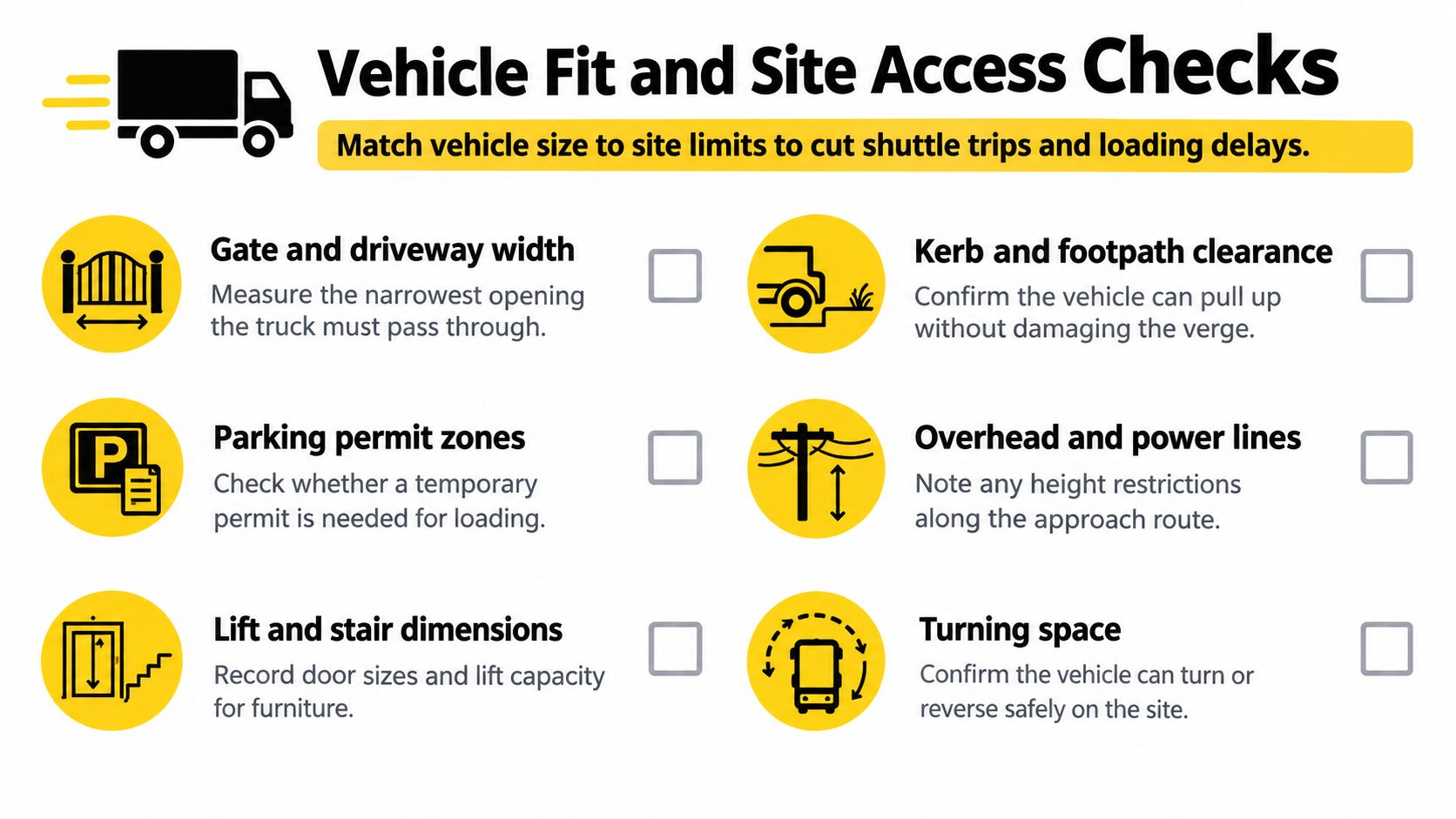
Check the route in the order the crew will encounter it:
- Measure the driveway. Note its length, narrowest width and slope. Include gates and any steep transition from the street.
- Choose a lawful stopping position. Confirm the truck can load without blocking traffic or relying on an unsuitable verge.
- Check kerb restrictions. Photograph nearby signs and confirm whether a loading permit is needed.
- Inspect the road surface. Check whether estate roads and the property approach are sealed, finished and open to moving vehicles.
- Ask about active works. Find out whether builders, deliveries or roadworks could block the route during the booked window.
- Assess turning room. Account for parked cars, cul-de-sac layout and any reversing. Conditions may change by arrival time.
- Book apartment access. Reserve the loading dock and lift with the building manager, and confirm the route for furniture.
- Confirm moving hours. Obtain strata approval where required, then give the removalist the written restrictions.
- Record shared areas. Photograph hallways, stairs and lift interiors before moving items through them.
Check overhead branches, power lines and clearance signs as well. Measure narrow doorways and stair turns if large furniture, a fridge or a cabinet must pass through.
Match the crew to the work
Pianos, antiques and artwork need suitable handling, regardless of truck size. Identify these items before booking so the removalist can assess the protection, equipment and carrying route.
More movers may speed up loading when tasks can be done safely at the same time. A restricted lift or narrow staircase still limits the flow of furniture, so a larger crew may not shorten the job by much.
A larger truck only helps if it can park and the crew can carry items efficiently. If an access detail is uncertain, arrange a site visit or agree on a smaller vehicle and any shuttle arrangement before confirming the quote. The vehicle, crew and site conditions all affect the job time, so clarify them upfront.
Pricing Bands and the Hidden Costs Behind Them
The published starting rate is $120/hr + GST, with quotes adjusted to each job. Use it alongside the hidden moving costs checklist, not as a complete price for every vehicle and crew.
The calculations below are planning scenarios, not measured average durations or fixed offers. They assume the starting rate covers the whole listed crew, which must be confirmed in writing.
Indicative labour bands at the base rate
| Move scale | Typical crew to discuss | Indicative hours for planning | Indicative labour before GST |
|---|---|---|---|
| Studio or one-bedroom home | 2 movers | 2–3 hours | $240–$360 |
| Two- to three-bedroom home | 2–3 movers | 4–6 hours | $480–$720 |
| Four-plus bedroom home | 3–4 movers | 6–10 hours | $720–$1,200 |
| Office or warehouse relocation | Matched to inventory and handling requirements | Site-dependent | Quote required |
These are arithmetic extensions of the stated base rate. Actual pricing depends on the agreed crew, vehicle, scope and charging terms.
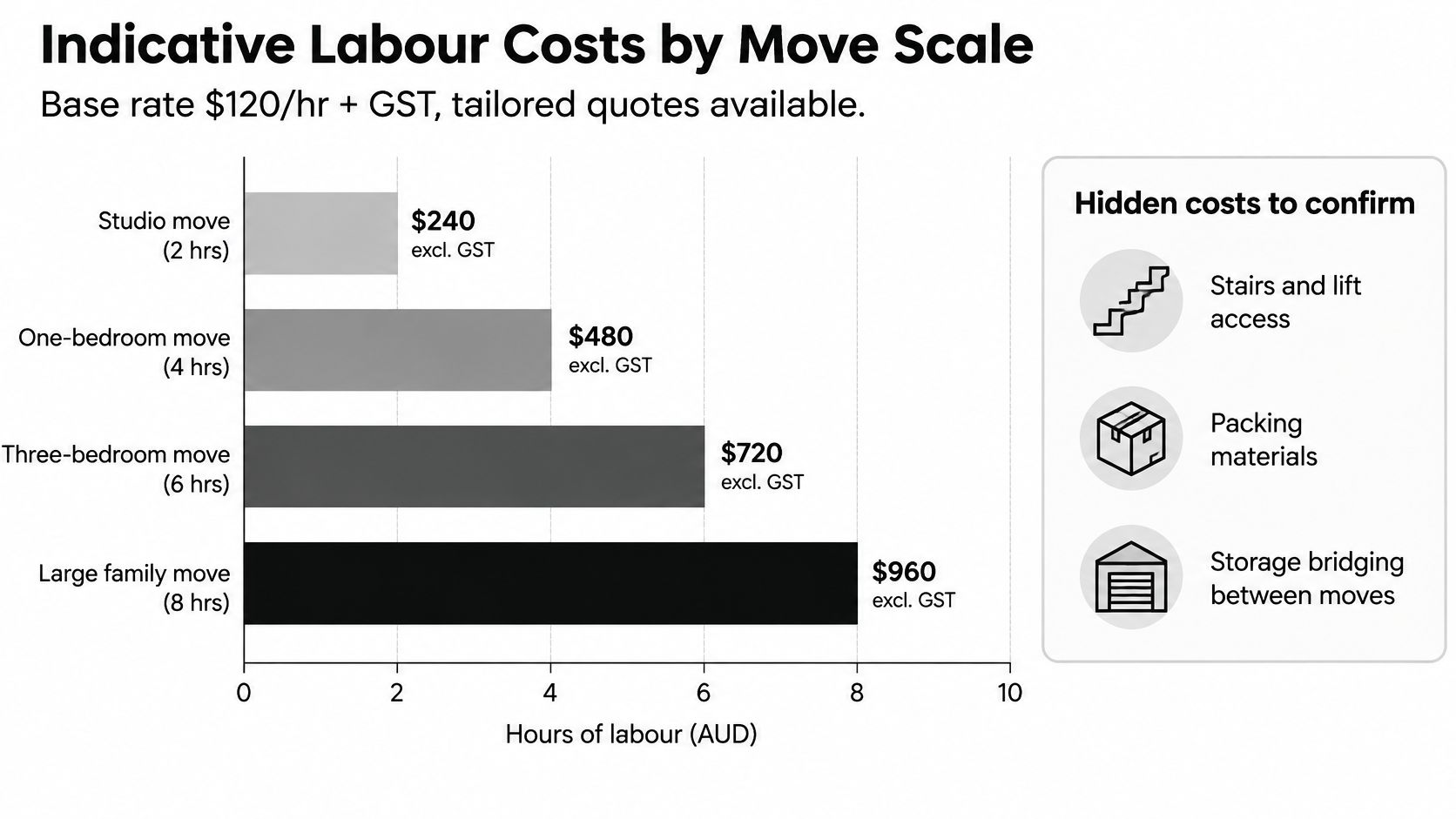
Stairs, a long truck-to-door carry, unfinished packing and furniture assembly can increase working time. Ask when billing starts and stops, how travel is treated, and whether materials or additional services sit outside the hourly charge.
Compare the full disruption cost
The renter figures at the start include costs beyond transport. Keep a separate allowance for:
- Tenancy overlap: Rent payable while both properties remain your responsibility.
- Time away from work: Packing, waiting for access and attending handovers.
- Service changes: Utility transfers and any separate internet installation arrangements.
- Bridging services: Temporary storage and end-of-tenancy cleaning.
Renters generally arrange utility transfers rather than just disconnecting everything. Internet activation needs its own check because the installation date may not match the electricity transfer.
Put key collection, loading windows, cleaning and service dates on the same calendar. For example, a cheaper quote can lose its advantage if a missed handover creates duplicate rent and an unplanned storage booking. That's a hypothetical comparison, not a customer case study.
Quote comparison: Ask what the move will cost if access goes to plan, and what changes if it doesn't.
Storage Options for Gaps Between Moves
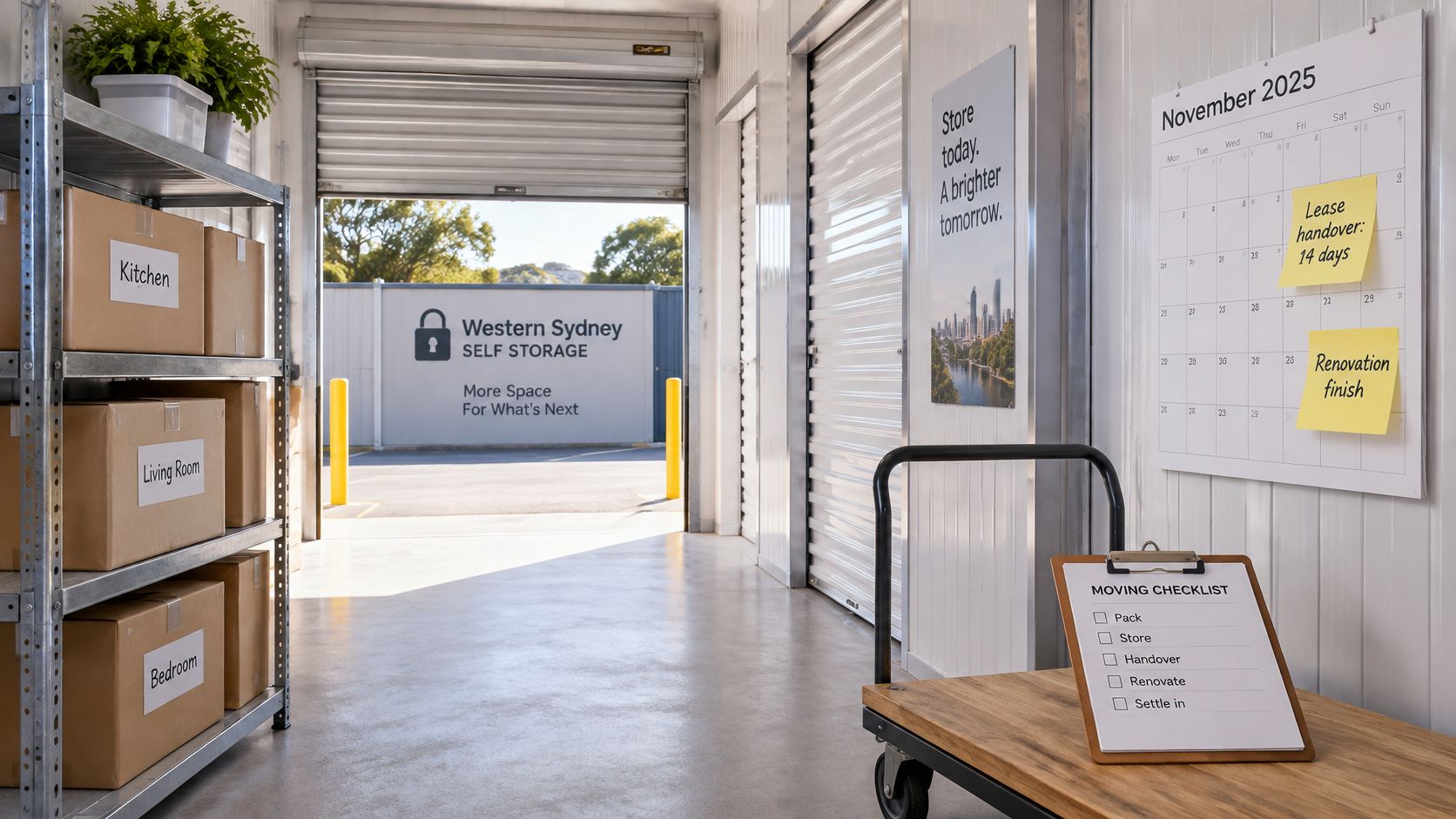
Storage is a timing tool, not somewhere to send an unresolved inventory. It can bridge a lease handover, renovation or business relocation when the destination isn't ready.
Choose the arrangement around retrieval needs. The secure storage service offers 24/7 access, but confirm how that access works for your particular goods and booking.
Storage options and when each fits
| Storage option | Best for | Access | Confirm before booking |
|---|---|---|---|
| Short-term storage, days to a few weeks | Gap between tenancies | 24/7 access | Minimum term and retrieval time |
| Long-term storage, months | Renovations, overseas stays or interstate waiting periods | 24/7 access | Insurance cover and item list |
| Office and stock storage | Files, equipment and pallets during relocation | 24/7 access | Pallet count and stock sequence |
| Staged furniture | New home not ready for delivery | Agreed retrieval or delivery arrangement | Whether the crew handles delivery in and out |
Storage works like a bus stop: the onward trip is shorter when the stop sits close to the destination. Still, location isn't the only consideration. Easy retrieval can matter more than proximity when you need particular cartons or business stock during the storage period.
Confirm the handling arrangement
Ask whether belongings can remain boxed, who unloads them and who prepares them for collection. Establish the minimum booking term, retrieval notice and insurance cover, including any conditions for fragile or high-value items.
Don't assume customer access means a removal crew is available at the same time. Arrange labour separately if heavy furniture or pallets need handling.
Supply a useful inventory before booking:
- Volume: Estimated cubic metres or pallet count.
- Categories: Furniture, cartons, equipment, files or stock.
- Special handling: Artwork, antiques and other fragile or high-value goods.
For staged delivery, mark essential items clearly. You shouldn't have to unpack the entire storage load to retrieve the bed or equipment needed first.
Business and Warehouse Relocation Scheduling
Infrastructure NSW's freight analysis expects most new distribution centres and warehousing to locate in Sydney's south-west and projects NSW gateway container growth of approximately 5–8% annually over a 25-year horizon. That is a planning projection, not a statement of current annual performance.
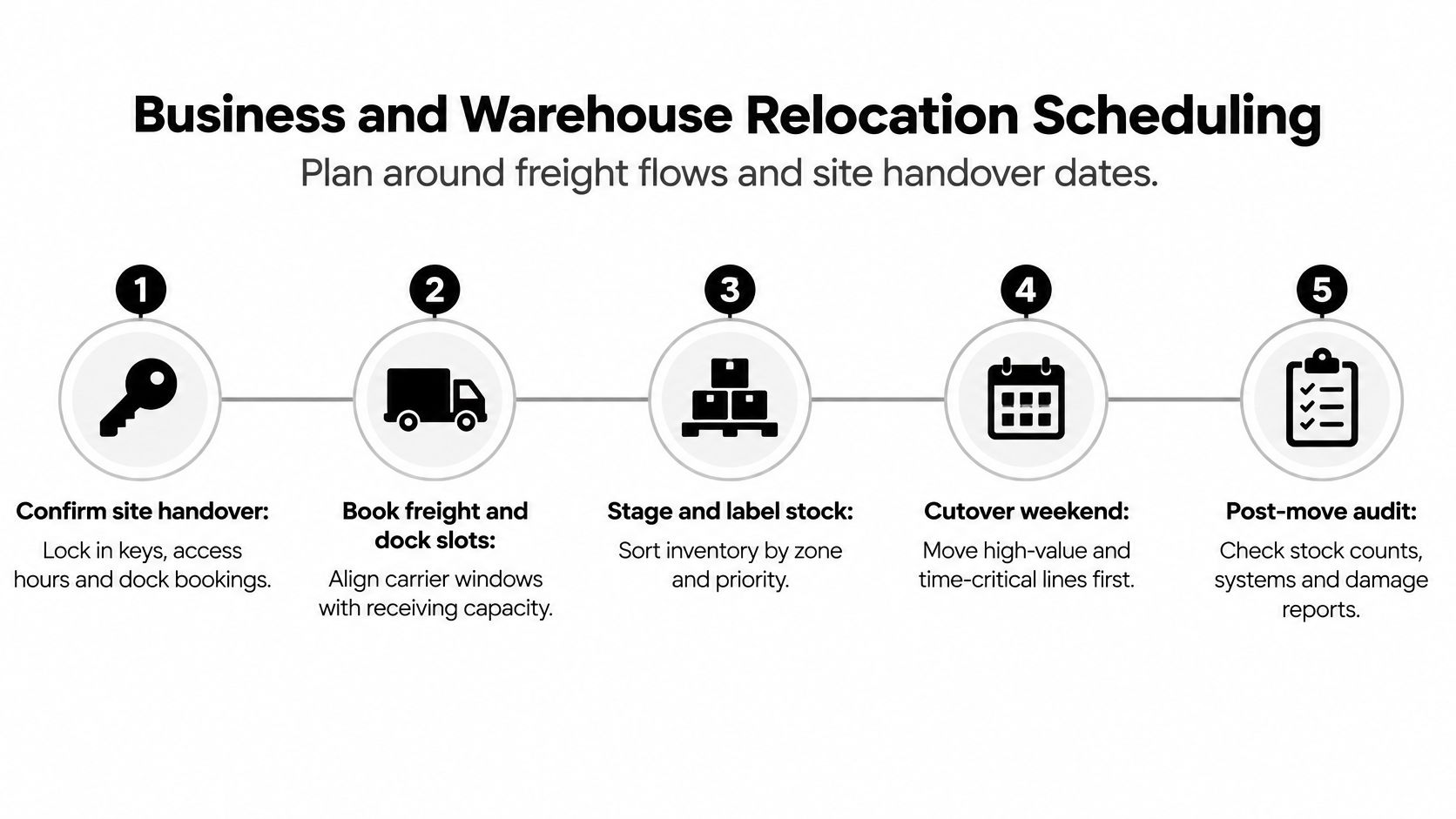
For office relocations and warehouse moves, plan around receiving capacity and road conditions rather than distance alone. The following lead times are a suggested working schedule, not mandatory booking deadlines.
A practical commercial move timeline
- Six weeks out: Audit stock and equipment, then confirm site handover, building loading permits and lift bookings.
- Two weeks out: Stage inventory by destination zone. Separate goods travelling directly, items entering storage and material leaving through disposal or reuse channels.
- Move day: Schedule outside known weekday freight peaks where possible. Use GPS-based arrival buffers and maintain contact with the receiving site.
- Arrival: Unload priority stock first by having loaded it last. Check it against the destination-zone list before releasing the vehicle.
For businesses within the City of Sydney, arrange waste collection during preparation. The council's commercial waste rules require businesses to organise their own collection, produce their contract if requested, and keep bins correctly labelled with lids closed. Material left outside bins is treated as illegal dumping.
Keep the receiving team involved
A labelled pallet still needs an available unloading position and someone authorised to receive it. Confirm handling equipment, clear floor space and the person responsible for checking discrepancies.
For a warehouse, pallet count and loading sequence can matter more than distance. A nearby destination won't make the day efficient if the crew has to rearrange stock repeatedly to reach the required goods.
Household Questions About Bonds, Reports and Disposal
Rental handover essentials
Do I need to photograph the property?
Yes, take time-stamped photographs before furniture enters, including walls, floors, doors, stairs and shared hallways. Under the NSW move-in documentation requirements, the landlord or agent must provide a completed condition report, and you should add comments, return a completed copy within seven days of receiving possession, and retain your copy.
Can I transfer my bond?
Eligible NSW renters can transfer an existing bond through Smart Rental Bonds, as explained in the NSW moving-out guidance. Check eligibility and timing before relying on the transfer to support your new tenancy.
Clearing the old home
What must be cleared before the final inspection?
Remove belongings, rubbish and unwanted items, return keys and leave the property in a similar condition to the original report, allowing for reasonable wear and tear. The NSW moving-out guidance above explains the landlord's ability to claim bond money for relevant damage or unmet obligations, so keep your reports and dated photographs together.
Where does unwanted furniture go?
Usable furniture can be sold, donated or offered for reuse; City of Sydney residents can also book a free weekly bulky-waste collection before putting eligible items outside, following the council's moving waste guide. Apartment residents should check with their building representative first, while households elsewhere must check their own council's service.
The access checklist remains useful during handover. Keep the furniture route clear until the last inspection and collection are complete.
Business Move Questions Answered
Approvals and unwanted items
Do we need approval to move an office?
Check with the building manager before booking, because loading access, lift reservations and approved moving hours may require advance approval. City of Sydney businesses must also be able to produce their commercial waste contract, as noted in the scheduling guidance above.
What happens to old desks, chairs and cartons?
Sort them into relocation, reuse, recycling and disposal streams before move day. Arrange the appropriate collection rather than leaving unwanted office items beside regular building bins, and keep the loading route free for the removal crew.
Timing and quote scope
Can the move happen outside business hours?
It often can, subject to building access, receiving arrangements and crew availability. Agree on the timing when booking so the move can work around operating hours and the freight conditions covered in the business scheduling timeline.
What does a business quote include?
It should identify the crew, vehicle, inventory assumptions, access conditions, insurance and any packing or storage services. Request exclusions and variation terms in writing so you can compare providers on the same basis rather than comparing hourly rates with different inclusions.
For office relocations, nominate someone who can approve room placement and equipment destinations. For warehouse work, nominate a receiving contact who understands the stock plan.
A clear authority chain prevents avoidable waiting. The removal crew shouldn't have to choose between conflicting instructions from different departments while a loading slot is running.
Request Your Western Sydney Quote This Week
A complete inventory and access details help a removalist assess the job before allocating a vehicle and crew. Western Sydney covers different access conditions, so include:
- Identify the move. Give both suburbs, property types and your preferred date.
- Describe the inventory. List rooms, boxes and special items such as pianos, antiques or artwork.
- Record access conditions. Note driveway gradient, parking restrictions, lift hours and loading-dock bookings.
- Submit the enquiry. Send these details through the website's quote form, then ask when to expect a response.
Check the written inclusions
Ask for the crew, vehicle and access assumptions alongside the starting rate already outlined. Confirm insurance terms and whether packing, unpacking, furniture assembly, boxes and bubble wrap are included or charged separately.
Secure storage, flexible scheduling, additional removalists and interstate removals from Sydney can be arranged to suit the scope. Request what you need and identify those needs before the vehicle is allocated. Access delays can add waiting time, while a move that overlaps rent or takes time away from work may cost more overall than the hourly rate suggests.
Use the same inventory and access checklist for each quote. This gives providers the same job to assess and makes price differences easier to understand.
Home Removals Sydney offers local and interstate moving, packing support and storage for households and businesses across Western Sydney. Visit Home Removals Sydney to request a quote, including your inventory and access photographs so the team can assess the suitable vehicle and crew.
