


Your lease is ending, the cupboards are half-packed, and you're still waiting to confirm when you can collect the next set of keys. Or you're leaving Sydney for Rockhampton and trying to work out whether the removal quote covers delivery, storage and the awkward driveway you've only seen in listing photos.
Choosing a Rockhampton removal company means looking beyond the truck rate. The useful quote is the one that accounts for your actual furniture, property access, delivery timing and backup arrangements, so you're not negotiating those details while the crew waits outside.
Who Needs a Removal Company in Rockhampton
A family moving across Rockhampton might need beds dismantled, appliances protected and everything delivered before the children's bedtime. A renter could have a different priority: clearing the property in time for cleaning and the final inspection, even if the next home isn't ready. Neither job is just about transporting boxes.
Rockhampton has a substantial residential base. The Australian Bureau of Statistics recorded 81,968 residents in the 2021 Census, compared with 79,726 in 2016, supporting its role as a regional service centre. That population provides context for continuing household moves, furniture deliveries and interstate relocation needs, although it doesn't establish how many removal bookings occur.
Match the service to your situation
Homeowners usually need to coordinate settlement, key collection and the handover of a largely complete household. Renters need to protect their vacate deadline without assuming a new tenancy will line up neatly. For either group, packing assistance can be useful when work, caring responsibilities or limited mobility make self-packing difficult.
Business owners face another kind of disruption. Office relocations involve desks, documents and equipment that staff need to find quickly after delivery; warehouse moves require attention to stock identification, loading order and receiving arrangements.
- Local households: Prioritise access, packing readiness and where furniture should go at delivery.
- Interstate customers: Confirm collection arrangements, delivery expectations and who coordinates each end.
- Businesses: Identify equipment that must remain operational and goods that need separate handling.
- Renters between properties: Establish somewhere suitable for belongings before committing to a collection date.
Recognise when transport alone isn't enough
A removal service is particularly worth considering when you've got bulky furniture, stairs, difficult access or a deadline you can't easily change. A small load of already-packed belongings may suit a simpler transport arrangement, provided the handling and protection are appropriate.
If the main uncertainty is where your belongings will stay, use Container Self Store's resource to compare storage options for your move. Treat storage as a separate decision about access, protection and retrieval, rather than assuming any available space will suit.
Comparing Local and Interstate Removal Options
A local move and an interstate move need different booking conversations. Within Rockhampton, the practical focus is usually the collection property, the destination and the loading work between them. For a Sydney-to-Rockhampton relocation, you also need a clear transport and delivery arrangement.
This comparison helps separate those decisions.
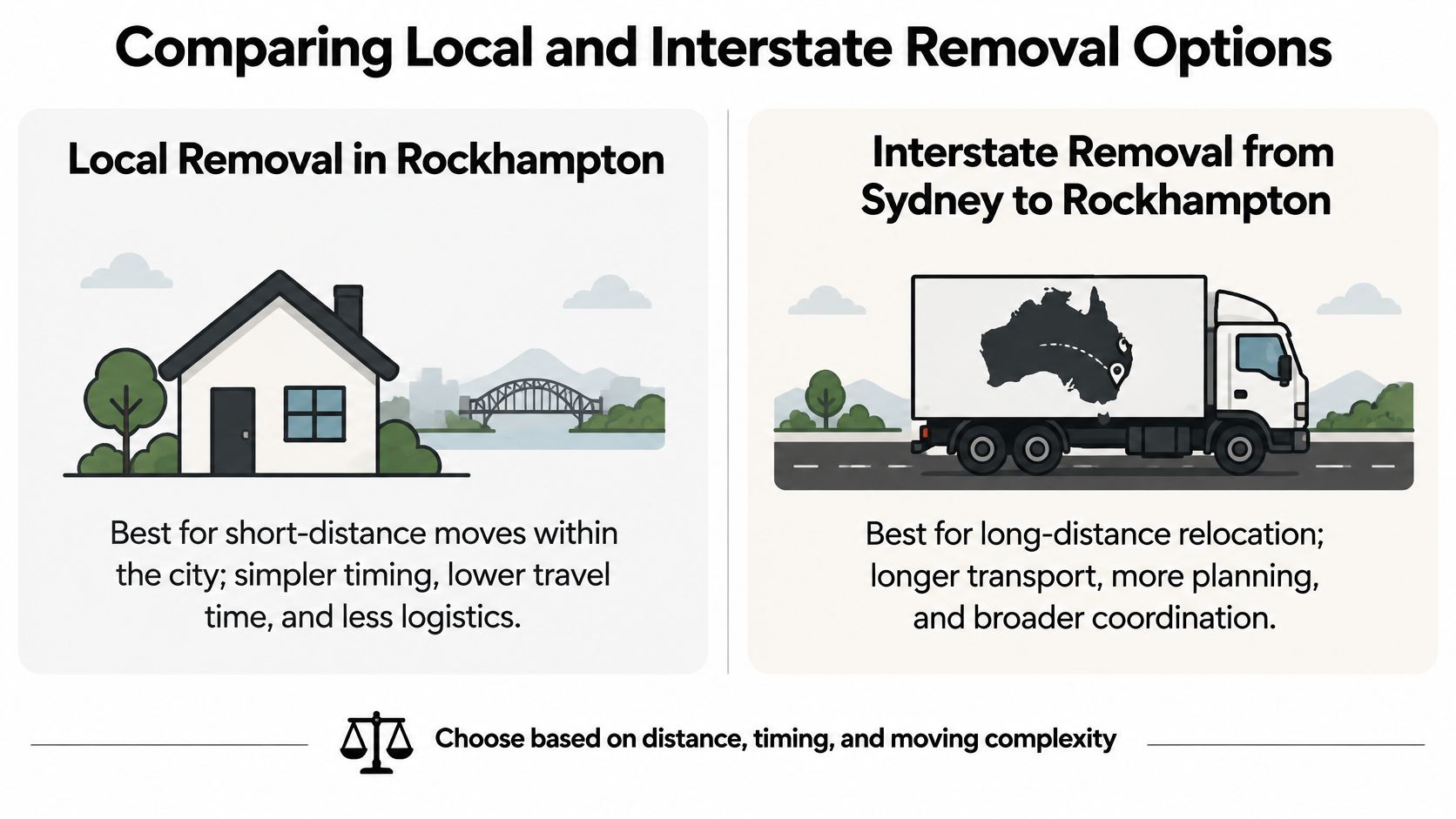
Local convenience versus interstate coordination
A local removal generally involves less travel, making a straightforward collection-and-delivery plan easier to organise. However, don't confuse a short distance with an easy job. A steep driveway, apartment stairs or furniture that needs dismantling can take more attention than the drive.
Interstate removals introduce longer transport and more dependencies. Ask whether your belongings travel directly or share vehicle space, whether delivery is booked for a specific appointment or an agreed window, and what happens if the receiving property becomes unavailable.
| Decision | Local Rockhampton move | Sydney-to-Rockhampton move |
|---|---|---|
| Timing | Coordinate property access and crew availability | Coordinate collection, transport and delivery availability |
| Vehicle | Match the load and property approach | Balance load capacity with route and destination access |
| Preparation | Have goods ready for the booked collection | Prepare for belongings to be unavailable during transit |
| Flexibility | Clarify changes to the day's schedule | Clarify changes to collection and delivery separately |
Assess the provider rather than the label
One option for the Sydney end is Home Removals Sydney, a family-owned removalist based in Fairfield, NSW. Its interstate removal service supports moves across Australia, backed by over a decade of experience and a fleet ranging from 4-tonne vans to 62-tonne trucks. Ask which vehicle and delivery arrangement the team proposes for your actual load.
A broad fleet range doesn't mean the largest vehicle should attend your property. Nor does advertised fleet capacity establish the lawful load for every route. The provider should explain how it will collect and deliver your goods where access is restricted.
Choose the service around the delivery commitment you need, not simply the largest truck or earliest collection offer.
When comparing removalists in Sydney with a Rockhampton-based operator, establish who controls the booking throughout. You should know who confirms arrival, who receives changes and who resolves a delivery problem.
What Removal Costs in Rockhampton Include
The publisher's advertised starting price is $120/hr + GST, but a starting rate isn't a complete relocation budget. Before using it to compare quotes, confirm which crew, vehicle and tasks it covers, when charging starts and stops, and whether your interstate job uses a different pricing arrangement.
A lower hourly rate can produce a higher total if loading takes longer than expected. Conversely, additional removalists can increase the hourly charge while making an awkward job more manageable. The useful comparison is the documented scope and likely total, not the headline rate alone.
Factors That Shape a Removal Quote
| Cost factor | What it affects | What to provide |
|---|---|---|
| Crew size | Handling capacity and labour charges | Bulky items, stairs and awkward carries |
| Time on site | Loading, unloading and placement | Packing readiness and distance from truck to door |
| Packing and unpacking | Labour and preparation scope | Rooms needing help and fragile contents |
| Furniture assembly | Tools, labour and reassembly work | Bed, desk and shelving details |
| Materials | Boxes, bubble wrap and protection | What you already have and what needs supplying |
| Vehicle size | Load allocation and access arrangements | Complete inventory and property photographs |
| Storage | Space, handling and later delivery | Goods to store and anticipated retrieval arrangements |
| Specialist items | Equipment and handling requirements | Piano, antique or artwork details and photographs |
Read the assumptions behind the estimate
For furniture removals from Sydney, a description such as “household furniture” leaves too much unresolved. A solid timber table, flat-pack shelving and a piano don't call for the same handling plan. Mention fragile finishes, oversized pieces and anything that can't be dismantled.
Packing is another common difference between estimates. One provider may price transport for sealed, labelled cartons; another may include wrapping furniture but exclude packing kitchen contents. Neither arrangement is necessarily unsuitable, but they aren't equivalent.
- Ask about travel charges: Establish whether depot travel, waiting or changes to the route are included.
- Separate optional services: Request clear pricing for packing, unpacking, materials and assembly.
- Identify specialist care: Don't leave antiques, artwork or difficult items until collection day.
- Record exclusions: Ask what circumstances could change the estimate and how you'll approve extra work.
Quote check: If you can't tell what the crew is expected to do, you can't reliably compare the price.
Keep the accepted inventory and service description with the quote. If your load changes, update the provider before the booking rather than relying on spare truck space.
Planning Around Heat, Rain and Flood Risk
Rockhampton's weather should influence the loading plan, not just what you wear. Bureau of Meteorology climate data records average rainfall of 139.3 mm in February, 127.0 mm in January, 105.0 mm in March and 103.6 mm in December, with average maximum temperatures reaching 32.3°C in December and 32.1°C in January.
Wet loading can expose cartons to water and make walking surfaces slippery. Summer heat can soften adhesives, stress electronic equipment and increase the heat load for workers inside a truck. Booking an earlier loading window where practical is useful, but it doesn't replace protection or a weather contingency.
A driveway check should cover weather exposure as well as available space.
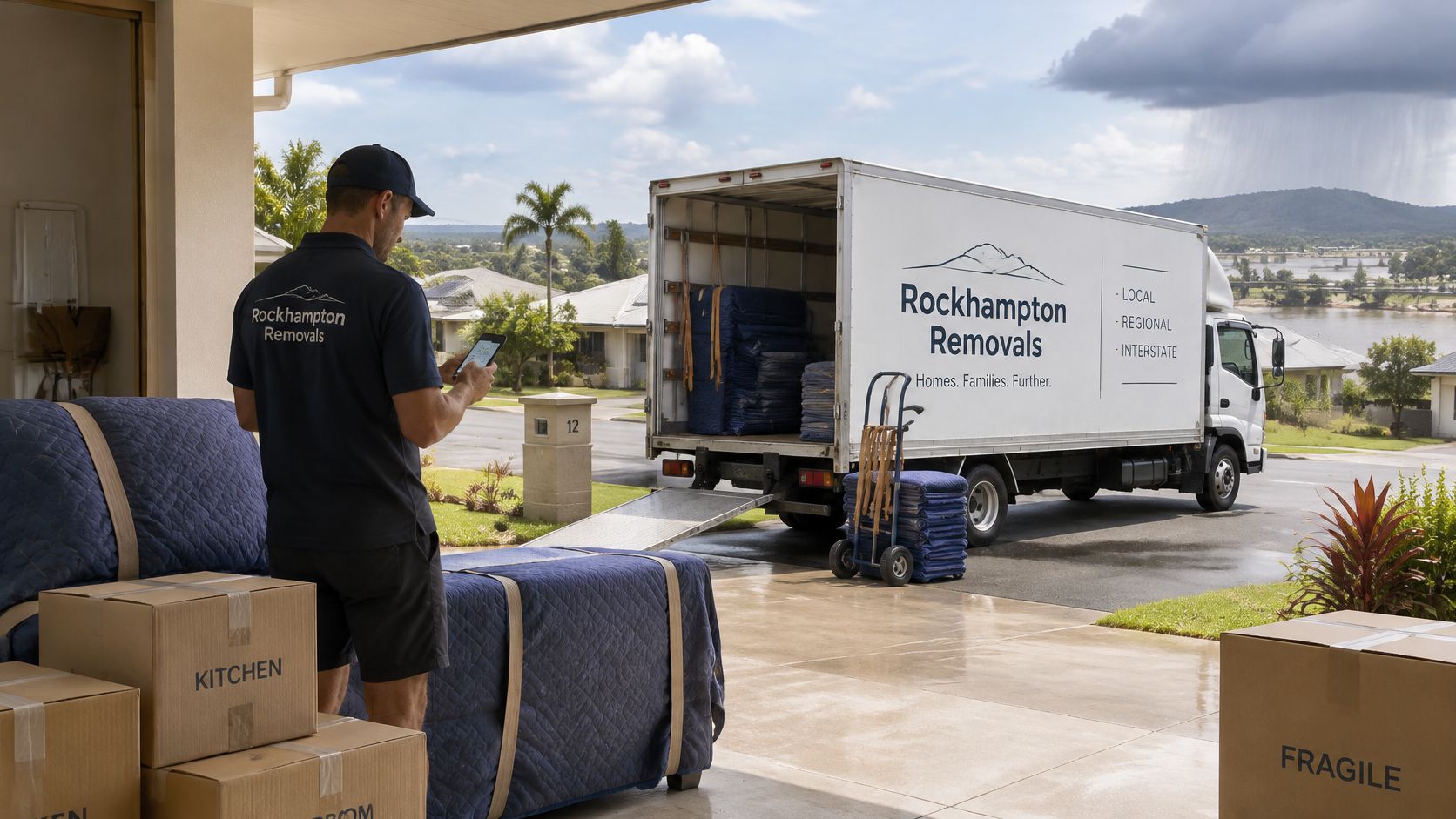
Protect goods before opening the truck
Keep packed cartons indoors or raised under suitable cover until the crew is ready. Use moisture-resistant floor protection along the carrying route and appropriate plastic wrapping for upholstered furniture exposed during loading. Don't leave electronics waiting in direct sun.
- Before collection: Confirm a sheltered staging area and keep doorways clear.
- During loading: Protect the route without creating loose edges or slippery surfaces.
- If conditions deteriorate: Pause and reassess rather than continuing because the truck has arrived.
Queensland's official flood preparation guidance advises moving valuables higher, securing outdoor items, relocating pets and placing hazardous materials above expected flood levels. Apply that thinking to packed goods, outdoor furniture and cleaning chemicals awaiting removal.
Agree on the postponement trigger
Postpone when the crew can't safely reach, load or leave the property, or when official directions prevent the trip. Ask who makes that decision, how you'll be notified and what rescheduling or waiting charges could apply.
For broader location research, you can compare disaster risk with ReloMaps. Use that alongside current official advice, not instead of checking the conditions affecting your particular address and route.
Keep flood-exposed goods separate, photograph existing water damage and discuss their suitability for transport before loading. Confirm disposal arrangements for unwanted or damaged items rather than assuming normal waste access will be available.
Safe Handling and Truck Access on Moving Day
A fridge at the bottom of stairs is an equipment and access problem, not a test of strength. The same applies to dense cartons carried along a driveway or furniture manoeuvred onto a truck ramp. The crew needs a method that suits the load and the route.
WorkSafe Victoria's hazardous manual handling guidance supports using moving aids, reducing awkward postures and excessive force, and organising work to control handling risks. Keep loads close to the body, avoid unnecessary overhead lifting and store heavy items at low, accessible heights.
Equipment should match the carrying route
Trolleys and moving devices are particularly useful for heavy boxes over long carries. However, equipment needs to suit the surface and available space. A trolley doesn't resolve a narrow stair landing, and extra workers don't remove the need to assess an unstable load.
For warehouse and pallet relocations, grouping suitable dense cartons on pallets can reduce repeated carrying. For household furniture, assigning additional staff to awkward pieces can help the crew control the item without relying on an individual's lifting strength.
- Show the full route: Include gates, steps, ramps and the approach from the parking position.
- Identify handling concerns: Flag unstable furniture, damaged bases and unusually heavy contents.
- Prepare receiving space: Clear somewhere suitable for heavy goods so they aren't repeatedly moved.
Confirm that the truck can reach the loading point
In NSW, a motor vehicle with a gross vehicle mass exceeding 4.5 tonnes is a heavy vehicle under Transport for NSW's heavy-vehicle dimensions guidance. Vehicle dimensions, loaded weight and the chosen route matter for suburban streets, loading areas and bridges.
The distinction between General Access Vehicles and Restricted Access Vehicles also matters. Restricted vehicles require access authority through an applicable notice or permit; a large truck can't use every road available to a smaller van.
For the Sydney collection, provide narrow-driveway photographs, low-clearance details, loading-dock conditions and building restrictions. Give the same information for the Rockhampton destination so the operator can check the applicable arrangements there.
Access rule: Measure and photograph restrictions before booking. Don't ask the driver to discover them with a loaded truck outside.
If a smaller vehicle or longer carry is necessary, agree on that arrangement beforehand. It may change the labour, equipment and collection sequence.
Insurance, Storage and Rental Timing Buffers
A confirmed vacate date and an unconfirmed move-in date require a contingency booking. REIQ reported Rockhampton's rental vacancy rate at 0.7% in June 2025, illustrating the constrained conditions renters faced at that time. Don't assume you'll secure an alternative property quickly enough to avoid a gap.
The practical comparison is between planned temporary storage and an emergency arrangement made after your lease deadline becomes urgent. Storage adds handling and another delivery, but it gives you a defined place for furniture while you resolve accommodation.
Use a written checklist to keep those commitments together.
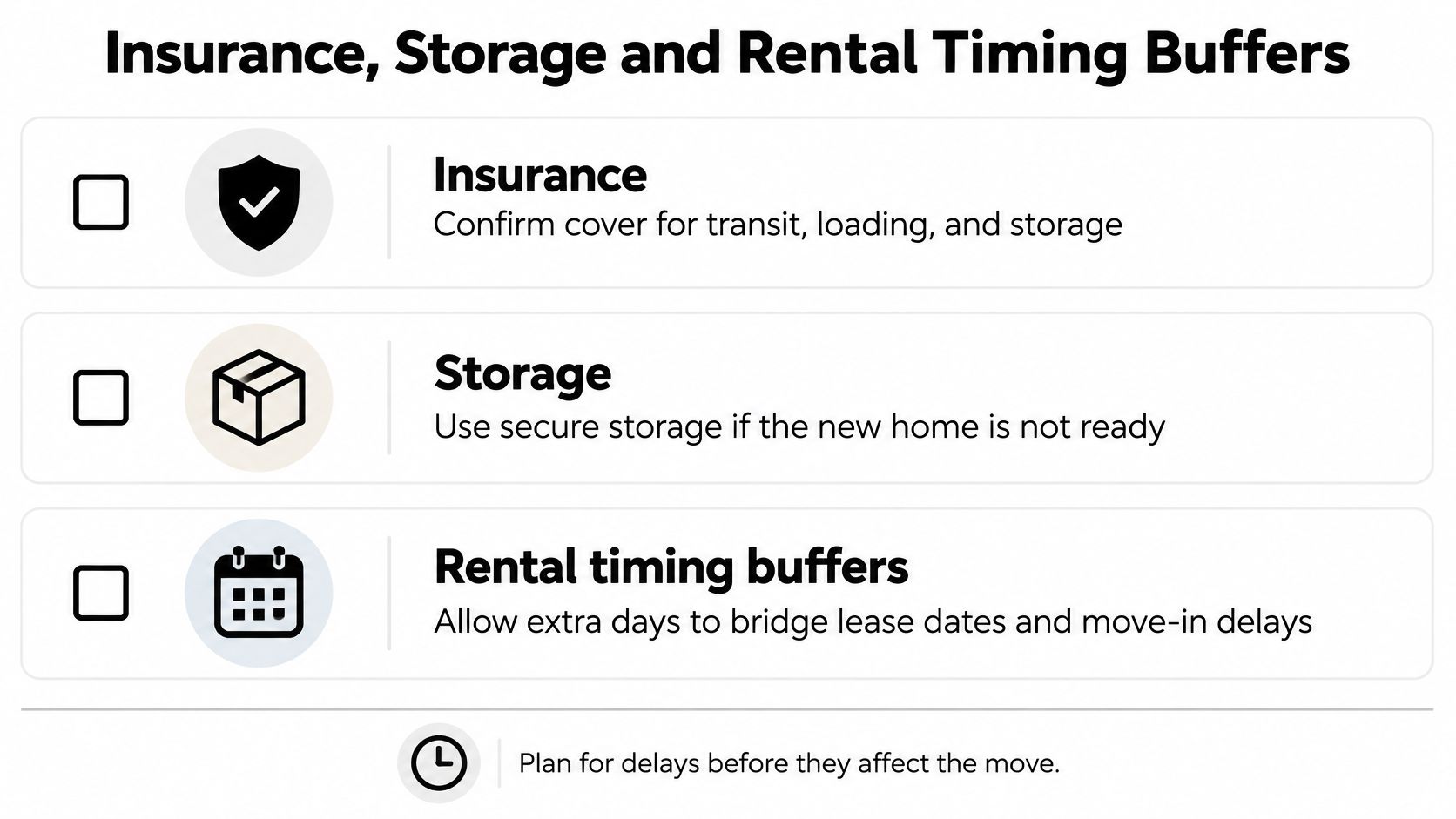
Compare the whole contingency cost
Request a combined estimate for collection, storage intake, storage charges, retrieval and final delivery. Then compare it with practical alternatives, including urgent transport, additional accommodation or changing an existing booking.
The cheapest truck rate may not produce the cheapest strategy. A flexible storage arrangement can be more useful than a low-priced delivery booking that depends on keys you haven't been promised.
- Align the handover: Leave room for cleaning and inspection after belongings are removed.
- Separate essentials: Keep medication, documents, chargers and work items with you.
- Check retrieval conditions: Confirm notice requirements, access arrangements and how goods are released.
- Set the delivery trigger: Tell the provider when you'll confirm the new address and property access.
Confirm what insurance actually covers
The publisher describes its moves as fully insured and offers secure storage with 24/7 access. Before relying on those descriptions, review its removal insurance information and ask for the terms applicable to your booking.
“Fully insured” isn't a substitute for understanding cover. Ask whether the relevant protection applies during loading, transit, unloading and storage; what exclusions apply; and how owner-packed cartons, high-value items and existing damage are treated.
Photograph furniture surfaces, appliance condition and fragile items before collection. Keep an inventory with identifying details, and record pre-existing marks so any later discussion starts from documented condition rather than memory.
A workable buffer combines a place for the goods, clear release arrangements and understood insurance. It shouldn't depend on everyone agreeing to an improvised plan after the original delivery falls through.
How to Request a Tailored Removal Quote
Send enough information for the provider to plan the job, not just name a price. “Moving to Rockhampton” gives a destination, but it doesn't explain the load, property restrictions or services you need.
A useful consultation starts with the details that change the work.

Submit a job description the crew can use
Prepare an inventory of furniture and packed or anticipated cartons. Add photographs of bulky pieces and explain what needs dismantling, packing or specialist handling.
- Addresses and dates: Supply collection and delivery addresses, preferred dates and any fixed handover deadlines.
- Property access: Include stairs, lift dimensions, driveway width, parking arrangements and loading restrictions.
- Service scope: Identify packing, unpacking, assembly and storage requirements.
- Commercial loads: Describe pallets, equipment and stock, including weight information where available.
Declare NSW vehicle-access constraints upfront so the operator can select an appropriate vehicle and check route requirements. For office relocations, nominate who can authorise access and sign for delivery.
If you're also preparing a property for sale, keep presentation work separate from the transport scope. Edinhart Realty and Property Management's resource can help you compare professional real estate stagers and decide what furniture needs to remain until presentation work is complete.
The accompanying video can support your planning conversation.
Request the estimate and check the commitments
The publisher offers tailored removal quotes through a 60-second online form, with responses within 30 minutes during business hours. It also offers flexible scheduling, secure transactions and multiple payment options. Confirm availability and the payment terms for your particular booking before accepting.
Keep the written quote, inventory and agreed changes together. Check the collection arrangement, delivery commitment, included services, exclusions and cancellation or rescheduling conditions before paying.
Request your quote today with the actual access details and contingency requirements attached. You'll have a more useful basis for choosing a Rockhampton removal company than a rate supplied against an incomplete description.
Home Removals Sydney offers household, office and interstate moving services, with packing, furniture assembly and storage options for a Sydney-to-Rockhampton relocation. Visit Home Removals Sydney to request a quote and confirm the vehicle, service scope and delivery arrangements for your move.
