


In Sydney, a standard local furniture move commonly costs about $140–$200 per hour, while total local jobs typically range from $300–$3,500 and interstate moves from $2,000–$6,000, depending on the size and distance. Those figures are starting points, not guaranteed final bills.
You've probably seen the problem already. One removalist advertises a low hourly rate, another quotes more but promises a larger truck, and both estimates appear to cover the same move. Then you notice that one includes travel, stairs and insurance while the other charges for them separately.
Furniture removal prices feel confusing because the hourly figure is only one part of the calculation. Crew size, truck capacity, access, parking, packing, minimum charges and the distance between the truck and your front door can all change the final amount. The good news is that Sydney removalist pricing follows a practical logic once you know what to look for.
Introduction Why Furniture Removal Quotes Vary So Much in Sydney
A renter in Parramatta might receive a quote for a small apartment move that looks affordable at first glance. The advertised rate seems manageable, but the building has a lift booking, a narrow driveway and limited kerbside parking. The second quote costs more per hour, yet includes a larger truck and enough movers to finish sooner. The cheaper hourly rate may not produce the cheaper move.
Australian pricing guides place standard local removalist work in major cities such as Sydney, Melbourne, Brisbane and the Gold Coast at roughly $140–$200 per hour, while the wider national range can run from about $110–$300 or more per hour depending on the truck, crew and complexity of the job (Airtasker's Australian furniture removal pricing guide). Sydney sits towards the higher end of local Australian pricing because labour and operating costs are generally higher than in smaller capitals.
The invoice usually reflects three basic resources:
- People: The movers provide the lifting, carrying, protection and loading work.
- Vehicle: The truck must fit the furniture without creating extra trips.
- Time: The crew needs time to travel, load, unload, assemble and deal with access restrictions.
A move can therefore become more expensive even when the distance looks short. A high-rise apartment, a steep staircase, a long walk from the truck or a delay at the loading zone can keep the team on the clock.
Practical rule: Compare the expected total and inclusions, not just the largest hourly-rate number on the page.
Local removalist jobs in Australia commonly fall between $300 and $3,500, while interstate work often sits around $2,000–$6,000 or more, depending on home size, route and service level (Airtasker's furniture removal service guide). The sections below show how to read those figures, question exclusions and choose a sensible service for a home, office or interstate relocation.
How Hourly Rates Work for Furniture Removals in Sydney
Most local furniture removals Sydney services use an hourly model built around time, muscle and a truck. Think of it as hiring a small moving team rather than hiring a vehicle. The clock measures how long the crew works, the crew determines how quickly the job progresses, and the truck determines how much furniture can travel in one load.
A typical local move uses the two-men-and-a-truck model. If the team works for three to six hours, even a modest difference in the hourly rate can compound across the job. The advertised rate may also be subject to a minimum charge, so a short job still has a base cost. Sydney sources commonly describe minimum charges of about $100–$200, usually covering one to two hours at standard rates (The Quote Yard's NSW removalist pricing guide).
What the hourly clock can include
Ask the removalist when billing begins and ends. Some quotes include travel from the depot or between properties, while others start when the crew reaches the pickup address. The wording matters, particularly if traffic, a difficult loading area or a delayed lift keeps the team waiting.
A clear quote should explain:
- Arrival and travel time, including whether transit between addresses is chargeable.
- Loading and unloading, including furniture protection and placement.
- Disassembly and reassembly, if beds, wardrobes or desks need preparation.
- Waiting time, such as a lift booking delay or unavailable parking.
- Minimum billing, so a short furniture pickup doesn't produce an unexpected base charge.
The hourly rate also reflects the number of movers. A lower rate with two people may take longer than a higher rate with three or four people. That's why a quote should state both the hourly price and the expected crew.
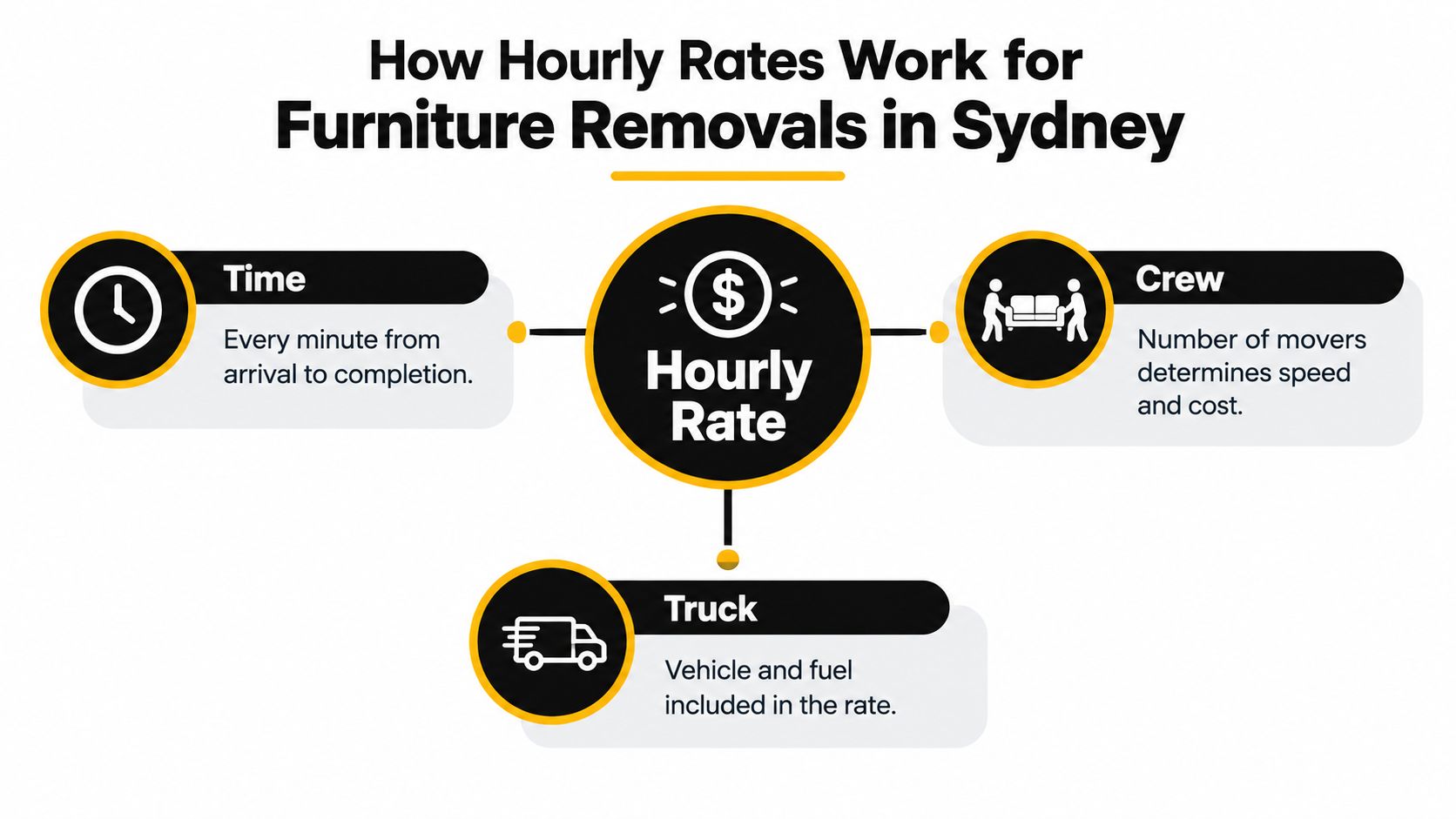
For a practical explanation of how time, labour and vehicle selection interact, use this guide to removalist cost per hour in Australia. It can help you turn a headline rate into questions about the complete job rather than treating the rate as the final answer.
Crew Size and Truck Size and How They Change Your Total Cost
Crew and truck selection changes both the hourly rate and the time required. A small team may look cheaper, but it can spend longer carrying heavy items through hallways, stairs and lifts. A larger crew costs more per hour, yet may complete the loading stage faster and reduce the total time on site.
One Sydney pricing guide gives these indicative configurations:
| Crew and Truck Configuration | Typical Hourly Rate Sydney | Best Suited For |
|---|---|---|
| 2 movers with a small truck | $99–$130/hr | Smaller apartments, studios and light furniture loads |
| 3 movers with an 8-tonne truck | $165–$195/hr | Larger apartments and moderate household moves |
| 4+ movers with a 12-tonne truck | $220+/hr | Bigger homes, heavy furniture and complex access |
These figures come from a Sydney removalist pricing guide (We Move Group's Sydney removalist cost guide). They show why comparing two hourly rates without checking the vehicle and crew can produce a misleading result.
Match the setup to the property
A one-bedroom apartment with a straightforward ground-level entry may suit two movers and a smaller truck. The same crew could struggle with a three-bedroom home containing solid timber furniture, outdoor items and appliances. In that situation, the team might need extra loading time or even a second trip if the truck is too small.
Australian cost examples also show the effect of labour intensity. One guide lists about $125 per hour for two movers for a one-bedroom apartment, around $175 per hour for three movers for a small three-bedroom apartment, approximately $245 per hour for four movers for a large three-bedroom home, and about $315 per hour for five or more movers for a large family home (Airtasker's Australian removal service pricing information).
Those rates aren't a recommendation to hire the biggest crew. They illustrate the trade-off. A larger crew only makes financial sense when the extra people and truck capacity meaningfully reduce handling time, access delays or repeat trips.
Why truck capacity matters
The right truck protects the schedule. A vehicle that's too small can force additional loading, unloading and travel. A vehicle that's larger than necessary may cost more without improving the job.
Before accepting a quote, provide an inventory that includes beds, lounges, dining settings, wardrobes, desks, whitegoods and bulky outdoor furniture. For a more detailed sizing check, review this guide on choosing the right moving truck size. The aim is a workable combination, not the lowest hourly number.
Hidden Fees That Quietly Increase Furniture Removal Prices
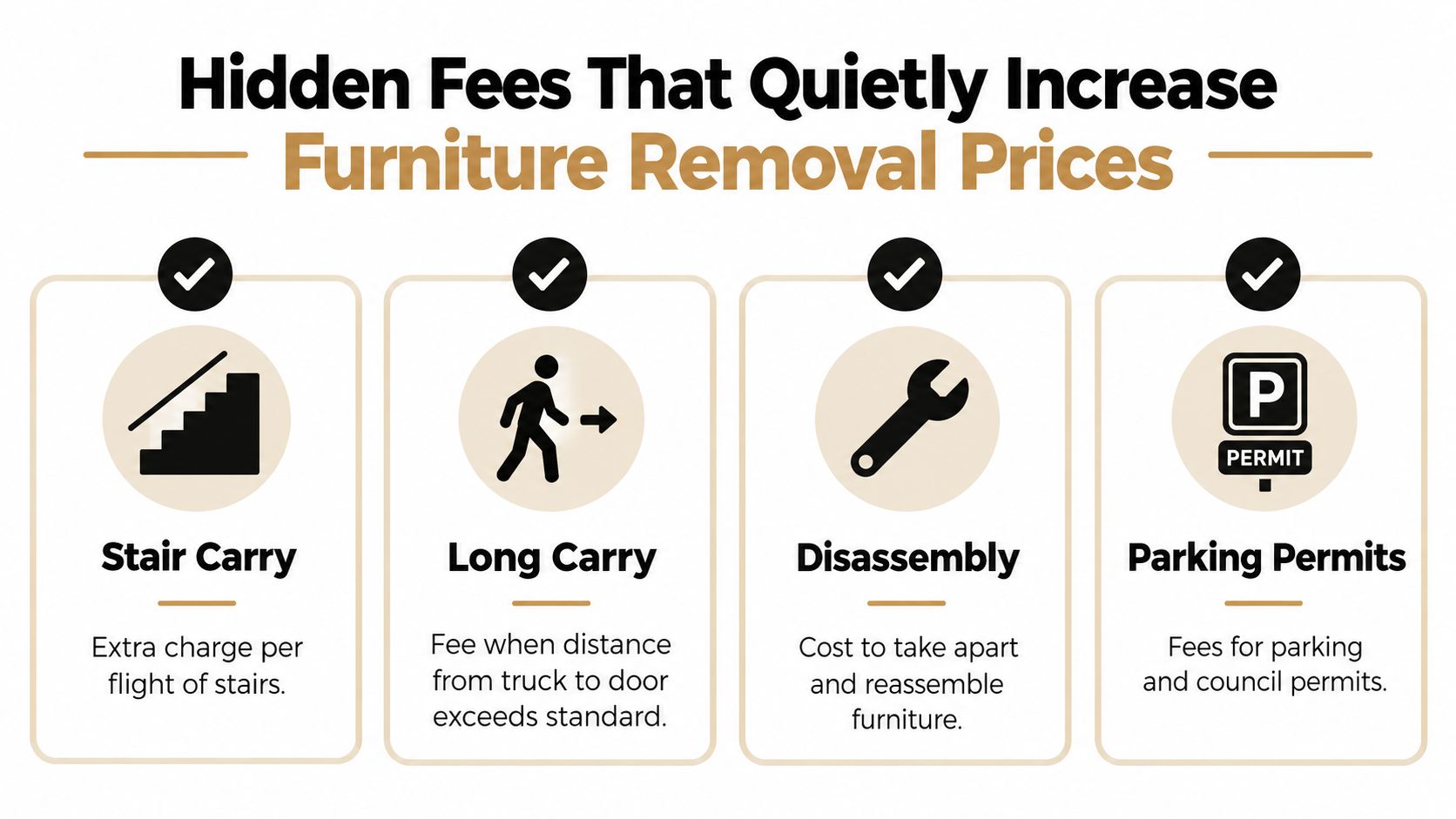
Two removalists can quote the same hourly rate and still produce very different final totals. The difference usually appears in the assumptions. One team may include standard carrying from a nearby parking position, while another treats stairs, a long carry, packing or waiting as separate charges.
Sydney apartments create plenty of these variables. A truck might not stop directly outside the entrance. A loading zone may have a time limit. A lift may be shared with other residents, or the building manager may require a booking before the crew arrives.
Ask about the access conditions
The following details can affect the work involved:
- Stair carries: Confirm whether stairs are included and how the removalist handles furniture that can't use the lift.
- Long carries: Tell the company if the truck will park away from the entrance because of a narrow street, driveway or building restriction.
- Disassembly: Ask whether beds, desks, wardrobes and other large pieces will be dismantled and reassembled.
- Packing materials: Check whether boxes, tape, blankets and bubble wrap are included or charged separately.
- Fuel and travel: Establish whether fuel, depot travel or movement between addresses appears as a separate line.
- Waiting time: Clarify what happens if a lift, concierge or parking space isn't ready.
- Insurance: Ask what cover applies to your furniture and whether additional protection is available.
Understand Sydney parking rules
NSW parking rules allow a goods vehicle to use a loading zone while actively picking up or dropping off goods for up to 30 minutes, unless the sign sets a shorter limit (NSW Government parking rules). Trucks over 4.5 tonnes GVM are treated differently under some stopping and parking restrictions, so the vehicle choice and address conditions should be discussed before moving day.
Don't assume a loading zone guarantees enough time for a full apartment move. Send photographs of the frontage, driveway, stairs, lift and parking area if possible. Your removalist can then identify access risks before issuing the quote.
A useful question is: “Which items could increase the quoted total, and how will each one be charged?” An itemised answer is more valuable than a low headline rate with vague exclusions. You can also review this guide to hidden moving costs in Sydney before comparing proposals.
Local Versus Interstate Furniture Removal Prices Explained
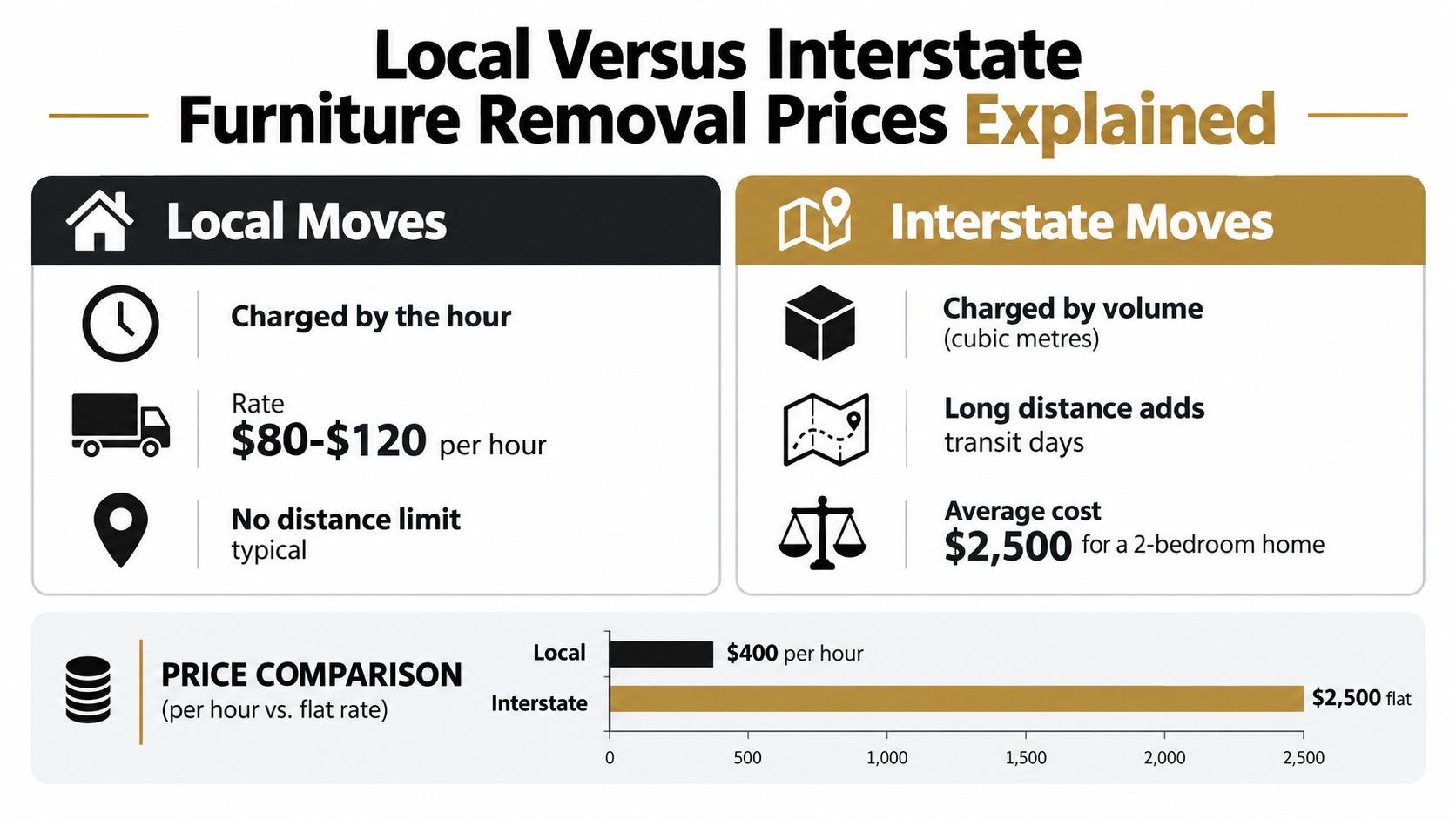
Local and interstate removals use different pricing logic. A local Sydney job is commonly organised around hours worked, while an interstate move is more strongly influenced by volume, route distance, truck utilisation and service level.
For local work, the crew arrives, loads the truck, travels to the destination and unloads. The final charge depends heavily on the time required. For an interstate move, the removalist must plan how much space your furniture occupies in the vehicle and how efficiently that space can be used alongside the route.
An industry calculator reports an average interstate job price of A$2,822 and an average of A$172 per cubic metre (ServiceSeeking's furniture removal cost guide). The per-cubic-metre figure gives you a useful sense-check. If a quote sits materially above that benchmark, ask whether difficult access, packing, insurance or route conditions explain the difference.
What changes between the two move types
Local furniture removals Sydney customers usually compare crew hours, truck size and access. Interstate removals require a broader inventory and a clearer description of the service:
- Volume: More furniture occupies more cubic metres and may require more truck capacity.
- Distance: Longer routes increase transit requirements and fuel exposure.
- Packing: Full or partial packing adds labour and materials.
- Insurance: Confirm what protection applies during loading, transit and delivery.
- Delivery conditions: An apartment, regional property or restricted street can affect unloading.
National Australian guides place interstate moves broadly at A$2,000–A$6,000, while local moves can range from about $300–$3,500, depending on size and inclusions (Airtasker's Australian furniture removal pricing guide). A Sydney-to-Melbourne move for a three-bedroom house is benchmarked at about $3,500–$5,000, including insurance and packing materials, in the same Australian pricing material (Airtasker's furniture removal service guide).
The right comparison isn't “hourly versus flat fee”. Ask what volume the interstate quote assumes and which services are bundled into it.
How to Get an Accurate Quote and Compare Removalists Like a Pro
A reliable quote starts with accurate information from you. A removalist can't price a staircase, long carry or oversized wardrobe properly if the inventory only says “standard household furniture”.
Send a room-by-room list with photographs where useful. Include the number of beds, lounges, dining settings, wardrobes, desks, appliances and outdoor items. Mention fragile pieces, artwork, antiques, pianos and anything that needs disassembly.

Give the details that affect labour
A short access brief prevents many misunderstandings:
- Pickup address: Note stairs, lift access, driveway width and the distance from parking to the entrance.
- Delivery address: Provide the same details for the destination, not just the suburb.
- Parking: Explain whether a loading zone, strata booking or council arrangement is involved.
- Timing: State your preferred date and whether the move must meet a settlement or lease deadline.
- Services: Specify packing, unpacking, furniture assembly, storage or disposal requirements.
- Business needs: For office relocations, list desks, IT equipment, filing cabinets, meeting-room furniture and access restrictions.
Compare like with like
Put each quote into a simple comparison sheet. Record the hourly rate or fixed price, crew size, truck type, minimum charge, travel treatment, packing materials, insurance, stairs, long carries, waiting time and payment terms.
A quote that states “two movers and a small truck” is easier to assess than one that only says “removal service”. Ask the provider to confirm the estimated hours and what happens if the inventory changes. If the answer is unclear, the quote isn't ready for a fair comparison.
For NSW moves, confirm who handles parking arrangements and whether the chosen truck falls under any relevant restrictions. These checks take a few minutes and can prevent a crew arriving without a workable loading position.
Smart Ways to Reduce Your Furniture Removal Costs in Sydney
The safest savings come from reducing labour time and avoiding preventable delays. Haggling over the hourly rate can help, but choosing a suitable crew, preparing the access route and removing unwanted items often has a greater effect on the final bill.
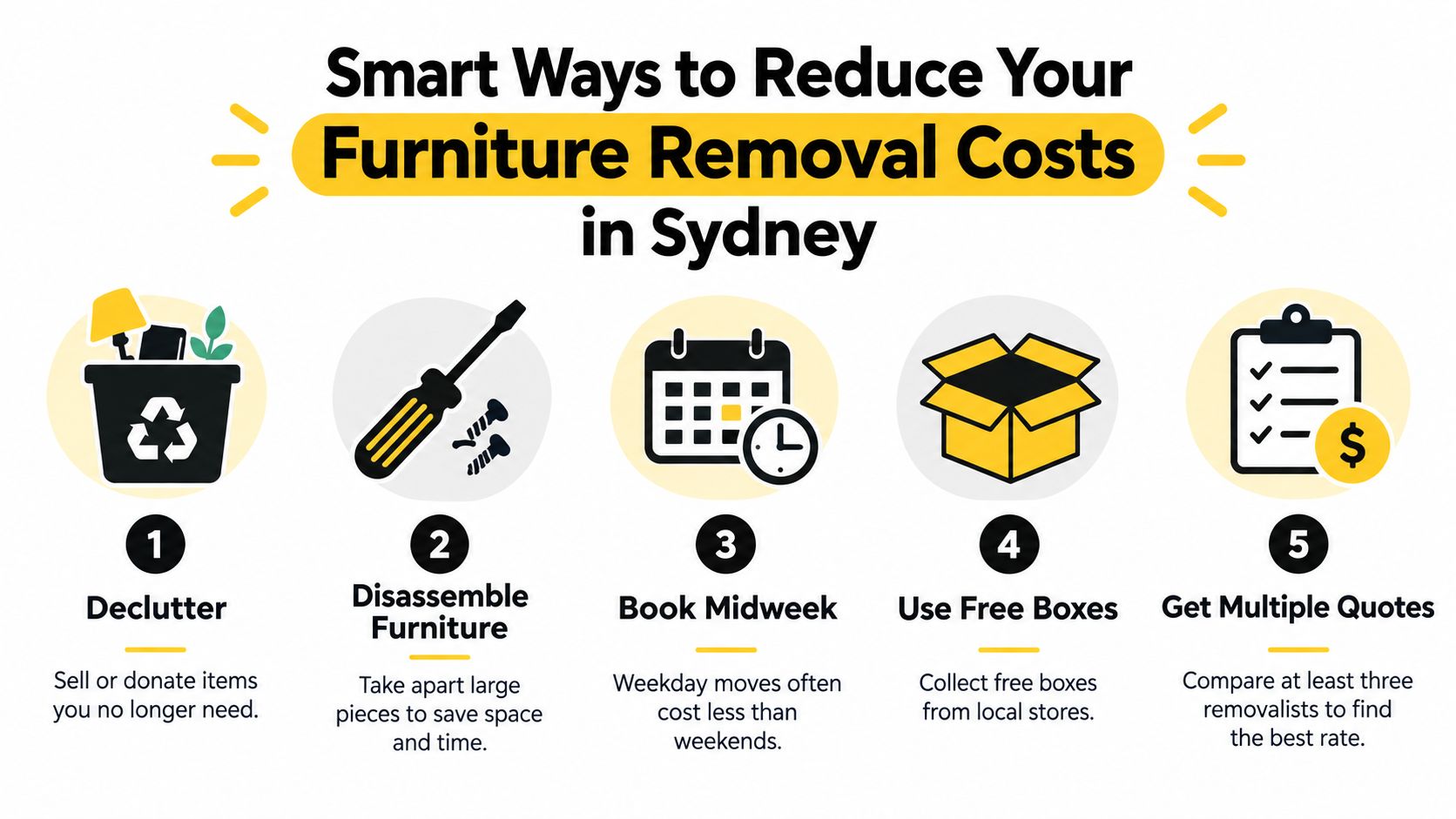
Start with a declutter. Every bookcase, broken chair or unused appliance that stays behind still takes space, handling and protection. Usable furniture may suit donation or resale, while damaged items can be directed to a responsible disposal provider such as Reworx Recycling junk removal.
Prepare the move before the crew arrives
- Declutter early: Sell, donate or dispose of items you won't take.
- Disassemble suitable furniture: Take apart beds, tables and modular pieces if you're comfortable doing so, and keep all hardware labelled.
- Use free boxes: Collect sturdy boxes from local shops, then seal and label them by room.
- Clear access: Remove pot plants, toys and loose items from hallways, driveways and stairwells.
- Book a practical time: Ask whether a weekday appointment suits your budget and availability.
- Get several quotes: Compare the full scope, not just the rate printed beside the phone number.
Don't choose a two-person crew for a demanding move because the rate looks lower. A suitable team and truck can reduce carrying time, repeat trips and waiting. The cheapest hourly rate isn't automatically the cheapest furniture removal price.
For a comparison that fits your situation, describe the inventory and access conditions before booking. That lets the removalist price the actual job rather than a vague estimate.
Home Removals Sydney provides itemised quotes for home removals Sydney customers, furniture removals Sydney households and businesses planning office relocations or interstate removals. Visit Home Removals Sydney to submit your move details and request a transparent quote for the crew, truck and services your relocation requires.
